
Background
BMW 7 Series (E65) was the fourth generation of BMW’s flagship luxury saloon, introduced in 2001, and represented one of the most significant turning points in the history of the model. Replacing the more conservative E38, the new 7 Series introduced an entirely new design language and a much greater emphasis on electronic technology. The E65 demonstrated that BMW’s flagship could be luxurious and driver-focused while also embracing radical new ideas.
A new and controversial design language
The E65 was created during the BMW design era led by Chris Bangle and differed dramatically from its predecessor. Its high rear deck, imposing front end and more complex body surfaces generated considerable debate when the car was launched, but the new design language later influenced many other BMW models. Traditional BMW elements nevertheless remained, including twin headlights, the kidney grille and the Hofmeister kink.
iDrive transforms the interior
One of the most important innovations introduced with the E65 was BMW iDrive. Many comfort, navigation, communication and entertainment functions were brought together on a central display and operated using a rotary controller on the centre console. This significantly reduced the number of conventional dashboard buttons. Although the system initially attracted criticism, similar centralised control concepts subsequently became common throughout the automotive industry.
New V8 engines and a six-speed automatic
The new 7 Series went on sale in November 2001 as the 735i and 745i. Both featured a new generation of V8 petrol engines equipped with VALVETRONIC, Double-VANOS and variable-length intake systems. The 735i produced 272 hp, while the 745i developed 333 hp. Power was transmitted through the world’s first six-speed automatic transmission fitted to a production car, featuring electronic shift-by-wire control.
An expanding model range
In 2002, the long-wheelbase E66 models arrived with a wheelbase extended by 140 millimetres, together with the diesel-powered 730d and 740d. In 2003, the BMW 760i became the flagship of the range, powered by a 6.0-litre V12 producing 445 hp and 600 Nm. Six-cylinder petrol engines and updated V8 models were added later, making the E65/E66 one of the most technically diverse generations of the 7 Series.
The 2005 model update
The 7 Series received an extensive model update in 2005. Headlights, kidney grille, bumpers and particularly the rear styling were revised, giving the car a more balanced appearance. BMW also updated the iDrive operating system, engine range and numerous electronic systems. The underlying architecture and technological character of the E65 remained in production until 2008.
An important technological turning point
The BMW 7 Series E65/E66 was produced from 2001 to 2008 at BMW Plant Dingolfing in Germany. Commonly published production statistics give a total of 344,674 cars for the model family. The E65’s historical importance lies particularly in the fact that many ideas considered unconventional at its launch – centralised vehicle control, electronic gear selection and highly networked electronic systems – later became standard features of modern luxury cars.
Model in the collection
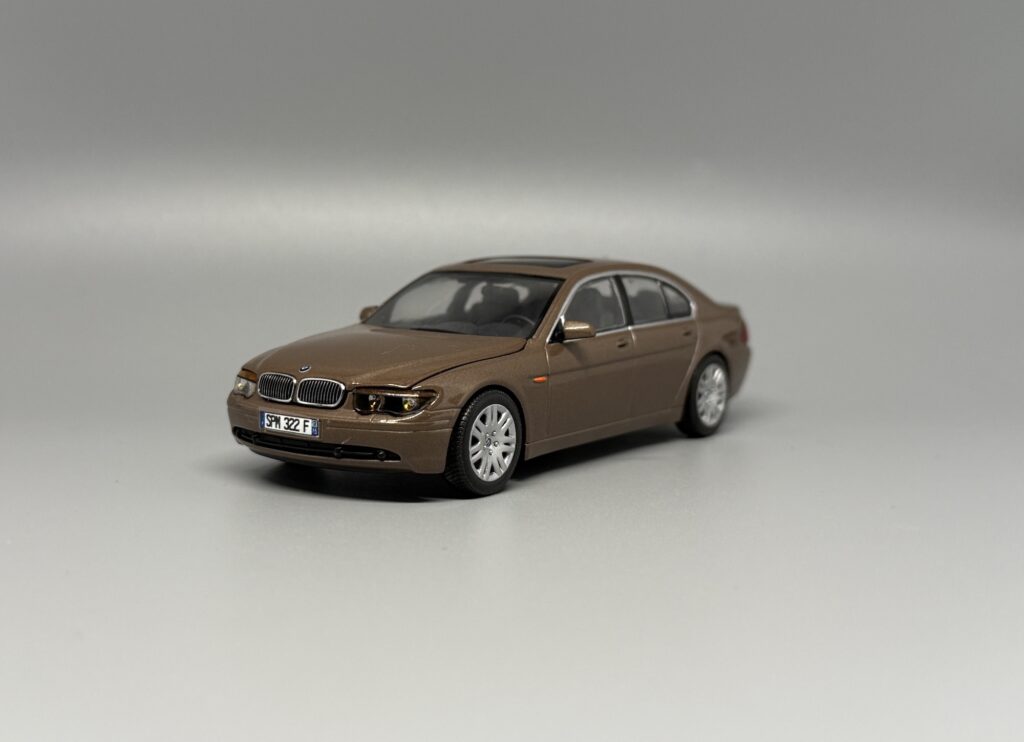
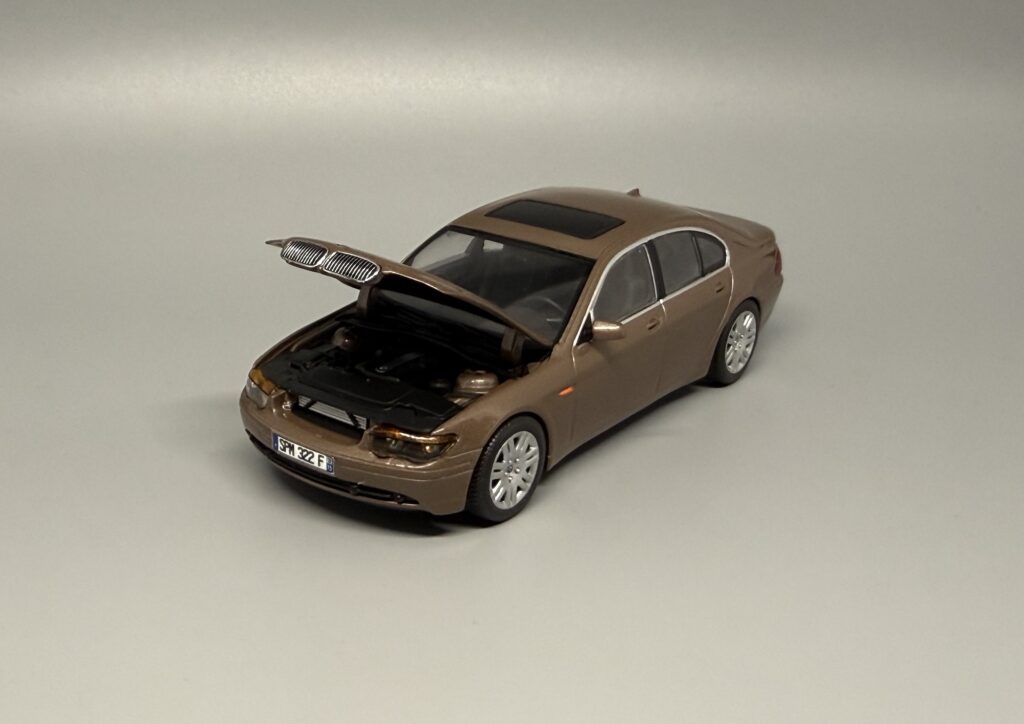
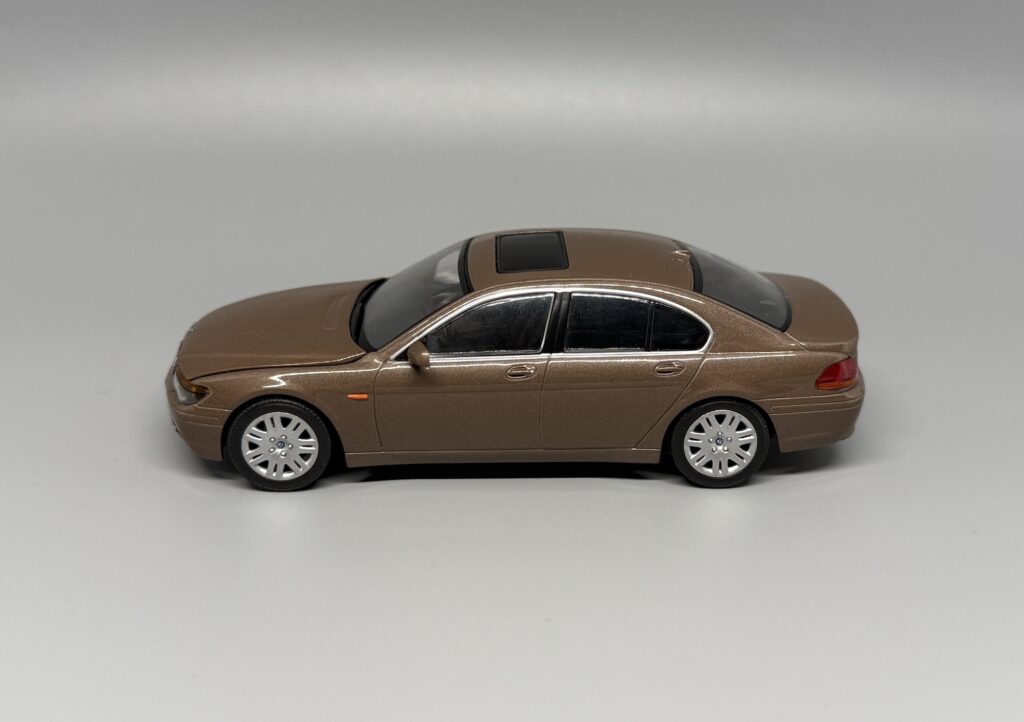
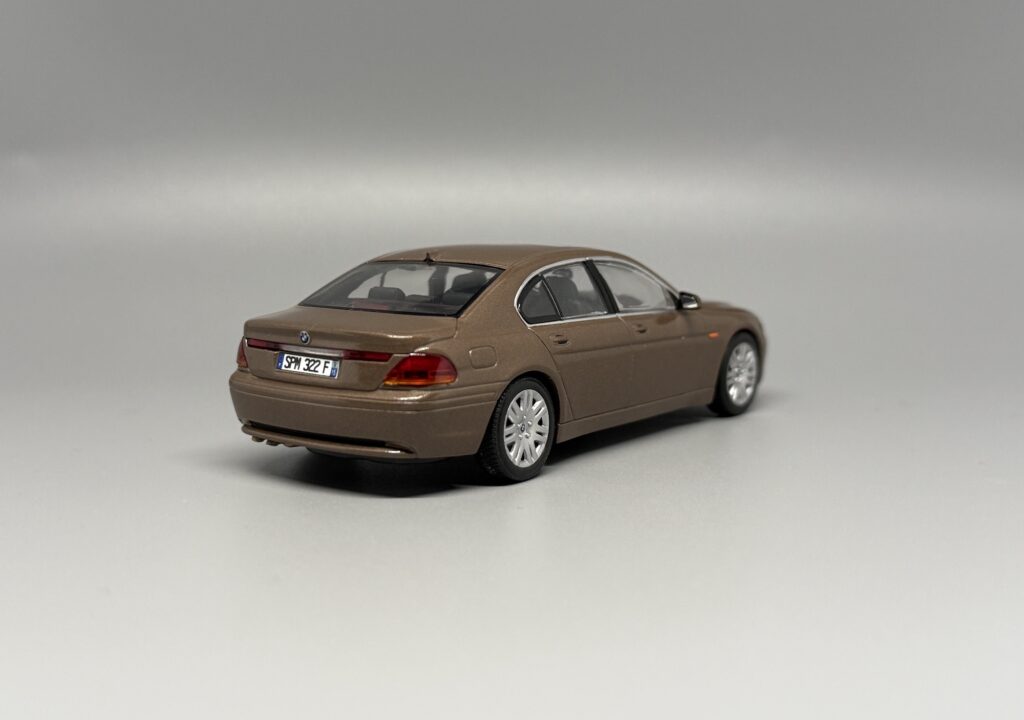
The BMW 7 Series (E65) in my collection was produced by Minichamps and represents a 2001 car from the beginning of the fourth-generation 7 Series. It is a limited-edition model, with a total production run of 1,008 examples.
Technical data in brief
World premiere: IAA Frankfurt, September 2001
Production period: July 2001 – August 2008
Production location: BMW Plant Dingolfing, Germany
Body style: four-door luxury saloon
Standard-wheelbase version: E65
Long-wheelbase version: E66
Original models: 735i and 745i
Engines: straight-six, V8 and V12 petrol engines, plus six- and eight-cylinder diesels
Power: approximately 218–445 hp depending on version
Transmission: 6-speed automatic
Drivetrain: rear-wheel drive
Most powerful regular version: BMW 760i / 760Li, 445 hp
Production: 344,674 cars according to commonly published production statistics
Special feature: introduction of BMW iDrive and the world’s first six-speed automatic transmission in a production car