
Background
BMW 1800 TI/SA was one of the most competition-oriented production cars in the Neue Klasse range and a homologation model developed specifically for motorsport. It was based on the already sporting BMW 1800 TI, but the TI/SA brought the four-door saloon much closer to a genuine racing car. In the model designation, TI stood for “Turismo Internazionale”, while SA meant “Sonderausführung”, or special version. BMW produced the car only in 1965 and in very limited numbers to make it eligible for international touring-car competition.
The sporting side of the Neue Klasse
The BMW Neue Klasse was a breakthrough model family for the company in the early 1960s. The 1500 and 1800 combined a practical four-door body with good handling and a modern four-cylinder engine, helping to establish BMW’s reputation as a manufacturer of sporting saloons. The BMW 1800 TI, introduced in 1963, took this idea further with more power, a sportier chassis and improved handling, making it a suitable basis for competition. The TI/SA became the most extreme road-going development of this concept.
From 1800 TI to TI/SA
The standard BMW 1800 TI produced 110 hp, but the 1,773 cm³ M10-series four-cylinder engine was extensively developed for the TI/SA. The compression ratio was increased to 10.5 : 1, while a more aggressive camshaft, larger valves and two Weber 45 DCOE twin-choke carburettors were fitted. These modifications increased output to 130 hp at 6,100 rpm. The result was a discreet-looking four-door saloon with very serious performance for the mid-1960s.
Five-speed sports transmission
The TI/SA was equipped with a sporting five-speed manual transmission, distinguishing it from the standard 1800 TI. The closer gear ratios allowed the engine to remain in its most effective rev range during competition use. Power was transmitted to the rear wheels, and different final-drive ratios could be selected to suit the demands of different racing circuits.
Chassis prepared for competition
The chassis was also developed with motorsport in mind. The TI/SA received stronger anti-roll bars and larger front brakes, while buyers could prepare the car even further for racing. BMW offered equipment such as adjustable dampers, alternative final-drive ratios and even a 105-litre fuel tank. These features demonstrate that the TI/SA was not simply a slightly more powerful saloon, but a car designed from the outset to be developed further for competition.
Sporting interior
Externally, the TI/SA was very understated and could easily be mistaken for an ordinary BMW 1800. Inside, however, several details revealed its sporting purpose. BMW equipped the car with a wooden sports steering wheel and adjustable bucket seats. This combination of discreet appearance and serious competition engineering later became one of the defining characteristics of BMW’s sporting saloons.
Only 200 cars
BMW produced the 1800 TI/SA only from February to June 1965, with exactly 200 cars built. The very small production run was directly connected with motorsport homologation requirements. The cars were sold mainly to licensed racing drivers and private competitors intending to use them in competition. When new, the BMW 1800 TI/SA cost 13,500 Deutsche Mark in Germany.
Victory at the 1965 Spa 24 Hours
The BMW 1800 TI/SA proved its capabilities in the same year it was introduced. Pascal Ickx and Gérard Langlois van Ophem won the 1965 Spa-Francorchamps 24 Hours in a BMW 1800 TI/SA. It was BMW’s first overall victory in the famous endurance race and marked the beginning of a long series of BMW successes at Spa. The TI/SA therefore helped establish BMW’s reputation not only for sporting road cars, but also for highly competitive touring cars.
Performance
BMW gives the 1800 TI/SA a top speed of 186 km/h. Its 130 hp output may not appear remarkable by modern standards, but in the context of a lightweight Neue Klasse saloon and the competition of 1965, the car was genuinely fast. Just as important were its balanced weight distribution, independent suspension, strong brakes and durability, all of which made the TI/SA a highly effective long-distance competition car.
Historical significance
The BMW 1800 TI/SA was much more than a rare special version of the 1800. It demonstrated as early as the mid-1960s a principle that BMW would return to repeatedly: combining a practical production car with serious competition engineering and high performance. BMW M GmbH had not yet been established, but the same philosophy that would later define BMW’s most sporting saloons can already be clearly seen in the TI/SA. With only 200 cars built and a direct competition history, it remains one of the rarest and most historically important Neue Klasse variants.
Model in the collection
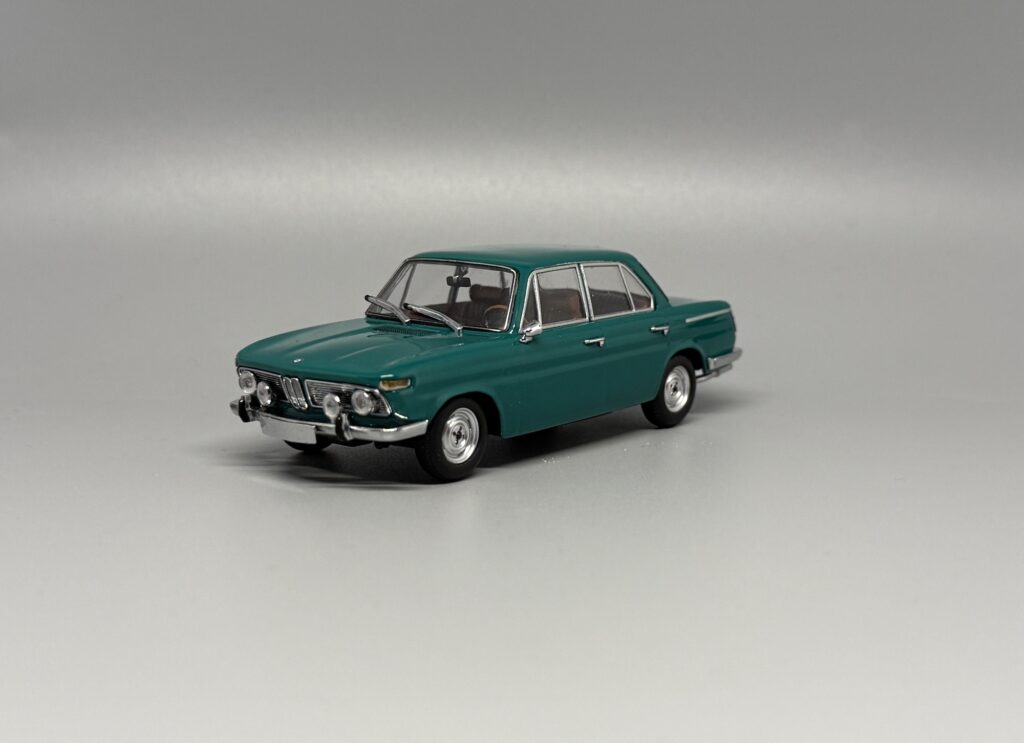
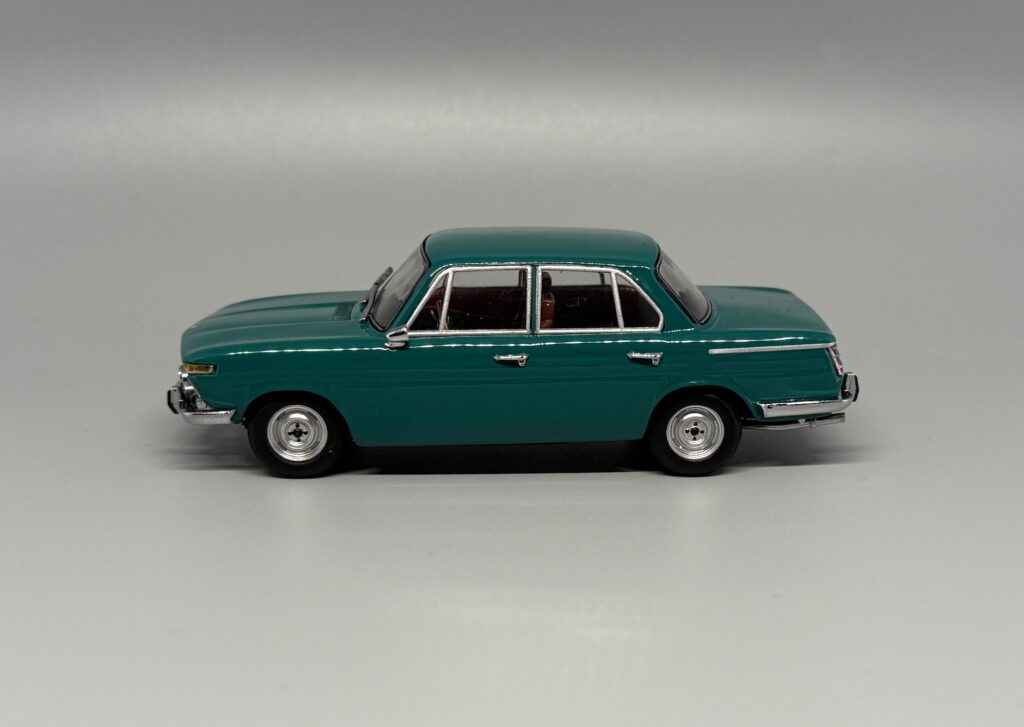
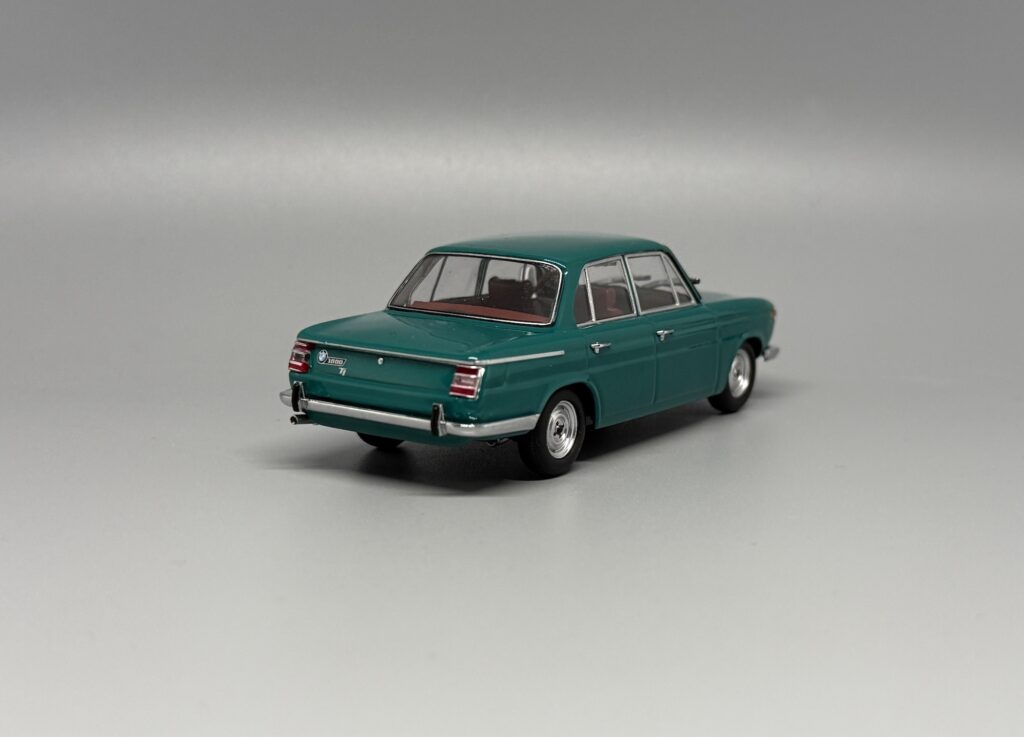
The model in my collection was produced by Minichamps and represents a 1965 BMW 1800 TI/SA saloon. It was produced as a special edition for Model Car World, with my model’s edition marked as limited to 1,008 examples.
Technical data in brief
Production period: February–June 1965
Production location: Munich, Germany
Body style: four-door sports saloon
Engine: four-cylinder in-line engine
Displacement: 1,773 cm³
Compression ratio: 10.5 : 1
Carburettors: two Weber 45 DCOE twin-choke carburettors
Power: 130 hp @ 6,100 rpm
Transmission: 5-speed manual
Drivetrain: rear-wheel drive
Top speed: 186 km/h
Price when new: 13,500 Deutsche Mark
Production: 200 cars
Special feature: limited-production homologation version of the BMW 1800 TI developed for motorsport
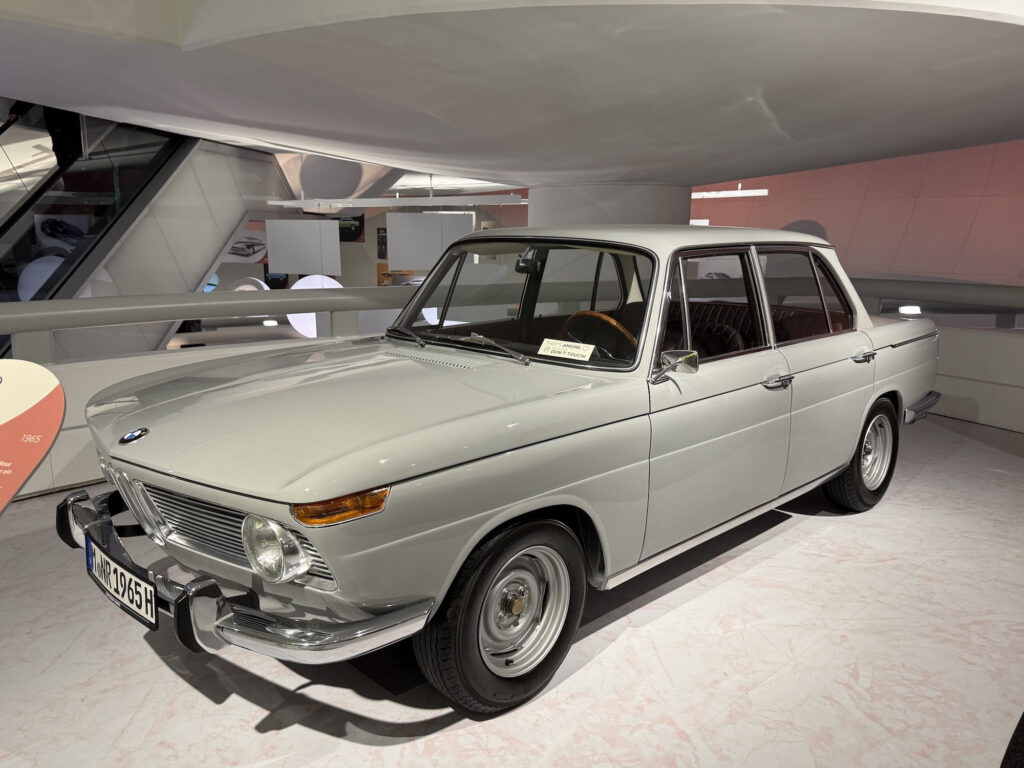
Photo of the real car, BMW Museum. Photo: Sten-Patrick Kreek