Background
BMW Kamm K4 was one of the most remarkable German aerodynamic research cars of the late 1930s. Behind the project was Professor Wunibald Kamm, one of the most important pioneers of early automotive aerodynamics. The K4 was not intended for series production or motor racing, but as an experimental vehicle for studying reduced aerodynamic drag, high-speed stability, fuel economy and efficient long-distance driving. Its mechanical basis came from the BMW 335, while development took place at the Forschungsinstitut für Kraftfahrwesen und Fahrzeugmotoren, or FKFS, in Stuttgart. The K4 was designed in 1939 and its full-size body was completed in 1940.
Wunibald Kamm and the K-Wagen prototypes
One of the central principles of Wunibald Kamm’s research was that an aerodynamically efficient car did not necessarily require an extremely long and pointed tail. Airflow could also be managed with a carefully shaped body that tapered towards the rear before ending relatively abruptly – a principle that later became widely known as the Kamm tail or Kammback. Between 1938 and 1941, FKFS built four experimental K-Wagen vehicles to study these ideas. The K1 and K4 used BMW 335 mechanical components, while the intermediate K2 and K3 were based on the smaller Mercedes-Benz 170 V. The K4 was the fourth and final running prototype and had a somewhat more restrained appearance than the earlier K1, although it remained highly futuristic compared with conventional production cars of the period.
BMW 335 mechanical basis
BMW supplied Kamm’s research team with a pre-production BMW 335 chassis. The 335 was BMW’s large and prestigious six-cylinder model of the period and provided a suitable platform for experiments involving a high-speed touring car. The K4 used the BMW 335’s water-cooled 3,485 cm³ six-cylinder in-line engine, producing 90 hp, or 66 kW, at 3,500 rpm. Power was transmitted to the rear wheels through a four-speed manual transmission. The wheelbase was approximately 2,984 mm and the K4 was around five metres long, making it a full-size five-seat passenger car rather than a small aerodynamic experimental vehicle.
Aerodynamic body
The most important feature of the K4 was its streamlined ponton-style body, constructed in 1940 by Stuttgart coachbuilder Reutter & Co. The wheel arches were integrated as smoothly as possible into the overall body shape, the rear wheels were fully covered and the underside was designed to be as smooth as practical. Windows and body panels were also intended to sit as flush as possible with the exterior surfaces. Particular attention was paid to the rear, where Kamm’s aerodynamic principles were applied through a body that tapered smoothly before ending relatively abruptly. A reliable final drag coefficient for the K4 has not survived, but the purpose of the entire design was to achieve substantially lower aerodynamic resistance than conventional large saloons of the period.
Experimental roof fins
During testing, the K4 was occasionally fitted with two large vertical aerodynamic fins at the rear of the roof. These were not part of a permanent final design but formed part of the experimental programme and were intended to improve high-speed directional stability. Details such as these demonstrate that the K4 was not a static show car with a fixed design, but a genuine research vehicle whose configuration was altered as different aerodynamic ideas were tested.
Reducing fuel consumption
The K4 project was not limited to reducing aerodynamic drag. An important objective was also to achieve lower fuel consumption during sustained high-speed driving. The engine used a system that allowed the fuel-air mixture to become leaner under steady operating conditions. A high-speed transmission arrangement was also used to reduce engine speed during fast cruising. These measures show that Kamm approached efficiency as a complete system: aerodynamic drag, rolling resistance and drivetrain losses all had to be reduced rather than concentrating on body shape alone.
Adjustable tyre pressure
One of the most unusual technical features of the K4 was a tyre-pressure adjustment system. The driver was able to alter tyre pressure from the dashboard while the car was moving. At high speeds the pressure could be increased to reduce rolling resistance and therefore improve fuel economy. Today, central tyre-pressure systems are mainly associated with specialised vehicles, but Kamm was already experimenting with the same basic principle in the late 1930s as a method of improving efficiency.
Weight – the other side of experimentation
Not every experimental feature brought only advantages. The K4’s complex body, large passenger compartment and additional technical systems made the car relatively heavy. Its weight was approximately 1,500 kg, compared with around 1,300 kg for a conventional BMW 335. This illustrated one of the compromises of experimental development at the time: aerodynamic improvements and reduced rolling resistance could lower fuel consumption, while the sophisticated construction itself added weight. The K4 was therefore best understood as a mobile laboratory in which a wide variety of technical ideas could be evaluated in real driving conditions.
Testing and the war
The K4 was used for actual road testing, but further development coincided with the Second World War, when the possibilities for experimental civilian vehicle development in Germany became increasingly limited. Completed in 1940, the K4 belonged to the last group of such civilian research projects before industrial priorities changed completely. The later history of the car is not securely documented. One post-war account suggests that it may have fallen into the hands of French forces in 1945, but the trail disappears afterwards and the original K4 is not known to have survived.
Influence on later BMW development
The experience gained from the K1 and K4 did not remain completely isolated from later BMW development. Ideas involving streamlined ponton bodywork and aerodynamically efficient rear sections could also be seen in plans for future BMW models. One example was the BMW 332, developed in 1939–1940 as a possible successor to the BMW 326. Its body was more conventional than that of the experimental K-Wagen cars, but it followed a similar direction with integrated wings, smoother ponton bodywork and a more aerodynamic rear section. The war prevented the BMW 332 from reaching series production as well.
Significance in automotive history
The importance of the BMW Kamm K4 extends beyond its place as a BMW-related prototype. It formed part of Wunibald Kamm’s research programme, whose principles later influenced automotive aerodynamics around the world. The term Kammback or Kamm tail is still used today for an aerodynamically optimised truncated rear design. At the same time, the K4 demonstrates how early engineers were already investigating subjects that remain central to modern vehicle development: aerodynamic drag, rolling resistance, engine efficiency and energy consumption at cruising speeds. For this reason, the K4 is one of the most technically fascinating experimental cars associated with pre-war BMW.
Model in the collection
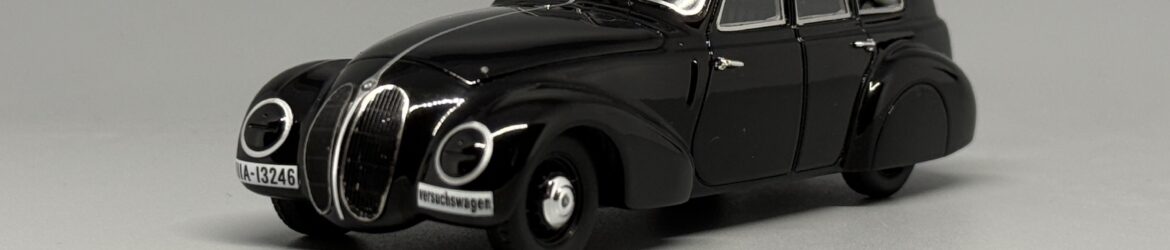
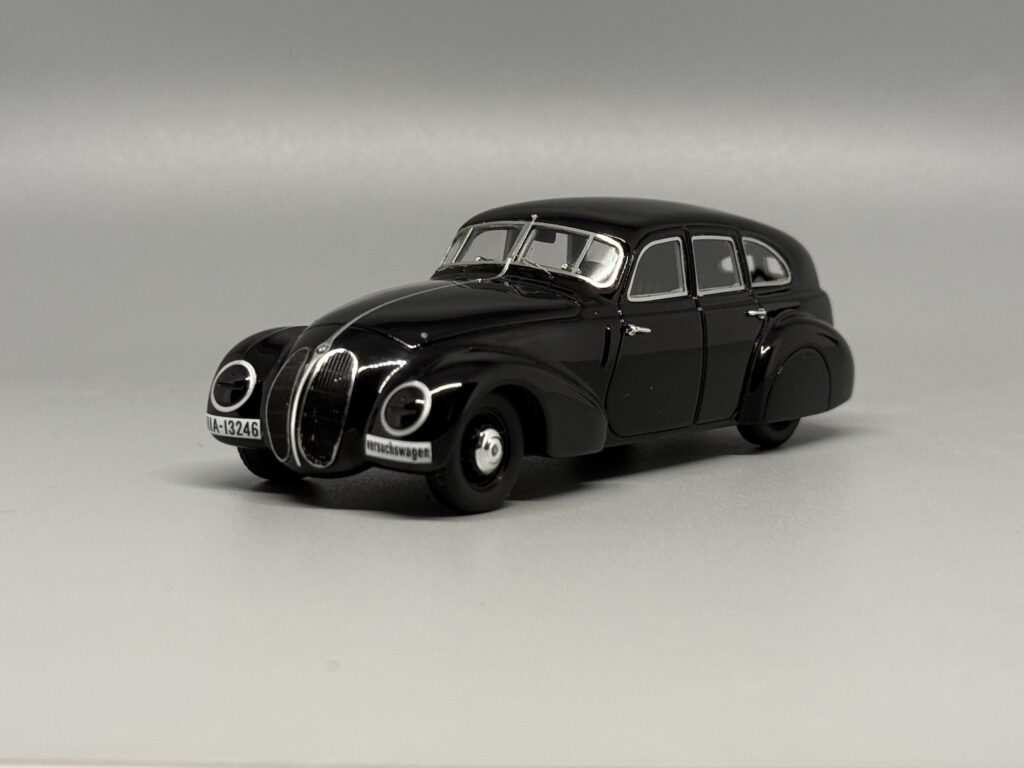
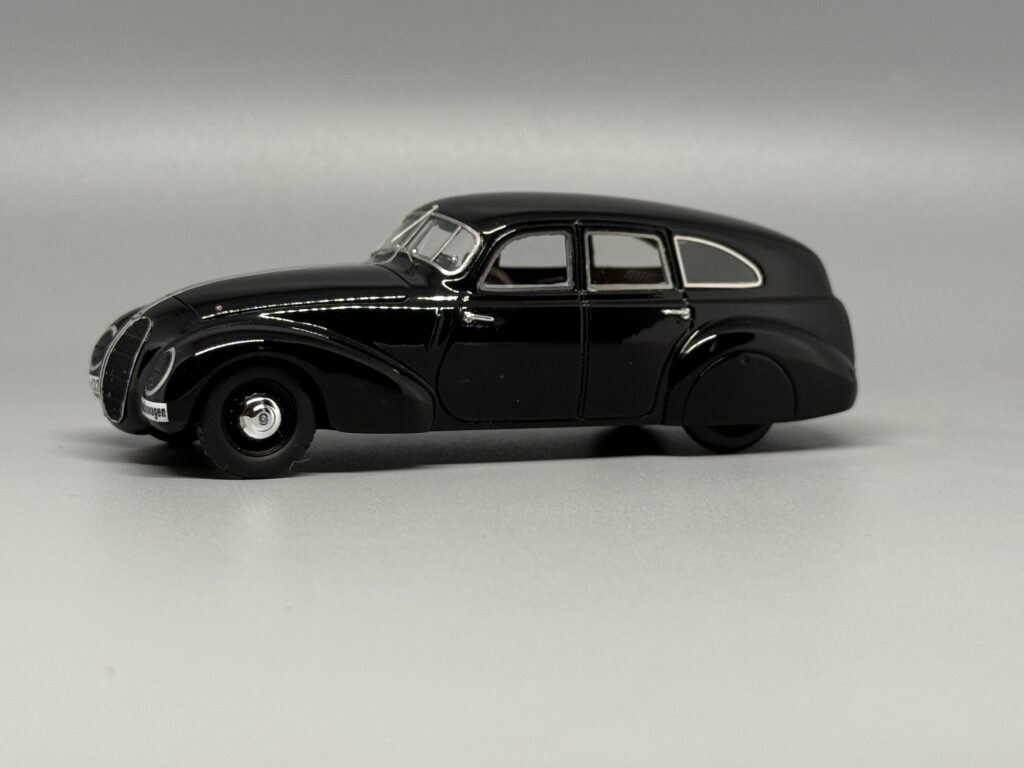
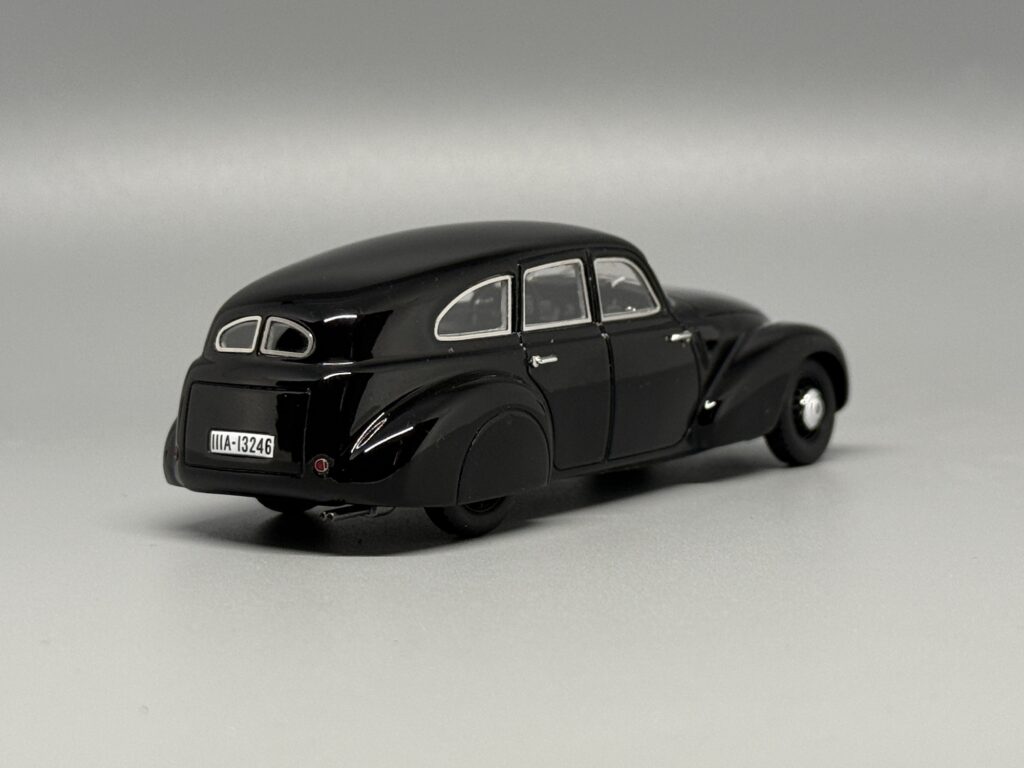
The model in my collection was produced by Autocult and represents the 1940 BMW Kamm K4 experimental car. It was produced in a limited edition of 333 examples.
Technical data in brief
Design year: 1939
Year completed: 1940
Developer: Wunibald Kamm / FKFS, Stuttgart
Coachbuilder: Reutter & Co., Stuttgart
Basis: pre-production BMW 335 chassis
Body style: four-door five-seat aerodynamic experimental saloon
Engine: BMW 335 six-cylinder in-line engine
Displacement: 3,485 cm³
Power: 90 hp / 66 kW @ 3,500 rpm
Transmission: 4-speed manual
Drivetrain: rear-wheel drive
Wheelbase: approximately 2,984 mm
Length: approximately 5,000 mm
Weight: approximately 1,500 kg
Production: 1 prototype
Special feature: an aerodynamic Kamm-tail research car with adjustable tyre pressure and experimental systems designed to reduce fuel consumption
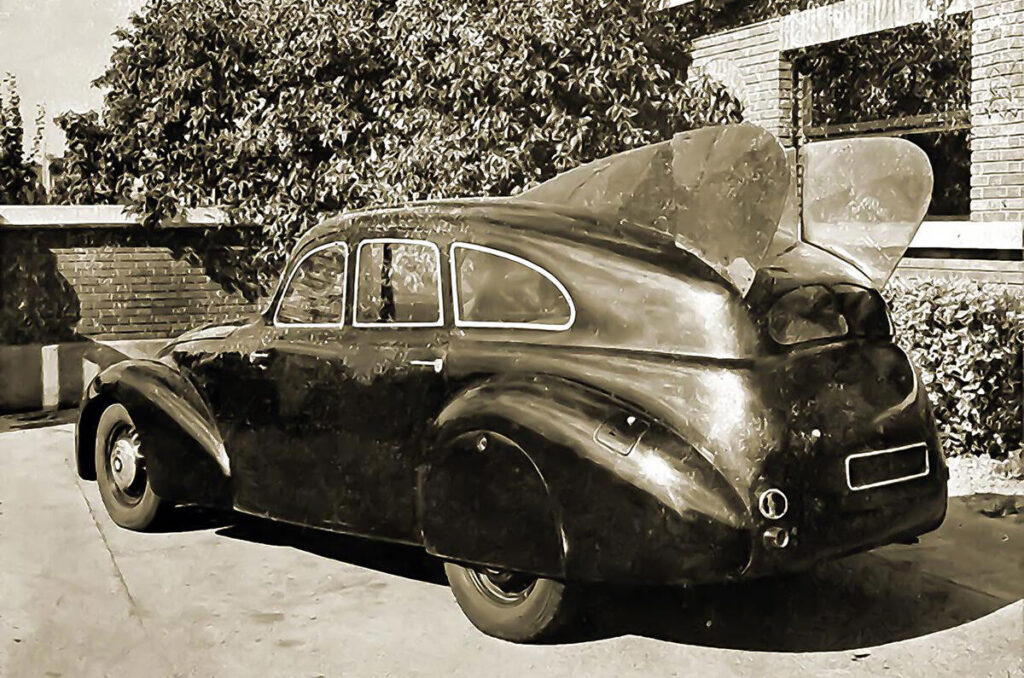
Photo of the real car. Source: autocar.co.uk