Background
BMW 3200 Michelotti Vignale Roadster was one of the most interesting special-bodied cars created on the basis of the BMW 507 and a remarkable example of the meeting between German engineering and Italian automotive design at the end of the 1950s. The car originated from the personal initiative of Italian designer Giovanni Michelotti and was intended to demonstrate what a more modern, forward-looking development of the BMW 507 might look like. It was not an official BMW factory project, but an independent design study based technically on the BMW 507. The completed car differed almost completely from the original 507 designed by Albrecht Graf Goertz.
Michelotti’s vision of a BMW 507 successor
Giovanni Michelotti began working on the idea of a possible next-generation BMW 507 as early as 1957. In the first sketches, the car was conceived as a closed sports car, but as the project developed it evolved into an open two-seat Roadster that could be fitted with a removable hardtop. Michelotti did not simply want to modernise the existing BMW 507, but proposed an entirely new design direction. Instead of Goertz’s soft and flowing forms, he used straighter lines, more sharply defined body surfaces and details influenced by late-1950s American automotive styling.
BMW 507 chassis 70184
Michelotti obtained BMW 507 chassis number 70184 through Italian BMW importer Alessandro Paolini. The chassis arrived in Italy in September 1958 and became the technical basis for the new car. The BMW 507 V8 engine, drivetrain, suspension and basic structure were retained, while the entire visible body was redesigned. The BMW 3200 Michelotti Vignale was therefore closely related to the BMW 507 mechanically, but visually it was a completely independent car.
Scaglietti and Vignale
Two well-known Italian coachbuilding companies were involved in the creation of the car. Based on Michelotti’s drawings, the body was built by Scaglietti in Modena, a company especially famous for constructing bodies for Ferrari sports and racing cars. The car was then taken to Alfredo Vignale in Turin, where the body was fitted to the BMW chassis and final assembly and finishing were completed. It is because of this Vignale connection that the car is known today as the BMW 3200 Michelotti Vignale.
Roadster, soft top and removable hardtop
The BMW 3200 Michelotti Vignale was completed as a two-seat Roadster. It had a folding soft top and could also be fitted with a removable hardtop. With the hardtop installed, the side profile became so coupé-like that some model catalogues and older sources have described the car as a Coupé. It was not, however, a separate coupé version, but the same one-off car shown in different roof configurations. The original preserved car has been displayed at the BMW Museum with its soft top, while historical photographs and scale models often show it with the removable hardtop fitted.
Design
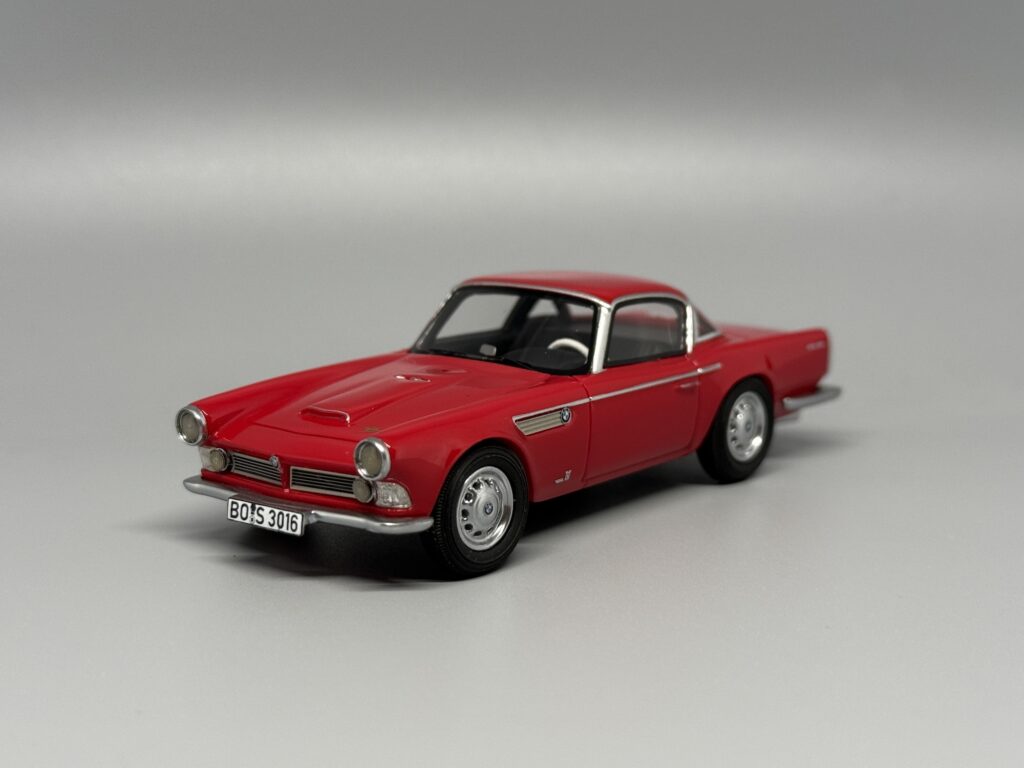
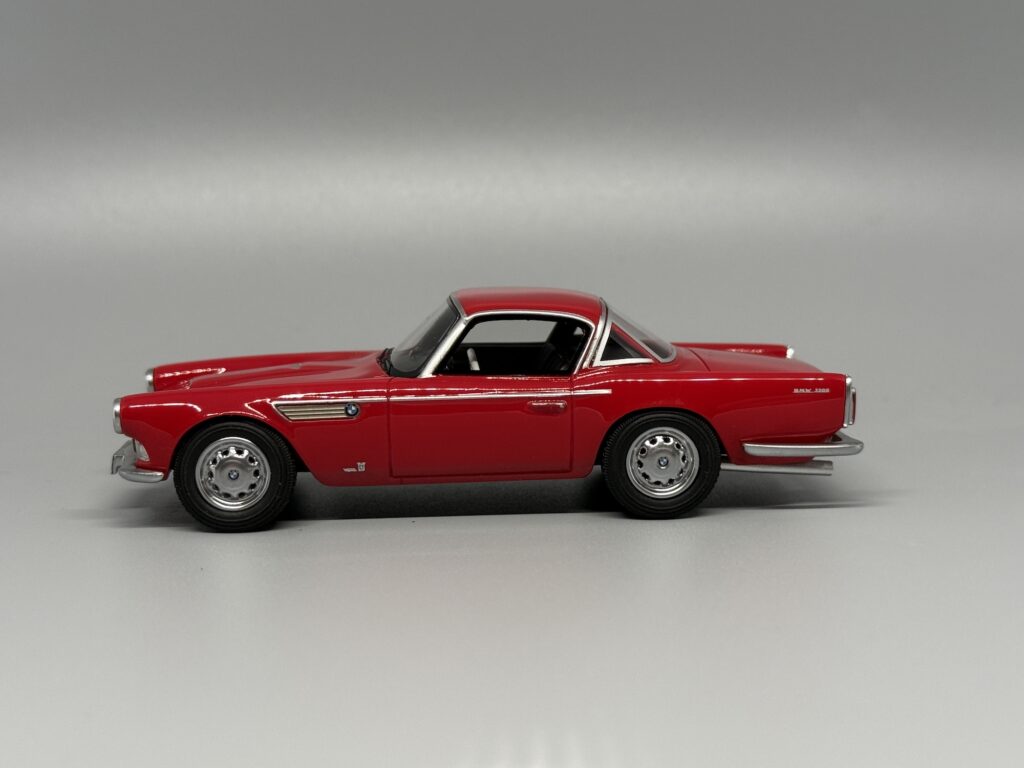
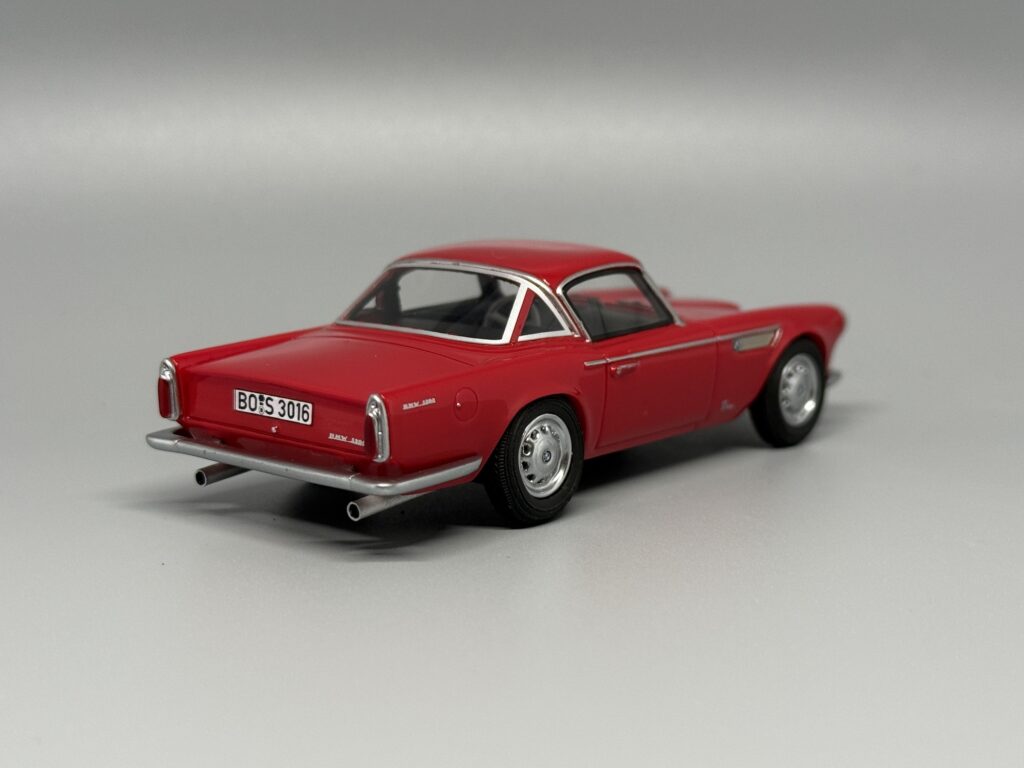
Michelotti’s design differed markedly from the standard BMW 507. The front became straighter and lower, the side profile sharper and the wheel arches more clearly defined. Small fins at the rear reflected the influence of late-1950s American automotive design. The hardtop gave the car a strong coupé-like silhouette, while with the soft top it retained the character of a classic Roadster. Michelotti was not attempting to refine Goertz’s 507 with minor changes, but to demonstrate an entirely new possible design direction for a future BMW sports car.
BMW 507 mechanical components
Beneath the body, the BMW 3200 Michelotti Vignale retained much of the BMW 507’s mechanical specification. It used a 3,168 cm³ V8 engine producing 150 hp or 110 kW. Power was transmitted to the rear wheels through a four-speed manual transmission. According to the information panel accompanying the car at the BMW Museum, its top speed was 220 km/h. This is somewhat higher than the approximately 205 km/h usually quoted for the production BMW 507, but as 220 km/h is the figure given by the BMW Museum specifically for the Michelotti Vignale car, it can be used for this unique vehicle.
1958 or 1959?
The BMW Museum dates the car to 1958, referring to the period in which the prototype was completed. The car was presented to the public at the 1959 Turin Motor Show. For this reason, both 1958 and 1959 appear in different sources. The most accurate interpretation is to regard 1958 as the year of completion and 1959 as the year of its public debut.
1959 Turin Motor Show
The car shown at the Turin Motor Show represented Michelotti’s idea of a more modern BMW sports car. Although the project was not an official BMW proposal for a new production model, its purpose was to demonstrate how the design of a possible BMW 507 successor might evolve. The car remained a one-off, and production of the BMW 507 ended without a direct successor.
BMW and Michelotti
The BMW 3200 Michelotti Vignale was not the only connection between Michelotti and BMW. Michelotti was also involved in the development of the BMW 700, and his design ideas influenced the evolution of BMW’s new generation of cars in the late 1950s and early 1960s. The 3200 Michelotti Vignale therefore forms part of a broader period in which Italian designers played an important role in shaping BMW’s emerging visual identity.
A one-off and its later history
The BMW 3200 Michelotti Vignale remained a one-off. The car later passed through the United Kingdom to the United States and belonged to several collectors. It eventually became part of the Blackhawk Museum collection in California, and in 2005 it was acquired by BMW Group Classic. Today, the surviving original belongs to BMW’s historic factory collection and is displayed at the BMW Museum in Munich.
Historical significance
The BMW 3200 Michelotti Vignale Roadster demonstrates particularly well how differently the same BMW 507 mechanical basis could be interpreted. Albrecht Graf Goertz’s original represented the classic and flowing elegance of a mid-1950s European Roadster, Raymond Loewy created a futuristic special-bodied coupé on the same basis, and Giovanni Michelotti proposed a straighter, more modern Roadster with partial American styling influences. Michelotti’s car never became the official successor to the BMW 507, but as a unique design study it remains an important part of both BMW history and Italian automotive design.
Model in the collection
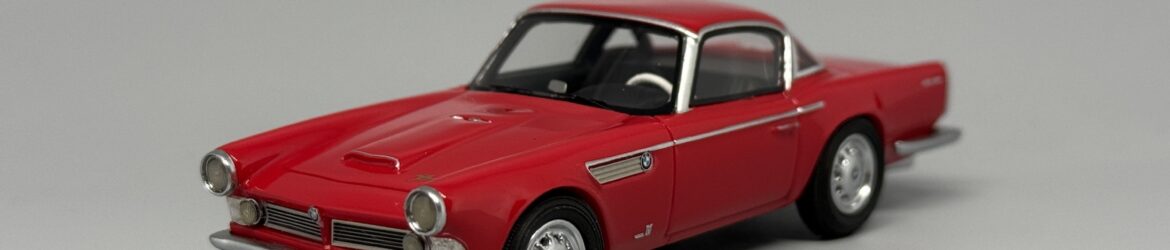
The model in my collection was produced by BoS Models, or Best of Show, and represents the unique BMW 3200 Michelotti Vignale Roadster with its removable hardtop fitted. The hardtop gives the model a clearly coupé-like appearance, although the original car was a Roadster. In my photograph taken at the BMW Museum, the same surviving car is shown with its soft top, illustrating a different configuration of the same vehicle.
Technical data in brief
Design work began: 1957
Year completed: 1958
Public debut: Turin Motor Show 1959
Basis: BMW 507
Chassis number: 70184
Designer: Giovanni Michelotti
Body built by: Scaglietti, Modena
Assembly and finishing: Vignale, Turin
Body style: two-seat Roadster
Roof: folding soft top and removable hardtop
Engine: V8
Displacement: 3,168 cm³
Power: 150 hp / 110 kW
Transmission: 4-speed manual
Drivetrain: rear-wheel drive
Top speed: 220 km/h according to the BMW Museum
Production: 1 car
Special feature: unique BMW 507-based design study created independently by Giovanni Michelotti and usable with either a soft top or removable hardtop
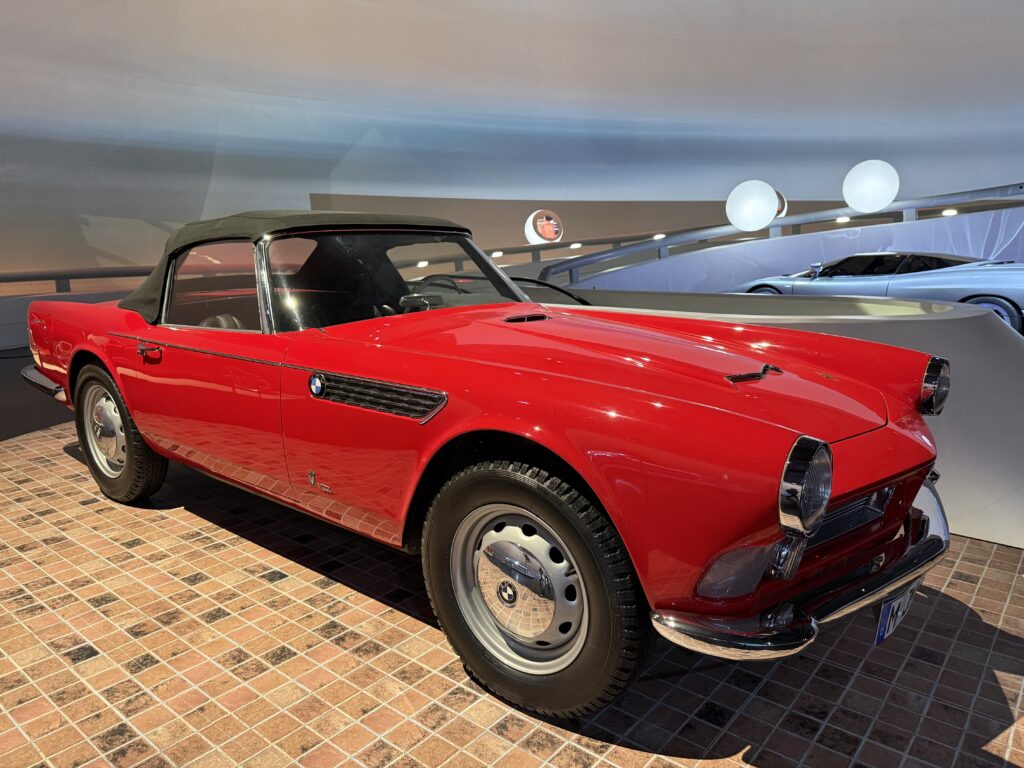
Photo of the real car, BMW Museum. Photo: Sten-Patrick Kreek