BMW E1 (Z15) was one of BMW’s earliest and most serious attempts to create a fully electric city car already in the early 1990s. It was a prototype presented in 1993, following the earlier BMW E1 Z11 version, but technically and visually developed much further. While the first E1 showed BMW’s interest in a small electric city car, the Z15 made the idea more mature, more modern and more usable as a concept.
The BMW E1 was created at a time when electric cars were still far from ordinary series production. In the early 1990s, the main challenges for electric mobility were battery technology, cost, driving range, charging time and the lack of charging infrastructure. Despite this, BMW approached the subject seriously. The E1 was not merely a design study, but a technological experiment intended to explore what a future urban vehicle could be: small, light, energy-efficient, spacious and environmentally conscious.
The project was developed by BMW Technik GmbH, which worked on BMW’s future technologies and experimental vehicles. This was important because, with the E1, BMW was not simply trying to convert an existing model into an electric car. The car was designed from the beginning according to a new principle. A compact body, lightweight construction, electric powertrain and the use of recyclable materials formed a complete concept that was clearly ahead of its time.
Design and concept
In terms of design, the BMW E1 Z15 differed noticeably from the earlier Z11 version. The body was lower, wider and more streamlined, giving it a more modern and confident appearance. Although it was a small city car, it did not look merely like a practical utility vehicle. The E1 had a recognisably BMW-like face, a compact three-door body, large glass areas and short overhangs, all of which suited a car intended for urban use.
At the centre of the BMW E1 concept was the idea that an electric car did not have to be just an electric version of a conventional car. Instead, BMW tried to create a completely new small vehicle whose dimensions, materials, powertrain and usage concept were based on the needs of urban mobility. The car had to be compact enough for dense city environments, while still offering enough space and practicality for everyday use.
The body structure used solutions that were very innovative for their time. The car was built on an aluminium spaceframe, and the exterior panels were made from recyclable plastic. This showed that BMW was not focusing only on the electric motor, but was looking more broadly at the entire car’s material use and environmental impact. In the context of the later BMW i series, this is especially important, because lightweight materials, special construction and sustainability also became central parts of the identity of the i3 and i8.
Technology
Technically, the BMW E1 Z15 was developed in several directions. In addition to the fully electric version, BMW also explored combustion-engine and hybrid solutions. This shows that BMW did not see the mobility of the future as having only one technological answer, but experimented with different possibilities. The electric version remained the most important, however, because it is the one that connects the E1 most clearly with BMW’s later electric mobility development.
The electric BMW E1 Z15 used an asynchronous electric motor producing around 43 hp. In today’s terms this is not a large figure, but it was entirely suitable for a small and lightweight city car. The purpose of the car was not to achieve sporting acceleration figures, but to offer quiet, efficient and practical urban driving. The immediate torque of the electric motor suited city traffic well and made the E1’s driving experience different from that of conventional small petrol-powered cars.
The driving range was estimated at around 160–200 kilometres, which was a very ambitious figure for an electric car of the early 1990s. Charging was carried out from a normal household socket and took around 6–8 hours. This usage concept was aimed primarily at everyday city driving: the car could be used during the day and charged overnight or during longer periods of parking. Today this seems natural, but at the time of the E1 it was still a highly experimental way of thinking.
Production
The BMW E1 Z15 did not enter series production. It remained a prototype and development project, intended to study the possibilities of an electric city car. For this reason, the E1 cannot be described as a regular production model, but rather as an idea and a technical test platform through which BMW gained experience with electric drives, batteries, lightweight construction and new materials.
The importance of the E1 does not lie in production numbers, but in the way BMW used it to test solutions that would become much more important only decades later. An aluminium supporting structure, recyclable plastic, a compact electric city car and environmentally conscious material use were all themes that later fitted naturally into the philosophy of the BMW i sub-brand.
Significance in BMW history
The significance of the BMW E1 Z15 in BMW history is mainly conceptual. It was not a model that reached series production, but it already showed in the early 1990s that BMW was studying the electric car as a completely new vehicle concept. The E1 was not merely a small car with an electric motor, but an attempt to rethink the entire structure of an urban vehicle: body, materials, powertrain, use of space and everyday usability.
Later, when BMW introduced the i3 and i8, many of the principles tested with the E1 became much more visible. The connection is especially clear with the i3: a compact urban vehicle, electric drivetrain, lightweight construction, special material use and a design clearly different from a conventional BMW. In this sense, the BMW E1 Z15 can be seen as an important bridge between BMW’s early electric vehicle experiments and the later BMW i era.
Today, the BMW E1 is especially interesting when viewed in retrospect. It shows that BMW’s electric mobility story did not begin only with the i3 and i8, but much earlier. The E1 was an experiment ahead of its time, remaining only a prototype, but its ideas and technical principles lived on in BMW’s later electrified models.
Model in the collection
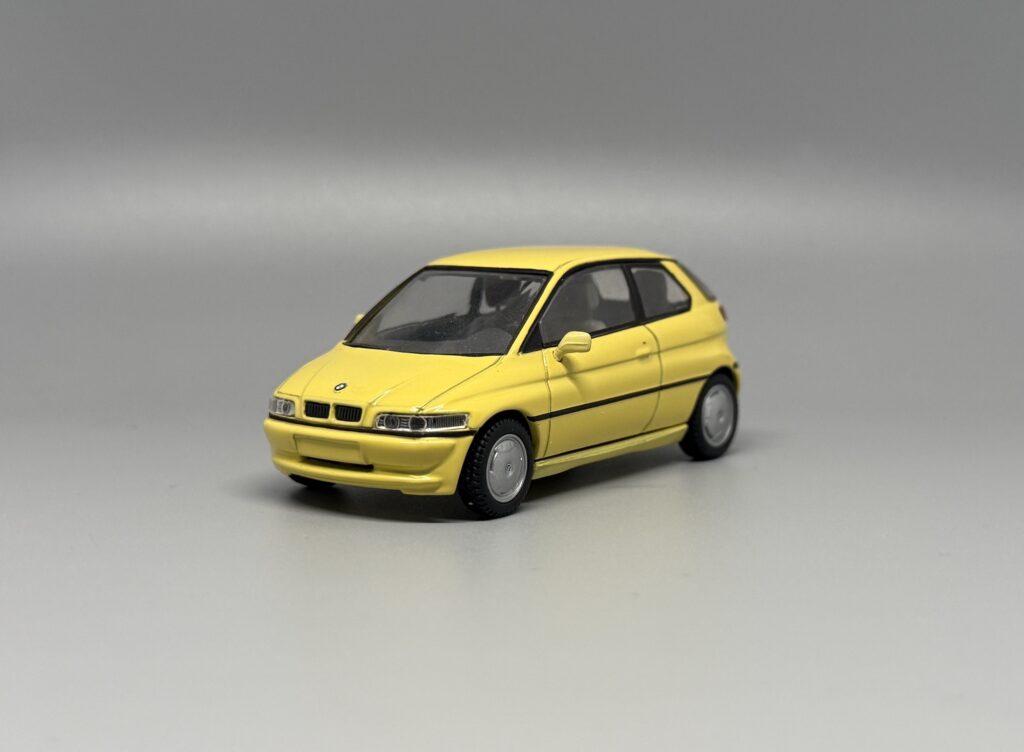
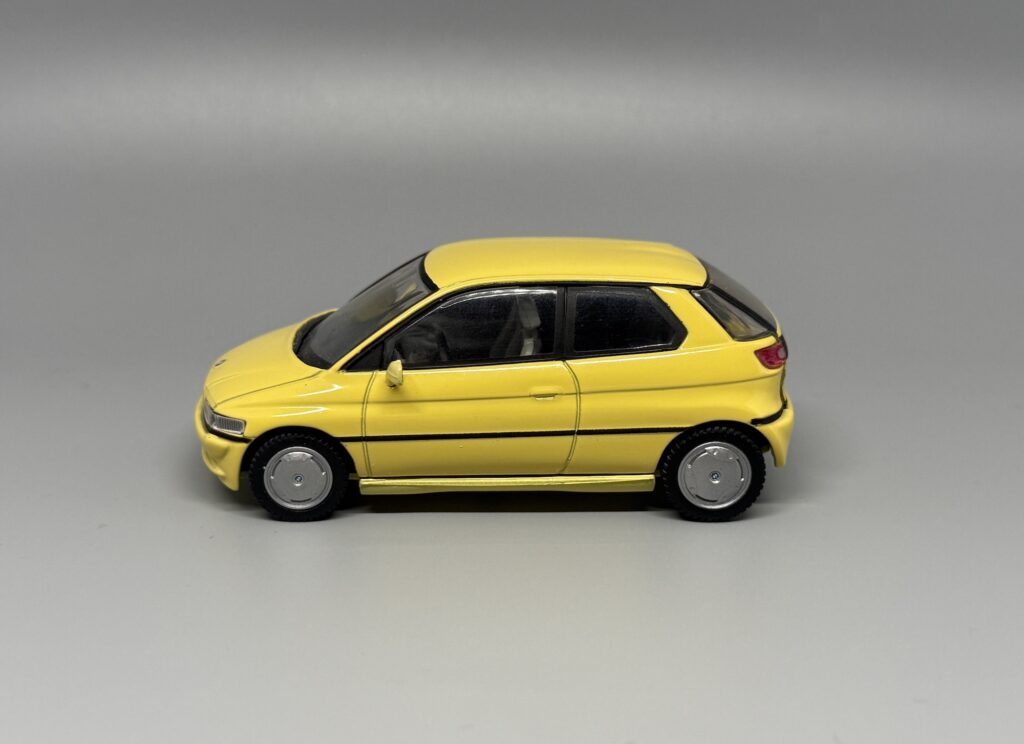
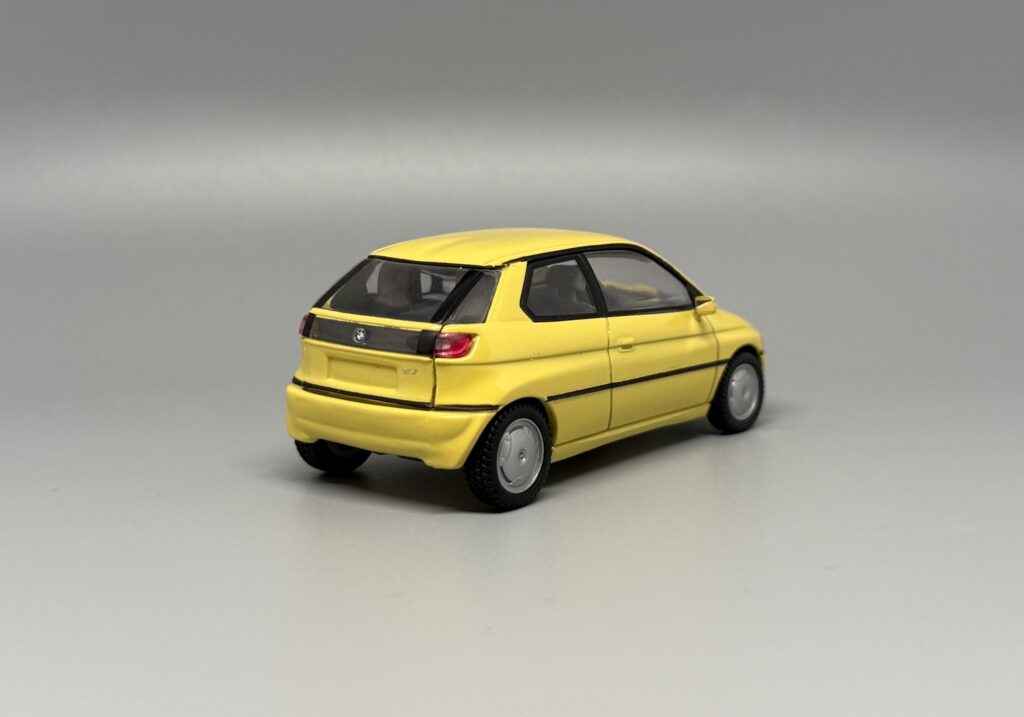
The model car in my collection is produced by Minichamps and represents the 1993 BMW E1 (Z15) prototype.
Technical data in brief
Year of presentation: 1993
Developer: BMW Technik GmbH
Country of development: Germany
Body style: three-door compact city car prototype
Construction: aluminium spaceframe
Body panels: recyclable plastic
Motor: asynchronous electric motor
Power: around 43 hp
Driving range: approximately 160–200 km
Charging time: around 6–8 hours from a normal household socket
Drivetrain: electric drive
Production number: prototype
Special feature: early BMW electric car concept whose lightweight construction, recyclable materials and urban mobility focus anticipated the later philosophy of the BMW i series

Background
BMW E1 (Z15) was one of BMW’s earliest and most serious attempts to create a fully electric city car already in the early 1990s. It was a prototype presented in 1993, following the earlier BMW E1 Z11 version, but technically and visually developed much further. While the first E1 showed BMW’s interest in a small electric city car, the Z15 made the idea more mature, more modern and more usable as a concept.
The BMW E1 was created at a time when electric cars were still far from ordinary series production. In the early 1990s, the main challenges for electric mobility were battery technology, cost, driving range, charging time and the lack of charging infrastructure. Despite this, BMW approached the subject seriously. The E1 was not merely a design study, but a technological experiment intended to explore what a future urban vehicle could be: small, light, energy-efficient, spacious and environmentally conscious.
The project was developed by BMW Technik GmbH, which worked on BMW’s future technologies and experimental vehicles. This was important because, with the E1, BMW was not simply trying to convert an existing model into an electric car. The car was designed from the beginning according to a new principle. A compact body, lightweight construction, electric powertrain and the use of recyclable materials formed a complete concept that was clearly ahead of its time.
Design and concept
In terms of design, the BMW E1 Z15 differed noticeably from the earlier Z11 version. The body was lower, wider and more streamlined, giving it a more modern and confident appearance. Although it was a small city car, it did not look merely like a practical utility vehicle. The E1 had a recognisably BMW-like face, a compact three-door body, large glass areas and short overhangs, all of which suited a car intended for urban use.
At the centre of the BMW E1 concept was the idea that an electric car did not have to be just an electric version of a conventional car. Instead, BMW tried to create a completely new small vehicle whose dimensions, materials, powertrain and usage concept were based on the needs of urban mobility. The car had to be compact enough for dense city environments, while still offering enough space and practicality for everyday use.
The body structure used solutions that were very innovative for their time. The car was built on an aluminium spaceframe, and the exterior panels were made from recyclable plastic. This showed that BMW was not focusing only on the electric motor, but was looking more broadly at the entire car’s material use and environmental impact. In the context of the later BMW i series, this is especially important, because lightweight materials, special construction and sustainability also became central parts of the identity of the i3 and i8.
Technology
Technically, the BMW E1 Z15 was developed in several directions. In addition to the fully electric version, BMW also explored combustion-engine and hybrid solutions. This shows that BMW did not see the mobility of the future as having only one technological answer, but experimented with different possibilities. The electric version remained the most important, however, because it is the one that connects the E1 most clearly with BMW’s later electric mobility development.
The electric BMW E1 Z15 used an asynchronous electric motor producing around 43 hp. In today’s terms this is not a large figure, but it was entirely suitable for a small and lightweight city car. The purpose of the car was not to achieve sporting acceleration figures, but to offer quiet, efficient and practical urban driving. The immediate torque of the electric motor suited city traffic well and made the E1’s driving experience different from that of conventional small petrol-powered cars.
The driving range was estimated at around 160–200 kilometres, which was a very ambitious figure for an electric car of the early 1990s. Charging was carried out from a normal household socket and took around 6–8 hours. This usage concept was aimed primarily at everyday city driving: the car could be used during the day and charged overnight or during longer periods of parking. Today this seems natural, but at the time of the E1 it was still a highly experimental way of thinking.
Production
The BMW E1 Z15 did not enter series production. It remained a prototype and development project, intended to study the possibilities of an electric city car. For this reason, the E1 cannot be described as a regular production model, but rather as an idea and a technical test platform through which BMW gained experience with electric drives, batteries, lightweight construction and new materials.
The importance of the E1 does not lie in production numbers, but in the way BMW used it to test solutions that would become much more important only decades later. An aluminium supporting structure, recyclable plastic, a compact electric city car and environmentally conscious material use were all themes that later fitted naturally into the philosophy of the BMW i sub-brand.
Significance in BMW history
The significance of the BMW E1 Z15 in BMW history is mainly conceptual. It was not a model that reached series production, but it already showed in the early 1990s that BMW was studying the electric car as a completely new vehicle concept. The E1 was not merely a small car with an electric motor, but an attempt to rethink the entire structure of an urban vehicle: body, materials, powertrain, use of space and everyday usability.
Later, when BMW introduced the i3 and i8, many of the principles tested with the E1 became much more visible. The connection is especially clear with the i3: a compact urban vehicle, electric drivetrain, lightweight construction, special material use and a design clearly different from a conventional BMW. In this sense, the BMW E1 Z15 can be seen as an important bridge between BMW’s early electric vehicle experiments and the later BMW i era.
Today, the BMW E1 is especially interesting when viewed in retrospect. It shows that BMW’s electric mobility story did not begin only with the i3 and i8, but much earlier. The E1 was an experiment ahead of its time, remaining only a prototype, but its ideas and technical principles lived on in BMW’s later electrified models.
Model in the collection
The model car in my collection is produced by Minichamps and represents the 1993 BMW E1 (Z15) prototype.
Technical data in brief
Year of presentation: 1993
Developer: BMW Technik GmbH
Country of development: Germany
Body style: three-door compact city car prototype
Construction: aluminium spaceframe
Body panels: recyclable plastic
Motor: asynchronous electric motor
Power: around 43 hp
Driving range: approximately 160–200 km
Charging time: around 6–8 hours from a normal household socket
Drivetrain: electric drive
Production number: prototype
Special feature: early BMW electric car concept whose lightweight construction, recyclable materials and urban mobility focus anticipated the later philosophy of the BMW i series
Photo of the real car. Source: story-cars.com