
Background
BMW 531 was one of the most important prototypes from BMW’s early post-war period because it shows that the company’s future direction was still far from certain in the late 1940s. Post-war Germany had a strong demand for small, inexpensive and economical cars, and BMW had to decide whether to target this mass market or re-establish itself as a manufacturer of larger and more prestigious automobiles. To explore this question, BMW developed a small passenger car alongside its large luxury-car project, and this programme became the BMW 531.
A small car between motorcycle and automobile
The original idea behind the BMW 531 was highly practical: it was intended to become something of a replacement for a motorcycle and sidecar. BMW had restarted post-war production primarily with motorcycles, and using existing motorcycle technology for a small car was therefore a logical approach. The aim was not simply to create a scaled-down luxury car, but a simple and economical vehicle for customers who found a full-size automobile too expensive but wanted something more practical and weatherproof than a motorcycle.
Beginning of development
The first ideas for a small BMW date back to 1948, and in early 1949 BMW’s development department was formally instructed to work on a small car alongside the company’s luxury-car programme. The project carried the designation 531, although some later sources have also referred to it as the BMW 331. Development is associated with BMW’s long-serving engineer Fritz Fiedler, who had played an important role in both the company’s pre-war and post-war technical development.
Four stages of development
The BMW 531 did not immediately appear in the form of the surviving prototype. During development, several very different technical layouts were investigated. Early concepts placed the boxer engine at the rear of the car or ahead of the rear axle, with cooling air intended to reach it through a duct running through the centre of the vehicle. Various engine capacities of approximately 350 to 750 cm³ were considered, together with different body and chassis configurations. By early 1951 the project had reached its fourth development stage, from which a fully driveable prototype was produced.
Front engine and rear-wheel drive
In the final 531 prototype, the original rear-engine concept was abandoned. The two-cylinder boxer engine and gearbox were installed ahead of the front axle, while power was transmitted to the rear wheels through a propeller shaft. This conventional front-engine, rear-wheel-drive arrangement made more efficient use of the passenger compartment. Moving the engine to the front also created enough room behind the two main seats for two small occasional seats, allowing the 531 to carry a small family when necessary.
Motorcycle-derived boxer engine
The BMW 531 used an air-cooled two-cylinder boxer engine derived from BMW motorcycle technology. Because the engine was now enclosed within a car body and could no longer receive cooling air as freely as on a motorcycle, forced-air cooling with an additional fan was used. During development, BMW investigated both 500 and 600 cm³ versions, identified as M531b and M531a. The surviving 1951 prototype is generally associated with the 600 cm³ version. However, the exact power output is not documented consistently enough in reliable surviving sources to justify assigning one specific horsepower figure to the car.
Compact, but still a real car
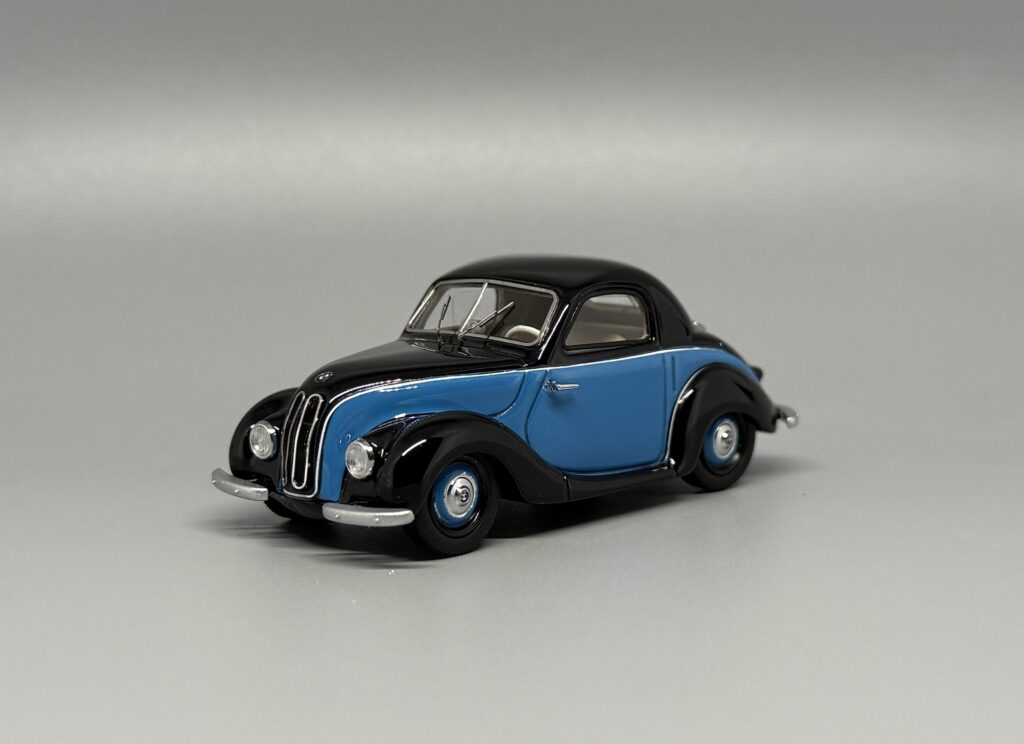
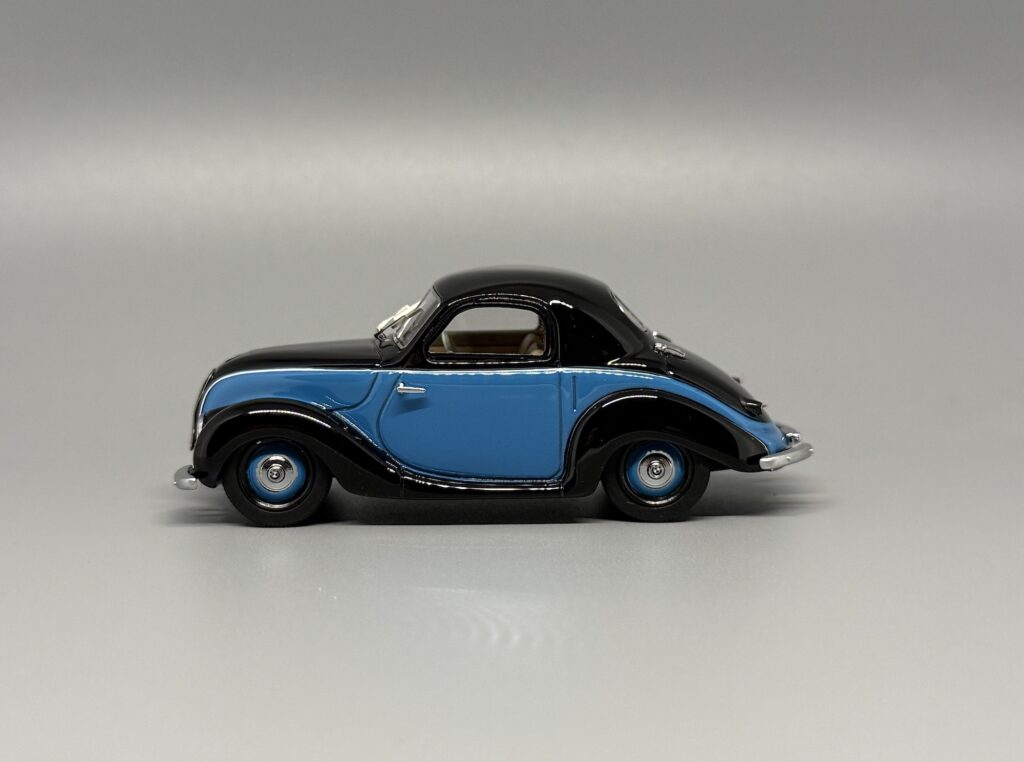
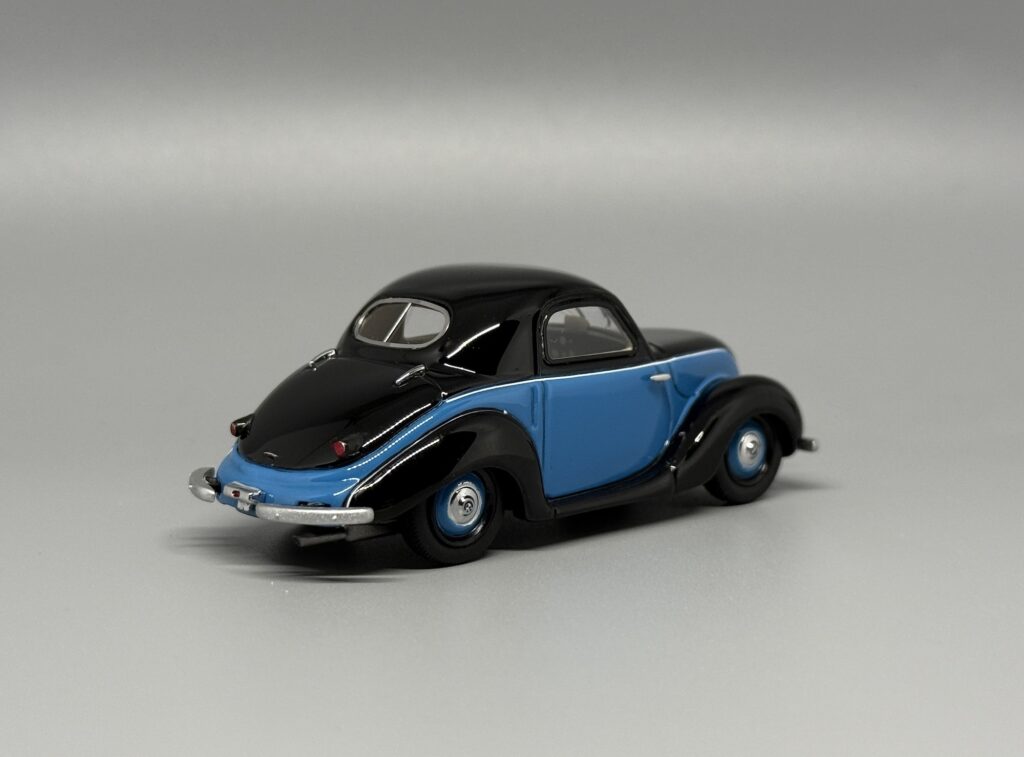
Although the BMW 531 was intended to be inexpensive, it was not conceived merely as a minimal microcar. It had a conventional two-door enclosed body, a separate luggage compartment and several design features associated with BMW. The headlamps were integrated into the rounded front wings, the doors were rear-hinged and both the front and rear windows were divided into two sections by a narrow central pillar. In overall size, the car was comparable with contemporary European small cars and was intended to provide the practical qualities of a proper automobile within very compact dimensions.
Why did the 531 not reach production?
The 531 programme was not abandoned simply because BMW wanted to concentrate on luxury cars. To make such a small car profitable, it would have needed to be produced in very large numbers, which in turn required major investment in large body-panel presses and other mass-production equipment. BMW’s difficult post-war financial position did not allow such an investment. At the same time, management was concentrating its resources on the much more prestigious BMW 501 project. Development of the 531 was therefore discontinued, and BMW returned to automobile production in the early 1950s with a large six-cylinder luxury model.
One surviving prototype
Only one fully driveable BMW 531 prototype is known to have been completed. Unlike many experimental vehicles, however, it did not disappear over the decades. The car survived for many years in a private collection in Sweden and later returned to BMW ownership. In 2008, the BMW 531 was installed in the renewed BMW Museum exhibition in Munich. This makes the 531 particularly valuable today, because it is not merely a project known from drawings or documents – one of the alternative paths BMW could have taken after the war still survives as a physical automobile.
Historical significance
The BMW 531 is especially fascinating in retrospect because it shows how different BMW’s post-war development might have been. In the early 1950s the company chose to concentrate on luxury cars and the 531 remained a prototype, but only a few years later BMW’s difficult economic situation forced the company back towards smaller and more affordable vehicles. The BMW Isetta entered production in 1955, followed by the BMW 600 and 700. The 531 can therefore be seen as an early attempt to solve the same problem BMW would later face again – how to offer a small and affordable car under the BMW name.
Model in the collection
The model in my collection was produced by Autocult and represents the driveable 1951 BMW 531 prototype. It was produced in a limited edition of 333 examples.
Technical data in brief
Year completed: 1951
Development began: 1948–1949
Place of development: Munich, Germany
Developer: BMW
Project designation: BMW 531
Body style: two-door compact prototype
Seating: 2 + 2 occasional seats
Engine: air-cooled two-cylinder boxer engine
Displacement: 600 cm³
Cooling: air cooling with additional fan
Engine position: front, ahead of the front axle
Drivetrain: rear-wheel drive
Power: exact figure not reliably documented
Production: 1 fully driveable prototype
Special feature: BMW’s early post-war small-car project, conceived as a more practical alternative to a motorcycle and sidecar
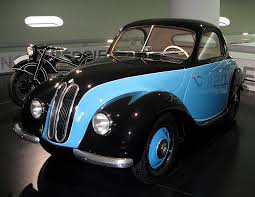
Photo of the real car. Original source Wikipedia