Background
BMW 2 Series Coupé (F22) was introduced in autumn 2013 and reached the market in 2014 as the first model to carry the BMW 2 Series name. The new model continued the idea of the earlier BMW 1 Series Coupé (E82), but BMW now separated the two-door coupé into its own model series. This established a new naming logic in which the 1 Series remained primarily associated with hatchbacks, while the sportier two-door models adopted the 2 Series designation. At the same time, the F22 retained the classic BMW coupé formula: a longitudinally mounted front engine, rear-wheel drive, compact dimensions and a clearly driver-focused character.
Design and concept
Compared with its E82 predecessor, the BMW 2 Series Coupé gained a longer and wider body, a longer wheelbase and a more spacious interior, while retaining the proportions of a compact sports coupé. The long bonnet, low and smoothly flowing roofline, short overhangs and strongly shaped rear section emphasised its rear-wheel-drive architecture and visually distinguished the F22 from the 1 Series hatchbacks. It was a four-seat coupé intended to combine sporting design with everyday usability. Luggage capacity increased compared with the previous model, while folding rear seats added further practicality, meaning the F22 was designed not only as an enthusiast’s car but also as a compact BMW suitable for everyday use.
Technology and engine range
The engine range of the BMW 2 Series Coupé F22 changed considerably during its production life and also varied between markets. The model was offered with four-cylinder petrol and diesel engines as well as powerful six-cylinder petrol units. All engines used BMW TwinPower Turbo technology, and depending on the version, customers could choose between a six-speed manual gearbox and an eight-speed Steptronic automatic transmission. Rear-wheel drive remained the basic concept of the F22, while BMW xDrive all-wheel drive later became available on selected more powerful versions. The broad engine range allowed the same body to serve very different roles, from an efficient everyday coupé to a high-performance sporting model.
Sportier versions
The sporting potential of the F22 model family was demonstrated particularly clearly by the development of the M Performance versions. The original BMW M235i Coupé used a 3.0-litre turbocharged six-cylinder engine and produced 326 hp in European specification. It was later replaced by the BMW M240i Coupé, whose 3.0-litre turbocharged six-cylinder engine developed up to 340 hp. These models were not full BMW M cars in the same sense as the separate F87 M2, but they offered very strong performance combined with the compact dimensions and traditional BMW coupé layout of the F22. The technical base of the F22 was capable enough to later support the development of the dedicated BMW M2, further strengthening the sporting reputation of the 2 Series Coupé.
Chassis and driving character
BMW placed particular emphasis on handling when introducing the F22. The rear-wheel-drive chassis, near-balanced weight distribution, wider track and longer wheelbase compared with the predecessor helped combine stability with quick responses. The front wheels were primarily responsible for steering, while in the basic versions engine power was transmitted to the rear wheels – a layout that had already become unusual in the compact segment by the time the F22 was launched. BMW tuned the suspension with a clear focus on sporting driving while still maintaining everyday comfort. This combination made the F22, for many BMW enthusiasts, one of the most traditionally BMW-like modern compact coupés.
2017 model update
In 2017, the BMW 2 Series Coupé received a Life Cycle Impulse update. The car gained a revised front end, larger air intakes, an updated kidney grille, standard bi-LED headlights and redesigned LED rear lights. Adaptive full-LED headlights were available as an option. The interior also received new materials, trim details and updated control solutions, while navigation and connectivity services were further improved. These changes did not alter the fundamental character of the F22, but modernised its design and technology for the second half of its production life.
Production
The BMW 2 Series Coupé F22 was produced at BMW Group Plant Leipzig in Germany from 2013 to 2021. According to BMW’s official factory statistics, a total of 165,224 F22 Coupés were built. The model reached the market in 2014 and remained in production until the arrival of the next-generation 2 Series Coupé. Alongside the F22, Leipzig also produced the F23 Convertible of the same generation and later the F87 BMW M2, making the plant an important production location for BMW’s compact rear-wheel-drive sports models.
Significance in BMW history
The significance of the BMW 2 Series Coupé F22 lies in the fact that it continued the classic tradition of the small rear-wheel-drive BMW coupé at a time when this type of technical layout was becoming increasingly rare in the automotive industry. The model took over the role previously held by the E82 1 Series Coupé while at the same time establishing an entirely new 2 Series coupé line. Its compact body, longitudinally mounted engine, rear-wheel drive and availability with six-cylinder power gave it qualities that had been associated with BMW coupés for decades. The success of the F22 ensured the continuation of the 2 Series Coupé into the next generation, and for many enthusiasts the model remains one of the clearest modern examples of the traditional BMW driver’s car.
Model in the collection
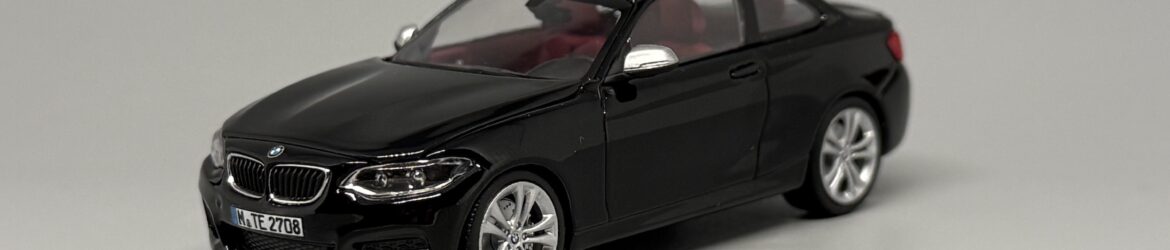
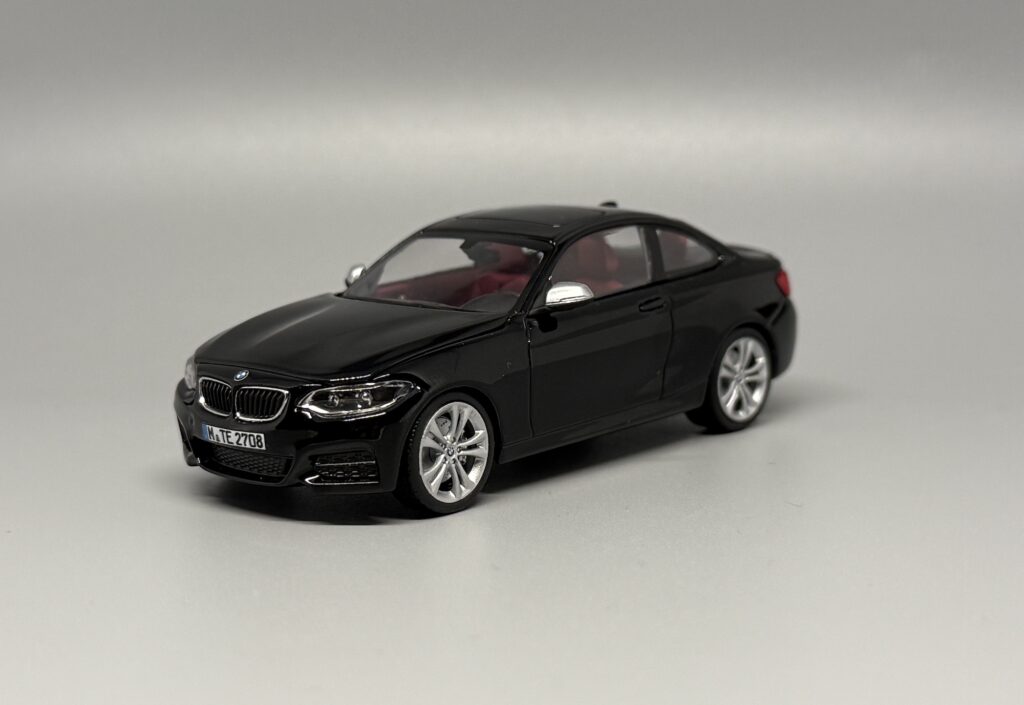
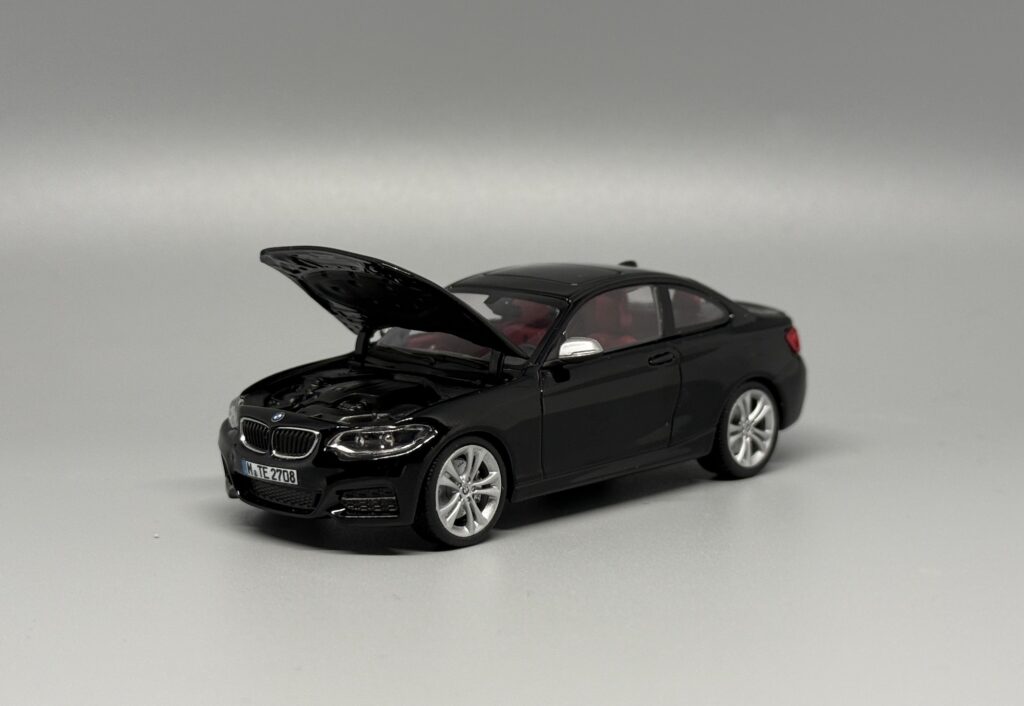
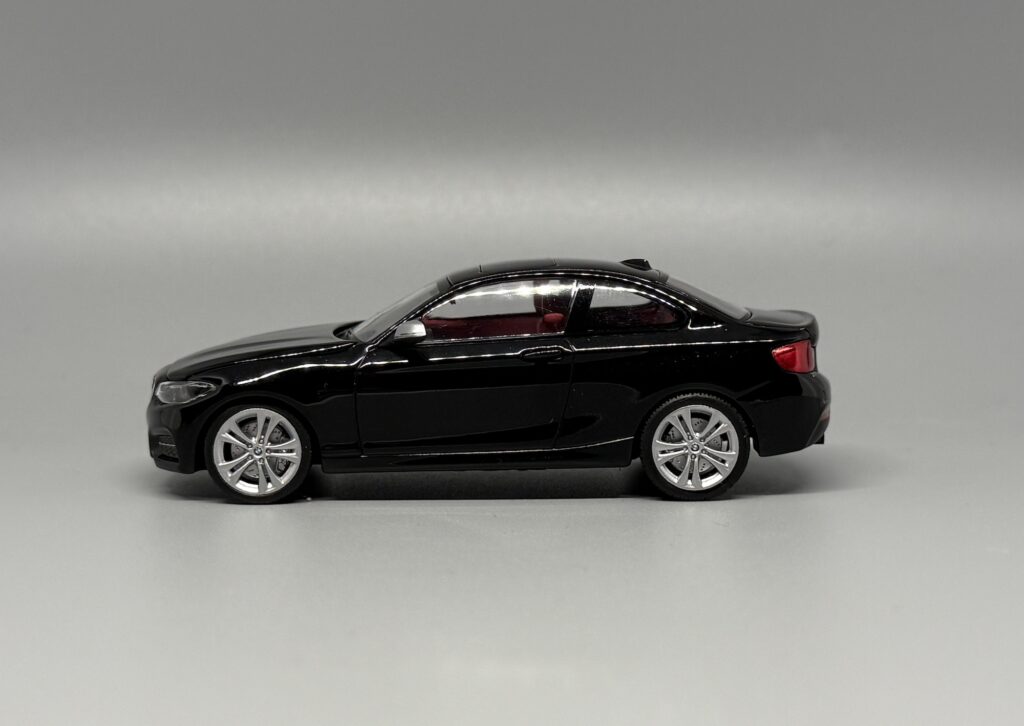
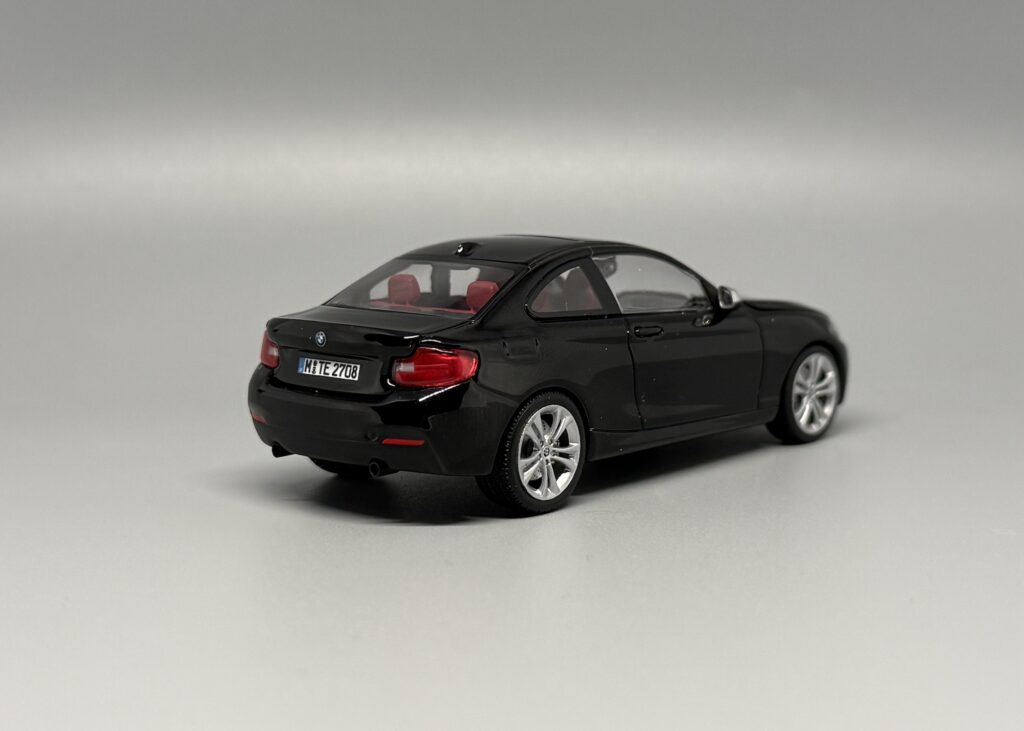
The model in my collection was produced by Minichamps and represents the BMW 2 Series Coupé (F22). It is a promotional model produced for BMW’s official dealer network and intended for presentation and sales purposes. As the exact engine version of the scale model is not known, this description covers the BMW 2 Series Coupé F22 model family as a whole.
Technical data in brief
Production period: 2013–2021
Market launch: 2014
Place of production: BMW Group Plant Leipzig, Germany
Body style: two-door four-seat Coupé
Engines: four- and six-cylinder petrol and diesel engines
Drivetrain: rear-wheel drive; xDrive all-wheel drive on selected versions
Gearboxes: 6-speed manual or 8-speed Steptronic
M235i Coupé power: up to 326 hp
M240i Coupé power: up to 340 hp
Production number: 165,224 cars
Successor: BMW 2 Series Coupé (G42)
Special feature: the first Coupé to carry the BMW 2 Series name and a continuation of the marque’s classic compact rear-wheel-drive sports coupé tradition