
Background
BMW M6 Coupé (E63) brought the M6 name back to the BMW model range in 2005 and combined the large luxury 6 Series coupé with some of the most advanced powertrain and chassis technology then available from BMW M GmbH. Its historical predecessor was the BMW M635CSi of the 1980s, which was sold as the BMW M6 in North America and Japan. While the M635CSi combined the elegant E24 grand tourer body with BMW Motorsport engineering, the E63 M6 translated the same idea into the technological world of the 2000s. A high-revving V10 engine, seven-speed SMG transmission, M-specific chassis and carbon-fibre roof made it one of the most technically distinctive large coupés in BMW M history.
The return of the BMW M6
The new M6 was based on the BMW 6 Series Coupé E63, but BMW M GmbH extensively reworked the engine, chassis, brakes, aerodynamics and electronic control systems. BMW described the M6 at launch as its most powerful 6 Series to date and as a car intended to combine supercar-like dynamics with the comfort and practicality of a luxurious 2+2 coupé. This dual character defined the M6: it was not a lightweight and uncompromising track car, but a large grand tourer capable of very high performance while remaining suitable for long-distance driving.
Design
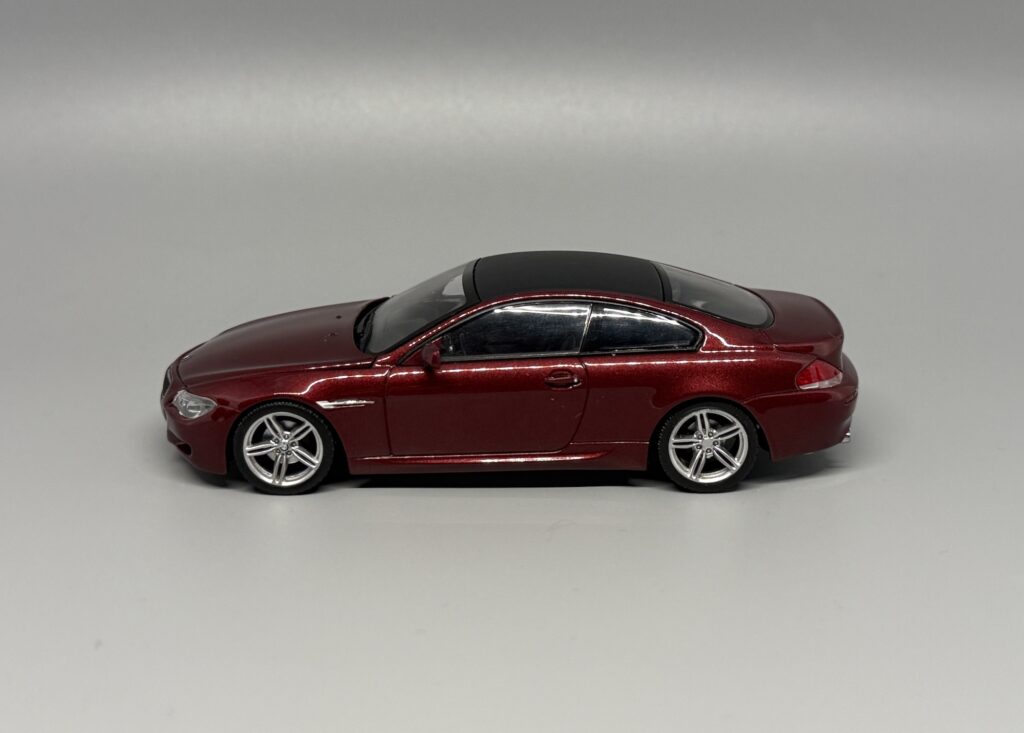
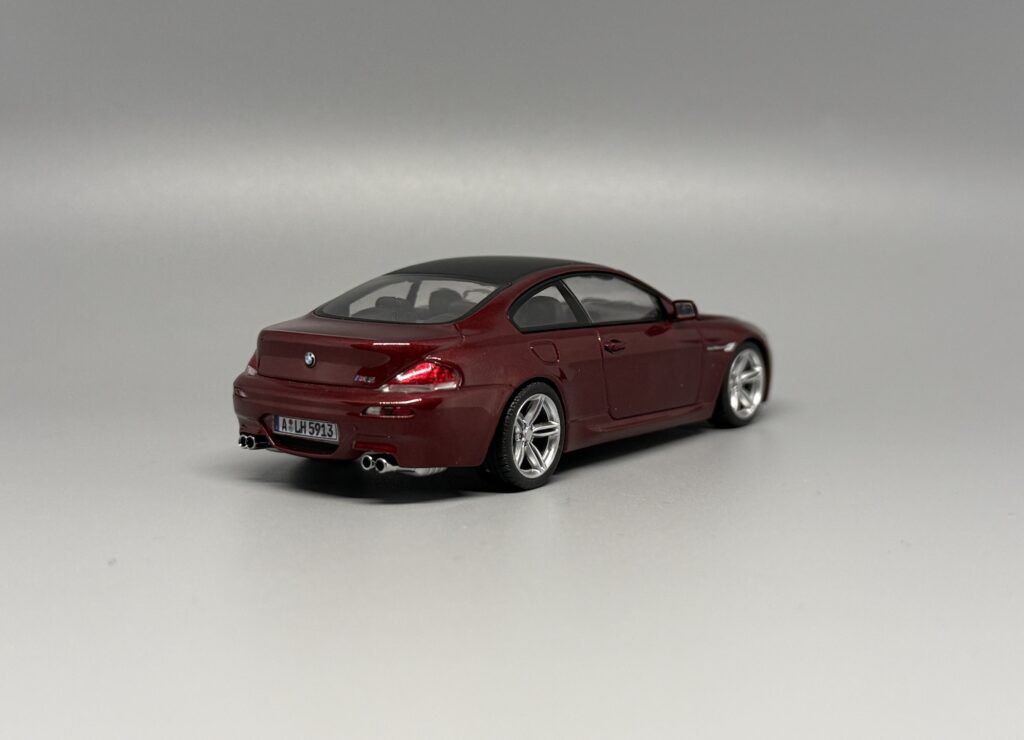
Compared with its performance, the M6 remained relatively restrained in appearance, although several functional M-specific details distinguished it from the regular E63 6 Series. Larger air intakes at the front provided the V10 engine with considerably more cooling air than the standard V8 models required. M-specific side skirts and exterior mirrors emphasised the lower stance, while the rear featured four exhaust outlets arranged on either side of an aerodynamic diffuser. Special 19-inch forged alloy wheels were designed to minimise unsprung mass while also exposing the large brake discs behind them. The result remained recognisably an E63 6 Series, but its details clearly reflected its BMW M origins.
S85 V10
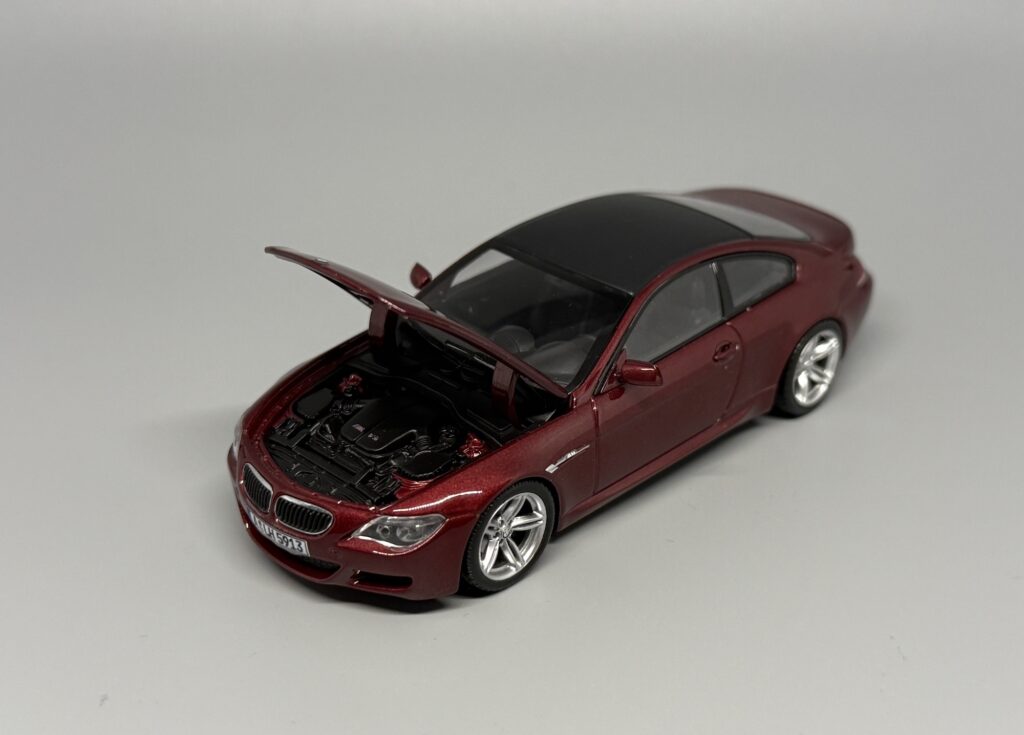
The most important technical feature of the BMW M6 was its 4,999 cm³ S85 naturally aspirated V10 engine, also used in the E60-generation BMW M5. The engine produced 507 hp, or 373 kW, at 7,750 rpm and a maximum torque of 520 Nm at 6,100 rpm. Maximum engine speed reached 8,250 rpm, while specific output exceeded 100 hp per litre – an exceptional figure at the time for a naturally aspirated engine in a series-production road car. The S85’s design and electronic management were heavily influenced by BMW M’s motorsport experience and included ten individually controlled throttle butterflies, Double-VANOS and a sophisticated oil-supply system developed to maintain lubrication under high lateral acceleration.
Motorsport influence
The S85 V10 was developed during a period when BMW was heavily involved in Formula One, and BMW itself emphasised the engine’s motorsport-inspired high-revving philosophy. It was not a direct road-going version of a Formula One engine, but its engineering concept incorporated several principles familiar from racing: very high engine speed, individual throttle butterflies for each cylinder, lightweight construction and the ability to maintain oil pressure under high lateral loads. The engine’s exceptional character was also recognised internationally, as the S85 won the overall International Engine of the Year award in both 2005 and 2006.
P400 and P500
The M6 offered an unusual system that allowed the character of the engine to be changed at the touch of a button. When the car was started, the P400 programme was activated automatically, limiting output to approximately 400 hp and giving the accelerator a more progressive response. By pressing the Power button, the driver could access the full 507 hp output and a sharper throttle response. BMW integrated this system with the other MDrive settings, allowing the driver to tailor the car according to whether the priority was relaxed long-distance cruising or maximum performance. It illustrated the dual nature of the M6 particularly well – the same car could behave as a refined grand tourer or as an extremely fast sports coupé.
SMG Drivelogic
At the heart of the European M6 drivetrain was the seven-speed SMG Drivelogic sequential transmission. It was an automated manual gearbox in which clutch operation and gear changes were controlled electrohydraulically. The driver could select gears using the centre-console lever or steering-wheel paddles, while Drivelogic offered a total of 11 different shift programmes. In its sportiest settings, gear changes were extremely rapid, and Launch Control allowed maximum acceleration from a standing start. The transmission also offered an automatic mode better suited to relaxed everyday driving.
Performance
The combination of the 507 hp V10 and seven-speed SMG allowed the M6 Coupé to accelerate from 0 to 100 km/h in 4.6 seconds, while 200 km/h was reached in approximately 14 seconds. Top speed was electronically limited to 250 km/h. BMW emphasised from the beginning that the powertrain was capable of more, with the speedometer itself extending to 330 km/h. The M6 was also highly capable on a circuit: BMW stated that the car could lap the Nürburgring Nordschleife in around eight minutes, an impressive achievement for a four-seat luxury coupé weighing more than 1,700 kilograms.
Chassis and differential
BMW M GmbH extensively reworked the E63 chassis to handle the performance of the M6. The car received dedicated M suspension, while Electronic Damper Control, or EDC, offered three settings: Comfort, Normal and Sport. At the rear axle, a variable-locking M Differential Lock improved traction, particularly when accelerating out of corners or when the two rear wheels had different levels of grip. Dynamic Stability Control also featured an M Dynamic Mode, allowing greater slip before the electronics intervened. The stability-control system could also be switched off completely.
Brakes
To control its performance, the M6 used large cross-drilled compound brake discs and lightweight aluminium brake components. According to BMW, the car could stop from 100 km/h in around 36 metres and from 200 km/h in less than 140 metres. The braking system was designed not only for strong deceleration, but also for heat resistance and reduced unsprung mass, both important for repeated high-speed road and circuit driving.
Carbon-fibre roof and lightweight construction
One of the most distinctive technical features of the M6 Coupé was its CFRP, or carbon-fibre-reinforced plastic, roof. BMW had already used the material on the limited-production M3 CSL, but the M6 brought the carbon-fibre roof to a much larger-volume BMW M model. The lighter roof reduced mass at the highest point of the car and therefore lowered the centre of gravity. Intelligent lightweight construction was also used elsewhere: the bonnet and much of the front structure were aluminium, the front wings were made from plastic material, and aluminium components were used extensively in the suspension. The objective was not simply to make the car as light as possible, but to achieve the best possible balance between the mass and performance of a large luxury coupé.
Interior and grand touring character
Despite its highly sporting engineering, the M6 remained a luxurious 2+2 grand tourer. The interior featured Merino leather, M-specific instruments, sports seats and an M steering wheel, while MDrive allowed the driver to store preferred settings for the engine, transmission, suspension and stability-control systems. BMW emphasised that the M6 retained much of the comfort and everyday usability of the regular 6 Series. This combination was central to the car’s character: technically it was an extremely powerful M car, but in concept it remained a large and luxurious coupé.
Relationship with the BMW M635CSi
BMW itself linked the history of the E63 M6 directly with the BMW M635CSi and BMW M1. The M635CSi of the 1980s had brought BMW Motorsport technology into the large E24 coupé, and in North America and Japan it carried the M6 name. The E63 continued the same basic idea almost two decades later, this time using the official M6 name worldwide. Both cars combined the large 6 Series body of their respective eras with some of BMW M’s most distinctive engine technology – the M635CSi used a six-cylinder engine related to the BMW M1, while the E63 M6 received the high-revving V10.
Production
The BMW M6 Coupé E63 was produced at BMW Group Plant Dingolfing in Germany from 2005 to 2010. According to official BMW M figures, a total of 14,152 M6 models of the E63/E64 generation were produced. Of these, 9,087 were E63 Coupés and 5,065 were E64 Convertibles. Approximately half of total M6 production was sold in the United States. Compared with the regular 6 Series, the M6 therefore remained a relatively rare model, particularly considering its unique V10 powertrain.
Significance in BMW M history
The BMW M6 Coupé E63 represents a particularly distinctive era in BMW M history. Its naturally aspirated V10 was created at a time when high engine speeds and motorsport-influenced engineering were central to the technical identity of BMW M. Later generations of the M6 switched to turbocharged engines, while the S85 remained the only V10 ever used in a BMW series-production road car. The M6 combined this exceptional engine with a carbon-fibre roof, complex SMG transmission, dedicated M chassis and the body of a luxurious grand tourer. This combination makes the E63 M6 one of the most characteristic and technically unusual BMW M models.
Model in the collection
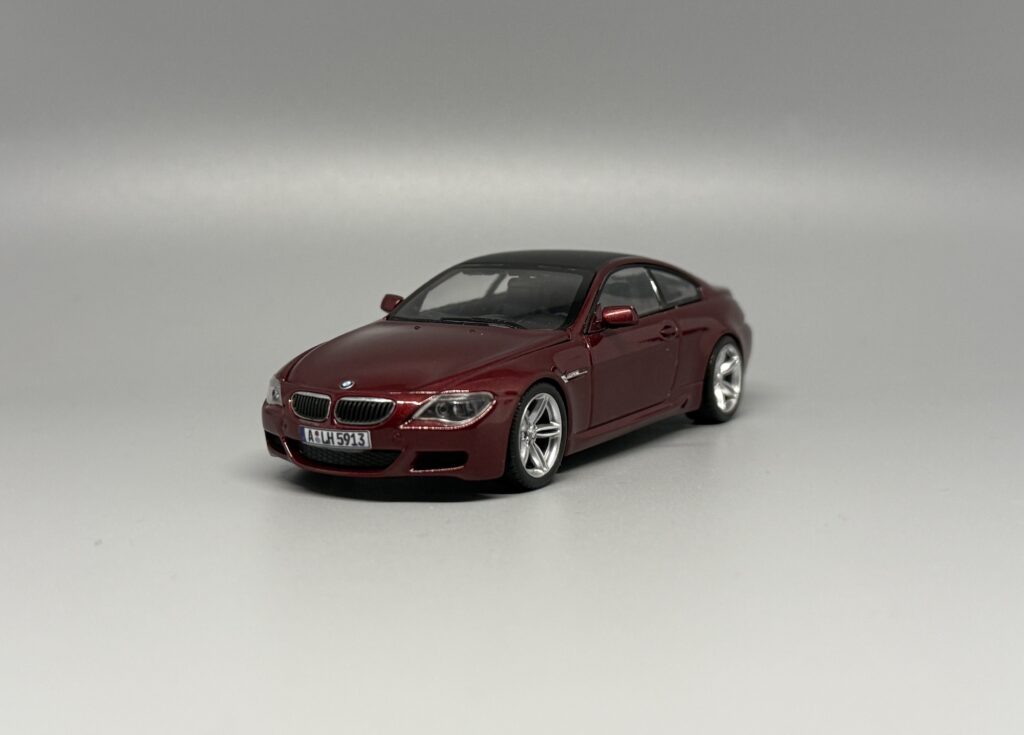
The model in my collection was produced by Minichamps and represents a 2006 BMW M6 Coupé (E63). It was produced in a limited edition of 2,016 examples.
Technical data in brief
Production period: 2005–2010
Place of production: BMW Group Plant Dingolfing, Germany
Body style: two-door 2+2 Coupé / grand tourer
Engine: S85 naturally aspirated V10
Displacement: 4,999 cm³
Power: 507 hp / 373 kW @ 7,750 rpm
Torque: 520 Nm @ 6,100 rpm
Maximum engine speed: 8,250 rpm
Drivetrain: rear-wheel drive
Transmission: 7-speed SMG Drivelogic
0–100 km/h: 4.6 s
0–200 km/h: approximately 14 s
Top speed: 250 km/h, electronically limited
Suspension: M-specific EDC with electronically controlled dampers
Differential: variable-locking M Differential Lock
E63 M6 Coupé production: 9,087 cars
Total E63/E64 M6 production: 14,152 cars
Special feature: a BMW M grand tourer combining a high-revving naturally aspirated V10 engine, carbon-fibre roof and luxury coupé concept
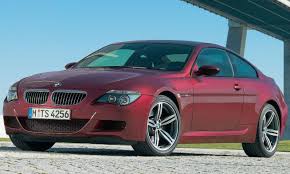
Photo of the real car. Source: bmw-m.com