Background
BMW 501 marked the true restart of BMW automobile production after the Second World War and the company’s return to the large luxury-car segment. A prototype was first presented at the 1951 Frankfurt Motor Show, but difficult economic conditions and problems associated with preparing production delayed series manufacture until late 1952. The BMW 501 was the first completely new passenger car produced by BMW after the war and also the first series-production BMW automobile built in Bavaria. With the 501, BMW sought to restore its pre-war reputation as a manufacturer of high-quality and technically sophisticated automobiles.
A new beginning in Munich
Before the war, BMW automobile production had been centred mainly in Eisenach, but after 1945 the plant was located in the Soviet occupation zone. BMW therefore had to rebuild passenger-car production almost from the ground up in Munich. Development of a new large saloon began during the late 1940s, and despite the company’s difficult financial situation, BMW chose not to return to the market with a simple economy car. Instead, it developed a prestigious and technically ambitious luxury model. This decision gave the BMW 501 great symbolic importance, but also made the project expensive and financially risky.
The “Baroque Angel”
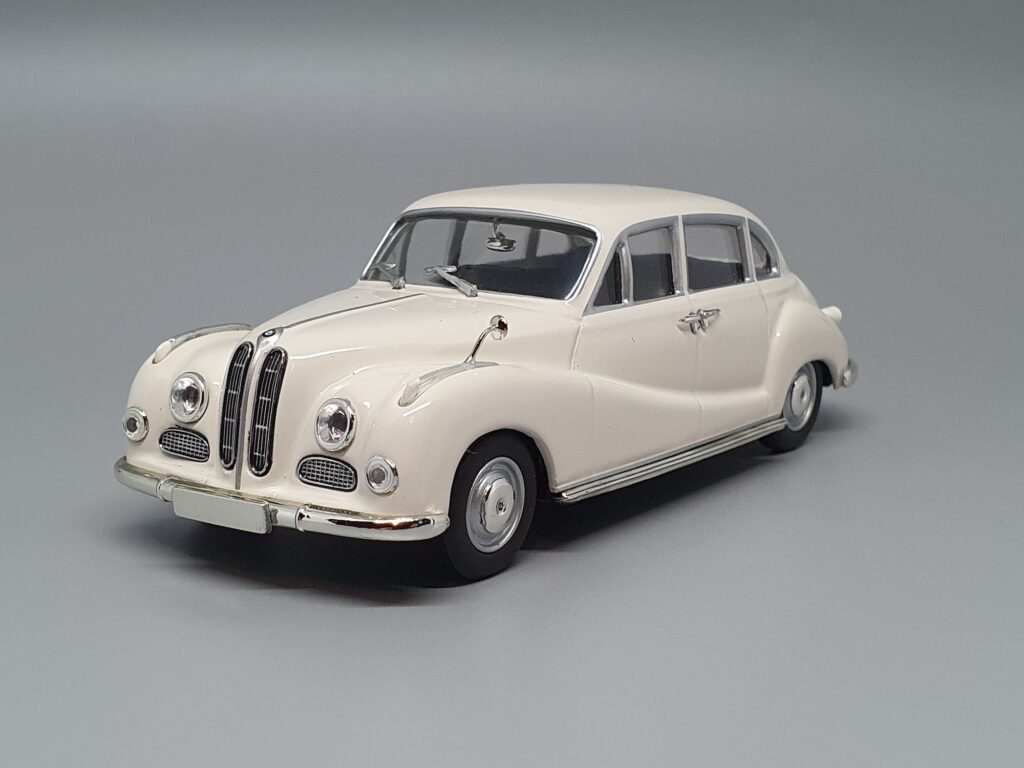
The BMW 501 soon became known in Germany by the nickname “Barockengel”, or “Baroque Angel”. The name referred to the car’s rounded and flowing body shape, which contrasted with the increasingly straight-sided ponton styling of the early 1950s. The basic body design is associated with BMW designer Peter Szymanowski. A long bonnet, flowing wings, high roofline and rounded rear gave the car an imposing and classically elegant appearance. The Baroque Angel nickname was later also used more broadly for the BMW 502 and other models belonging to the same body family.
Strong frame and spacious interior
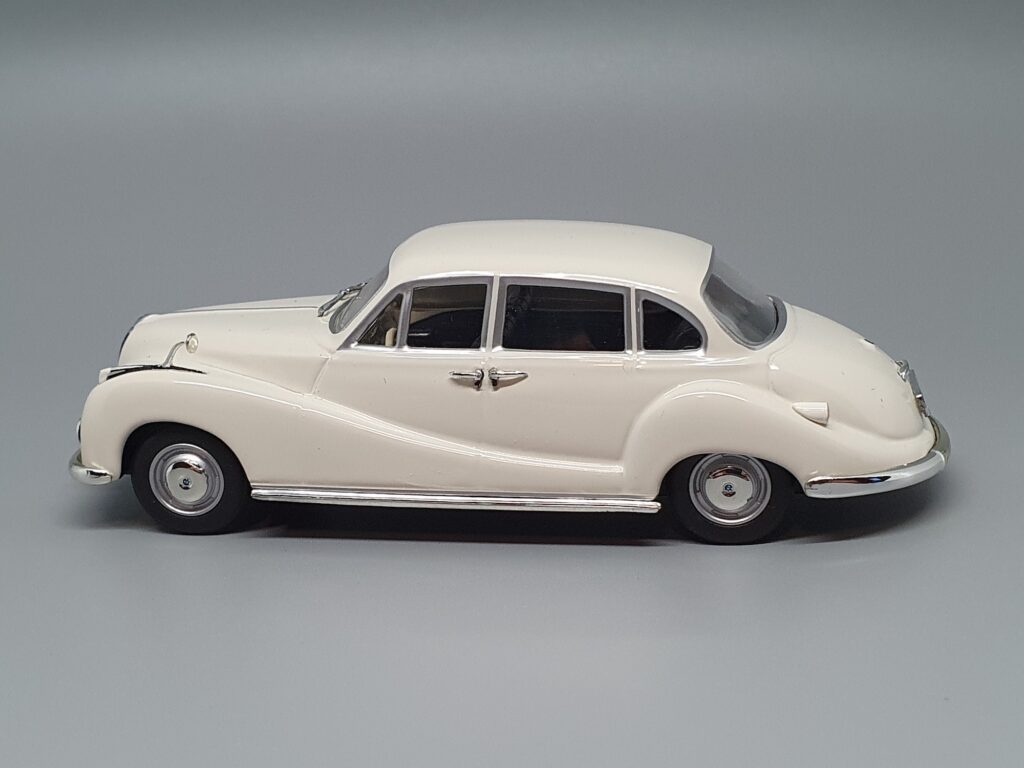
The BMW 501 body was mounted on a newly designed and very strong frame. The car was large and spacious for its time and could accommodate up to six people together with their luggage. One unusual engineering feature was the positioning of the gearbox separately from the engine, helping to create a relatively flat passenger-compartment floor. The front and rear doors opened in opposite directions, creating a particularly wide entry area around the B-pillar and reinforcing the car’s character as a prestigious saloon.
Bodies built by Baur
When production of the new model began, BMW did not yet have all the necessary equipment in Munich to manufacture the large body panels. The bodies of the early BMW 501 saloons were therefore produced by Karosserie Baur in Stuttgart and transported to Munich for final assembly. BMW continued using Baur-built bodies until 1954. This cooperation illustrates how challenging it was for BMW to rebuild automobile production after the war.
Development of the pre-war BMW 326 engine
The original BMW 501 used a 1,971 cm³ six-cylinder in-line engine whose technical roots went back to the pre-war BMW 326. While the BMW 326 engine produced 50 hp, output was increased to 65 hp for the 501. A four-speed manual transmission was operated by a column-mounted gear lever, and power was sent to the rear wheels. BMW gives the original 501 a top speed of 138 km/h.
High price and modest sales
One of the BMW 501’s greatest problems was its price. At launch, the car cost 15,150 Deutsche Mark, making it one of the most expensive German-built saloons of its time. At the same time, the 65 hp engine was considered relatively modest for such a large and heavy automobile. During its first 15 months on the market, slightly fewer than 2,300 examples found buyers. This was clearly below BMW’s expectations, and in 1954 the original version was replaced by the BMW 501 A and 501 B, whose engines produced 72 hp.
Development of the 501 model family
BMW continued developing the 501 after production of the original 65 hp version ended. The 501 A and 501 B appeared in 1954, followed in 1955 by a BMW 501 with a larger 2,077 cm³ six-cylinder engine, while V8-powered versions were also added to the range. For this reason, different sources often give very different production periods and total numbers for the BMW 501. The original 1952–1954 65 hp BMW 501 should therefore be distinguished from the later models that continued to use the 501 name.
Historical significance
The BMW 501 was not a major commercial success, and its high development and production costs did not solve BMW’s post-war financial difficulties. Its historical importance, however, is considerable. The model re-established BMW passenger-car production, formed the basis of an entire family of 1950s luxury cars and provided the technical foundation from which models such as the BMW 502, 503 and 507 developed. The BMW 501 therefore represents the moment when BMW began rebuilding its identity after the war as a manufacturer of high-quality, technically ambitious and driver-oriented automobiles.
Model in the collection
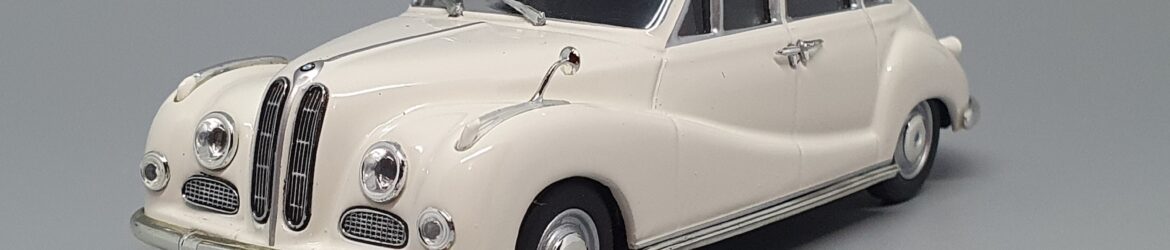
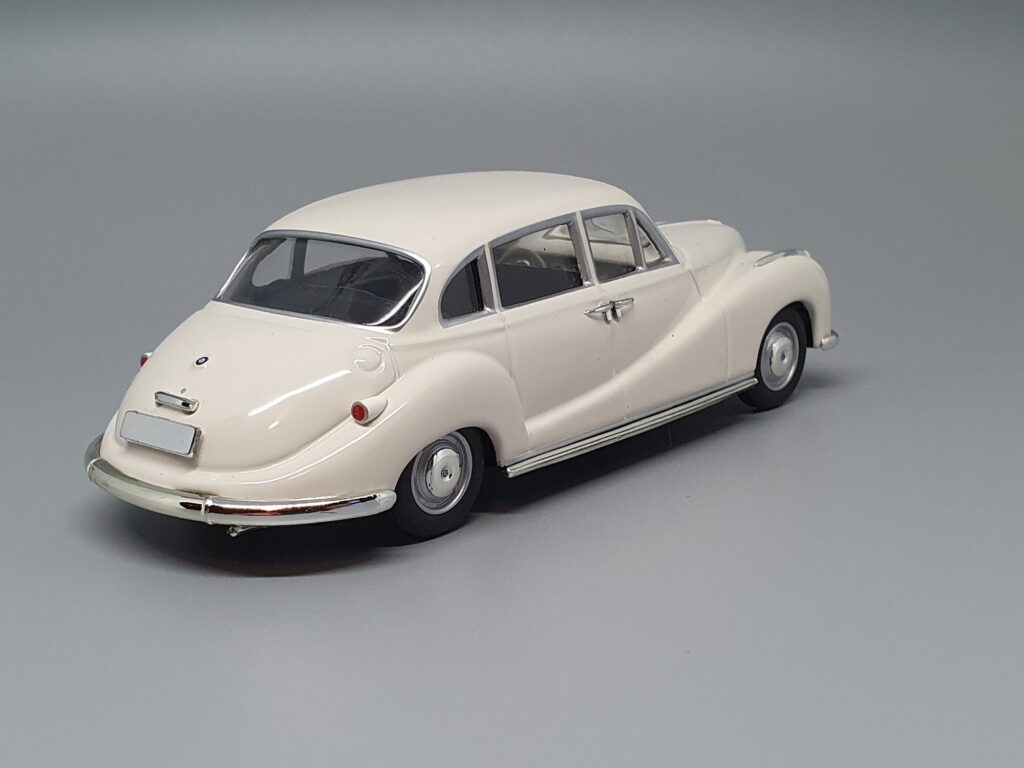
The model in my collection was produced by Minichamps and represents a 1953 BMW 501 saloon, the original version powered by the 2.0-litre six-cylinder engine producing 65 hp. The model was produced in a limited edition of 1,008 examples.
Technical data in brief
Public debut: Frankfurt Motor Show 1951
Production period of the original BMW 501: November 1952 – 1954
Final assembly: Munich, Germany
Bodies of early cars: Karosserie Baur, Stuttgart
Body style: four-door luxury saloon
Seating capacity: up to 6
Engine: six-cylinder in-line engine
Displacement: 1,971 cm³
Power: 65 hp
Transmission: 4-speed manual
Drivetrain: rear-wheel drive
Top speed: 138 km/h
Weight: approximately 1,340 kg
Price when new: 15,150 Deutsche Mark
Production of the original version: approximately 2,300 cars
Special feature: BMW’s first completely new post-war passenger car and the beginning of the “Baroque Angel” model family
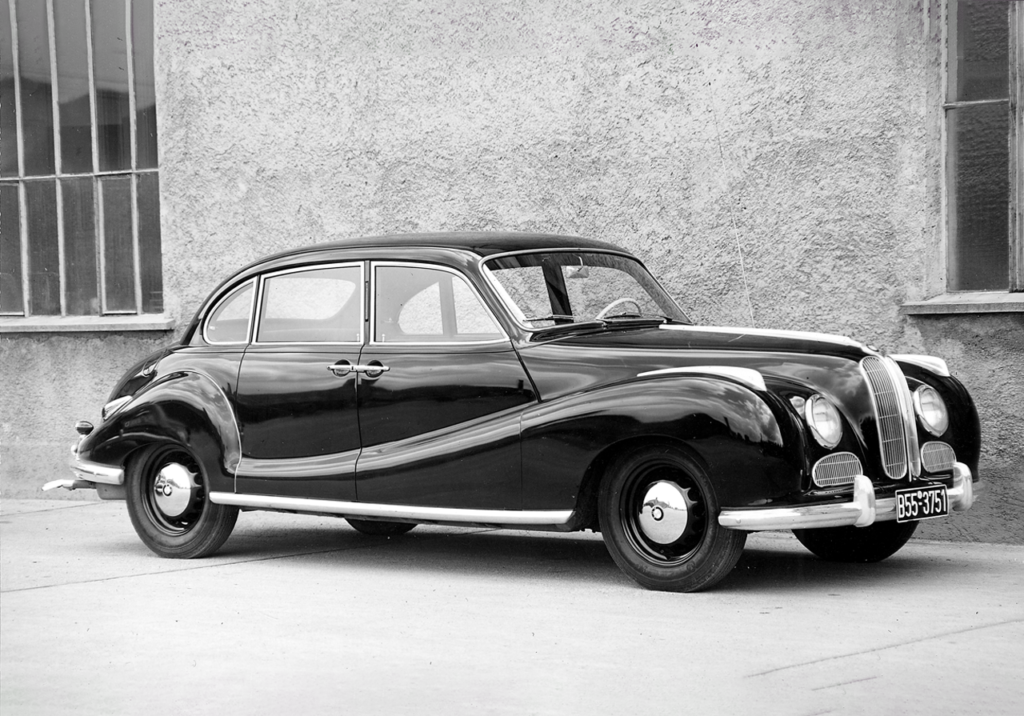
Photo of the real car. Source: bmwgroup-classic.com