BMW Turbo X1 (E25), more commonly known simply as the BMW Turbo, is one of the most important concept cars in BMW history. Presented in 1972, the futuristic sports car was BMW’s first official concept car. Its purpose was not only to demonstrate the design of a future sports car, but also to explore new technical and safety-related solutions.
The BMW Turbo was created at an exceptional moment in the company’s history. The 1972 Summer Olympic Games were held in Munich, while BMW’s new headquarters and museum were becoming symbols of a new era for the company. BMW wanted to demonstrate that the rapidly expanding manufacturer was not only focused on its existing production cars, but was also thinking about what the sports car of the future might look like. The Turbo was presented to the public during the 1972 Olympic Games and quickly became one of BMW’s most striking technological showcases of the period.
The car was created under the direction of BMW chief designer Paul Bracq. He was given considerable freedom in developing the concept because the car was not intended directly for series production. This allowed Bracq to concentrate on aerodynamics, new proportions and an entirely new approach to combining performance, safety and driver-focused design.
Design and concept
The appearance of the BMW Turbo was exceptionally radical for 1972. The car was only around 1.10 metres high, and its extremely low wedge-shaped body, pointed nose, wide proportions and large gullwing doors made it completely different from BMW’s production cars of the time.
Paul Bracq’s design incorporated several elements that would later become important to BMW. The low, sharply sloping front end represented an early interpretation of the so-called shark nose design. The car also featured retractable headlights, aerodynamic covers around the rear wheels and a body whose lower sections were carefully shaped to improve airflow.
The large upward-opening gullwing doors were particularly striking, but they were not merely a dramatic styling feature. The extensive glass areas improved visibility, and the entire vehicle was designed around the principle that the driver should have the best possible view of the surrounding traffic.
The BMW Turbo’s bright reddish-orange colour scheme was also part of its safety concept. The car was intended to be highly visible in traffic, meaning that even its colour was considered part of the vehicle’s overall approach to safety.
Engineering and performance
The BMW Turbo was a mid-engined, rear-wheel-drive sports car. Its mechanical components were related to the BMW 2002, while power came from a 1,990 cm³ turbocharged four-cylinder engine.
According to BMW, the engine produced around 200 DIN hp in its standard setting, while increased boost pressure could raise output to as much as 280 hp. Combined with a kerb weight of only around 980 kilograms, this gave the car exceptional performance by early-1970s standards.
The BMW Turbo could accelerate from 0 to 100 km/h in approximately 6.6 seconds and reach a top speed of around 250 km/h. Power was transmitted to the rear wheels through a four-speed manual gearbox.
The mid-engine layout allowed for balanced weight distribution and a very low centre of gravity. BMW’s aim was not simply to create a fast car, but to demonstrate that high performance and excellent handling could be combined with a high level of safety.
Safety as a central theme
The most important feature of the BMW Turbo was not actually its turbocharged engine or its dramatic design. The car was conceived primarily as a safe sports car, and BMW described it at the time as the world’s first safety sports car.
In the early 1970s, greater safety often meant large bumpers and heavy structural components. BMW wanted to demonstrate that a safe car did not have to be cumbersome or sacrifice sporting performance. The Turbo therefore became a kind of rolling laboratory in which both active and passive safety solutions were tested.
Special energy-absorbing structures with hydraulic impact absorbers were used at the front and rear of the car. The energy from minor collisions was intended to be absorbed without damaging the passenger compartment. Reinforced door and roof structures were designed to provide additional protection in more serious impacts or if the car overturned.
The Turbo also featured a collapsible safety steering column, while the seat belts were connected to the starting system: the engine could not be started until the seat belt had been fastened.
Driver assistance systems ahead of their time
Even more remarkable were the BMW Turbo’s electronic safety systems. The car incorporated technologies that appeared almost futuristic in 1972 but have since become commonplace in modern vehicles.
The BMW Turbo was the first BMW to feature an ABS braking system. It also had a lateral acceleration indicator and a radar-based system that monitored the distance to the vehicle ahead and could warn the driver if the following distance became too short.
In this respect, the Turbo anticipated modern driver assistance systems by several decades. Today, radar-based distance monitoring, collision warnings and electronically controlled braking systems are common, but in the early 1970s such technologies were highly experimental.
The car also featured systems for monitoring tyre pressure and the condition of the vehicle’s lights. As a result, the Turbo’s dashboard resembled an aircraft cockpit more than the interior of a conventional passenger car of the period.
Driver-focused cockpit
One of the BMW Turbo’s most enduring innovations was its centre console angled towards the driver. The original purpose of this design was primarily related to safety: a driver secured by the seat belt needed to be able to reach all important controls without leaning forward from the seat.
This functional solution later became one of the most recognisable characteristics of BMW interior design. The first-generation BMW 3 Series E21 already featured a dashboard oriented towards the driver, and the same principle remained a feature of BMW models for decades.
The BMW Turbo therefore provides a good example of how an experimental concept-car solution can eventually become part of an entire brand’s design identity.
Two prototypes
The BMW Turbo never entered series production. Only two cars were built. The first prototype was completed in 1972 and presented during the Munich Olympic Games. A second, somewhat further-developed example followed in 1973.
BMW treated both cars as research and development platforms. The objective was not to prepare a direct production version of the Turbo, but to test ideas, some of which would later find their way into BMW production models.
The significance of the BMW Turbo therefore cannot be measured by its production numbers. Despite the fact that only two examples were built, the project had a far greater influence on BMW’s design and engineering philosophy than many models produced in much larger numbers.
Connection with the BMW M1
The most visible legacy of the BMW Turbo was the BMW M1 (E26), which entered production in 1978. Although the final design of the M1 was created by Giorgetto Giugiaro, the influence of Paul Bracq’s BMW Turbo can clearly be seen in its proportions and several of its design details.
Both cars used a very low, wedge-shaped sports-car body and a mid-engine layout. The M1 also adopted elements seen on the Turbo, including retractable headlights and BMW badges positioned on both sides of the rear of the car.
The Turbo was therefore not a direct prototype of the M1, but it established several of the ideas and proportions that were later developed further in BMW’s first series-produced mid-engined sports car.
The influence of the BMW Turbo extended beyond the M1. Traces of its sharply shaped front end, low proportions and aerodynamic thinking can be found in several later BMW models and concept cars.
Significance in BMW history
The importance of the BMW Turbo in BMW history is far greater than its production run of just two prototypes might suggest. It was BMW’s first official concept car and one of the company’s earliest projects to deliberately combine sporting performance, futuristic design and a comprehensive safety concept.
The Turbo pointed towards BMW’s future in several areas at the same time. Its mid-engine sports-car concept provided inspiration for the later BMW M1, Paul Bracq’s design influenced BMW’s subsequent styling language, and the driver-oriented cockpit became one of the defining features of BMW interiors for decades.
Equally important was the car’s role as a test platform for safety technology. ABS, radar-based distance warning, the seat-belt-linked ignition interlock and energy-absorbing structures showed that BMW was already exploring in 1972 technologies that would only become commonplace in production cars many years later.
Today, the BMW Turbo can be regarded as one of the most influential concept cars in BMW history. It was simultaneously a design study, a fast mid-engined sports car and a technological laboratory – a car whose ideas reached far beyond the two prototypes that were actually built.
Model in the collection
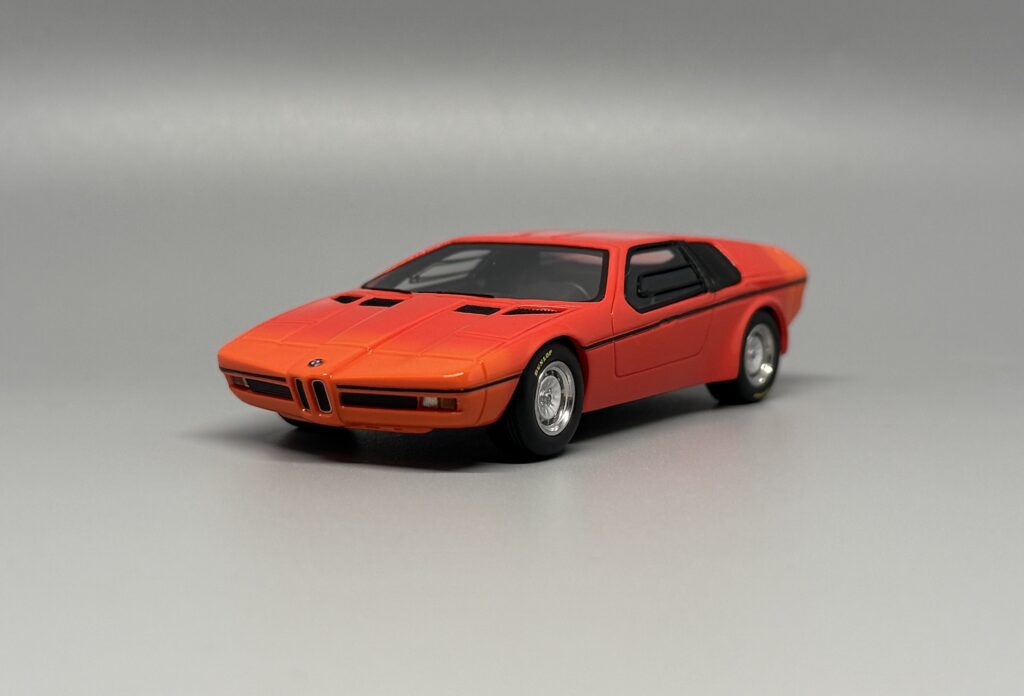
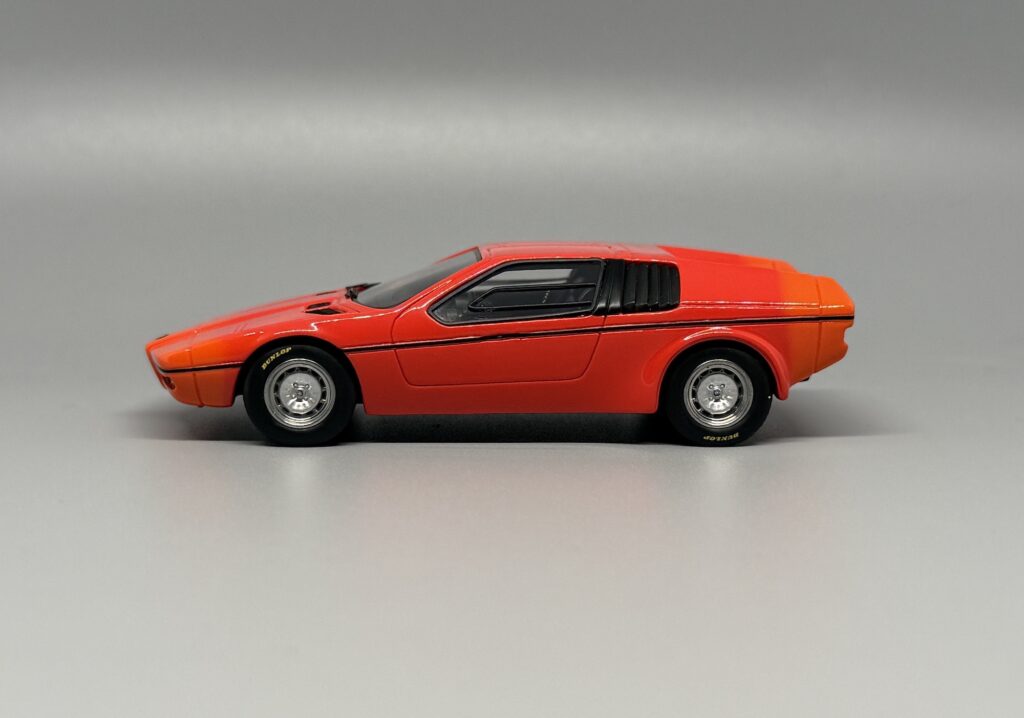
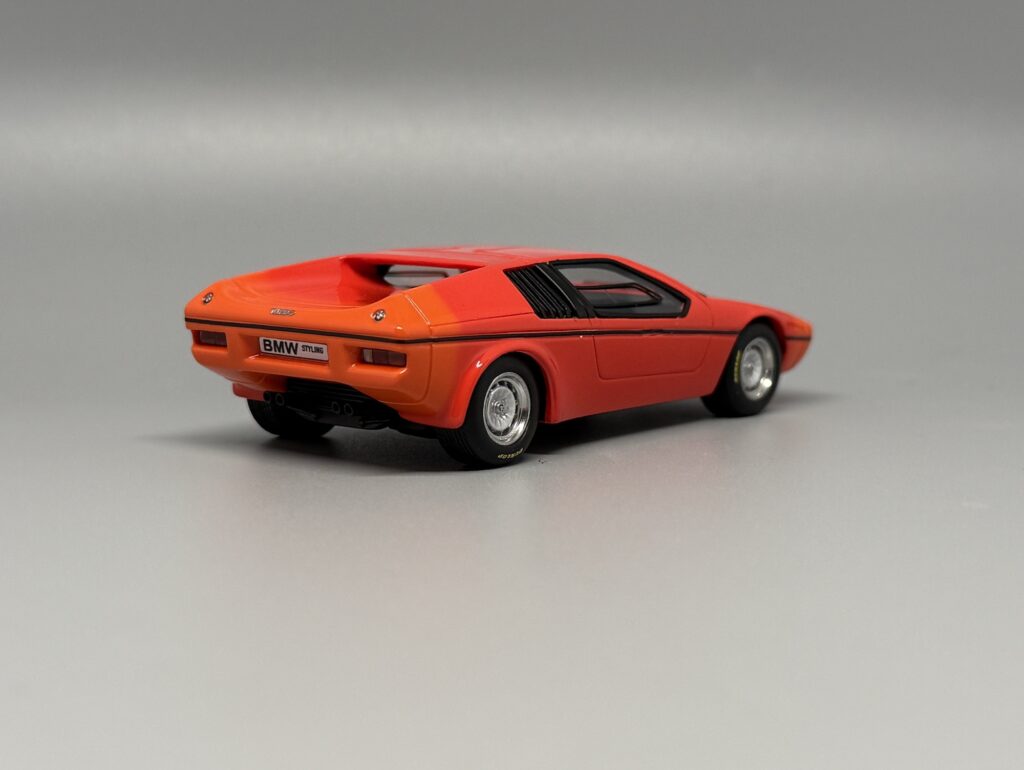
The model in my collection was produced by Schuco Pro.R43. It is a limited-edition model, with a total production run of 1,000 examples.
Technical specifications
Public debut: 1972
Development code: E25
Type: concept car / prototype
Design: Paul Bracq
Body style: two-seater mid-engined sports car
Engine: 2.0-litre turbocharged inline-four, 1,990 cm³
Power: 200 DIN hp, up to 280 hp with increased boost pressure
Drivetrain: mid-engine, rear-wheel drive
Gearbox: 4-speed manual
Kerb weight: approximately 980 kg
0–100 km/h: approximately 6.6 seconds
Top speed: approximately 250 km/h
Number built: 2 prototypes
Special feature: BMW’s first official concept car and a technological test vehicle whose design and mid-engine concept influenced the later BMW M1
Background
BMW Turbo X1 (E25), more commonly known simply as the BMW Turbo, is one of the most important concept cars in BMW history. Presented in 1972, the futuristic sports car was BMW’s first official concept car. Its purpose was not only to demonstrate the design of a future sports car, but also to explore new technical and safety-related solutions.
The BMW Turbo was created at an exceptional moment in the company’s history. The 1972 Summer Olympic Games were held in Munich, while BMW’s new headquarters and museum were becoming symbols of a new era for the company. BMW wanted to demonstrate that the rapidly expanding manufacturer was not only focused on its existing production cars, but was also thinking about what the sports car of the future might look like. The Turbo was presented to the public during the 1972 Olympic Games and quickly became one of BMW’s most striking technological showcases of the period.
The car was created under the direction of BMW chief designer Paul Bracq. He was given considerable freedom in developing the concept because the car was not intended directly for series production. This allowed Bracq to concentrate on aerodynamics, new proportions and an entirely new approach to combining performance, safety and driver-focused design.
Design and concept
The appearance of the BMW Turbo was exceptionally radical for 1972. The car was only around 1.10 metres high, and its extremely low wedge-shaped body, pointed nose, wide proportions and large gullwing doors made it completely different from BMW’s production cars of the time.
Paul Bracq’s design incorporated several elements that would later become important to BMW. The low, sharply sloping front end represented an early interpretation of the so-called shark nose design. The car also featured retractable headlights, aerodynamic covers around the rear wheels and a body whose lower sections were carefully shaped to improve airflow.
The large upward-opening gullwing doors were particularly striking, but they were not merely a dramatic styling feature. The extensive glass areas improved visibility, and the entire vehicle was designed around the principle that the driver should have the best possible view of the surrounding traffic.
The BMW Turbo’s bright reddish-orange colour scheme was also part of its safety concept. The car was intended to be highly visible in traffic, meaning that even its colour was considered part of the vehicle’s overall approach to safety.
Engineering and performance
The BMW Turbo was a mid-engined, rear-wheel-drive sports car. Its mechanical components were related to the BMW 2002, while power came from a 1,990 cm³ turbocharged four-cylinder engine.
According to BMW, the engine produced around 200 DIN hp in its standard setting, while increased boost pressure could raise output to as much as 280 hp. Combined with a kerb weight of only around 980 kilograms, this gave the car exceptional performance by early-1970s standards.
The BMW Turbo could accelerate from 0 to 100 km/h in approximately 6.6 seconds and reach a top speed of around 250 km/h. Power was transmitted to the rear wheels through a four-speed manual gearbox.
The mid-engine layout allowed for balanced weight distribution and a very low centre of gravity. BMW’s aim was not simply to create a fast car, but to demonstrate that high performance and excellent handling could be combined with a high level of safety.
Safety as a central theme
The most important feature of the BMW Turbo was not actually its turbocharged engine or its dramatic design. The car was conceived primarily as a safe sports car, and BMW described it at the time as the world’s first safety sports car.
In the early 1970s, greater safety often meant large bumpers and heavy structural components. BMW wanted to demonstrate that a safe car did not have to be cumbersome or sacrifice sporting performance. The Turbo therefore became a kind of rolling laboratory in which both active and passive safety solutions were tested.
Special energy-absorbing structures with hydraulic impact absorbers were used at the front and rear of the car. The energy from minor collisions was intended to be absorbed without damaging the passenger compartment. Reinforced door and roof structures were designed to provide additional protection in more serious impacts or if the car overturned.
The Turbo also featured a collapsible safety steering column, while the seat belts were connected to the starting system: the engine could not be started until the seat belt had been fastened.
Driver assistance systems ahead of their time
Even more remarkable were the BMW Turbo’s electronic safety systems. The car incorporated technologies that appeared almost futuristic in 1972 but have since become commonplace in modern vehicles.
The BMW Turbo was the first BMW to feature an ABS braking system. It also had a lateral acceleration indicator and a radar-based system that monitored the distance to the vehicle ahead and could warn the driver if the following distance became too short.
In this respect, the Turbo anticipated modern driver assistance systems by several decades. Today, radar-based distance monitoring, collision warnings and electronically controlled braking systems are common, but in the early 1970s such technologies were highly experimental.
The car also featured systems for monitoring tyre pressure and the condition of the vehicle’s lights. As a result, the Turbo’s dashboard resembled an aircraft cockpit more than the interior of a conventional passenger car of the period.
Driver-focused cockpit
One of the BMW Turbo’s most enduring innovations was its centre console angled towards the driver. The original purpose of this design was primarily related to safety: a driver secured by the seat belt needed to be able to reach all important controls without leaning forward from the seat.
This functional solution later became one of the most recognisable characteristics of BMW interior design. The first-generation BMW 3 Series E21 already featured a dashboard oriented towards the driver, and the same principle remained a feature of BMW models for decades.
The BMW Turbo therefore provides a good example of how an experimental concept-car solution can eventually become part of an entire brand’s design identity.
Two prototypes
The BMW Turbo never entered series production. Only two cars were built. The first prototype was completed in 1972 and presented during the Munich Olympic Games. A second, somewhat further-developed example followed in 1973.
BMW treated both cars as research and development platforms. The objective was not to prepare a direct production version of the Turbo, but to test ideas, some of which would later find their way into BMW production models.
The significance of the BMW Turbo therefore cannot be measured by its production numbers. Despite the fact that only two examples were built, the project had a far greater influence on BMW’s design and engineering philosophy than many models produced in much larger numbers.
Connection with the BMW M1
The most visible legacy of the BMW Turbo was the BMW M1 (E26), which entered production in 1978. Although the final design of the M1 was created by Giorgetto Giugiaro, the influence of Paul Bracq’s BMW Turbo can clearly be seen in its proportions and several of its design details.
Both cars used a very low, wedge-shaped sports-car body and a mid-engine layout. The M1 also adopted elements seen on the Turbo, including retractable headlights and BMW badges positioned on both sides of the rear of the car.
The Turbo was therefore not a direct prototype of the M1, but it established several of the ideas and proportions that were later developed further in BMW’s first series-produced mid-engined sports car.
The influence of the BMW Turbo extended beyond the M1. Traces of its sharply shaped front end, low proportions and aerodynamic thinking can be found in several later BMW models and concept cars.
Significance in BMW history
The importance of the BMW Turbo in BMW history is far greater than its production run of just two prototypes might suggest. It was BMW’s first official concept car and one of the company’s earliest projects to deliberately combine sporting performance, futuristic design and a comprehensive safety concept.
The Turbo pointed towards BMW’s future in several areas at the same time. Its mid-engine sports-car concept provided inspiration for the later BMW M1, Paul Bracq’s design influenced BMW’s subsequent styling language, and the driver-oriented cockpit became one of the defining features of BMW interiors for decades.
Equally important was the car’s role as a test platform for safety technology. ABS, radar-based distance warning, the seat-belt-linked ignition interlock and energy-absorbing structures showed that BMW was already exploring in 1972 technologies that would only become commonplace in production cars many years later.
Today, the BMW Turbo can be regarded as one of the most influential concept cars in BMW history. It was simultaneously a design study, a fast mid-engined sports car and a technological laboratory – a car whose ideas reached far beyond the two prototypes that were actually built.
Model in the collection
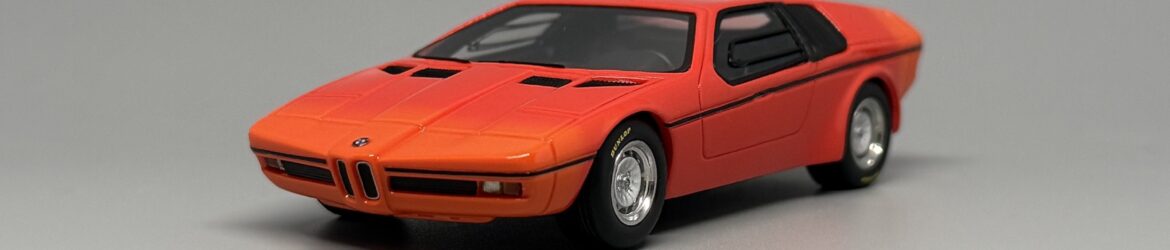
The model in my collection was produced by Schuco Pro.R43. It is a limited-edition model, with a total production run of 1,000 examples.
Technical specifications
Public debut: 1972
Development code: E25
Type: concept car / prototype
Design: Paul Bracq
Body style: two-seater mid-engined sports car
Engine: 2.0-litre turbocharged inline-four, 1,990 cm³
Power: 200 DIN hp, up to 280 hp with increased boost pressure
Drivetrain: mid-engine, rear-wheel drive
Gearbox: 4-speed manual
Kerb weight: approximately 980 kg
0–100 km/h: approximately 6.6 seconds
Top speed: approximately 250 km/h
Number built: 2 prototypes
Special feature: BMW’s first official concept car and a technological test vehicle whose design and mid-engine concept influenced the later BMW M1
Photo of the real car. Source: gtplanet.net