
Background
BMW 6 Series Coupé (E63) marked the return of BMW’s large luxury coupé after a break of more than a decade. Production of the first-generation E24 6 Series had ended in 1989, and the new 6 Series was not introduced until 2003. The E63 was not intended as a direct reinterpretation of the E24, but rather as a new-millennium expression of the BMW grand tourer concept. A long bonnet, low coupé body, rearward-set passenger compartment, powerful engines and a luxurious four-seat interior combined long-distance comfort with the sporting, driver-focused character traditionally associated with BMW.
The return of the 6 Series
BMW presented the arrival of the new 6 Series as the revival of one of its most iconic model lines. The E24 had established the image of BMW’s large sporting coupé during the 1970s and 1980s, but the 6 Series name disappeared from the range after production ended. The E63, unveiled in 2003, restored that tradition in a completely new form. It occupied a position alongside the technical world of the 5 Series and 7 Series, but with a more emotional and exclusive character. It was aimed at buyers who wanted the comfort and technology of a large BMW saloon but preferred a lower, more elegant and more sporting two-door body.
Design
The E63 was created during BMW’s bold design era of the early 2000s, when Chris Bangle headed the company’s design organisation. Adrian van Hooydonk also played an important role in the development of the 6 Series exterior. The proportions were typical of a large grand touring coupé: a long, low body, extended bonnet, rearward-positioned passenger compartment and relatively short rear section. At the same time, the E63 featured strongly sculpted body surfaces, a high boot-lid line and a powerful front end, setting it apart from earlier BMW coupés. The design generated considerable discussion when new, but it also made the car instantly recognisable and helped establish the E63 as one of the most distinctive BMWs of the 2000s.
Lightweight construction and technical layout
The E63 shared many technical solutions with the contemporary BMW 5 Series E60, but particular attention was paid to reducing weight in the 6 Series body. Alongside steel, BMW made extensive use of aluminium and composite materials: the bonnet and doors, for example, were made from aluminium, while the front wings were produced from thermoplastic material. Lightweight materials were also used in other body areas, and key front- and rear-suspension components were made from aluminium. This intelligent lightweight construction helped the large luxury coupé retain the handling characteristics expected of a BMW while also reducing mass over the front axle.
Chassis and driving dynamics
BMW placed considerable emphasis on ensuring that the E63 did not become merely a comfortable long-distance cruiser. Its rear-wheel-drive architecture, aluminium suspension and electronic control systems gave it a clearly sporting character. Dynamic Drive active roll stabilisation was available, as was Active Steering, which varied the steering ratio according to speed and driving conditions. Combined with Dynamic Stability Control and Dynamic Traction Control, these systems allowed the 6 Series to combine the stability and comfort of a large coupé with more precise and agile handling.
Engine range
The E63 engine range evolved considerably during its production life. The first model to reach the market was the BMW 645Ci, whose 4.4-litre V8 produced 333 hp and 450 Nm. The six-cylinder 630i followed later, offering a lighter and more balanced alternative to the V8 models. The 645Ci was eventually replaced by the BMW 650i, whose 4.8-litre V8 developed 367 hp and 490 Nm, making it the most powerful regular E63 version. With the 2007 model update, the 630i received a new 3.0-litre direct-injection six-cylinder engine producing 272 hp. The range therefore allowed the 6 Series to fulfil roles ranging from a relatively refined luxury coupé to a very fast grand tourer.
BMW 635d
The BMW 635d joined the range with the 2007 model update and represented an important step for BMW, as it was the first diesel-powered 6 Series. Its 2,993 cm³ six-cylinder Variable Twin Turbo diesel engine produced 286 hp and a very strong 580 Nm of torque. BMW particularly emphasised the combination of strong performance, long cruising range and comparatively low fuel consumption. The 635d Coupé accelerated from 0 to 100 km/h in 6.3 seconds and had an electronically limited top speed of 250 km/h. Its high torque output and efficiency suited the long-distance grand touring character of the E63 particularly well.
Transmissions
Several different transmission systems were used during the production life of the E63. The early 645Ci was available with a six-speed manual gearbox, a six-speed Steptronic automatic and a six-speed SMG sequential transmission. In later models, the automatic transmission became increasingly important, and the 2007 update introduced a new six-speed sports automatic with steering-wheel shift controls. All regular E63 versions remained rear-wheel drive, preserving the traditional technical layout of a large BMW coupé.
Interior and technology
The E63 interior combined the comfort of a luxury grand tourer with BMW’s new electronic interface of the 2000s. The car used a 2+2 seating layout, providing generous comfort for the front occupants while retaining usable rear seats. A central feature was BMW iDrive, through which many comfort, navigation and entertainment functions were controlled. Depending on model year and specification, optional equipment included features such as Head-Up Display, Active Cruise Control, adaptive headlights, Night Vision, advanced audio systems and numerous other technologies, placing the 6 Series among BMW’s most technically advanced models of its time.
2007 model update
In 2007, the E63 received a Life Cycle Impulse update. Exterior changes included revised front- and rear-end details, lighting elements and trim, while the basic design was deliberately retained. More substantial changes took place beneath the surface. The 630i received a new 272 hp direct-injection engine, the 286 hp 635d joined the range, and several BMW EfficientDynamics measures were introduced. iDrive, interior materials and a number of driver-assistance systems were also updated, helping the E63 remain competitive through the final years of production.
BMW M6 Coupé
The absolute performance flagship of the E63 model family was the separately developed BMW M6 Coupé (E63) from BMW M GmbH. Its 4,999 cm³ naturally aspirated V10 produced 507 hp and could rev beyond 8,000 rpm. The M6 also received a seven-speed SMG Drivelogic transmission, dedicated M suspension, an Active M Differential and, in Coupé form, a carbon-fibre roof. Although it used the same basic E63 body structure, its technical specification differed sufficiently from the regular 6 Series for it to be considered a distinct BMW M model.
Production
The BMW 6 Series E63 Coupé was produced at BMW Group Plant Dingolfing in Germany. Production began in 2003 and continued until 2010, when the E63 and E64 generation gradually gave way to the following F12/F13 6 Series. Widely cited production statistics indicate that 62,575 E63 Coupés were produced, excluding M6 versions. Together with the E64 Convertible, total production of the regular model range reached 116,748 cars. Compared with BMW’s larger saloon models, the 6 Series remained a deliberately lower-volume and more exclusive offering.
Significance in BMW history
The importance of the BMW 6 Series Coupé E63 lies above all in the fact that it restored BMW’s large luxury sports coupé after the end of E24 production. The E63 combined the classic elements of a grand tourer – a long bonnet, six-cylinder and V8 engines, rear-wheel drive and a four-seat interior – with the electronics, lightweight engineering and bold design language of the 2000s. It was not a nostalgic recreation of the E24, but a deliberately modern interpretation of the large BMW coupé for its era. The E63 also laid the foundation for the continuation of the 6 Series in later generations and re-established the large coupé as a permanent part of BMW’s model range.
Model in the collection
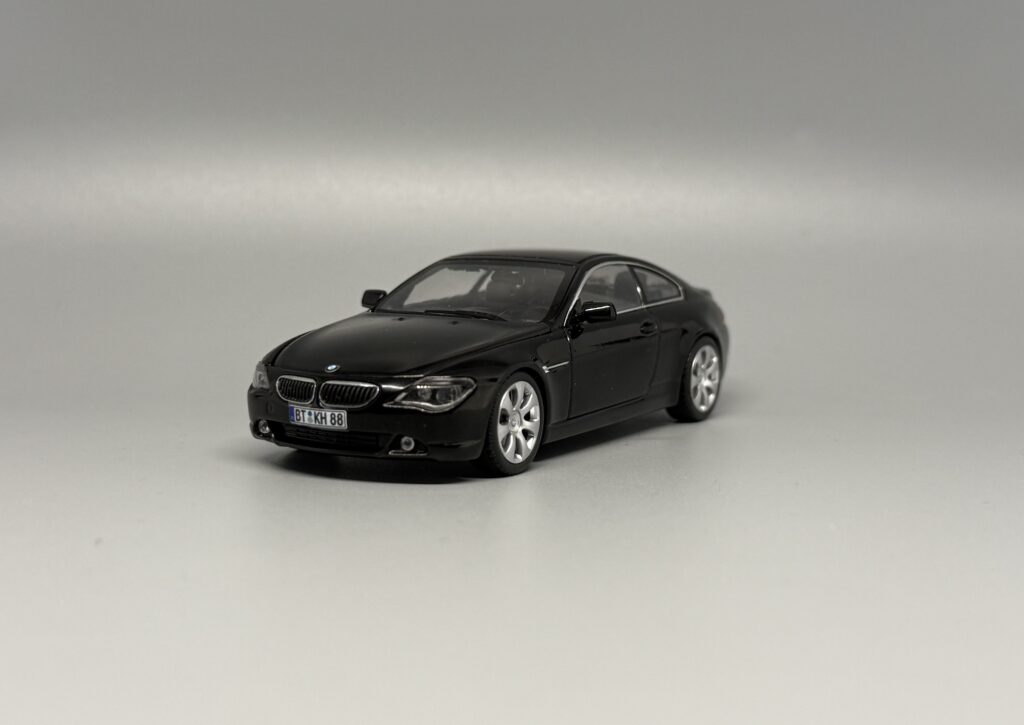
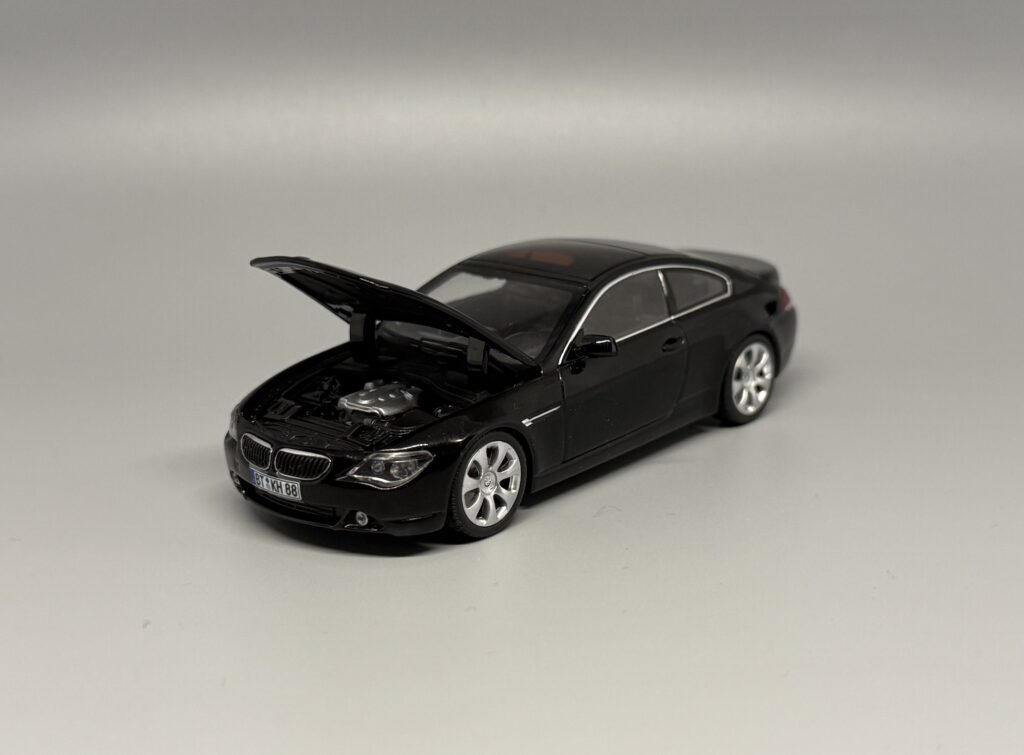
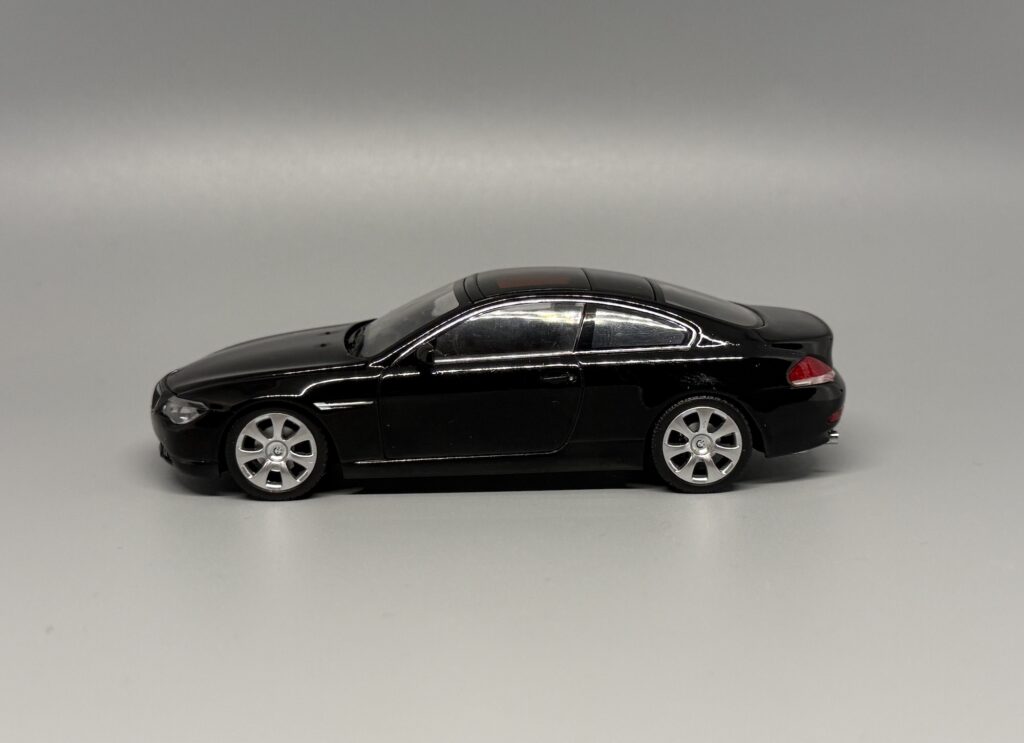
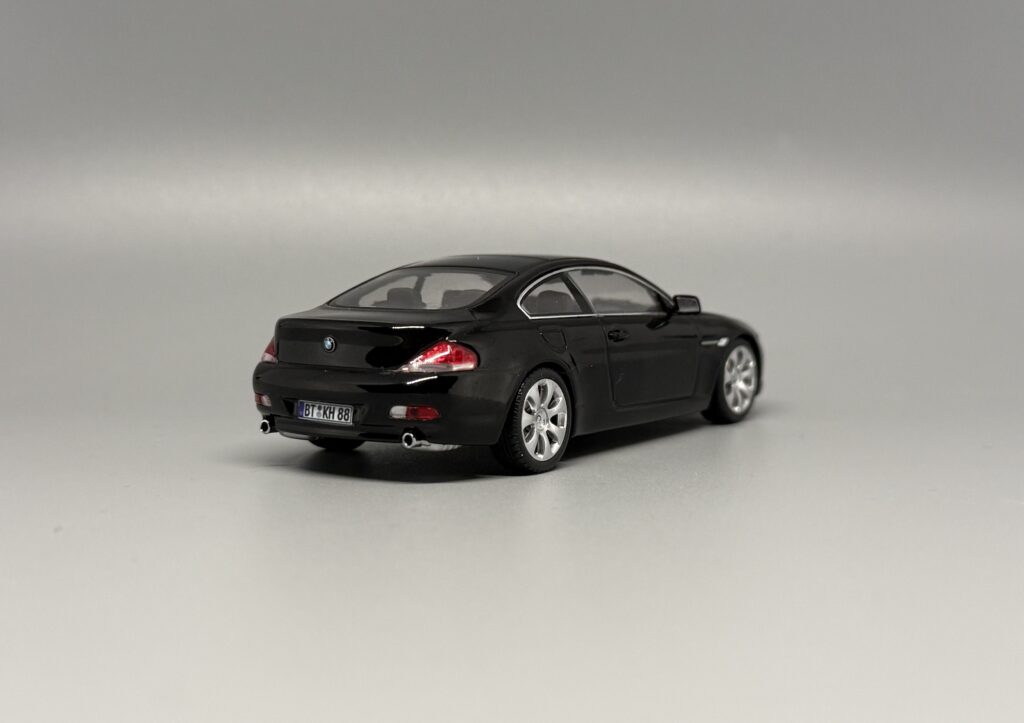
The model in my collection was produced by Minichamps and represents a 2006 BMW 6 Series Coupé (E63). As the exact engine version of the scale model is not known, this description covers the E63 Coupé model family as a whole. The model was produced in a limited edition of 1,824 examples.
Technical data in brief
Production period: 2003–2010
Place of production: BMW Group Plant Dingolfing, Germany
Body style: two-door four-seat Coupé / grand tourer
Drivetrain: rear-wheel drive
Petrol engines: six-cylinder in-line engines and V8
Diesel engine: 2,993 cm³ six-cylinder Variable Twin Turbo
645Ci: 4.4-litre V8, 333 hp
650i: 4.8-litre V8, 367 hp
630i after the 2007 update: 3.0-litre six-cylinder in-line engine, 272 hp
635d: 3.0-litre twin-turbo six-cylinder in-line diesel, 286 hp and 580 Nm
Transmissions: depending on version, 6-speed manual, 6-speed automatic or 6-speed SMG
M6 Coupé: separate BMW M model, 5.0-litre V10, 507 hp
E63 Coupé production number: 62,575 cars, excluding the M6
Special feature: the return of the BMW 6 Series after the E24 generation and a modern interpretation of BMW’s luxury grand tourer