
Background
BMW Isetta 250 Standard is one of the most recognisable and at the same time most important small cars in BMW history. In the mid-1950s, BMW was in a difficult financial situation and needed an affordable model that could be sold in far greater numbers than the expensive BMW 501, 502, 503 and 507 luxury cars. The solution came from Italy, where Iso had developed a tiny microcar with a front-opening door. BMW acquired the production rights, adapted the design to its own technical requirements and introduced the BMW Isetta in 1955. The little “bubble car” quickly became a sales success and one of the symbols of post-war German motorisation.
Italian idea, BMW engineering
The original Isetta concept came from the Milan-based company Iso, but BMW made several important changes to the car. Instead of the Italian two-stroke engine, BMW used a four-stroke single-cylinder unit based on its own motorcycle technology. The first BMW version was the Isetta 250 Standard, production of which began in the spring of 1955. The car retained the most distinctive feature of the Iso original – the large front door forming almost the entire nose of the vehicle – but technically it became very much BMW’s own interpretation of the Isetta concept.
The Standard version
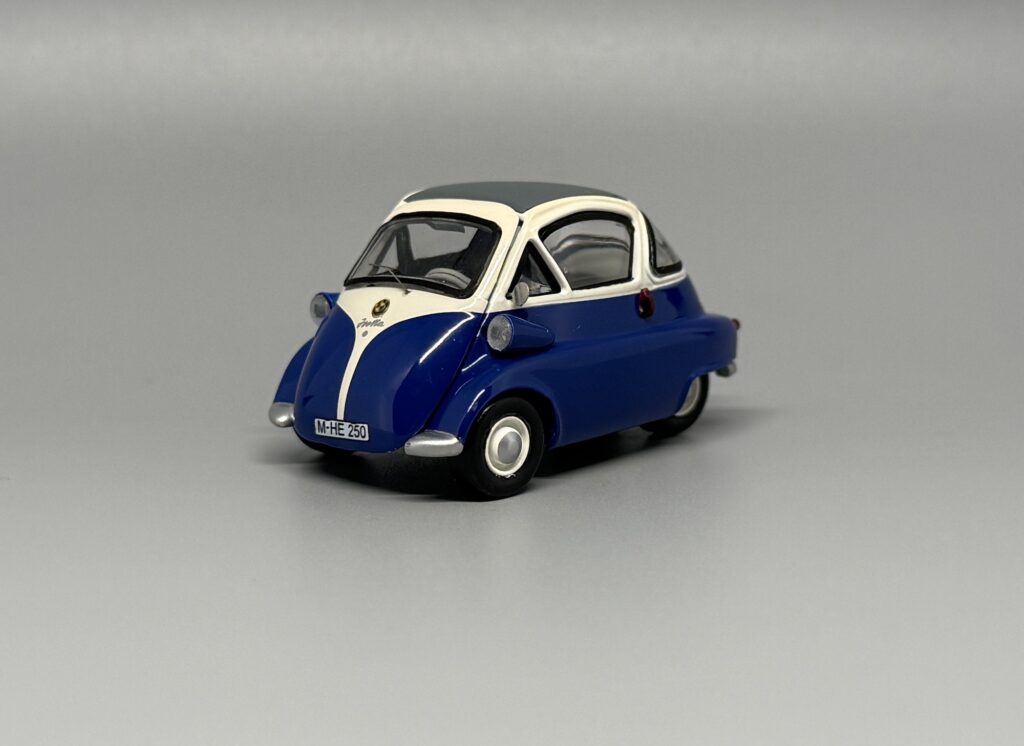
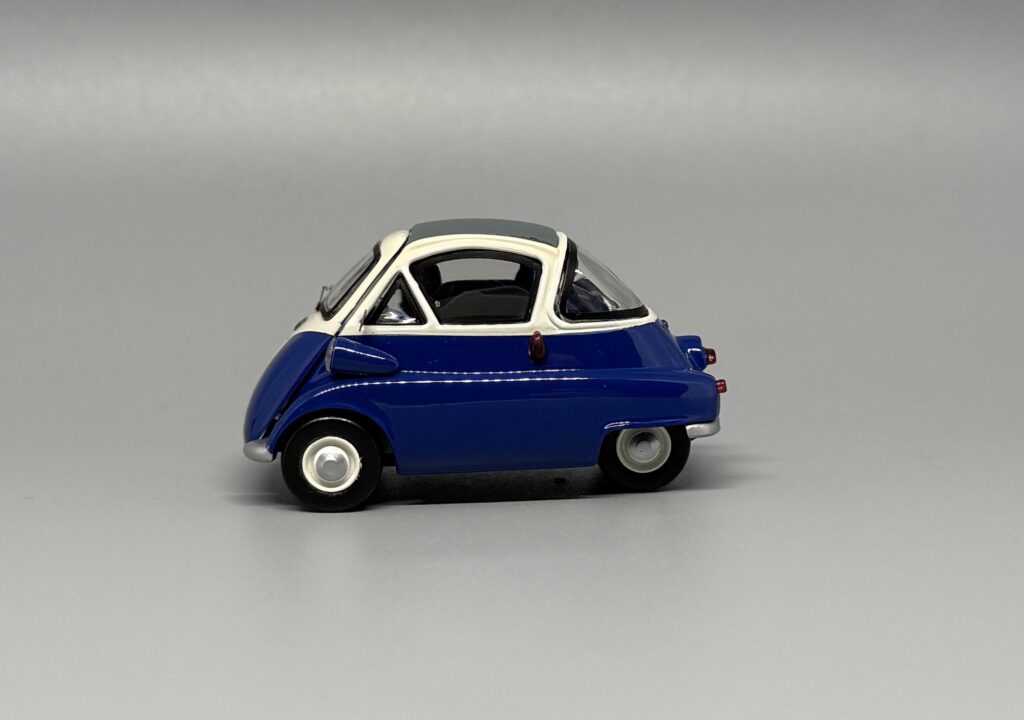
The designation Standard refers to the first BMW body style of the Isetta, produced from 1955 until early 1957. Its most recognisable feature was the characteristic early “bubble window” side-window arrangement. Viewed from the side, the glass area was divided into several sections and the overall body shape differed clearly from the later Isetta Export. This distinctive glazing gave the Standard a particularly characteristic 1950s microcar appearance.
Standard and Export
At the end of 1956, BMW introduced the significantly revised Isetta Export. The Export received a smoother, more coupé-like roofline and larger sliding side windows, giving the car a longer and more modern appearance. The basic engines remained largely the same, but the body design changed noticeably. The early Standard is therefore easily distinguished from the later Export by its unusual window arrangement. The model in my collection represents this earlier stage in the development of the BMW Isetta.
One door at the front
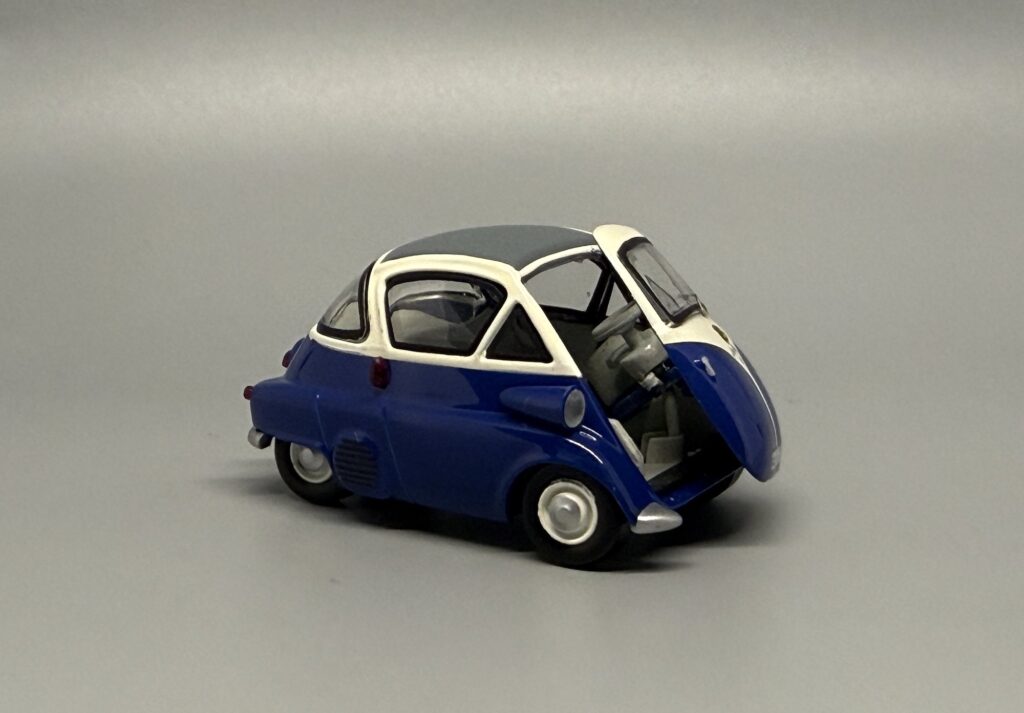
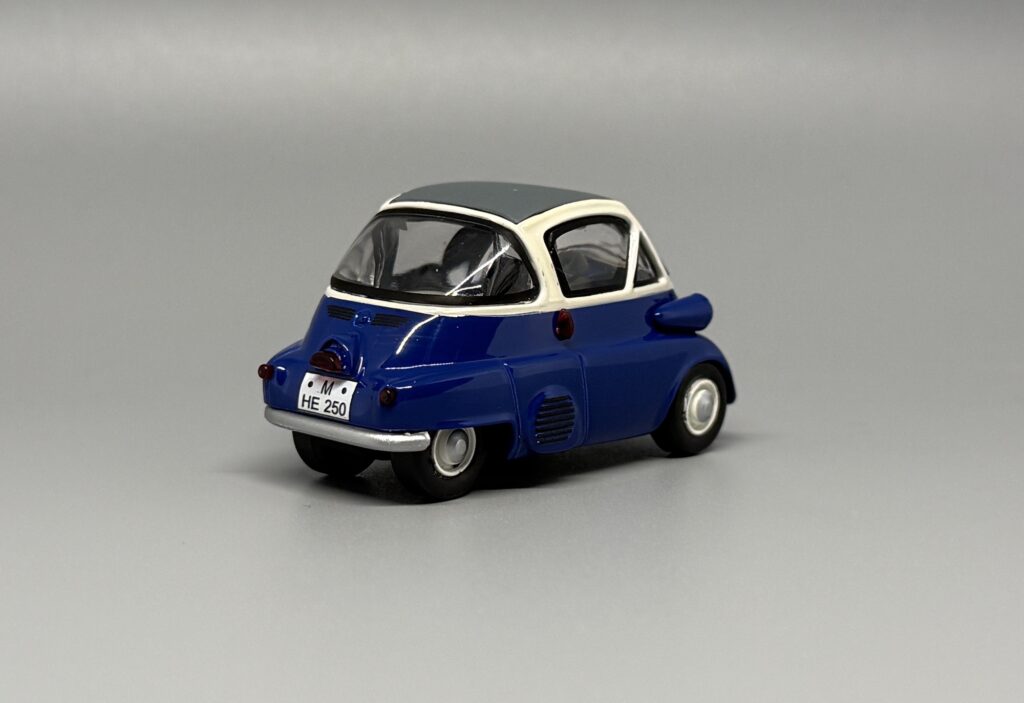
The Isetta’s most famous feature was its front-opening door. Instead of conventional side doors, almost the entire front of the car opened forward, and the steering column moved with the door. This unusual arrangement allowed surprisingly usable space for two people within an extremely small body. The engine was mounted at the rear, while the rear wheels were positioned so close together that a conventional differential was not required.
Small but practical
The BMW Isetta was only about 2.3 metres long, and its purpose was not performance or luxury but inexpensive and practical transport. The two-seat cabin offered weather protection for people who might otherwise have travelled by motorcycle or scooter. In the conditions of 1950s Europe, this was an important advantage: the Isetta cost much less than a conventional passenger car but still provided a roof, seating for two and the possibility of travelling independently of the weather.
245 cm³ single-cylinder engine
The Isetta 250 Standard used a single-cylinder four-stroke engine developed from the BMW R25/3 motorcycle unit. Its displacement was approximately 245 cm³ and it produced 12 hp at 5,800 rpm. Despite the modest power output, the lightweight Isetta was capable of reaching around 85 km/h. For urban traffic and short journeys this was entirely sufficient, while the small engine also kept fuel consumption low.
Isetta 300
Already in the autumn of 1955, BMW added the larger-engined Isetta 300 Standard to the range. Its 295 cm³ engine produced 13 hp and provided mainly better torque and smoother performance, although the top speed remained around 85 km/h. The 250 and 300 Standard versions were produced in parallel for a period. For this reason, production figures must distinguish between the whole Standard family and the specific 250 version.
An important sales success
The BMW Isetta proved highly successful for the company. According to BMW Group Classic, more than 26,000 Isetta 250 Standards were sold in less than two years, while total production of the early Standard body style, including the 300 version, reached almost 42,000 cars. The later Export version increased sales even further, and total BMW Isetta production from 1955 to 1962 exceeded 160,000 cars. With these numbers, the Isetta became one of BMW’s most important models of the 1950s.
Much more than a small car for BMW
The importance of the Isetta in BMW history lies not only in its unusual appearance. It arrived at a time when BMW’s range consisted largely of expensive cars built in relatively small numbers. The Isetta brought an entirely new group of customers to the brand and helped increase both sales volume and public visibility. It did not solve all of BMW’s financial problems on its own, but it played an important role in the company’s path towards the recovery that was later strengthened by the Neue Klasse models of the 1960s.
Historical significance
The BMW Isetta 250 Standard combines the post-war European need for affordable transport with one of the most inventive designs in automotive history. Its tiny dimensions, single front door, motorcycle-derived engine and distinctive bubble-like body made it a car that was almost impossible to confuse with anything else. At the same time, the Isetta was far more important to BMW commercially than its modest size might suggest. Today, it is regarded as one of the great symbols of the 1950s microcar era and one of the most distinctive models in BMW history.
Model in the collection
The model in my collection was produced by Schuco and represents a BMW Isetta 250 Standard. It was produced in a limited edition of 500 examples.
Technical data in brief
Production period: March 1955 – January 1957
Body style: two-seat microcar
Engine: single-cylinder four-stroke engine
Displacement: 245 cm³
Power: 12 hp @ 5,800 rpm
Drivetrain: rear-wheel drive
Top speed: 85 km/h
Price when new: 2,550 Deutsche Mark
Production: more than 26,000 Isetta 250 Standards
Special feature: early BMW Isetta “bubble window” body style preceding the later Export version
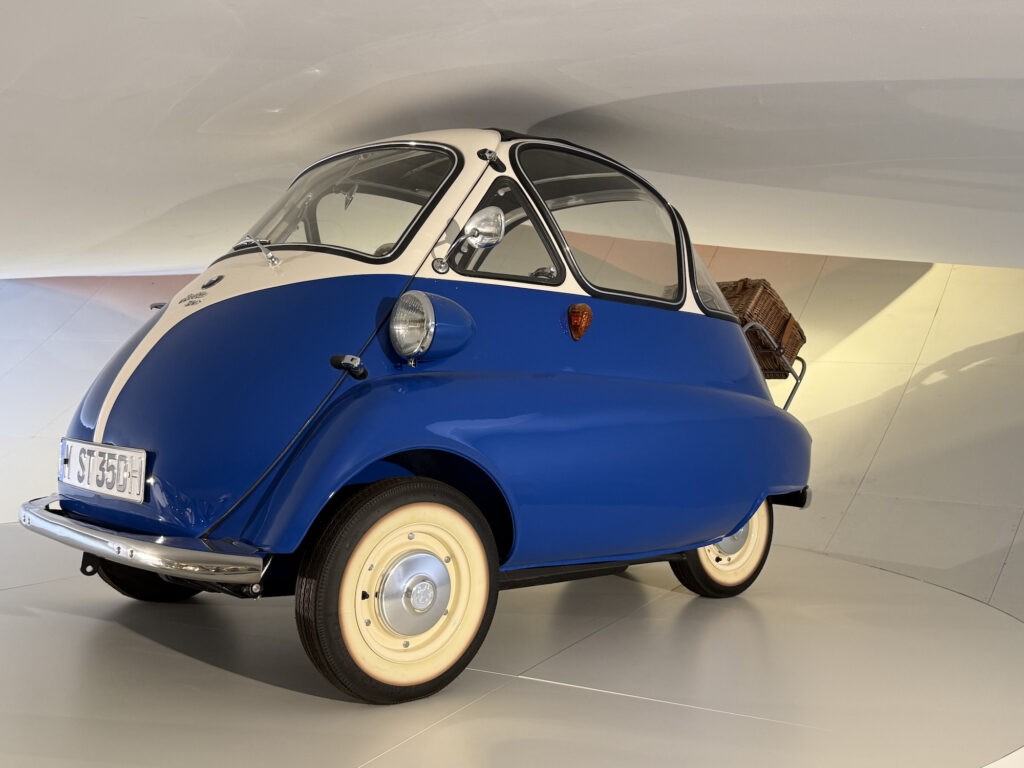
Photo of the real car, BMW Museum. Photo: Sten-Patrick Kreek