Background
BMW 340/1 Roadster was one of the rarest post-war prototypes to carry the BMW name and an important link between BMW’s pre-war heritage and the post-war automobile industry in Eisenach. The car was completed in 1949, at a time when the former BMW plant in Eisenach was located in the Soviet occupation zone and was no longer under the control of BMW AG in Munich. The factory nevertheless continued to use the BMW name and emblem for a time and developed new models based on pre-war designs. The 340/1 Roadster emerged during this complex transitional period and demonstrated that Eisenach intended to create a more sporting and emotional two-seat car alongside the large 340 saloon.
Background of the BMW 340
The BMW 340 was one of the most important new post-war models from Eisenach, although its technical roots went back to the BMW 326 of 1936. After the war, the 326 design was further developed, the front and rear bodywork were revised and the mechanical components were updated. The 340, introduced into production in 1949, was a large four-door six-cylinder saloon that continued BMW’s pre-war engineering tradition under an entirely new political and industrial environment. The 340/1 Roadster was created on this same technical basis.
Design by Hans Fleischer
The 340/1 Roadster was designed by Hans Fleischer, who was around 30 years old at the time and later became one of the most important automotive designers at Eisenach. Fleischer had already begun his career at the BMW plant in Eisenach before the war and returned to the factory’s design department afterwards. During development of the 340 saloon, he also created a sporting two-seat Roadster, from which one running prototype was built. Fleischer later went on to design models including the Wartburg 311 and several of its sporting derivatives.
1949 Leipzig Spring Fair
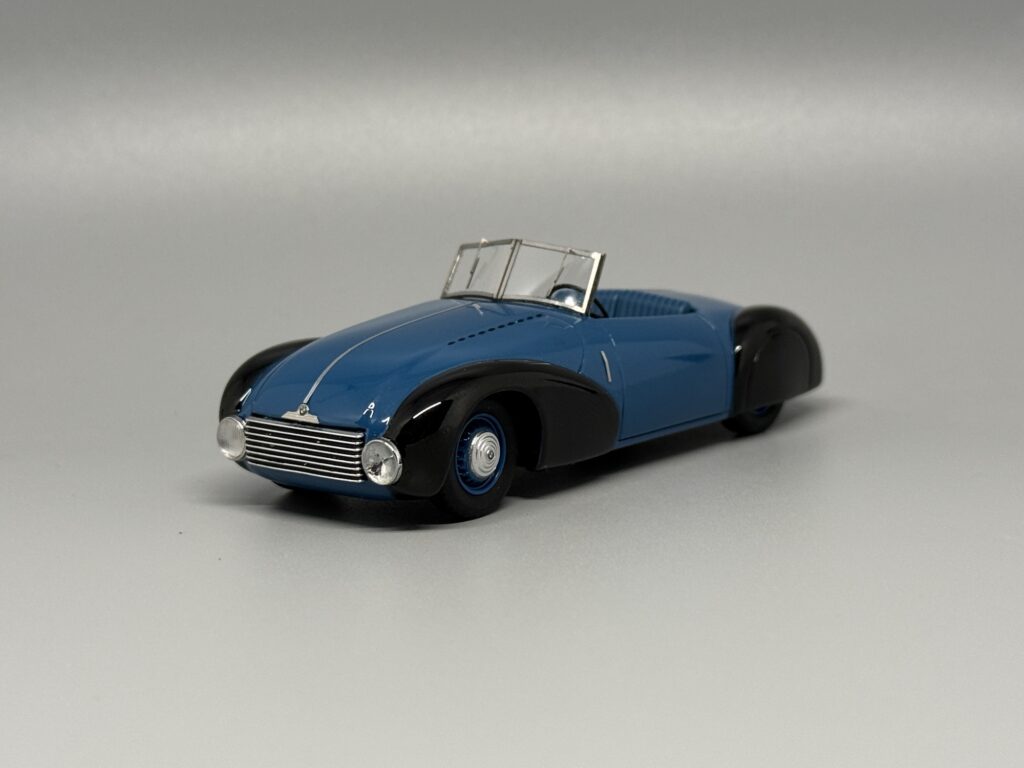
The BMW 340/1 Roadster was presented at the 1949 Leipzig Spring Fair as a new sporting vehicle. The car differed dramatically from the standard 340 saloon. Instead of the tall and substantial four-door body, the prototype featured a low two-seat open body, a long bonnet and smoothly rounded wings. The front end was considerably lower than that of the saloon, while the horizontal chrome bars of the radiator grille provided one of the clearest visual links to the regular 340. The result was an elegant and well-balanced sports car for its time.
Body and Roadster character
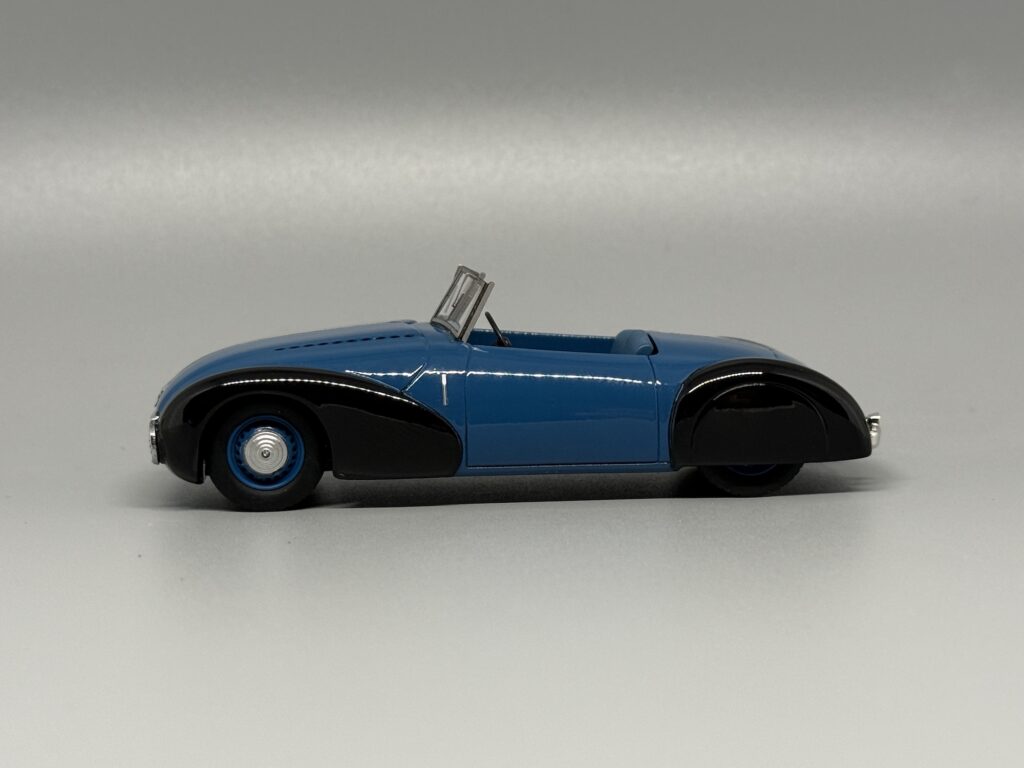
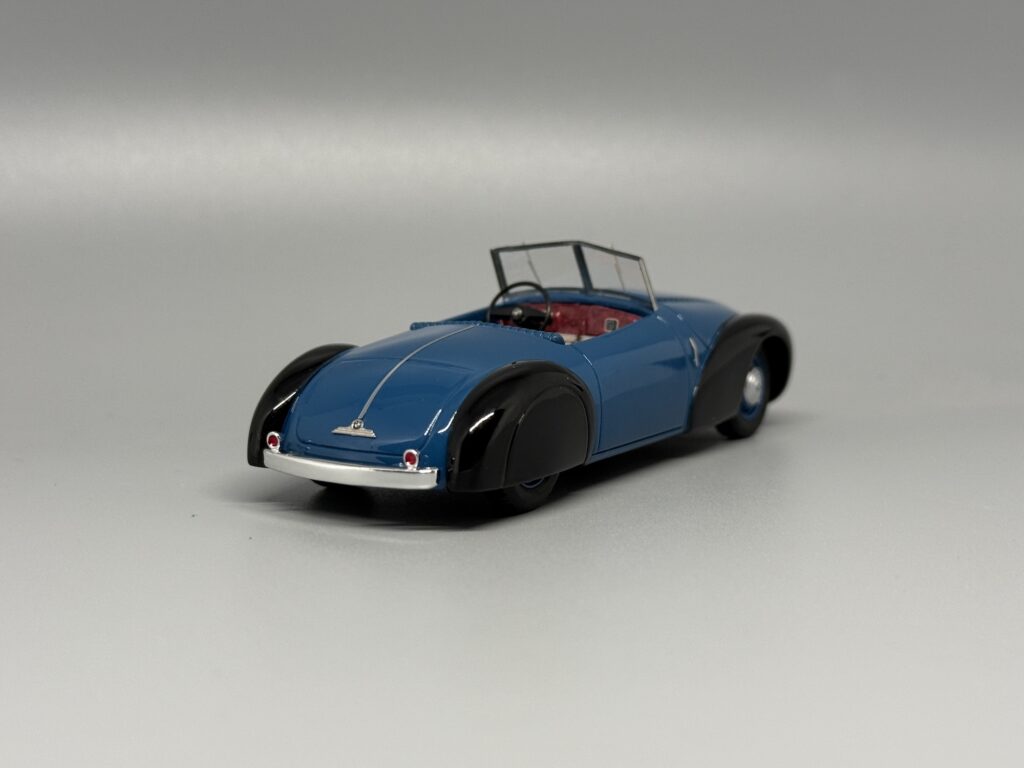
The 340/1 was conceived as a genuine two-seat Roadster. Its folding soft top was designed to disappear completely behind the seats, leaving a very clean side profile when the car was open. The low windscreen, long bonnet and rounded rear section gave it a light and sporting appearance that differed completely from the conventional 340 saloon. Although its mechanical foundation came from a large passenger car, the body was intended to create a much lighter and more emotional driving experience.
Technical basis
The BMW 340/1 used the production 340’s 1,971 cm³ six-cylinder in-line engine, producing 55 hp. The engine was technically descended from BMW’s pre-war six-cylinder family but had been further developed for the post-war 340. Power was transmitted to the rear wheels through a four-speed manual transmission. Unlike the column-mounted gear lever of the production 340, the Roadster received a more sporting floor-mounted gear lever.
340/1 and 340-S
The BMW 340/1 Roadster should not be confused with the later BMW 340-S sports car. The 340-S appeared in 1950 and represented a much more competition-oriented development of the 340/1 idea. Its engine produced around 90 hp and the car was used in several races, including events at the Dessau autobahn circuit and the Sachsenring. The 340/1 itself remained an elegant Roadster prototype with the standard 55 hp engine and was not intended as a racing car in the same sense.
A one-off prototype
Only one BMW 340/1 Roadster was built. The project never reached series production, while the sporting 340-S development also remained a very limited offshoot. This makes the 340/1 one of the rarest post-war vehicles built in Eisenach under the BMW name. A photograph from September 1949 preserved in the Bundesarchiv shows the 340/1 during road testing, confirming that it was not merely a show car or styling model, but a fully driveable prototype.
Historical significance
The BMW 340/1 Roadster is particularly interesting because of its transitional status. Technically, it carried forward the pre-war heritage of the BMW 326 and 340 six-cylinder models, while its appearance and concept already pointed towards a new generation of sports cars. At the same time, it was built at a factory that still used the BMW name but was no longer owned by BMW AG. A few years later, the Eisenach plant was forced to stop using the BMW trademark and its cars began to carry the EMW name and red-and-white emblem. The 340/1 therefore represents one of the most fascinating examples of the brief period in which BMW’s pre-war tradition continued in Eisenach under the BMW name after the war.
Model in the collection
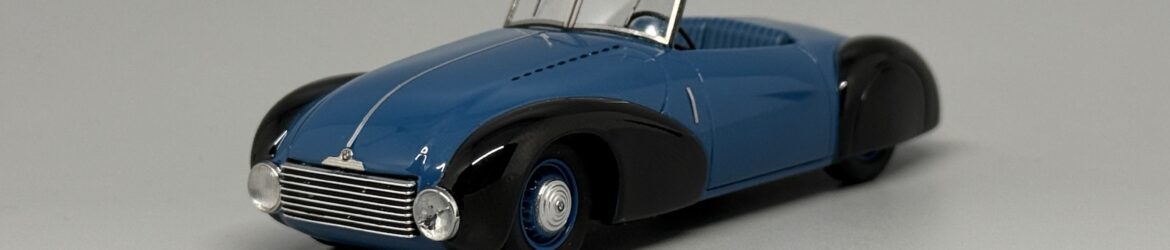
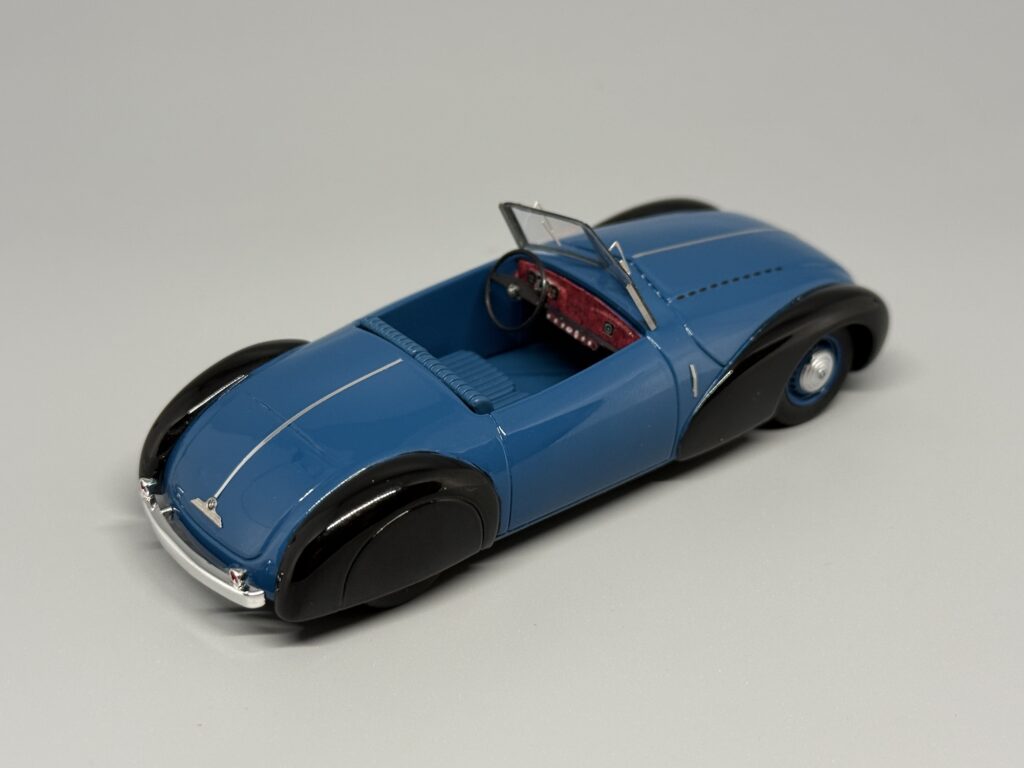
The model in my collection was produced by Autocult and represents the 1949 BMW 340/1 Roadster. It was produced in a limited edition of 333 examples.
Technical data in brief
Year completed: 1949
Place of production: Eisenach, Germany
Developer: Eisenach automobile plant / Awtowelo
Designer: Hans Fleischer
Basis: BMW 340
Body style: two-seat Roadster prototype
Engine: six-cylinder in-line engine
Displacement: 1,971 cm³
Power: 55 hp
Transmission: 4-speed manual
Gear lever: floor-mounted
Drivetrain: rear-wheel drive
Public debut: Leipzig Spring Fair, 1949
Production: 1 prototype
Special feature: unique two-seat Roadster designed by Hans Fleischer, combining BMW 340 mechanical components with a post-war Eisenach sports-car concept
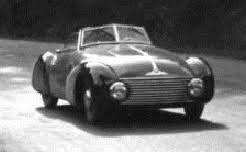
Photo of the real car. Source: Wikimedia Commons