
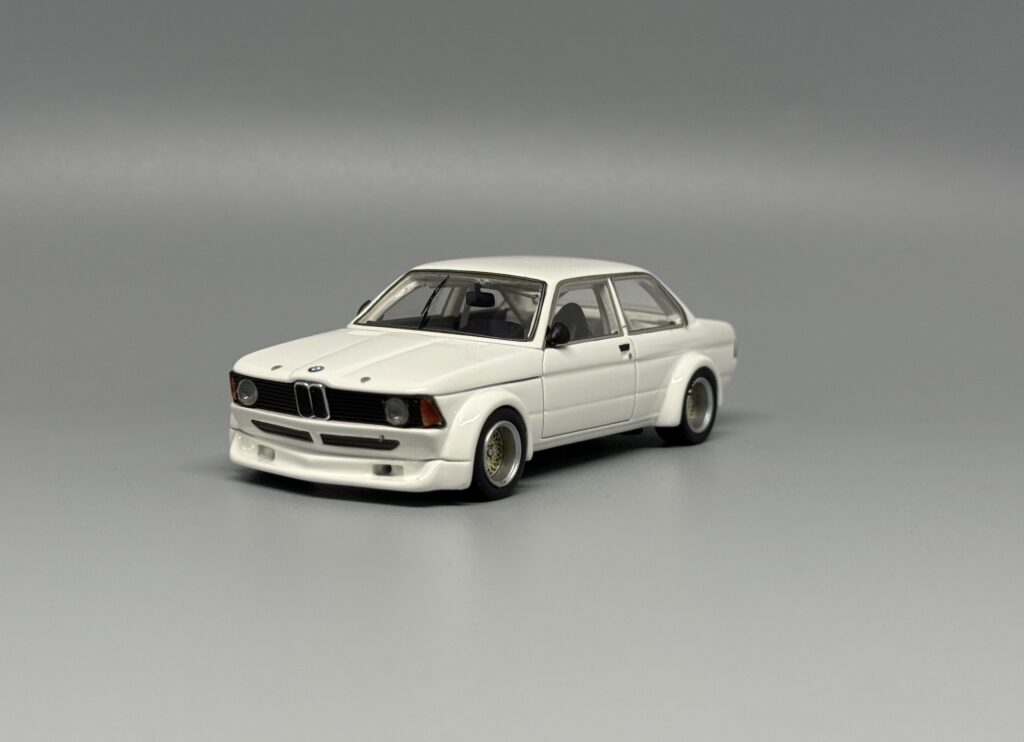
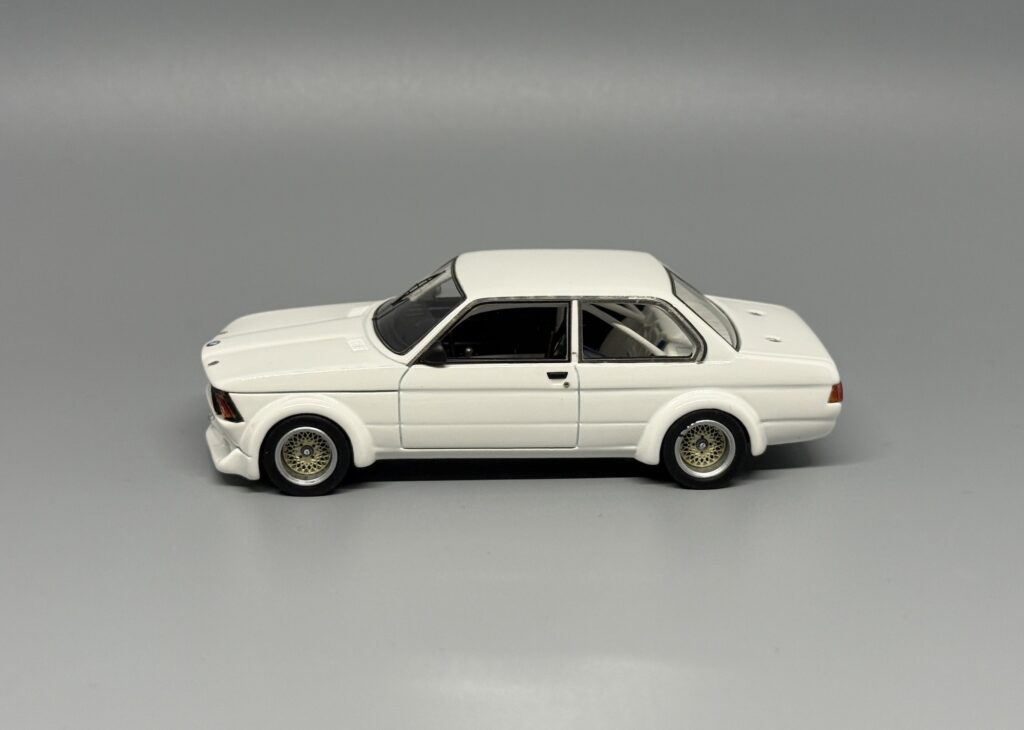
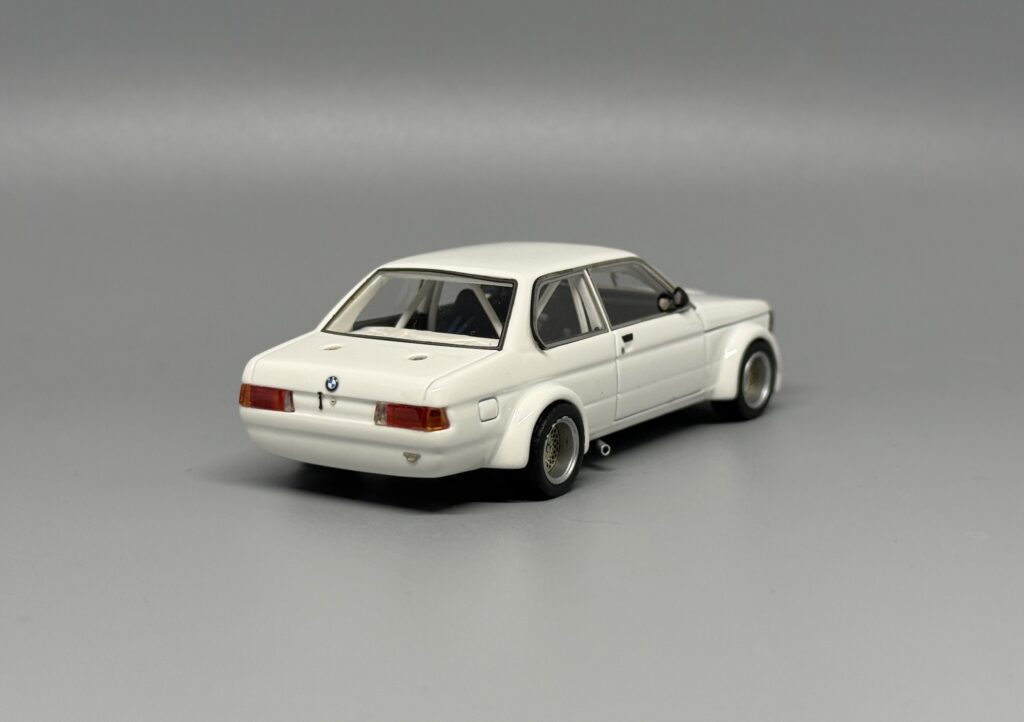
BMW 320i Group 2 (E21) represents the competition side of the first-generation 3 Series and an era in which BMW’s compact E21 became an increasingly familiar sight in European touring-car racing. Introduced in 1975, the first 3 Series was known as a road car for its compact dimensions, rear-wheel drive and driver-focused character, but these same qualities also made it a highly suitable basis for competition machinery.
The E21 quickly entered motorsport
By the mid-1970s, BMW had already established a strong motorsport reputation through the 02 Series and the 3.0 CSL. The arrival of the E21 made it possible to transfer this experience to the smaller and lighter 3 Series body. By the second half of the 1970s, competition versions of the BMW 320i were already appearing in various European touring-car championships.
The best-known factory E21 programme was developed for Group 5, where BMW Motorsport transformed the 320i into a highly specialised racing machine. At the same time, E21 320is were also built to Group 2 regulations, remaining considerably closer to the production car in their basic construction.
Group 2 – from production car to racing car
FIA Group 2, officially known as Special Touring Cars, was based on production models but permitted extensive modifications to engines, suspension, brakes and bodywork. Compared with a standard 320i, the racing cars were lower, wider and significantly lighter, with most of the regular interior equipment removed.
Typical Group 2 E21 features included widened wheel arches, wide racing tyres, a roll cage, competition suspension and uprated brakes. The engine was also extensively developed for racing, although the basic shape of the original two-door E21 sedan remained clearly recognisable.
The 320i in European touring-car racing
BMW 320i Group 2 cars competed in series including the European Touring Car Championship. During the late 1970s, E21 320is were raced by teams such as Heyco and Eggenberger in the highly competitive two-litre category.
These cars were based on BMW’s 2.0-litre M10 four-cylinder engine, which was substantially developed for competition use. Period Group 2 E21 320is could produce around 240 hp, although exact specifications varied according to team, season and individual event.
Group 2 and Group 5 were not the same car
When discussing E21 racing cars, it is important to distinguish between Group 2 and Group 5 versions. Both could feature dramatically widened bodywork and an aggressive competition appearance, which has sometimes resulted in the two types being confused in model-car descriptions.
The famous 1977 BMW Motorsport Junior Team cars and E21 320is associated with drivers such as Hans-Joachim Stuck and Ronnie Peterson were Group 5 machines. Their construction was considerably more radical, and their Formula 2-derived M12 engines produced more than 300 hp. Group 2 cars remained closer to their production origins and represented a more traditional touring-car racing concept.
No confirmed individual racing identity
It has not been possible to establish that the model in my collection represents one specific historical BMW 320i Group 2 racing car. It carries no racing number, team livery or other identifying details that would reliably connect it with a particular car, driver or event.
Neo Scale Models has also used the same E21 Group 2 body style for miniatures representing identified historic racing cars. This plain version is therefore best regarded as a neutral representation of a BMW 320i Group 2 competition car rather than a replica of one specific historical machine.
Model in the collection
The 1:43-scale BMW 320i Group 2 (E21) in my collection was produced by Neo Scale Models. It is an exclusive special edition produced for Model Car World and was released in a limited edition of 500 pieces.
The model adds the motorsport side of the E21 story to the collection. Its widened bodywork, low stance, racing wheels and other competition details illustrate how extensively a standard BMW 320i could be transformed under the touring-car regulations of the late 1970s.
Technical data
Base model: BMW 320i (E21)
Competition category: FIA Group 2
Body style: two-door racing sedan
Engine: competition-prepared 2.0-litre four-cylinder petrol engine
Engine family: BMW M10
Power output: unknown for the specific car represented; period Group 2 E21 320is produced around 240 hp
Drive: rear-wheel drive
Special features: widened bodywork, racing suspension, roll cage and Group 2 competition modifications
Specific historical car represented: not conclusively identified