


BMW M3 GTS (E92) was the most radical road-legal special version of the fourth-generation M3 and one of the most uncompromising BMW M cars of its era. Unveiled at the end of 2009 and entering production in 2010, the GTS was not simply intended to make the regular M3 Coupé slightly faster. BMW M GmbH developed it to bring the E92 concept as close as possible to a competition car while retaining full road legality.
Developed for the race track
The standard E92 M3 was already an exceptionally capable performance car, but development of the GTS focused primarily on club-sport and race-track use. The engine, transmission, suspension, brakes, aerodynamics and interior were all modified with the aim of improving performance and reducing weight.
In many respects, BMW treated the M3 GTS as a spiritual successor to the E46 M3 CSL. In both cases, development went far beyond simply increasing engine power. Weight reduction, aerodynamic improvements and extensive chassis modifications were combined to create a more focused and direct driving experience.
A 4.4-litre naturally aspirated V8
The M3 GTS was based on the S65 V8 used in the regular E92 M3, but displacement was increased from 3,999 cc to 4,361 cc. The additional capacity was achieved primarily by increasing the piston stroke, while retaining the high-revving naturally aspirated character of the original M3 engine.
Power increased from 309 kW or 420 hp to 331 kW or 450 hp, while maximum torque rose from 400 Nm to 440 Nm. Peak power arrived at 8,300 rpm, demonstrating how strongly the GTS remained committed to BMW M’s tradition of high-revving naturally aspirated engines.
Seven-speed M DCT
The only transmission offered in the GTS was the seven-speed M DCT Drivelogic dual-clutch gearbox. Its software and shift characteristics were specifically adapted to the enlarged engine and the demands of track driving.
Power was sent exclusively to the rear wheels, with gear changes taking place with virtually no interruption in drive. Together with the larger V8 and reduced weight, this allowed the GTS to accelerate from 0 to 100 km/h in 4.4 seconds. Top speed was 305 km/h, considerably higher than the electronically limited 250 km/h of a standard M3.
Less weight, more racing car
Weight reduction was central to the development of the M3 GTS. The car featured a carbon-fibre-reinforced plastic roof, lighter interior trim, polycarbonate rear side windows and rear window, and a special sports exhaust system with titanium rear silencers.
The rear seat was removed completely and replaced by a rigidly mounted roll bar. Racing-style seats, mounting points for six-point harnesses and a fire extinguisher further emphasised the car’s competition focus. Buyers could also delete the climate-control and audio systems, reducing unladen weight to approximately 1,530 kilograms. BMW M quoted a power-to-weight ratio of just 3.4 kilograms per horsepower.
Adjustable aerodynamics
One of the most distinctive features of the M3 GTS was its adjustable aerodynamics. Both the front spoiler element and the large rear wing could be adjusted according to circuit requirements and the desired level of downforce. These solutions drew directly on BMW M’s experience in motorsport.
The rear wing, matt-black 19-inch M alloy wheels, carbon-fibre roof and BMW Individual Fire Orange paintwork made the GTS immediately distinguishable from a regular M3. The striking orange finish in particular became one of the defining visual signatures of the model.
A chassis developed for the circuit
The GTS received adjustable coilover suspension, with separate damper adjustment and variable camber settings for both the front and rear axles. This allowed the chassis to be tailored more precisely to individual circuits.
The braking system was also extensively upgraded. Fixed callipers with six pistons at the front and four at the rear worked with enlarged brake discs, while the calibration of DSC and M Dynamic Mode was revised to suit the GTS’s increased dynamic potential.
One of the rarest BMW M models
The M3 GTS was never intended to be a conventional high-volume production model. Cars were assembled in small batches by BMW M GmbH and effectively built to order. According to BMW M, only 150 examples were produced, making the GTS one of the rarest BMW M models.
The GTS represented the most extreme factory-developed version of the E92 M3. Its 4.4-litre naturally aspirated V8, reduced weight and track-focused engineering also marked the end of an era, as the following generation of M3 and M4 models moved to turbocharged six-cylinder engines.
Model in the collection
The 1:43-scale BMW M3 GTS (E92) in my collection was produced by Jada Models. It is an official BMW dealer and promotional model. The miniature represents the 2009 presentation car and was released as a limited edition of 1,000 pieces.
The model captures the most characteristic features of the GTS, including its large rear wing, track-focused aerodynamics and significantly more aggressive appearance compared with the standard E92 M3.
Technical data
Unveiled: 2009
Production: 2010–2011
Production location: BMW M GmbH, Garching
Body style: two-door Coupé
Engine: S65B44 naturally aspirated V8 petrol engine
Displacement: 4,361 cc
Power output: 331 kW / 450 hp at 8,300 rpm
Torque: 440 Nm at 3,750 rpm
Transmission: 7-speed M DCT Drivelogic
Drive: rear-wheel drive
0–100 km/h: 4.4 seconds
Top speed: 305 km/h
Weight: as low as approximately 1,530 kg depending on equipment
Production total: 150 cars
Special feature: limited-production track-focused E92 M3 with a 4.4-litre V8, reduced weight and adjustable aerodynamics
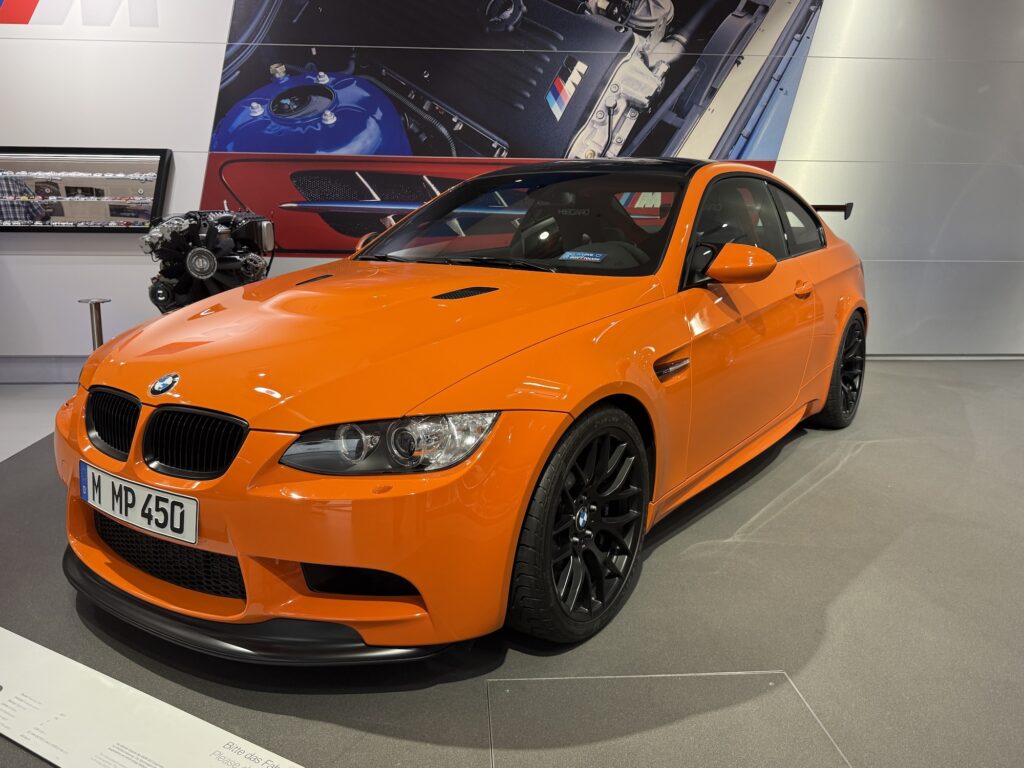
Photo of the real car, BMW Museum. Photo: Sten-Patrick Kreek