


Background
BMW i8 Coupé (I12) was one of BMW’s most important and distinctive models of the 2010s. It was a plug-in hybrid sports car that combined forward-looking design, a carbon-fibre body structure, the possibility of electric driving and the performance of a petrol engine. The BMW i8 was not simply another sports coupé, but a technological showcase for the BMW i sub-brand and one of the first cars with which BMW showed that sportiness and electrification could belong together.
The roots of the BMW i8 go back to the BMW Vision EfficientDynamics concept car, presented in 2009. This concept already clearly showed the direction in which BMW wanted to move: a low and aerodynamic sports car whose aim was not only high power, but also efficiency, low fuel consumption and innovative technology. The BMW i8 reached the market as a production model in 2014, and its appearance remained unusually close to the concept car.
Design and concept
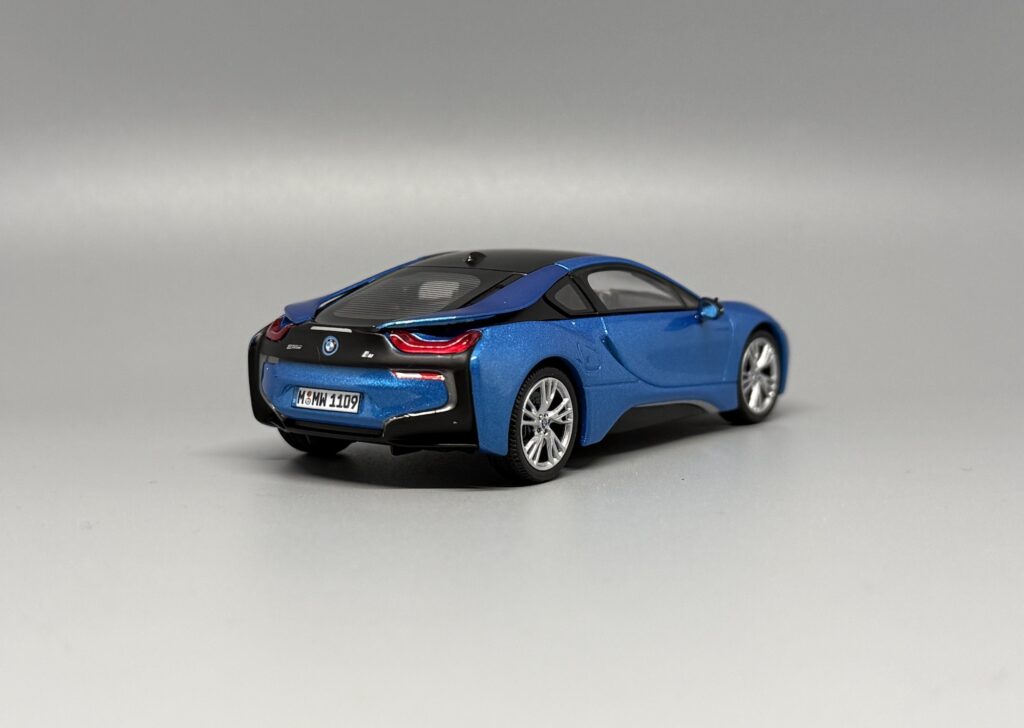
In terms of design, the BMW i8 was highly futuristic. The low body, air-guiding channels, layered rear section, upward-opening doors and very streamlined overall shape distinguished it from all other BMW models of the same period. The i8 did not try to imitate a traditional sports car, but created a visual identity of its own. It was a car that looked like a technological experiment even while standing still, yet at the same time it was a fully road-legal production model.
The BMW i8 was based on the LifeDrive architecture. Its central idea was to separate the passenger cell and drivetrain technology into two main modules. The Life module used carbon-fibre reinforced plastic, or CFRP, which helped keep the body light and rigid. The Drive module included the engine, electric drive, battery and chassis. This construction was a very important step for BMW in the development of new materials and electrified vehicles.
The interior continued the same forward-looking approach. The low seating position, wide centre console, digital instruments and distinctive use of materials created a very modern atmosphere. The BMW i8 was a 2+2 coupé, although the rear seats were more symbolic than practical. The character of the car was still clearly driver-oriented: it was intended to offer a sporting driving feel, but through a completely different technological approach from classic BMW M models.
Technology
Technically, the BMW i8 used a plug-in hybrid drivetrain. A 1.5-litre three-cylinder turbocharged petrol engine drove the rear wheels, while an electric motor drove the front wheels. In this way, the i8 had an all-wheel-drive character through the combination of electric front-wheel drive and petrol-powered rear-wheel drive. Earlier versions had a system output of 362 hp, later increased to 374 hp. Acceleration from 0 to 100 km/h took around 4.4 seconds, and top speed was electronically limited to 250 km/h.
The special nature of the i8 did not lie only in its acceleration figures. The purpose of this car was to show that a sports car could also be technologically efficient. The electric motor allowed short distances to be driven quietly and with zero local emissions, while the petrol engine gave the car higher speed and greater driving range. Unlike many traditional sports cars, the i8 was not built solely around a large engine; the entire concept of the car was based on the cooperation between the hybrid drivetrain, aerodynamics and lightweight construction.
Production
Production took place at BMW’s Leipzig plant from 2014 to 2020. The BMW i8 Roadster was later added to the model range, but the Coupé remained the original and most recognisable version of the model family. The production number of the BMW i8 Coupé is given as 16,581 cars. Together with the Roadster, more than 20,000 cars of the entire i8 model family were produced, making it a highly visible yet still special and relatively limited technological flagship.
Significance in BMW history
The significance of the BMW i8 in BMW history is considerable. It was BMW Group’s first series-production plug-in hybrid model and one of the first serious electrified sports cars in the world. The i8 helped shape the idea that electrification did not have to mean only practical city cars or economical family cars, but could also be used to create an emotional and visually distinctive sports car.
Today, the BMW i8 Coupé is especially interesting as a symbol of its era. It was not the most powerful BMW and it was not a classic M car, but its influence on BMW’s future direction was very significant. The carbon-fibre body structure, plug-in hybrid drivetrain, futuristic design and the meaning of the BMW i brand make the i8 one of the most important BMW models of the 2010s.
Model in the collection
The model in my collection is produced by Paragon. It is a promotional model made for BMW dealerships and was intended for use as a sales and display model.
Technical data in brief
Production period: 2014–2020
Production location: Leipzig, Germany
Body style: two-door 2+2 sports coupé
Architecture: LifeDrive with carbon-fibre passenger cell
Engine: 1.5-litre three-cylinder TwinPower Turbo petrol engine with electric motor
Drivetrain type: plug-in hybrid
System output: initially 362 hp, later 374 hp
Transmission: 6-speed automatic transmission for the petrol engine, separate transmission for the electric drive on the front axle
Drivetrain: hybrid all-wheel drive, with the petrol engine driving the rear wheels and the electric motor driving the front wheels
Acceleration 0–100 km/h: around 4.4 s
Top speed: 250 km/h, electronically limited
Production number: 16,581 Coupé cars
Special feature: plug-in hybrid sports car of the BMW i sub-brand, combining a carbon-fibre body structure, futuristic design and an electrified drivetrain