
Background
BMW 125i (F20) was one of the sportier petrol-powered versions of the second-generation BMW 1 Series. The five-door F20 debuted in 2011 as the successor to the first-generation E87 and continued a technical concept that was already becoming unusual in the compact class: a longitudinally mounted engine and rear-wheel drive. The BMW 125i joined the range in spring 2012 and was positioned towards the upper end of the regular four-cylinder models. It offered noticeably stronger performance than the 116i, 118i and 120i while remaining a practical five-door everyday car.
Design and concept
The F20 retained the classic BMW proportions that were becoming increasingly rare in the compact segment. A relatively long bonnet, short overhangs and a passenger compartment positioned visually towards the rear were largely the result of its longitudinal engine layout and rear-wheel-drive architecture. Compared with the E87, the second-generation 1 Series became larger and more spacious, offering improved passenger and luggage space. At the same time, the car remained compact on the outside and preserved its driver-oriented character. BMW also offered several design packages for the F20 family, including Sport Line, Urban Line and later M Sport, allowing the appearance and interior to be given a noticeably more sporting character.
BMW 125i
The BMW 125i was intended for customers who wanted more performance than a regular 1 Series without moving to the more extreme six-cylinder M135i or later M140i. The original F20 125i used a 1,997 cm³ four-cylinder BMW TwinPower Turbo petrol engine featuring a twin-scroll turbocharger, direct fuel injection, VALVETRONIC and Double-VANOS. The engine produced 218 hp and 310 Nm of torque, combining strong mid-range performance with compact dimensions and good everyday usability. This positioning made the 125i an interesting intermediate model between the regular petrol versions and the M Performance flagship models.
Performance and transmission
The first 218 hp BMW 125i accelerated from 0 to 100 km/h in approximately 6.4 seconds with the six-speed manual gearbox and reached a top speed of around 245 km/h. An eight-speed Steptronic automatic transmission was also available. The most important feature, however, was that power was sent to the rear wheels. This preserved the traditional BMW driving character in which the front wheels were primarily responsible for steering while the rear wheels transmitted the engine’s power. Together with balanced weight distribution and a multi-link rear axle, this gave the 125i a particularly dynamic character for a compact hatchback.
2016 technical update
In the summer of 2016, the BMW 125i received a new-generation 2.0-litre four-cylinder TwinPower Turbo engine. Output increased to 224 hp, while maximum torque remained at 310 Nm. With this version, the eight-speed Steptronic became standard equipment and acceleration from 0 to 100 km/h improved to approximately 6.1 seconds. The update illustrates the development of the F20 during its long production life: the 125i model designation remained unchanged, while the engine technology, performance and transmission evolved beneath the surface.
Chassis and driving character
One of the defining features of the F20 was its rear-wheel-drive platform. The front axle used BMW’s characteristic double-joint design, while the rear featured independent five-link suspension. This layout helped combine ride comfort with precise handling and distinguished the 1 Series from most competitors in the compact class. The greater power of the 125i highlighted the strengths of this chassis particularly well: the car remained comfortable and practical in everyday use while offering a noticeably more sporting experience on winding roads than a typical compact hatchback.
Development of the F20
The second-generation 1 Series received several updates during its production life. The most visible was the 2015 Life Cycle Impulse, which substantially revised the front and rear styling, introduced updated headlights and taillights and refreshed the interior and engine range. Further powertrain updates followed, including the new 125i engine in 2016. As a result, there can be both technical and visual differences between BMW 125i models from different production years, and when the exact model year of the scale model is not known, it is more appropriate to describe the 125i across its full development period.
Production
The five-door BMW 1 Series F20 was produced in Germany at both BMW Group Plant Regensburg and BMW Group Plant Leipzig. According to BMW’s official factory histories, 818,530 five-door F20 models were built in Regensburg and 424,111 in Leipzig. These figures include all F20 engine versions, and BMW has not published a separate total production figure for the BMW 125i. The 125i itself joined the range in 2012 and remained available in different technical forms during the F20 production period.
Significance in BMW history
The BMW F20 is historically significant primarily because, together with the three-door F21, it became the final generation of the 1 Series to use BMW’s classic longitudinal-engine and rear-wheel-drive layout as its basic architecture. The next-generation F40, introduced in 2019, switched to a platform based on front-wheel drive. The 125i represents this traditional BMW formula particularly well: a relatively compact and practical hatchback combined with a powerful petrol engine and rear-wheel drive. This made the 125i an interesting middle-ground model that was not an M Performance flagship, but already offered clearly more sporting performance and character.
Model in the collection
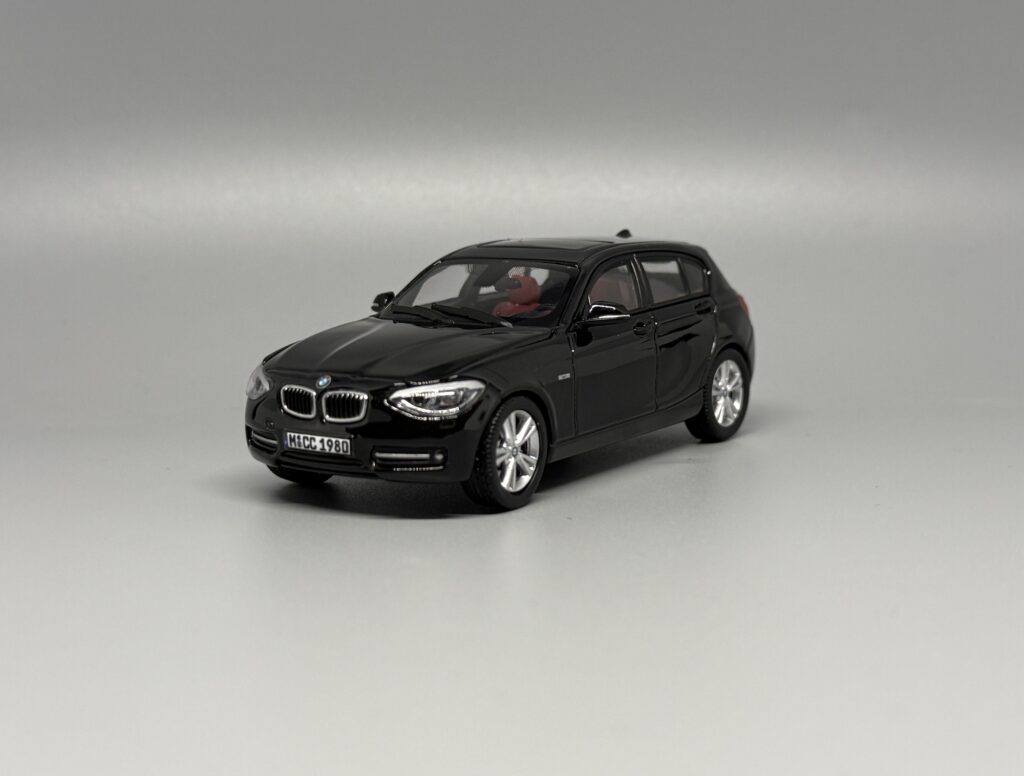
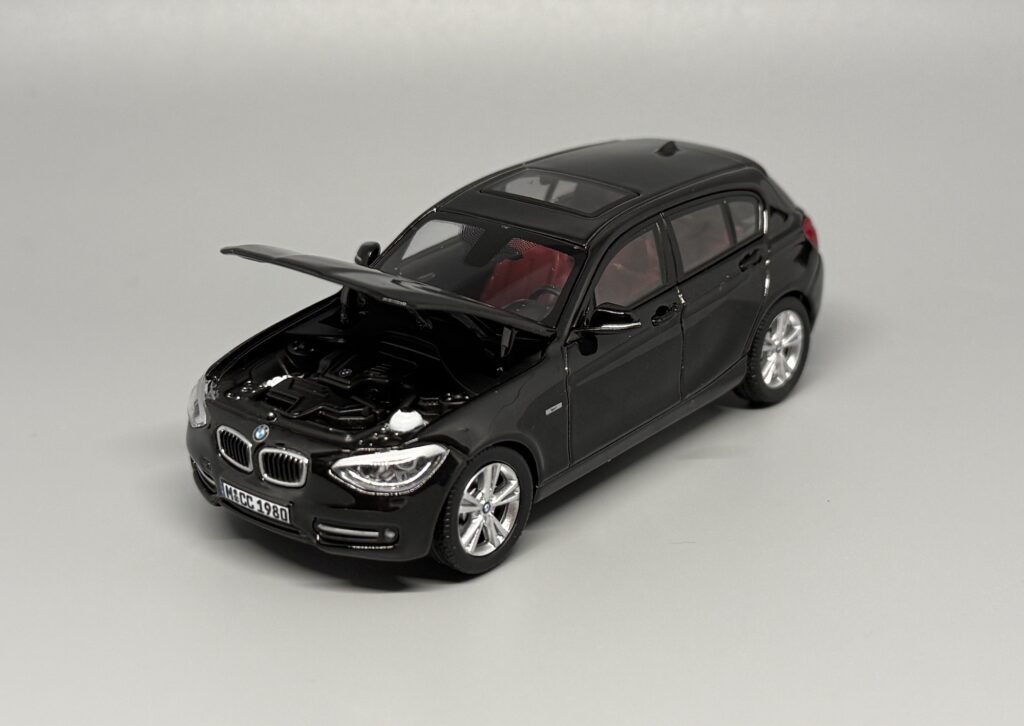
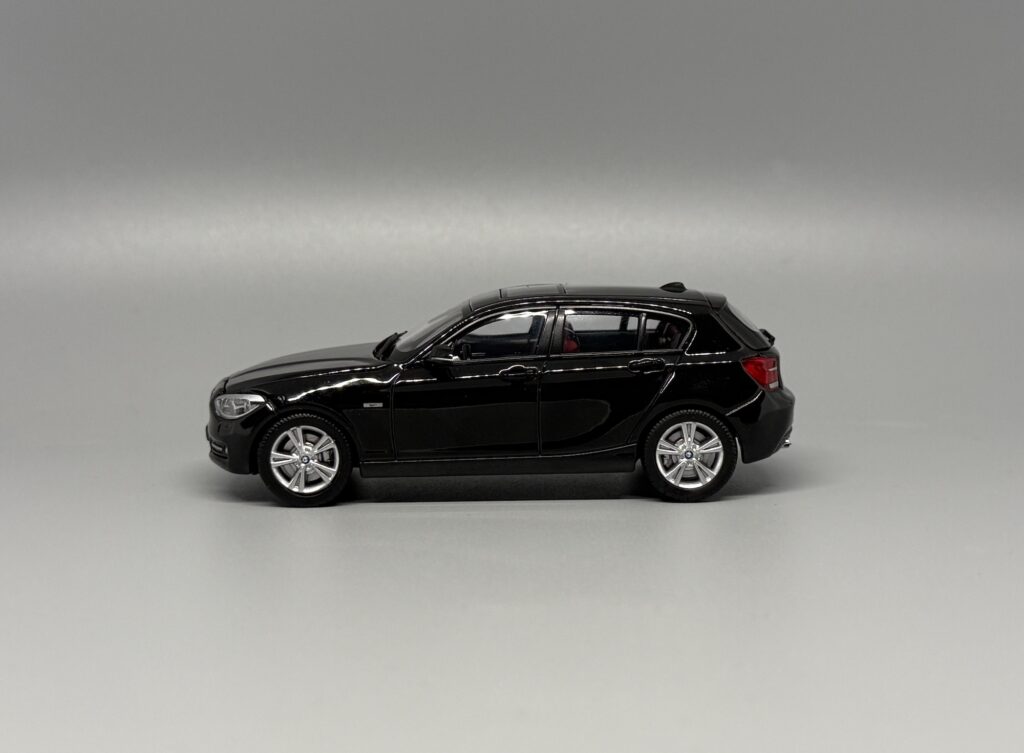
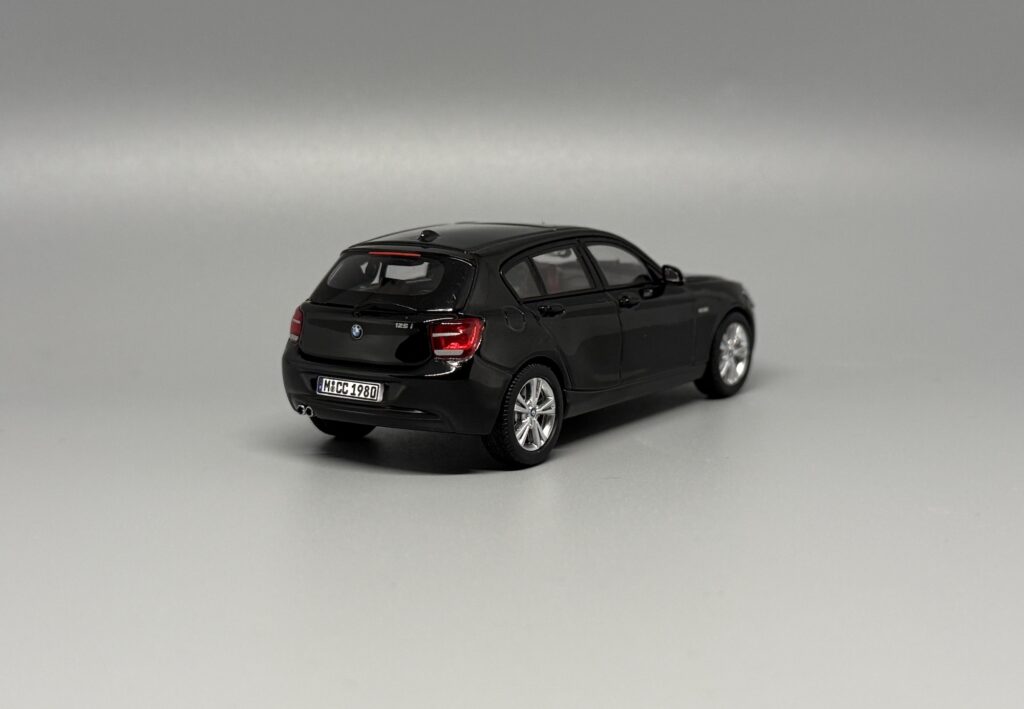
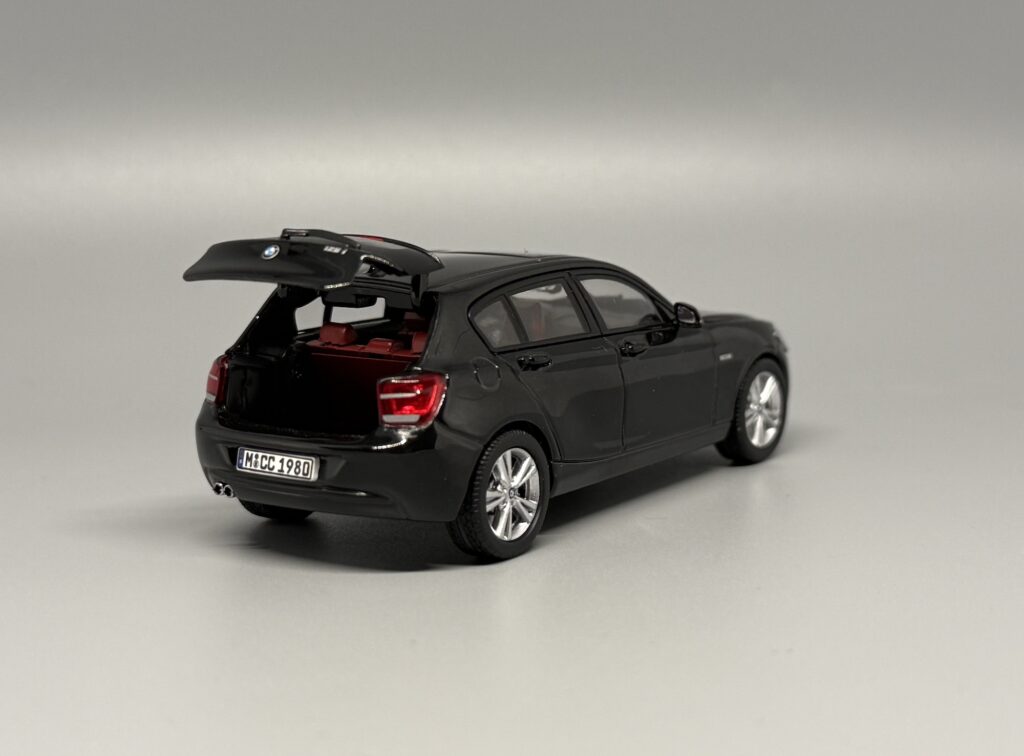
The model in my collection was produced by Paragon Models and represents a BMW 125i five-door hatchback (F20). As the exact production year of the scale model is not known, this description covers the BMW 125i F20 as a whole.
Technical data in brief
F20 production period: 2011–2019
BMW 125i in the model range: from 2012
Production locations: BMW Group Plant Regensburg and BMW Group Plant Leipzig, Germany
Body style: five-door hatchback
Drivetrain: rear-wheel drive
Original engine: 1,997 cm³ four-cylinder BMW TwinPower Turbo petrol engine
Original power: 218 hp
Original torque: 310 Nm
Original transmission: 6-speed manual or 8-speed Steptronic
0–100 km/h: approximately 6.4 s for the original 218 hp version
Top speed: approximately 245 km/h for the original 218 hp version
Power from 2016: 224 hp
Torque from 2016: 310 Nm
Transmission from 2016: 8-speed Steptronic
F20 production number: BMW has not published a separate production figure for the 125i
Special feature: a sporty four-cylinder version of the final rear-wheel-drive generation of the BMW 1 Series