
Background
BMW M2 (G87) is the second generation of the BMW M2 and the direct successor to the first-generation F87. The car was unveiled in autumn 2022, production began in December of the same year, and the worldwide market launch followed in April 2023. The G87 continued the original M2 idea of delivering BMW M performance in a relatively compact two-door coupé, but technically the new generation moved considerably closer to the larger BMW M3 and M4. Much of its engine and chassis technology was derived from those models, while key M2 characteristics such as a six-cylinder engine, rear-wheel drive and the availability of a manual gearbox were retained. The G87 also marked a major change in production: while the previous F87 generation was built in Leipzig, the new M2 moved to BMW Group Plant San Luis Potosí in Mexico.
Design
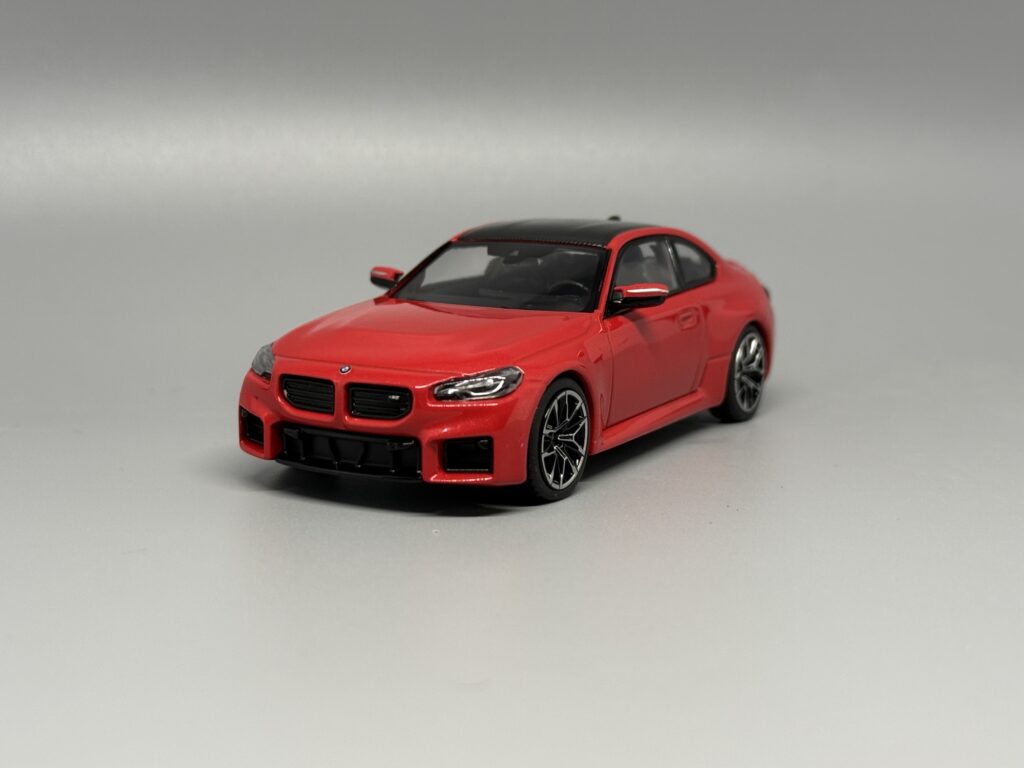
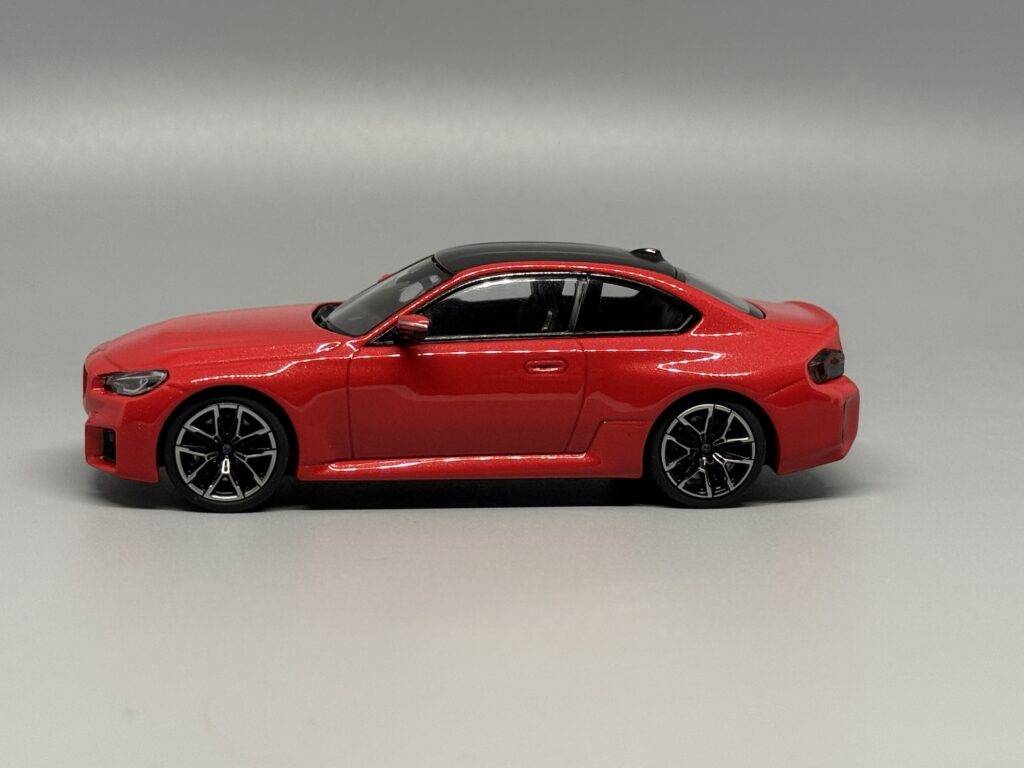
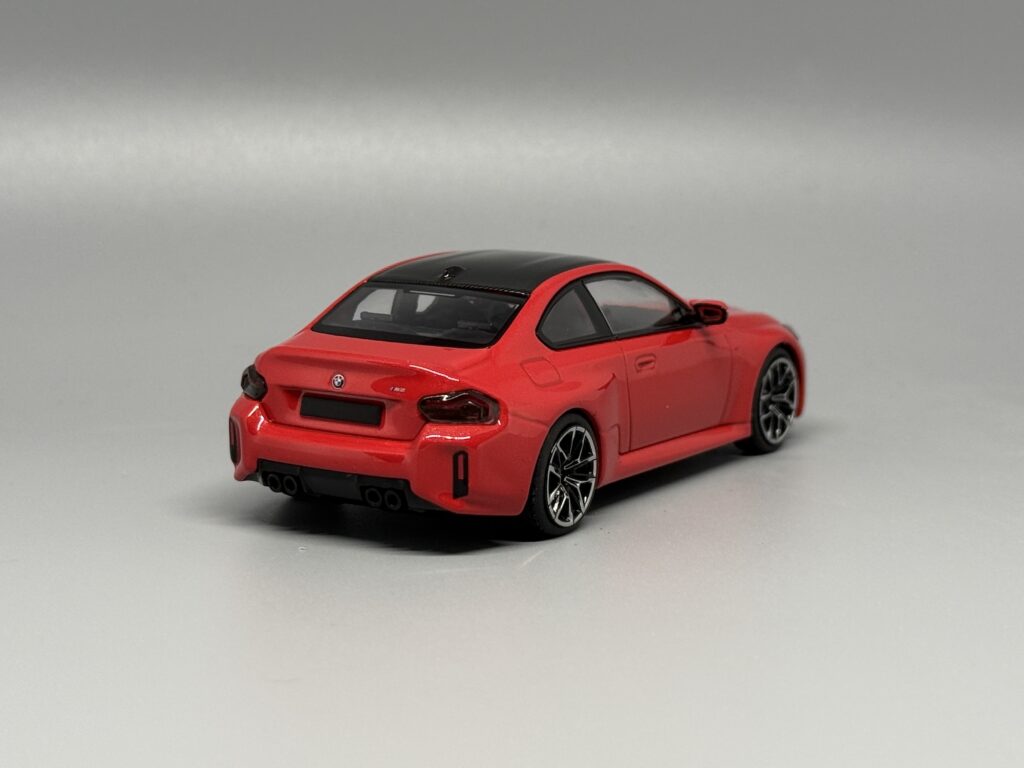
The design of the G87 was intentionally more muscular and angular than that of its predecessor. Large, almost rectangular air intakes, frameless BMW kidney grilles with horizontal bars, wide wheel arches and strongly sculpted side sills emphasised the car’s width and technical character. At the rear, vertical reflectors, a pronounced diffuser and the four exhaust outlets typical of BMW M models reinforced its performance identity. Although the G87 grew in size compared with the F87, its wheelbase remained shorter than that of the M4, and its proportions retained the classic sports coupé layout with a long bonnet, rearward-positioned passenger compartment and short boot section. The exterior design of the G87 was led by BMW designer José Casas.
S58 six-cylinder engine
The 2023 BMW M2 was powered by a 2,993 cm³ S58 M TwinPower Turbo six-cylinder in-line engine, technically related to the power units used in the BMW M3 and M4. The engine used two mono-scroll turbochargers, High Precision Injection, VALVETRONIC and Double-VANOS, and in its original European specification produced 460 hp, or 338 kW, together with 550 Nm of torque. Compared with the previous-generation 450 hp M2 CS, even the standard new M2 already offered slightly more maximum power. The high-revving character of the S58 and its close technical relationship with the M3 and M4 gave the G87 a level of performance that only a few years earlier had been associated with far more exclusive BMW M special models.
Transmission and performance
The standard transmission for the original G87 was an eight-speed M Steptronic with Drivelogic, while a six-speed manual gearbox was available for drivers seeking a more traditional driving experience. The original 460 hp M2 accelerated from 0 to 100 km/h in 4.1 seconds with the automatic transmission and 4.3 seconds with the manual. Acceleration from 0 to 200 km/h took 13.5 and 14.3 seconds respectively. Top speed was electronically limited to 250 km/h, while the optional M Driver’s Package raised the limit to 285 km/h. In 2023 specification, all power was sent to the rear wheels, preserving the classic layout of a traditional BMW M sports coupé.
Chassis
The G87 chassis made extensive use of technology developed for the BMW M3 and M4. At the front was an M-specific double-joint spring-strut axle, while the rear used a five-link independent suspension layout. The body and chassis mounting points were strengthened with additional bracing elements, and weight distribution was close to 50:50. Adaptive M suspension with electronically controlled dampers, M Servotronic steering and an Active M Differential were fitted as standard. The differential could vary its locking effect up to 100 per cent, while M Traction Control allowed the driver to select between ten different levels of intervention, making it possible to fine-tune the car’s behaviour according to road conditions and driving style.
Brakes and wheels
The BMW M2 was equipped as standard with powerful M Compound brakes. Six-piston fixed calipers with 380 mm discs were used at the front, while the rear featured single-piston floating calipers with 370 mm discs. The wheels were staggered in size, measuring 19 inches at the front and 20 inches at the rear, reinforcing both the car’s broad stance and its rear-wheel-drive-focused layout. More track-oriented tyres were also available. Combined with the wide track and relatively short wheelbase, these solutions gave the G87 considerably more dynamic capability than its compact dimensions might initially suggest.
Driver-focused technology
The G87 combined traditional BMW M mechanical engineering with modern digital control systems. The BMW Curved Display brought together the digital instrument cluster and central infotainment screen, while M-specific menus allowed the driver to configure the engine, suspension, steering, brake feel, transmission and traction-control settings individually. The standard M Drive Professional package included features such as M Drift Analyser, M Laptimer and ten-stage M Traction Control. The M1 and M2 buttons on the steering wheel could store two different combinations of settings, allowing the driver to switch quickly between configurations for everyday driving and more sporting use.
Lightweight construction and M Carbon
Although the G87 was larger and heavier than the previous M2, BMW also introduced several measures to reduce weight and lower the centre of gravity. The optional M Carbon roof reduced weight by approximately six kilograms while lowering the car’s centre of gravity. The M Race Track Package combined the carbon-fibre roof, M Carbon bucket seats, M Driver’s Package and track-oriented tyres. The carbon-fibre bucket seats themselves also reduced weight compared with the standard M Sport seats while providing substantially greater lateral support during hard cornering.
Development of the G87
The G87 M2 has continued to evolve during its production life. In 2024, BMW increased the output of the S58 engine to 480 hp. In the version fitted with the eight-speed M Steptronic transmission, maximum torque increased to 600 Nm, while the manual version retained 550 Nm. A further significant development followed in 2026, when M xDrive all-wheel drive was introduced to the M2 range for the first time. The M xDrive system retained a rear-biased character, sending power to the rear wheels during normal driving and involving the front axle according to traction requirements. A 2WD mode was also available. Production of the M xDrive version began at San Luis Potosí in August 2026. These later developments do not apply to the 2023 car represented in the collection, which depicts the original 460 hp rear-wheel-drive configuration.
Production
Production of the BMW M2 G87 began in December 2022 at BMW Group Plant San Luis Potosí in Mexico, with customer deliveries starting in spring 2023. The G87 became the first high-performance BMW M model to be produced in Mexico and is built in San Luis Potosí for the global market alongside the BMW 2 Series Coupé. The model remains in production, so a final total production figure is not yet available.
Significance in BMW M history
The BMW M2 G87 continues a remarkably traditional sports-car concept at a time when the BMW M range has increasingly adopted all-wheel-drive systems and electrified powertrains. The original G87 combination of a six-cylinder petrol engine, rear-wheel drive and an available manual gearbox follows principles that have been associated with BMW sports coupés for decades. At the same time, its engine, chassis, brakes and electronic control systems are closely related to the larger M3 and M4. The G87 therefore combines a classic BMW M layout with thoroughly modern performance and technology, continuing the M2 model line established by the F87.
Model in the collection
The model in my collection was produced by Minichamps and represents the 2023 BMW M2 (G87) in its original 460 hp specification. It was produced in a limited edition of 336 examples.
Technical data in brief
Introduction: 2022
Start of production: 12/2022
Market launch: 04/2023
Place of production: BMW Group Plant San Luis Potosí, Mexico
Body style: two-door four-seat Coupé
Engine: 2,993 cm³ S58 M TwinPower Turbo six-cylinder in-line engine
Forced induction: two turbochargers
2023 power output: 460 hp / 338 kW
2023 torque: 550 Nm
2023 drivetrain: rear-wheel drive
Gearbox: 8-speed M Steptronic or 6-speed manual
0–100 km/h: 4.1 s with M Steptronic / 4.3 s with manual gearbox
Top speed: 250 km/h
Top speed with M Driver’s Package: 285 km/h
Differential: Active M Differential
Suspension: Adaptive M suspension
Power from the 2024 update: 480 hp / 353 kW
Production number: model remains in production; final total not yet available
Special feature: the second generation of the BMW M2, originally combining a 460 hp S58 six-cylinder engine, rear-wheel drive and the option of a manual gearbox
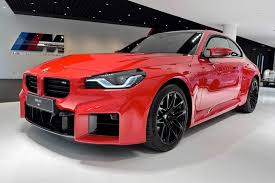
Photo of the real car. Source: bmwblog.com