
Background
BMW 507 Raymond Loewy was one of the most unusual cars ever created on the basis of the BMW 507 and one of the most fascinating special-bodied BMWs of the 1950s. The standard BMW 507 was an elegant two-seat Roadster designed by Albrecht Graf Goertz and later became one of the most celebrated design icons in BMW history. Raymond Loewy’s version took a completely different direction. It was neither an official BMW production model nor a factory prototype, but the personal car of the world-famous industrial designer, for which the BMW 507 mechanical basis received an entirely new body.
Teacher and student
The story of the BMW 507 Raymond Loewy is made particularly interesting by Loewy’s connection with the designer of the standard BMW 507, Albrecht Graf Goertz. After moving to the United States following the Second World War, Goertz worked in Raymond Loewy’s design studio and gained an important part of his professional experience there. He later designed the BMW 503 and 507. When Raymond Loewy decided a few years later to create an entirely new car for himself on the basis of the BMW 507, it produced a rare situation in which a famous designer reinterpreted a car originally styled by one of his former employees.
Raymond Loewy
Raymond Loewy was one of the most influential industrial designers of the 20th century. His work ranged from automobiles and locomotives to household appliances, packaging and corporate identities. In the automotive world he was particularly closely associated with Studebaker, and his design organisation influenced the appearance of several of the company’s models. Loewy later became one of the key figures behind the Studebaker Avanti. The special-bodied BMW 507 is therefore significant not only in BMW history but also within Loewy’s own design career.
Chassis 70024
In 1957, Loewy acquired a BMW 507 chassis numbered 70024. Instead of retaining the standard body, he wanted the car to receive an entirely new two-seat closed body reflecting his own design philosophy. Loewy’s intention was not simply to turn the BMW 507 into a coupé, but to create a highly individual sports car that differed from Goertz’s elegant Roadster in almost every visual detail. The completed car remained a one-off.
Pichon-Parat
The body designed by Loewy was built in Sens, France, by Pichon-Parat, a coachbuilding company founded by Bernard Pichon and André Parat. The firm specialised in special bodies and limited-production cars and worked on projects based on several French marques. Loewy had become familiar with Pichon-Parat’s work at the 1956 Paris Motor Show and chose the company to realise his BMW concept. The body was made from a lightweight synthetic material, essentially fibreglass-reinforced plastic, which allowed more complex curved forms than would have been practical with conventional hand-formed steel or aluminium bodywork.
A radically different BMW 507
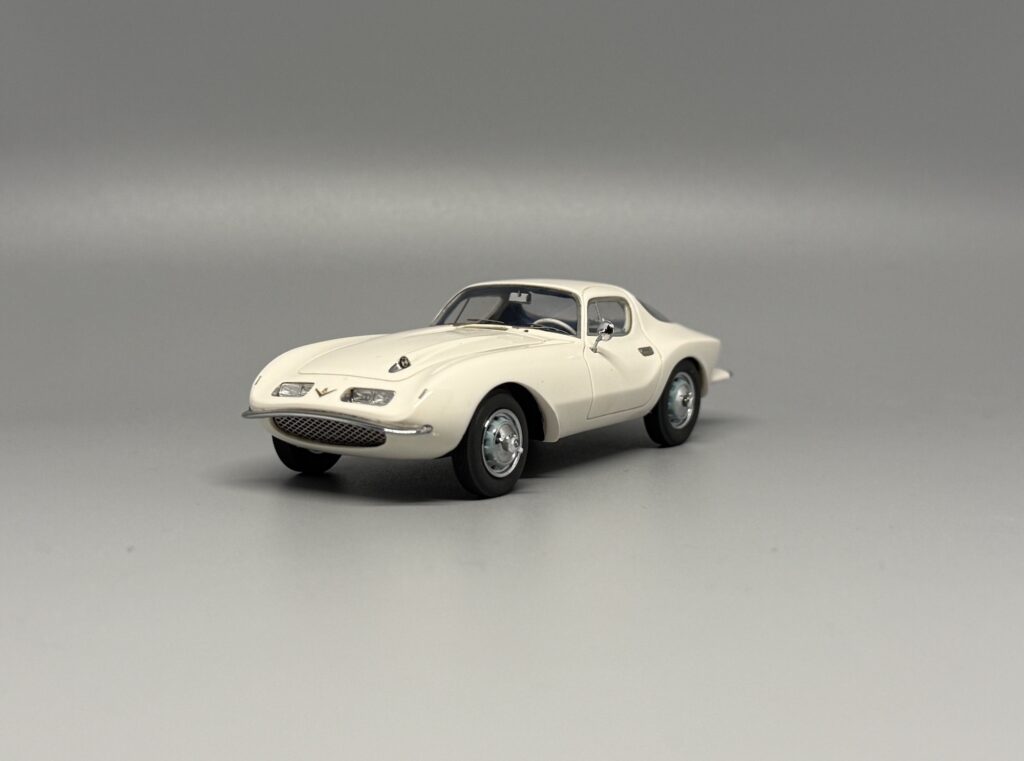
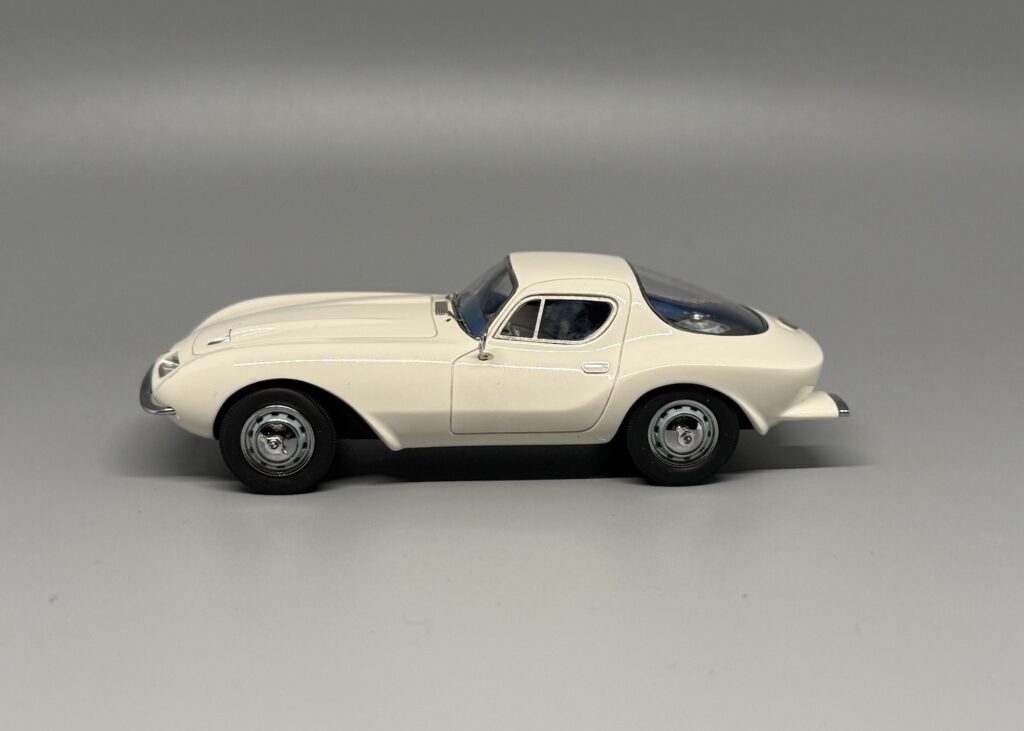
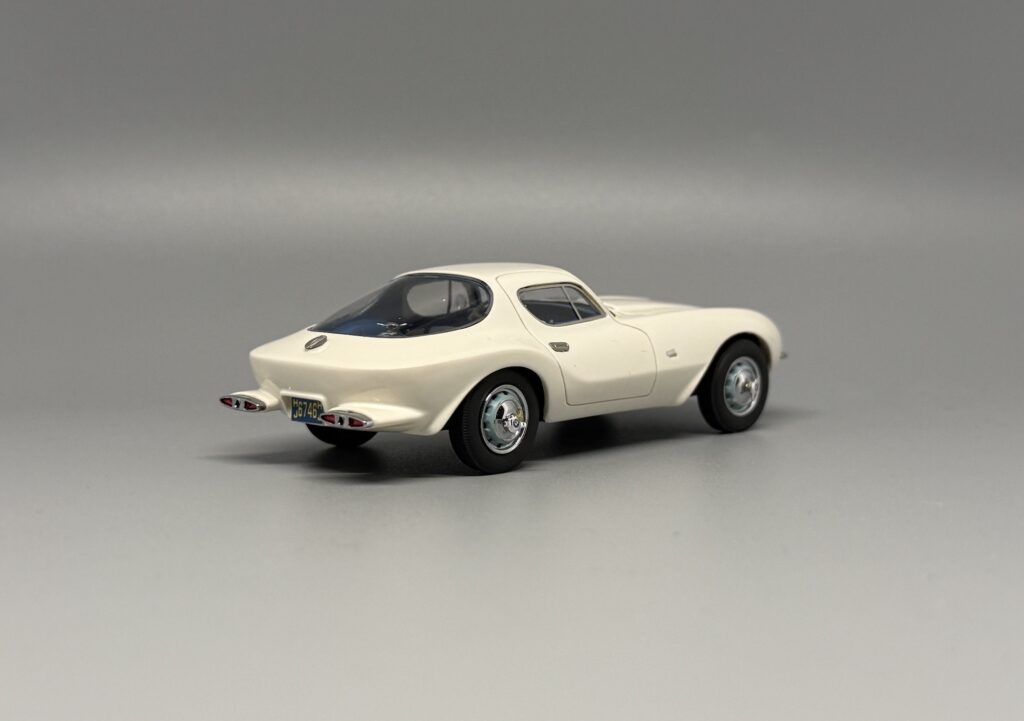
Loewy’s BMW 507 differed almost completely from the production car. In place of the classic long bonnet, open Roadster body and traditional BMW front end, the car received a very low and smooth nose, small air openings and headlamps integrated into the body. In side view, the strongly defined wheel arches and narrow central body section created a distinctly sculptural form. The rear was short and clean, and the overall car appeared more like a futuristic design experiment than a traditional European sports car.
Special panoramic windscreen
One of the most technically and visually striking features of the car was its large curved panoramic windscreen. Contemporary reports in 1957 described it as the first complex double-curvature automotive windscreen manufactured in France. Together with the slim roof pillars and wide rear window, it created an unusually large glazed area and gave the coupé a remarkably modern appearance for its time.
1957 Paris Motor Show
The completed BMW 507 Raymond Loewy was presented at the 1957 Paris Motor Show on the Pichon-Parat stand. The car attracted attention because, despite using BMW 507 mechanical components, its appearance was almost unrecognisable compared with the production model. Loewy did not intend the car as a proposal for a new BMW production model, but primarily as his personal vehicle and as a demonstration of his own design philosophy.
BMW 507 mechanical components
Beneath the special body, the BMW 507 mechanical basis was retained. The car used BMW’s 3,168 cm³ V8 engine, a four-speed manual transmission and rear-wheel drive. In production form, the BMW 507 engine produced 150 hp and the official top speed was approximately 205 km/h. Sources vary regarding the exact engine specification and performance of Loewy’s special-bodied car, so the 150 hp figure is best regarded as the technical reference point of the standard BMW 507 rather than a separately measured output for the Loewy car itself.
Loewy’s personal car
The BMW 507 was not merely a showpiece for Loewy. He used it as his personal car for several years, including on the French Riviera. The car remained in Loewy’s possession until 1962, when he donated it to a museum in Los Angeles so that his design work would also be represented on the west coast of the United States. As a result, the car survived and has since appeared at a number of important classic-car events.
Connection with the Studebaker Avanti
Several styling ideas visible on Loewy’s BMW 507 appeared again a few years later on the Studebaker Avanti. Particularly notable are the low grille-less front end, strongly defined side surfaces and sculptural treatment of the body. The BMW 507 was not a direct prototype for the Avanti, but it provides an interesting insight into the proportions and styling ideas with which Loewy was experimenting in the late 1950s.
Historical significance
The importance of the BMW 507 Raymond Loewy lies above all in the meeting of two very different design philosophies within one car. Goertz’s original BMW 507 represents balanced and classical European Roadster elegance, while Loewy’s version reflects much bolder influences from American and European industrial design. Both used the same BMW mechanical foundation, yet the visual results were completely different. As a one-off, the Loewy 507 remains one of the most unusual and historically fascinating special-bodied BMWs ever built.
Model in the collection
The model in my collection was produced by AutoCult and represents the special-bodied 1957 BMW 507 Raymond Loewy coupé. It was produced in a limited edition of 333 examples.
Technical data in brief
Year: 1957
Basis: BMW 507
Chassis number: 70024
Designer: Raymond Loewy
Coachbuilder: Pichon-Parat, Sens, France
Body style: two-seat special-bodied coupé
Body material: fibreglass-reinforced plastic
Engine: V8
Displacement: 3,168 cm³
Standard BMW 507 output: 150 hp
Transmission: 4-speed manual
Drivetrain: rear-wheel drive
Standard BMW 507 top speed: approximately 205 km/h
Production: 1 car
Special feature: unique BMW 507 coupé designed for Raymond Loewy’s personal use and built by Pichon-Parat
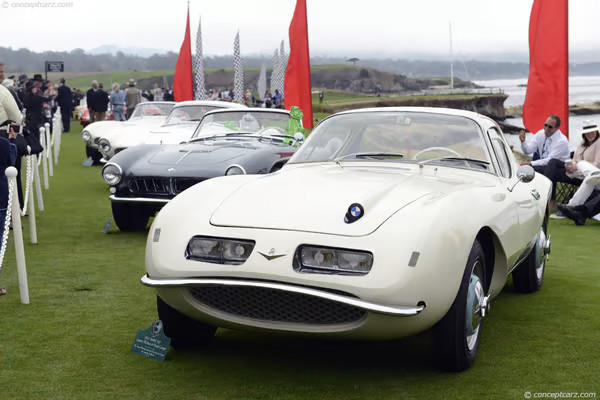
Photo of the real car. Source: curbsideclassic.com