
Background
BMW Vision Next 100 was presented on 7 March 2016 in Munich as part of BMW Group’s 100th anniversary celebrations and became one of the central future visions of the company’s centenary year. The car was not intended to preview a specific future production model, but rather to show how BMW imagined premium individual mobility in the decades ahead. BMW focused on the question of how to preserve the brand’s driver-oriented character and driving pleasure in a world where autonomous driving, artificial intelligence and constant connectivity would become increasingly common. Vision Next 100 was therefore designed to be both intelligent and capable of autonomous driving, while still remaining a car that its owner would want to drive personally. Preserving the emotional relationship between human and automobile was one of the central ideas behind the entire concept.
Design and aerodynamics
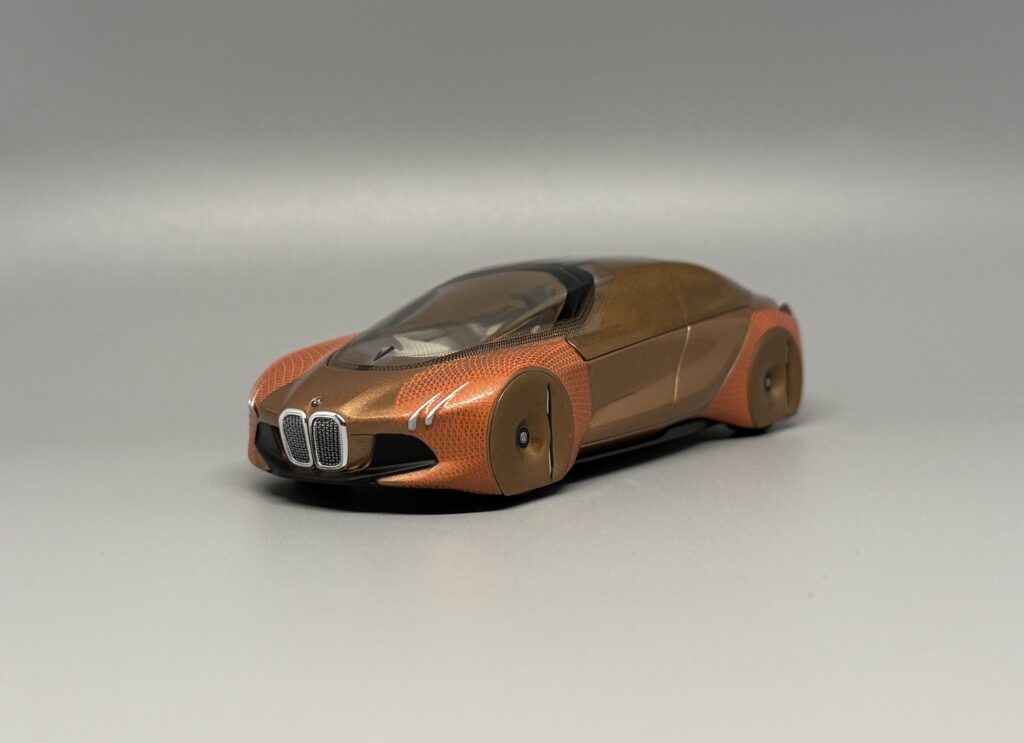
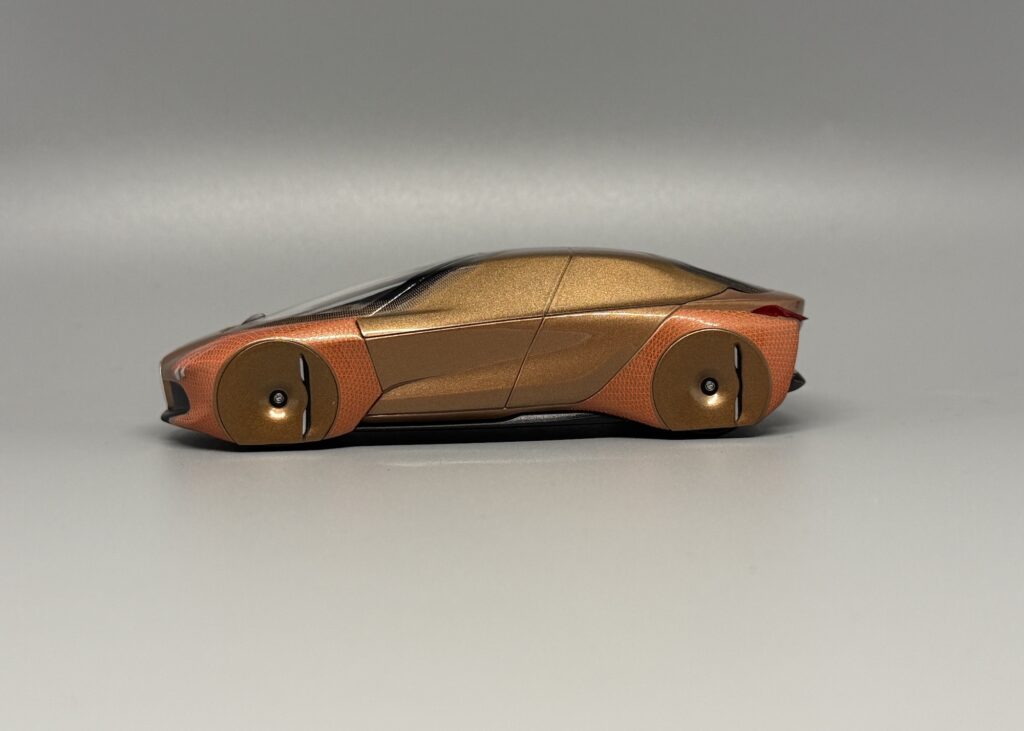
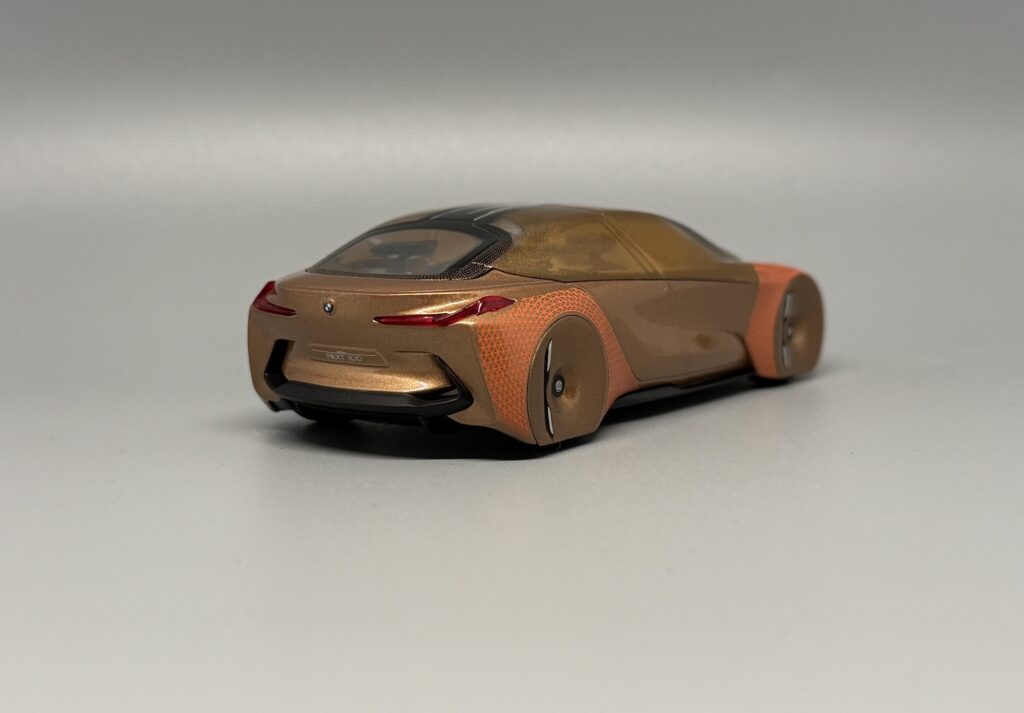
The BMW Vision Next 100 combined the sporting character of a coupé with the elegance of a large saloon. The car was approximately 4.90 metres long and only 1.37 metres high, yet BMW stated that its interior offered space comparable to that of a large luxury saloon. One of the most striking exterior features was the almost completely enclosed wheels. When steering, flexible body sections around the wheel arches adapted to the movement of the wheels, making the body appear almost like a living skin. This solution helped the concept achieve an exceptionally low drag coefficient of Cd 0.18. With its copper-coloured exterior finish, BMW aimed to combine a technological vision of the future with a certain sense of warmth, underlining the idea that even a highly digital future car should retain a personal and emotional character.
Boost and Ease
A central idea of the BMW Vision Next 100 was based on two very different operating modes: Boost and Ease. In Boost mode, the driver remained at the centre of the experience, while technology was intended to help turn the driver into what BMW called the “Ultimate Driver”. The seat, steering wheel and centre console adjusted for active driving, while a future-oriented Head-Up Display concept extending across the entire windscreen could show information such as the ideal driving line, braking or turning points and other relevant data. In Ease mode, the car took over the driving task and the interior transformed into a more relaxed space: the steering wheel and centre console retracted, the seating position changed and the occupants could turn more towards each other. BMW therefore did not present autonomous driving as a complete replacement for the driver, but as an opportunity to choose between active driving and automated mobility depending on the situation.
Alive Geometry and Companion
One of the most futuristic features of the Vision Next 100 was Alive Geometry. Nearly 800 small movable triangular elements were integrated into the interior and could change their position to communicate information to the driver in a visual and intuitive way. In Boost mode, for example, the system could indicate the ideal driving line or warn of an approaching hazard. BMW’s idea was that future communication between car and driver should not rely only on screens, but that the physical surfaces of the vehicle themselves could become intelligent and responsive. Another central element was the Companion, a sculptural digital assistant positioned on the dashboard that was intended to learn the driver’s habits and needs. When switching to Ease mode, the Companion rose from the dashboard and indicated that the vehicle was ready for autonomous driving. It was also intended to help the car communicate with other road users, including pedestrians.
Future materials and user experience
The BMW Vision Next 100 was not focused only on automation and digital technology, but also on how future cars might be manufactured. BMW anticipated that alongside conventional production methods, rapid manufacturing, 4D printing and intelligent materials could become increasingly important, combining structural and functional properties. The concept also made use of textiles made from recycled or renewable materials, while some carbon-fibre components were produced using material left over from conventional carbon-fibre manufacturing. This formed part of a broader vision in which a future premium car would not simply mean more technology, but also new production methods and a more conscious approach to materials.
Significance in BMW history
The significance of the BMW Vision Next 100 lies primarily in the fact that, on BMW’s 100th anniversary, it summarised the company’s vision for the next century. It was not a conventional prototype intended to lead to a production model a few years later, but a much broader exploration of what BMW could become in a world where the car knows its user, communicates with its surroundings and is capable of driving itself. At the same time, BMW’s message was clear: technological progress should not eliminate what has long been central to the brand’s identity – the connection between driver and car and the pleasure of driving. Vision Next 100 was also the first of BMW Group’s 2016 Vision Vehicles, through which BMW, MINI, Rolls-Royce and BMW Motorrad presented their own visions of future mobility.
Model in the collection
The model in my collection was produced by Norev and is an official BMW dealer model.
Technical specifications
Public debut: 7 March 2016
Presentation venue: Munich, Germany
Type: concept car / future vision
Length: approximately 4.90 m
Height: approximately 1.37 m
Drag coefficient: Cd 0.18
Driving modes: Boost and Ease
Key technologies: Alive Geometry, Companion and a full-windscreen Head-Up Display concept
Powertrain: no specific technical details were published
Power output: not disclosed
Concept: combining driver-controlled and autonomous driving with an intelligent and personalised user experience
Special feature: a future concept created for BMW’s 100th anniversary, presenting the company’s vision of premium mobility for the next century

Photo of the real car. Source: theinspirationgrid.com