
Background
BMW Vision EfficientDynamics was presented at the 2009 Frankfurt Motor Show and became one of BMW’s most important concept cars of the 21st century. The aim of the project was to demonstrate that sports-car performance, very low fuel consumption and an electrified powertrain did not have to be conflicting goals. BMW wanted to combine the brand’s characteristic driving pleasure, future-oriented technology and significantly improved efficiency in a single vehicle. Vision EfficientDynamics was not merely a futuristic design study, but a very concrete technological vision whose ideas would later be developed further for production. The project eventually led first to the 2011 BMW i8 Concept and then to the production BMW i8, which entered production in 2014.
Design and aerodynamics
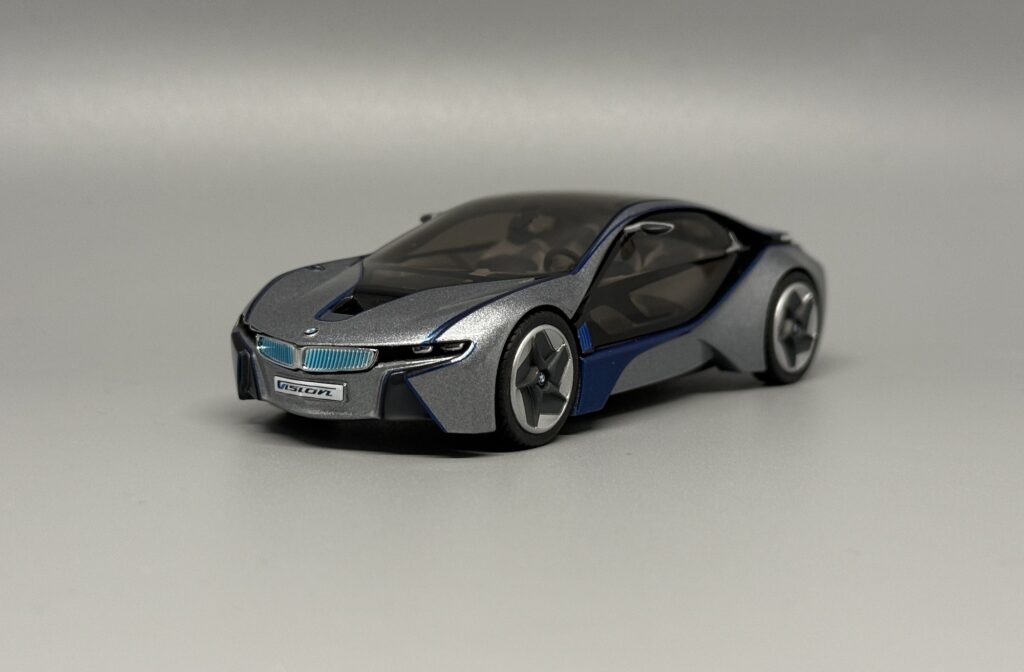
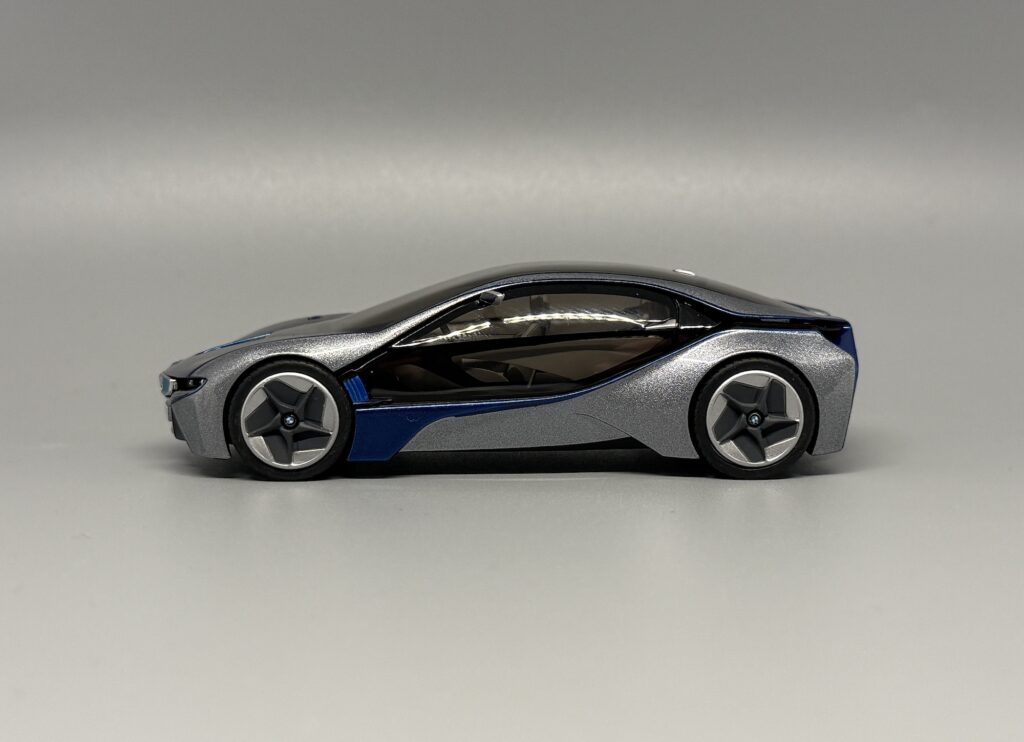
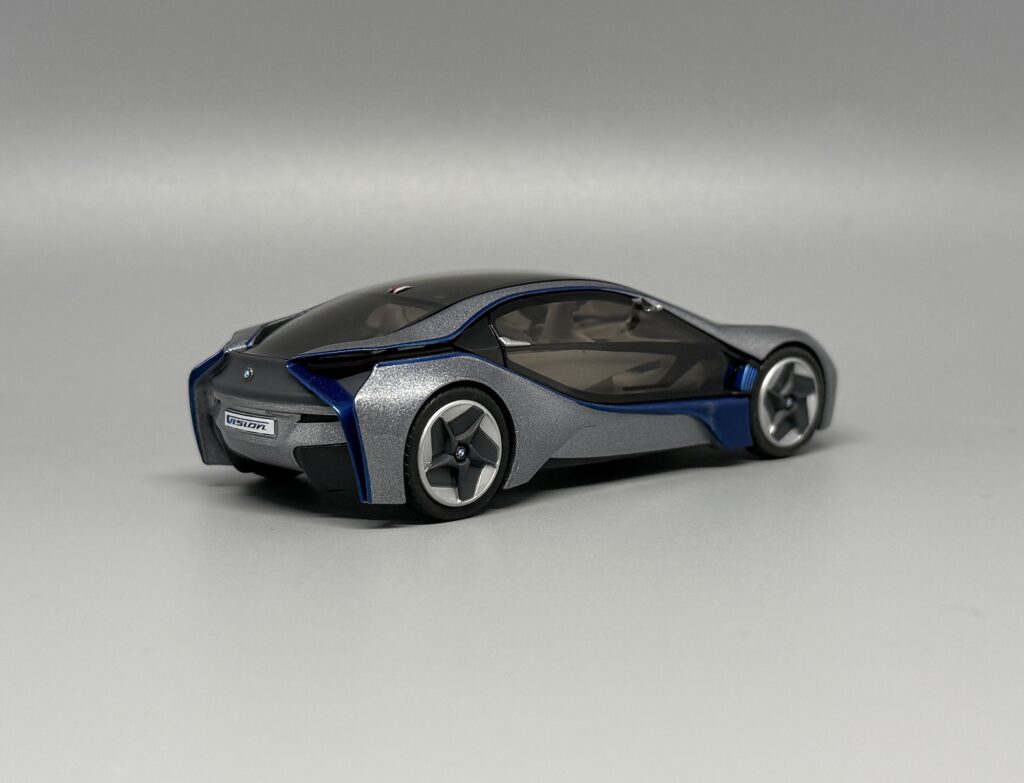
The BMW Vision EfficientDynamics was deliberately designed to look very different from the conventional hybrid cars of its time. Instead of focusing only on efficiency, BMW created a low and dramatic 2+2-seat sports car. Its wedge-shaped silhouette, large transparent surfaces, upward-opening doors and complex layered body design gave it a highly futuristic appearance. The form was strongly influenced by aerodynamics: airflow was carefully guided through and around the body, while special solutions around the wheels were used to reduce turbulence. The result was a drag coefficient of Cd 0.22, an exceptionally low figure for a sports car. The design of Vision EfficientDynamics later proved particularly important because several of its key features – including the low silhouette, layered body surfaces, aerodynamic channels and upward-opening doors – appeared in recognisable form on the BMW i8.
Hybrid powertrain
Vision EfficientDynamics used a highly advanced plug-in hybrid system for its time. Its internal-combustion engine was a 1.5-litre three-cylinder turbo diesel, positioned ahead of the rear axle and producing 163 hp. It was supported by two electric motors – one on the front axle and another at the rear. Working together, the three power sources delivered a total system output of 356 hp and maximum torque of 800 Nm. The arrangement of the electric motors allowed the car to operate with all-wheel drive and, depending on the situation, to drive using electric power alone, the diesel engine alone or all three power sources together. Electrical energy was stored in a lithium-polymer battery that could be charged from an external power supply and could also recover energy through regenerative braking.
Performance and efficiency
BMW’s aim with Vision EfficientDynamics was to combine sports-car performance with the fuel consumption and emissions of a much smaller car. The concept could accelerate from 0 to 100 km/h in approximately 4.8 seconds and had an electronically limited top speed of 250 km/h. At the same time, BMW quoted an average fuel consumption of around 3.76 l/100 km under the European test cycle, with CO₂ emissions of 99 g/km. The all-electric driving range was planned to be approximately 50 kilometres, while the total driving range with the diesel engine was around 700 kilometres. These figures were remarkable for a sports car in 2009 and clearly expressed BMW’s EfficientDynamics philosophy: greater performance did not necessarily have to mean greater energy consumption.
Lightweight construction and future technology
The car’s construction was just as important to its efficiency as the powertrain. Vision EfficientDynamics had a kerb weight of approximately 1,395 kilograms, which was remarkably low for a hybrid sports car carrying three motors and a large high-voltage battery. BMW used lightweight materials extensively and positioned the battery in the centre of the car to achieve a low centre of gravity and favourable weight distribution. The vehicle was also designed from the outset around its hybrid system rather than having electrification added later to an existing platform. This approach later became a key principle of BMW i models, where lightweight construction, carbon-fibre-reinforced plastic and architectures specifically developed for electrified drivetrains became central technical features.
The road to the BMW i8
The most important legacy of Vision EfficientDynamics is its direct connection to the BMW i8. The concept attracted so much attention after its 2009 debut that BMW began studying the possibility of turning its core ideas into a production car. In 2011, the BMW i8 Concept was presented, carrying forward both the design language and the plug-in hybrid sports-car philosophy of Vision EfficientDynamics in a much more production-ready form. When the BMW i8 entered series production in 2014, some of the technical details had changed – most notably, the turbo diesel engine was replaced by a petrol engine – but the basic concept remained the same: a small turbocharged internal-combustion engine, electric drive, lightweight construction, an aerodynamically optimised body and sports-car performance combined with very low energy consumption.
Significance in BMW history
BMW Vision EfficientDynamics marked an important transition from the earlier individual measures of the EfficientDynamics programme to a fully integrated electrified sports-car concept. It demonstrated more clearly than ever before that electrification did not have to mean giving up sportiness or emotional design. Vision EfficientDynamics became one of the key steps in the development of the BMW i sub-brand and the i8, and also showed how a radical concept car could evolve into a genuine production model within only a few years. In retrospect, it was one of the most important vehicles in BMW’s electrification history, combining performance, aerodynamics, lightweight construction and plug-in hybrid technology in a single coherent concept.
Model in the collection
The model in my collection was produced by Paragon Models and is an official BMW dealer model.
Technical specifications
Public debut: 2009
Presentation venue: IAA Frankfurt, Germany
Type: concept car / plug-in hybrid sports car
Body style: 2+2-seat sports car
Engine: 1.5-litre three-cylinder turbo diesel, 163 hp
Electric drive: two electric motors, one on the front axle and one at the rear
Total system output: 356 hp
Maximum torque: 800 Nm
Drivetrain: hybrid all-wheel drive
Battery: lithium-polymer battery
0–100 km/h: approximately 4.8 seconds
Top speed: 250 km/h, electronically limited
All-electric range: approximately 50 km
Fuel consumption: approximately 3.76 l/100 km
CO₂ emissions: 99 g/km
Drag coefficient: Cd 0.22
Kerb weight: approximately 1,395 kg
Special feature: the direct technological and design predecessor of the BMW i8 and one of BMW’s most important electrified sports-car concepts
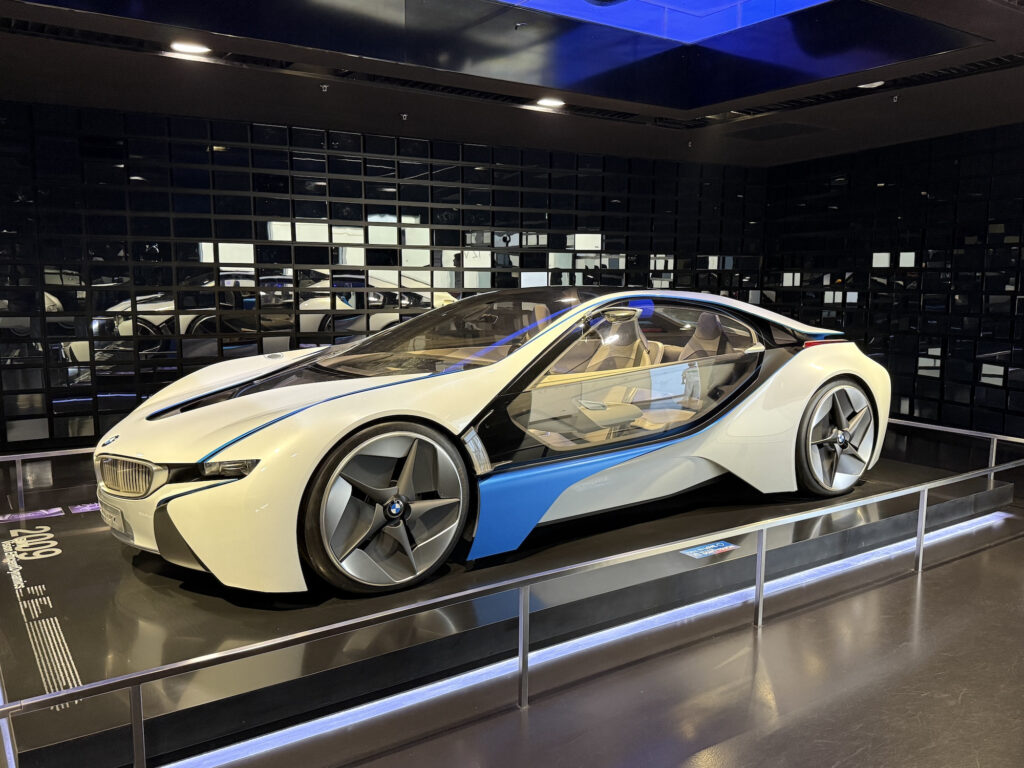
Photo of the real car, BMW Museum. Photo: Sten-Patrick Kreek