
Background
BMW M2 Competition (F87) was a substantially developed version of the first-generation BMW M2, joining the model range in 2018 and replacing the original BMW M2 Coupé. While the first M2, introduced in 2016, had already brought the idea of a compact BMW M car back into the modern era, the M2 Competition moved technically much closer to the larger BMW M3 and M4. The most important change was the replacement of the previous N55 engine with the BMW M GmbH S55 power unit, but the upgrades also included increased body rigidity, improved cooling, revised steering, differential, brakes and exhaust system. The result was a car that retained the compact dimensions and straightforward character of the original M2 while offering greater performance and an even stronger BMW M identity.
Design
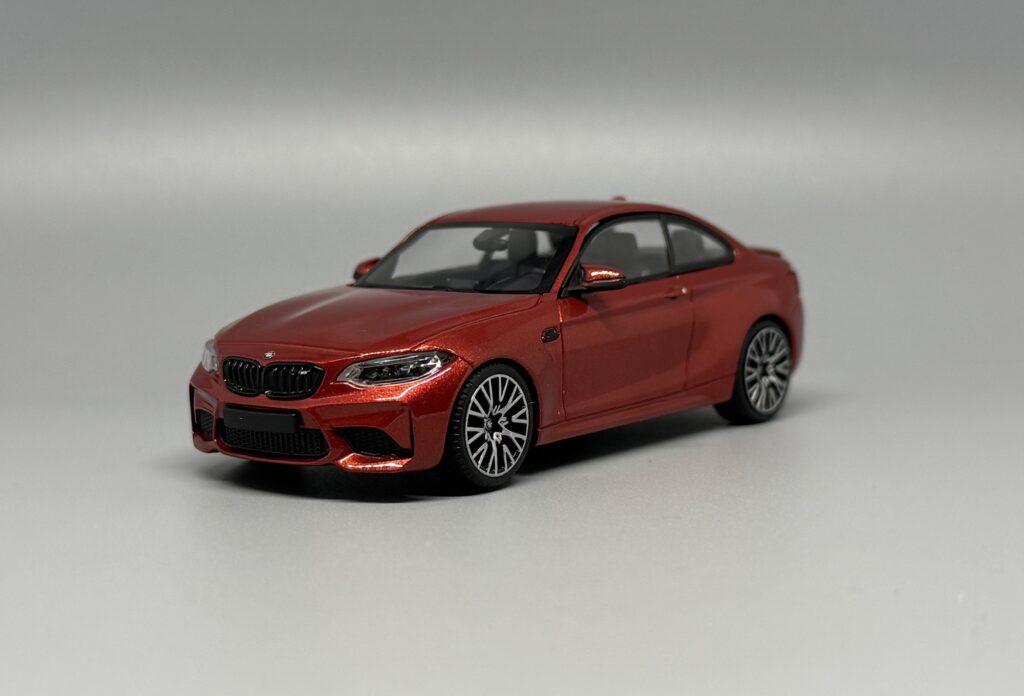
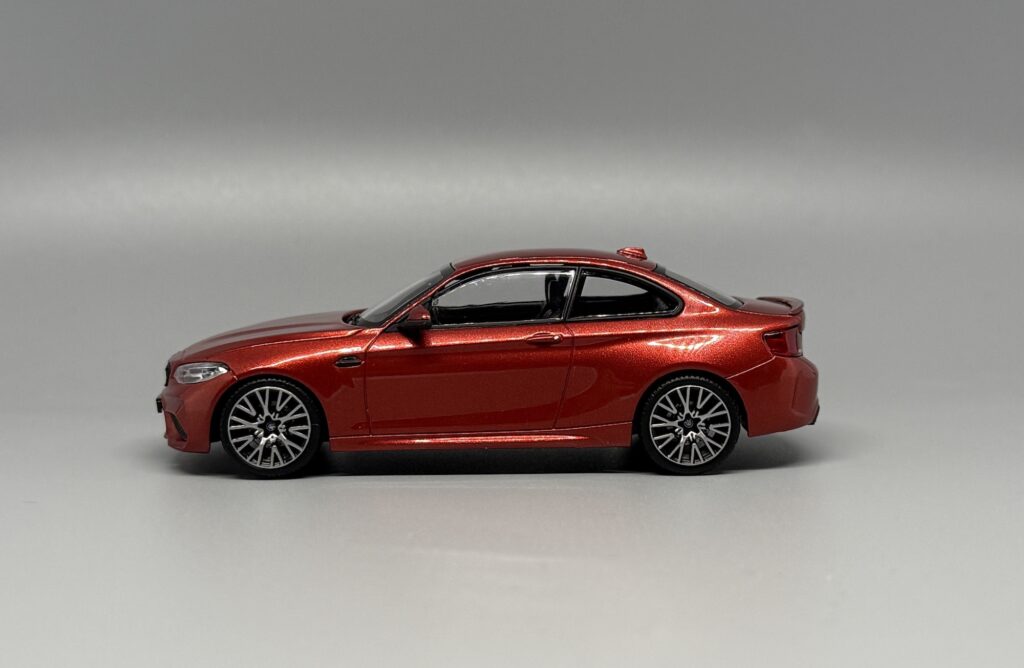
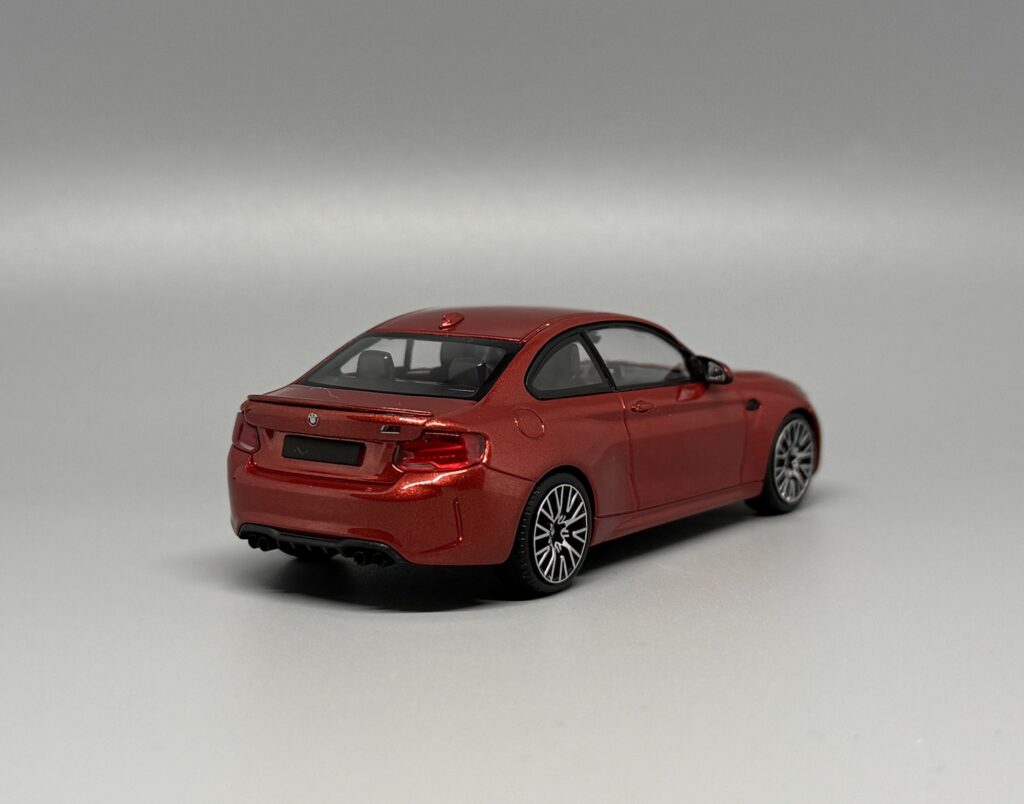
The M2 Competition retained the muscular proportions that characterised the F87: a short body, wide wheel arches, long bonnet and relatively short overhangs gave the car a compact and powerful appearance. Compared with the earlier M2, the Competition version was distinguished by larger high-gloss black BMW kidney grilles, a revised front end with enlarged cooling openings and BMW M-style double-stalk exterior mirrors. At the rear, the four-outlet M exhaust system remained, although the new system featured electronically controlled flaps. The M2 Competition also introduced the distinctive Hockenheim Silver metallic paint finish and newly designed 19-inch M light-alloy wheels. The changes did not alter the basic shape of the F87 but gave it an even stronger technical and visual connection with the BMW M3 and M4.
S55 six-cylinder engine
The biggest difference between the M2 Competition and the earlier M2 was its 2,979 cm³ S55 six-cylinder in-line engine, derived from the power unit used in the BMW M3 and M4. The twin-turbocharged M TwinPower Turbo engine produced 410 hp, or 302 kW, between 5,250 and 7,000 rpm and a maximum torque of 550 Nm between 2,350 and 5,200 rpm. Compared with the previous 370 hp M2, this represented a significant increase in performance, but equally important was the engine’s character and its close technical relationship with the larger BMW M models. The M2 Competition also received an upgraded cooling and oil-supply system derived from the M4 Competition Package in order to maintain reliability under heavy loads and during track use.
Transmission and performance
The BMW M2 Competition remained rear-wheel drive and was offered with two transmissions. The more traditional choice was a six-speed manual gearbox, while a seven-speed M Double Clutch Transmission, or M DCT, was available as an alternative. With the manual gearbox, the car accelerated from 0 to 100 km/h in approximately 4.4 seconds, while the M DCT version achieved the same sprint in 4.2 seconds. Top speed was electronically limited to 250 km/h, but the optional M Driver’s Package raised the limit to 280 km/h. Power was transmitted to the rear wheels through an electronically controlled Active M Differential, which could vary the locking effect according to driving conditions.
Chassis and body rigidity
The M2 Competition received much more than just a more powerful engine. BMW M GmbH also strengthened the front structure and fitted a CFRP, or carbon-fibre-reinforced plastic, precision strut brace derived from the BMW M3 and M4. Its purpose was to increase front-end rigidity and improve steering precision. The electromechanical power steering, Active M Differential and Dynamic Stability Control systems were all recalibrated specifically for the Competition version. The braking system was also upgraded, and an optional larger M Sport braking system was available with six-piston front calipers and four-piston rear calipers. All of these changes were intended to improve precision, durability and consistency when the car’s performance was used over longer periods, particularly on a race circuit.
Interior
The Competition version also differed from the earlier M2 inside. The steering wheel gained programmable M1 and M2 buttons, allowing the driver to access stored combinations of engine, steering and M DCT settings quickly. Newly designed M Sport seats with integrated head restraints were available, featuring illuminated M2 logos in the backrests. The overall interior design nevertheless remained deliberately simple and driver-focused. The M2 Competition was not intended as a luxury grand tourer, but as a compact four-seat high-performance car in which the main emphasis remained on the driver and the driving experience.
The Competition within the F87 development
The M2 Competition formed an important intermediate stage between the original M2 and the later M2 CS. The original 370 hp N55-powered M2 established the success of the F87, the Competition introduced the 410 hp S55 engine, and the BMW M2 CS, unveiled in 2019, developed the same concept even further with 450 hp, additional carbon-fibre components and an even more track-focused setup. BMW also developed an M2 CSL prototype based on the Competition, although the model that ultimately reached production was the M2 CS. The F87 generation therefore followed a clear development path from the original M2 through the M2 Competition to the more exclusive M2 CS.
Production
The BMW M2 Competition was produced at BMW Group Plant Leipzig in Germany. Production began in the summer of 2018 and continued until the end of the F87 generation. BMW’s publicly available factory statistics do not list a separate production total for the M2 Competition. According to BMW Group Plant Leipzig, a total of 61,856 F87 M2 models were produced between 2015 and 2021; this figure includes the different F87 M2 variants and does not represent the M2 Competition alone.
Significance in BMW M history
The BMW M2 Competition became one of the most characteristic versions of the F87 generation. It combined a relatively small and simple two-door body with technology from the BMW M3 and M4 at a time when BMW M models in general were becoming larger and more complex. Its six-cylinder engine, rear-wheel drive, availability with a manual gearbox and compact dimensions reflected many of the principles traditionally associated with earlier BMW M cars. At the same time, the M2 Competition was modern and powerful enough to deliver very high performance both on public roads and on the track. This combination helped establish the M2 as one of the most important compact performance models in the BMW M range.
Model in the collection
The model in my collection was produced by Minichamps and represents the 2019 BMW M2 Competition (F87). It was produced in a limited edition of 300 examples.
Technical data in brief
Production period: 2018–2021
Place of production: BMW Group Plant Leipzig, Germany
Body style: two-door four-seat Coupé
Engine: 2,979 cm³ S55 twin-turbocharged six-cylinder in-line engine
Power: 410 hp / 302 kW
Torque: 550 Nm
Drivetrain: rear-wheel drive
Gearbox: 6-speed manual or 7-speed M DCT
0–100 km/h: 4.4 s with manual gearbox / 4.2 s with M DCT
Top speed: 250 km/h
Top speed with M Driver’s Package: 280 km/h
Differential: Active M Differential
Total F87 M2 family production: 61,856 cars
Separate M2 Competition production figure: not published by BMW
Special feature: a development of the original BMW M2 using the S55 engine from the M3 and M4, and the technical basis for the more powerful BMW M2 CS
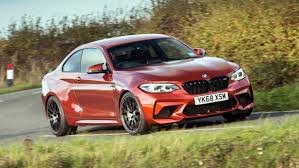
Photo of the real car. Source: evo.co.uk