Background
BMW M2 CS (F87) was the most powerful, exclusive and track-focused series-production version of the first-generation BMW M2. Unveiled at the end of 2019, the model entered production in 2020. The M2 CS was based on the BMW M2 Competition, but BMW M GmbH developed its technical concept considerably further. Engine output was increased, carbon-fibre-reinforced plastic was used extensively, the chassis received a dedicated setup and, for the first time in an M2, Adaptive M suspension was introduced. The result was a car that retained the compact dimensions and traditional rear-wheel-drive character of the F87 while moving even closer to the track-oriented philosophy of BMW M’s CS models.
CS – Competition Sport
The CS, or Competition Sport, designation has traditionally been reserved by BMW M for models combining greater performance, reduced weight and sharper driving dynamics while retaining usability on public roads. The M2 CS was positioned above the M2 Competition and followed the same philosophy previously applied to models such as the M3 CS and M4 CS. Unlike an even more radical CSL concept, the M2 CS retained four seats and remained suitable for everyday use, although its technical solutions and chassis setup were clearly designed with track driving in mind.
Design and carbon-fibre components
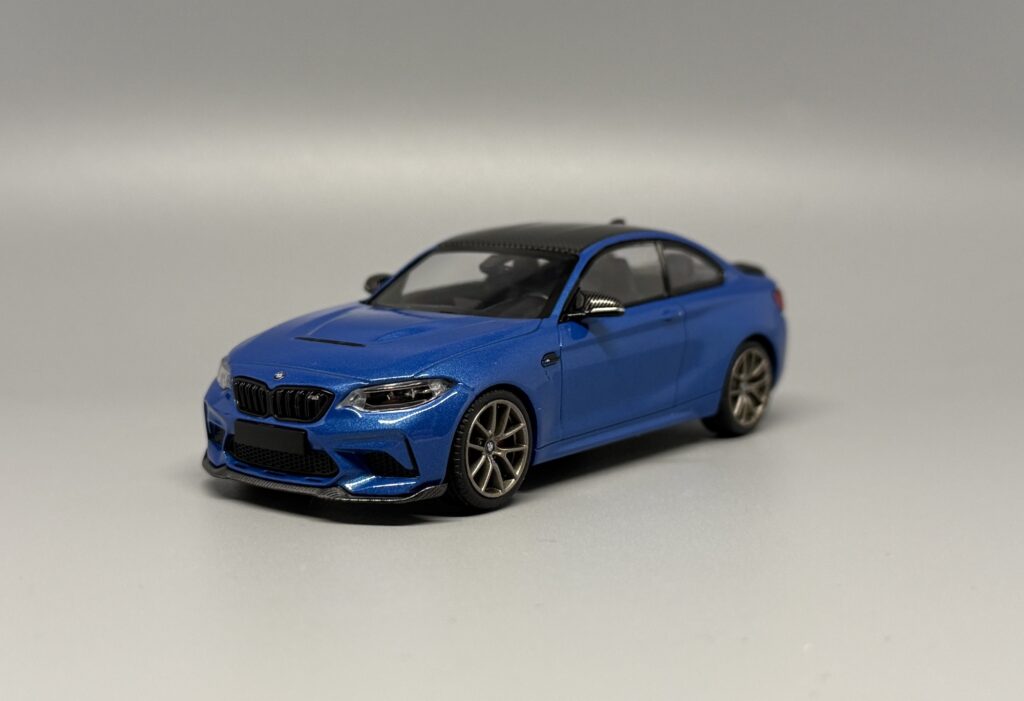
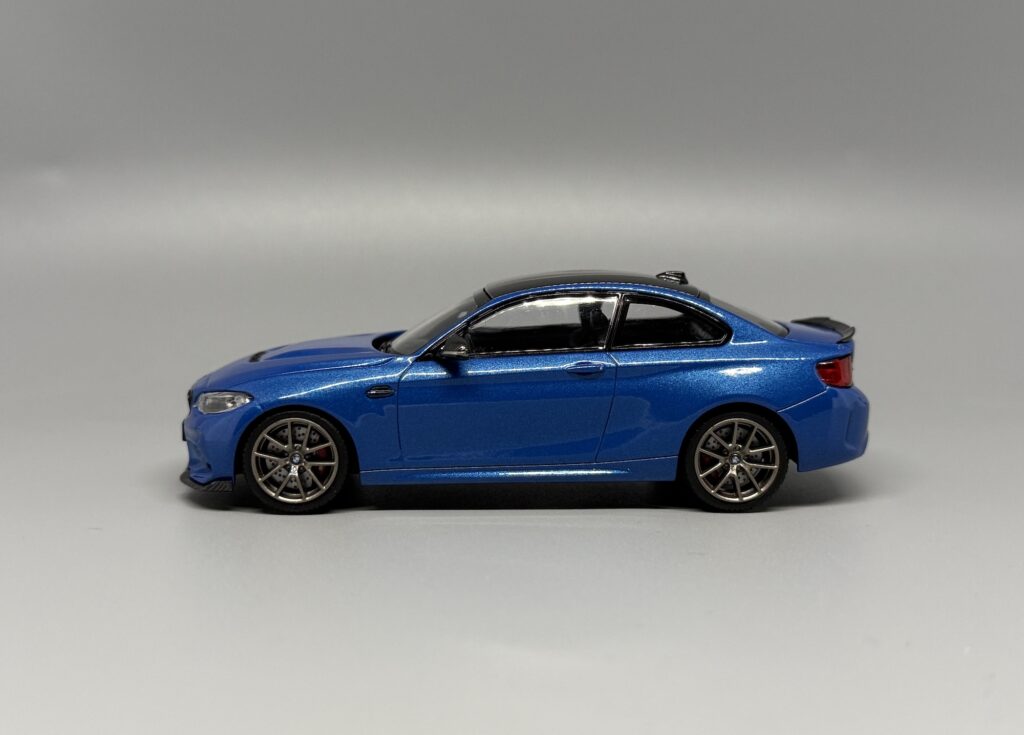
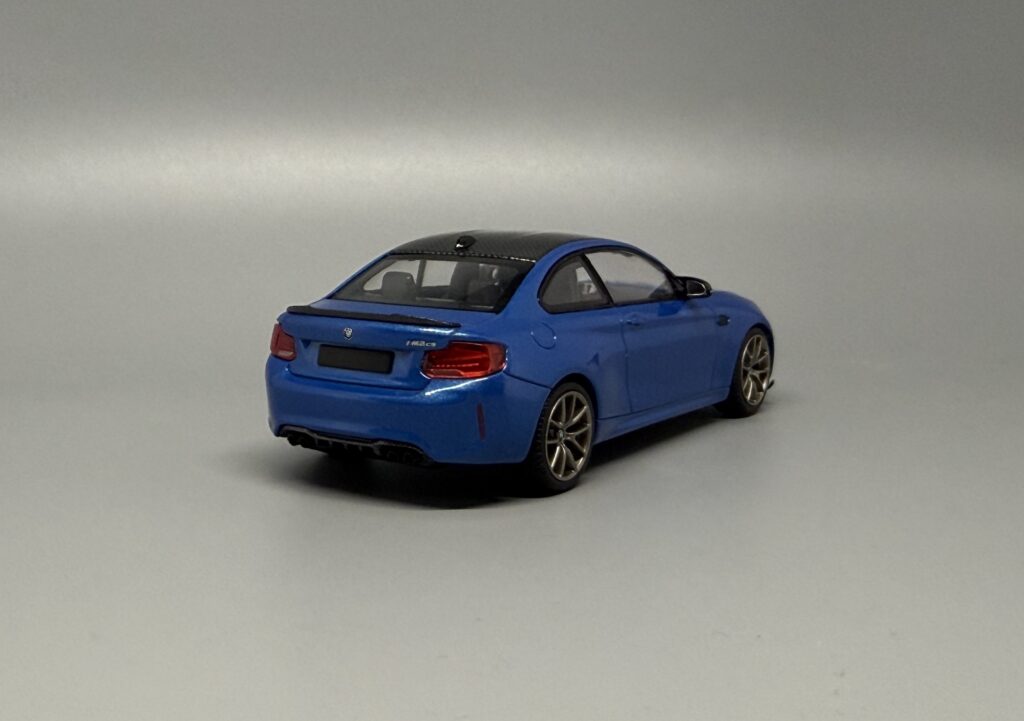
Externally, the M2 CS retained the compact and wide proportions of the F87 but received several features unique to the CS version. One of the most significant changes was the CFRP, or carbon-fibre-reinforced plastic, roof, used for the first time on an M2. A new bonnet was made from the same material, weighing approximately half as much as the conventional component, while its central air outlet improved both engine cooling and aerodynamics. Visible carbon fibre was also used for the front splitter, rear diffuser and Gurney-style spoiler lip on the boot lid. Exclusive Misano Blue metallic became one of the model’s signature colours, while the 19-inch forged M wheels were available in either black or a particularly distinctive matt-gold finish.
S55 six-cylinder engine
The BMW M2 CS used a 2,979 cm³ S55 M TwinPower Turbo six-cylinder in-line engine, further developed from the unit fitted to the M2 Competition and belonging to the same engine family used in the BMW M3 and M4. With two twin-scroll turbochargers, the engine produced 450 hp, or 331 kW, and maximum torque of 550 Nm. This represented an increase of 40 hp over the M2 Competition. The engine was supported by cooling and oil-supply systems designed for the high loads associated with BMW M models, helping maintain consistent performance during extended track use. The additional power not only improved acceleration but also gave the CS an even sharper and more energetic character at higher engine speeds.
Transmission and performance
One of the distinctive features of the M2 CS was the choice between two very different transmissions. A six-speed manual gearbox was fitted as standard, making the M2 CS the first BMW CS model to be offered with a manual transmission. A seven-speed M Double Clutch Transmission, or M DCT, was available as an option. With the manual gearbox, the car accelerated from 0 to 100 km/h in 4.2 seconds, while the M DCT version achieved the same sprint in 4.0 seconds. Power was sent exclusively to the rear wheels through an electronically controlled Active M Differential. The electronically limited top speed was 280 km/h, with the M Driver’s Package included as standard equipment on the M2 CS.
Chassis and brakes
The M2 CS was the first BMW M2 to receive Adaptive M suspension as standard. The electronically controlled dampers allowed the driver to select between Comfort, Sport and Sport+ settings, enabling the car to combine reasonable everyday usability with a considerably firmer track-oriented setup. Suspension geometry and electronic control systems were adapted to the greater performance of the CS, while specially selected Michelin Pilot Sport Cup 2 tyres were available to maximise grip. M Sport brakes with red brake calipers were fitted as standard, while an even more capable M Carbon ceramic braking system was available as an option. Together with the Active M Differential and M Dynamic Mode, the chassis was designed to withstand sustained high-performance driving far more effectively than that of a conventional road car.
Lightweight construction
Reducing weight and lowering the centre of gravity were major priorities in the development of the CS. The carbon-fibre roof, bonnet and aerodynamic components reduced mass particularly in the upper areas of the body, helping improve directional changes and overall balance. Lightweight solutions were also used inside the car: M Sport seats derived from the BMW M4 CS, a carbon-fibre centre console and extensive use of Alcantara and lighter trim materials helped eliminate unnecessary weight. The M2 CS was not, however, a stripped-out two-seat track car. BMW’s aim was to combine reduced weight and improved dynamics with the everyday usability of a four-seat coupé.
Interior
The interior of the M2 CS differed from that of the Competition through a number of model-specific details. Lightweight M Sport seats featured integrated head restraints, M colours and a combination of Merino leather and Alcantara. The carbon-fibre centre console emphasised both lightweight construction and the car’s exclusivity, while the Alcantara-covered M Sport steering wheel could be specified with a red centre marker. CS and M2 logos throughout the cabin reinforced the fact that this was not simply a more powerful M2, but a dedicated limited-production BMW M special model.
M2 CS and the M2 CSL prototype
The development history of the M2 CS is particularly interesting because BMW M also worked on an even more radical M2 CSL prototype. Both were based on the M2 Competition and their S55 engines produced 450 hp and 550 Nm. The CSL, however, was a two-seater, lighter still, and featured equipment such as a roll cage, racing seats, a large carbon-fibre rear wing and carbon-ceramic brakes. BMW M ultimately chose the more versatile M2 CS for series production, while the M2 CSL remained a one-off prototype. This development background illustrates how close the M2 CS came to an even more uncompromising track-focused concept.
Production
The BMW M2 CS was produced at BMW Group Plant Leipzig in Germany for a very short period. According to BMW M, production ran from March to September 2020. From the beginning, the model was presented as a limited-production special edition. Later compiled worldwide production data indicate that a total of 2,381 BMW M2 CS cars were produced, making it considerably rarer than the regular M2 and M2 Competition. Its short production period and limited numbers have helped establish the M2 CS as one of the most exclusive versions of the F87 generation.
Significance in BMW M history
The BMW M2 CS effectively represented the ultimate series-production development of the first-generation M2. The original M2 revived the idea of a compact rear-wheel-drive BMW M coupé, the M2 Competition introduced technology from the M3 and M4, and the CS combined this stronger technical basis with more power, adaptive suspension, lightweight carbon-fibre construction and a more track-focused setup. At the same time, it retained a six-cylinder engine, rear-wheel drive and even the option of a manual gearbox – qualities closely associated with the traditional driver-focused philosophy of BMW M. For this reason, the F87 M2 CS occupies a significant place among BMW M’s modern compact performance cars.
Model in the collection
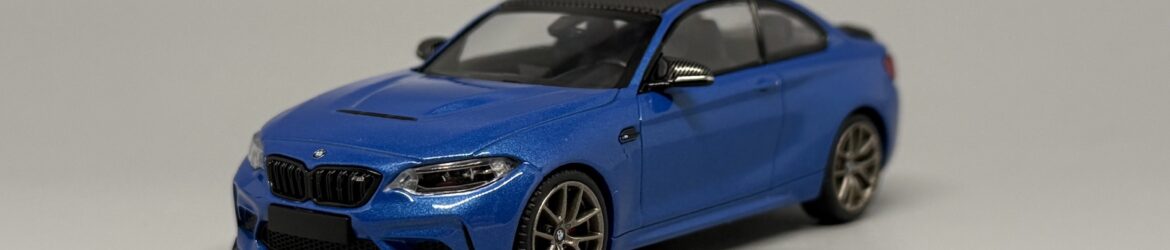
The model in my collection was produced by Minichamps and represents the 2020 BMW M2 CS (F87). It was produced in a limited edition of 864 examples.
Technical data in brief
Introduction: 2019
Production period: 03/2020–09/2020
Place of production: BMW Group Plant Leipzig, Germany
Body style: two-door four-seat Coupé
Engine: 2,979 cm³ S55 M TwinPower Turbo six-cylinder in-line engine
Forced induction: two twin-scroll turbochargers
Power: 450 hp / 331 kW
Torque: 550 Nm
Drivetrain: rear-wheel drive
Gearbox: 6-speed manual or 7-speed M DCT
0–100 km/h: 4.2 s with manual gearbox / 4.0 s with M DCT
Top speed: 280 km/h
Differential: Active M Differential
Suspension: Adaptive M suspension
Brakes: M Sport; M Carbon ceramic brakes optional
Production number: 2,381 cars
Special feature: the most powerful and track-focused series-production version of the F87 generation, featuring extensive use of CFRP components
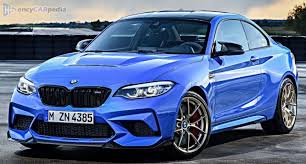
Photo of the real car. Source: encycarpedia.com