
Background
BMW 6 Series Convertible (E64) reached the market in 2004 and became the first series-production open-top BMW 6 Series. A few months earlier, the E63 Coupé had returned the 6 Series name to the BMW range after a long absence, and the E64 expanded the new model family with a luxurious four-seat Convertible. The car combined the essential qualities of a large BMW grand tourer – a long bonnet, rear-wheel drive, powerful six- and eight-cylinder engines and a high level of comfort – with the added appeal of open-air driving. The E64 was not simply a 6 Series Coupé without a roof, but a carefully engineered grand tourer with body structure, roof mechanism and aerodynamics developed specifically for the demands of a large luxury convertible.
The first 6 Series Convertible
The historical importance of the E64 lies in the fact that the earlier E24 6 Series had never been offered by BMW as a factory-built Convertible. The E64, introduced in 2004, was therefore the first official open-top 6 Series. The idea of a large four-seat luxury convertible was not entirely new to BMW, however, as its roots could be traced back to models such as the BMW 503 Cabriolet of the 1950s. The E64 reinterpreted the same basic concept for the new millennium, combining an elegant open body, sporting handling and long-distance comfort.
Design
The E64 continued the bold BMW design language of the early 2000s that also characterised the E63 Coupé. Its long bonnet, low beltline, rearward-positioned passenger compartment and strongly sculpted rear section created proportions appropriate for a classic grand tourer. The open body gave the car a softer and more elegant appearance than the Coupé, while the broad stance and muscular surfaces retained the sporting character of the 6 Series. It was particularly important that the Convertible should preserve a coupé-like silhouette with the roof raised, which led BMW to develop the model’s distinctive fin-roof design.
Distinctive fin-roof
One of the most recognisable features of the E64 was its electrically operated multi-layer fabric roof, whose rear section formed two elongated fins visually similar to the C-pillars of a coupé. Between them sat a vertical glass rear window that was not attached directly to the folding roof itself. The heated rear window could be electrically lowered independently with either the roof open or closed, allowing additional ventilation without lowering the entire roof. BMW emphasised that this solution combined good rearward visibility, low wind noise and a coupé-like exterior profile. The multi-layer roof also incorporated thermal and acoustic insulation, making the E64 suitable for year-round use.
Convertible practicality
BMW designed the E64 as a genuine four-seat grand tourer rather than merely an open sports car with token rear seats. Two individually shaped seats were provided in the rear, while the luggage compartment offered approximately 350 litres of capacity with the roof closed and around 300 litres with the roof open. The folded roof occupied a dedicated compartment, allowing the luggage area to remain reasonably usable during open-top driving. Automatic rollover protection, a strengthened body shell and structural measures developed specifically for the Convertible helped compensate for the loss of rigidity caused by the absence of a fixed roof.
Chassis and driving character
The E64 shared many of its chassis and electronic systems with the E63 Coupé. It retained a traditional rear-wheel-drive layout and made extensive use of aluminium suspension components. The optional Dynamic Drive system reduced body roll in corners, while Active Steering varied the steering ratio according to speed and driving conditions. Dynamic Stability Control and Dynamic Traction Control supported the driver in more demanding situations. Although the Convertible was heavier than the Coupé and placed slightly greater emphasis on comfort, it was still intended to retain the driver-focused and sporting character of the BMW 6 Series.
Engine range
The E64 initially reached the market as the BMW 645Ci Convertible. Its 4.4-litre naturally aspirated V8 produced 333 hp and 450 Nm and suited the character of a large luxury convertible particularly well. The six-cylinder 630i was added later, providing a lighter and more balanced alternative to the V8 models. The 645Ci was eventually replaced by the BMW 650i, whose 4.8-litre V8 developed 367 hp and 490 Nm. The regular petrol range therefore extended from the refined six-cylinder 630i to the powerful V8-powered 650i.
BMW 635d Convertible
With the 2007 model update, the BMW 635d Convertible joined the range, becoming the first diesel-powered 6 Series Convertible. Its 2,993 cm³ six-cylinder Variable Twin Turbo diesel engine produced 286 hp and 580 Nm. The strong torque output suited the character of a large grand tourer particularly well and allowed high-speed long-distance travel to be combined with comparatively low fuel consumption. At the time of its introduction, BMW described the 635d engine as the world’s most powerful series-production six-cylinder diesel. The Convertible accelerated from 0 to 100 km/h in 6.6 seconds and had an electronically limited top speed of 250 km/h.
2007 model update
In 2007, the E64 received a Life Cycle Impulse update together with the E63 Coupé. Exterior details at the front and rear, lighting elements and interior trim were revised, while the basic design and character of the model remained unchanged. The 630i received a new 272 hp direct-injection six-cylinder petrol engine, while the 635d joined the range. Transmissions, BMW iDrive, driver-assistance systems and several EfficientDynamics measures were also improved. The 650i continued with its 367 hp 4.8-litre V8.
Interior and technology
The E64 interior combined the materials and comfort of a luxury grand tourer with BMW’s modern electronic systems of the early 2000s. The driver-oriented cockpit, electrically adjustable seats, high-quality leather and trim materials and BMW iDrive underlined the car’s premium positioning. Depending on model year and specification, equipment could include Head-Up Display, Active Cruise Control, adaptive headlights, navigation, premium audio systems and various other comfort and driver-assistance features. The aim of the E64 was not to provide a stripped-out sports-car experience, but to combine performance and handling with a high level of everyday comfort.
Transmissions
During the production life of the E64, transmission availability depended on the engine version and market. The early 645Ci could be ordered with a six-speed manual gearbox, a six-speed Steptronic automatic or a six-speed SMG sequential transmission. Later, the automatic transmission became increasingly important, and the model update introduced a new Sport Automatic with quicker shifts and steering-wheel-mounted shift paddles. Regardless of engine choice, the regular E64 remained rear-wheel drive throughout the generation.
BMW M6 Convertible
The most powerful and technically advanced variant of the model family was the BMW M6 Convertible (E64). Developed by BMW M GmbH, it used the 4,999 cm³ naturally aspirated S85 V10 engine producing 507 hp and 520 Nm. A seven-speed SMG Drivelogic transmission, M-specific chassis, variable-locking M differential and more powerful brakes moved the open-top 6 Series into an entirely different performance category. The M6 was, however, technically distinct enough to be considered a separate BMW M model rather than simply another version of the regular E64 range.
Production
The BMW 6 Series Convertible E64 was produced at BMW Group Plant Dingolfing in Germany from 2004 to 2010. Widely cited E63/E64 production statistics indicate that 54,173 E64 Convertibles were built, excluding M6 versions. BMW’s own later historical overview gives a sales figure of 49,053 cars for the same generation between 2004 and 2010; the difference reflects production volume versus customer sales. Together with the E63 Coupé, the E64 formed an important part of the successful return of the 6 Series to the BMW model range.
Significance in BMW history
The BMW 6 Series Convertible E64 was significant above all as the first series-production open-top 6 Series. It combined BMW’s large grand tourer tradition with an open body and introduced a luxurious four-seat Convertible positioned clearly above the marque’s smaller open models. Its distinctive fin-roof, independently retractable glass rear window, six- and eight-cylinder engines and high level of technology gave the E64 a strong identity of its own. Together with the E63 Coupé, it laid the foundation for the continuation of the 6 Series in later generations and established the large luxury open grand tourer as a permanent part of BMW’s model range.
Model in the collection
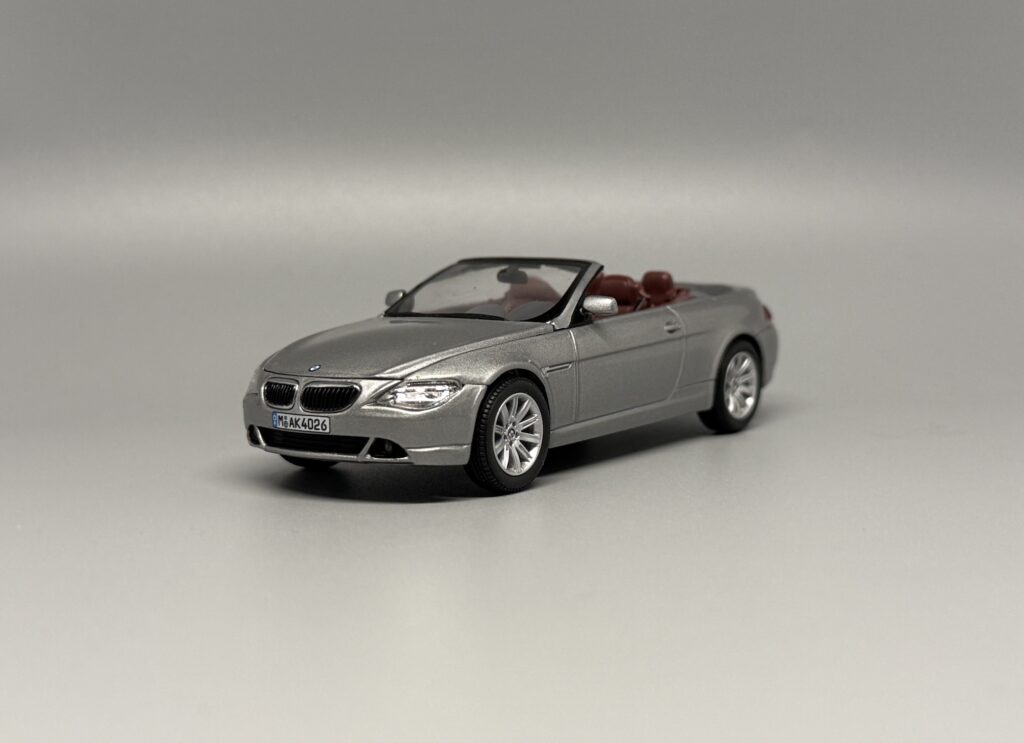
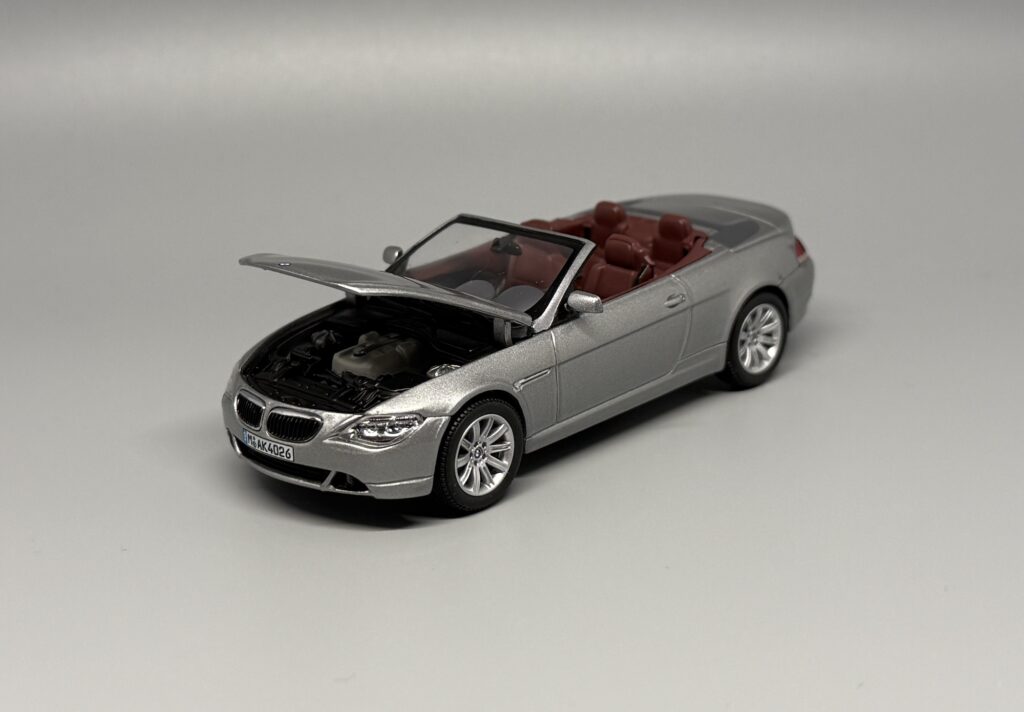
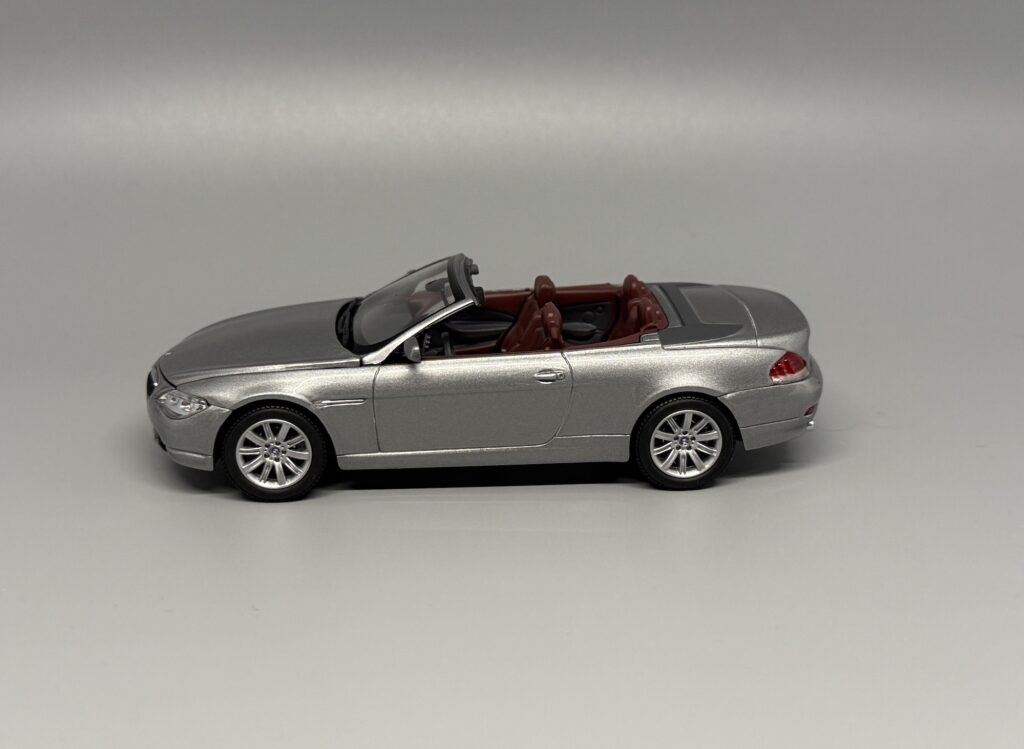
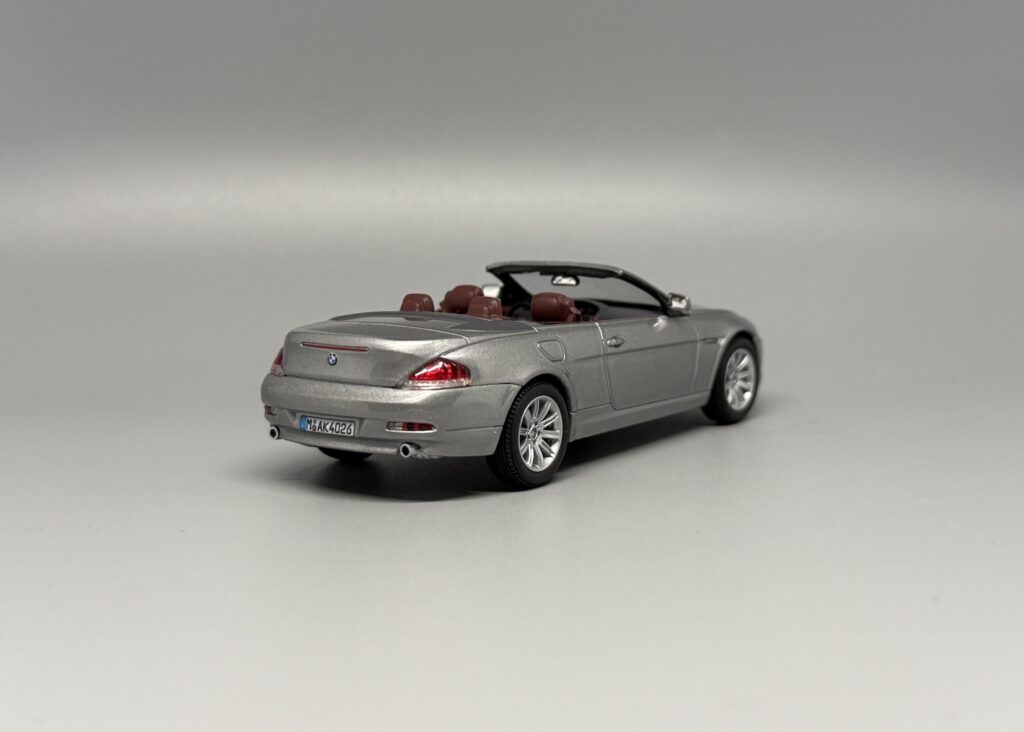
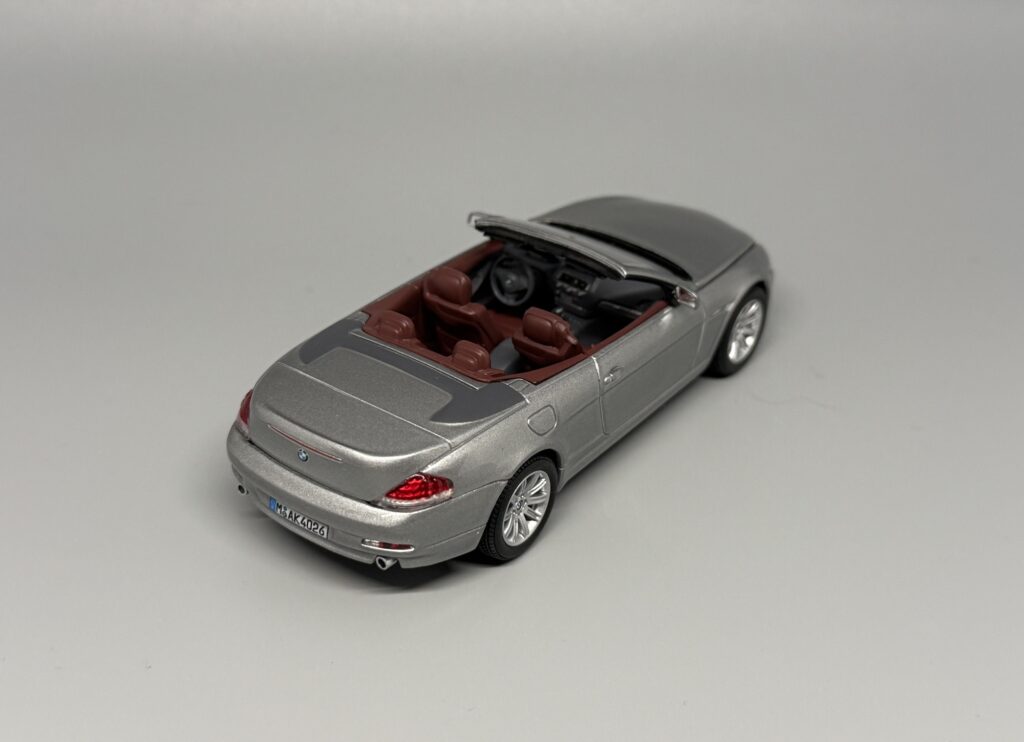
The model in my collection was produced by Kyosho and represents a 2004 BMW 6 Series Convertible (E64). It is an official BMW dealer model. As the exact engine version of the scale model is not known, this description covers the E64 Convertible model family as a whole.
Technical data in brief
Production period: 2004–2010
Place of production: BMW Group Plant Dingolfing, Germany
Body style: two-door four-seat Convertible / grand tourer
Drivetrain: rear-wheel drive
Roof: electrically operated multi-layer fabric roof
Rear window: independently electrically retractable vertical glass rear window
Petrol engines: six-cylinder in-line engines and V8
645Ci: 4.4-litre V8, 333 hp
650i: 4.8-litre V8, 367 hp
630i after the 2007 update: 3.0-litre six-cylinder in-line engine, 272 hp
635d: 3.0-litre Variable Twin Turbo six-cylinder diesel, 286 hp and 580 Nm
Transmissions: depending on version, 6-speed manual, 6-speed automatic or 6-speed SMG
M6 Convertible: separate BMW M model, 5.0-litre V10, 507 hp
E64 Convertible production: 54,173 cars, excluding the M6
BMW published sales figure 2004–2010: 49,053 cars
Special feature: the first series-production BMW 6 Series Convertible, featuring the distinctive fin-roof and independently retractable glass rear window
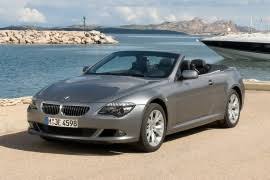
Photo of the real car. Source: autoevolution.com