
Background
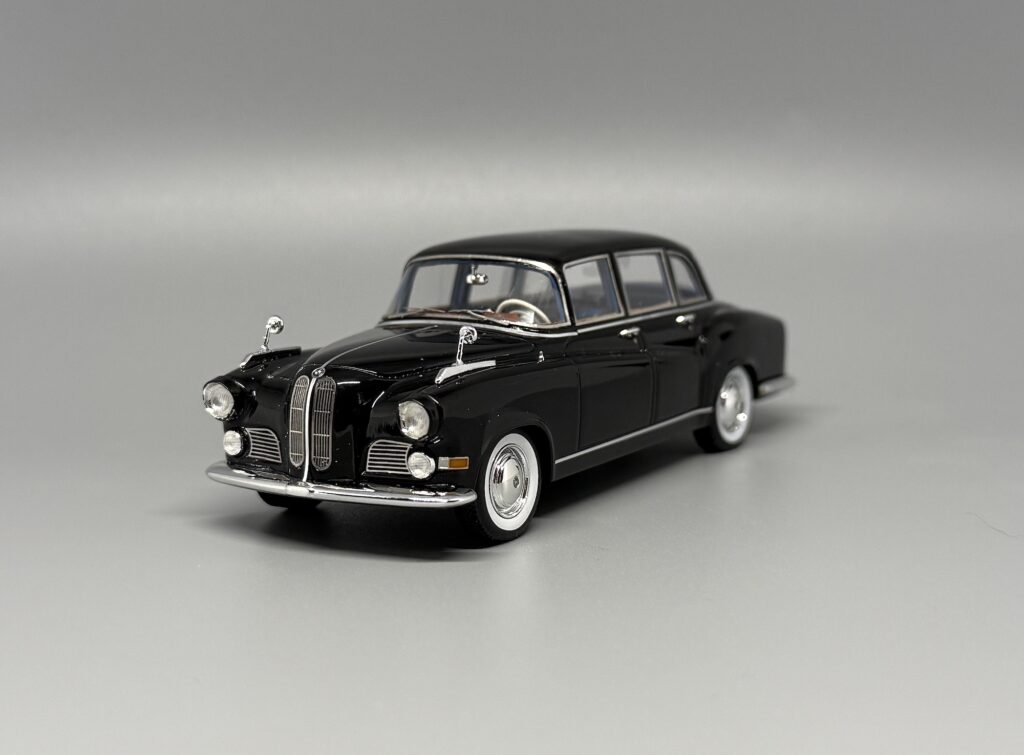
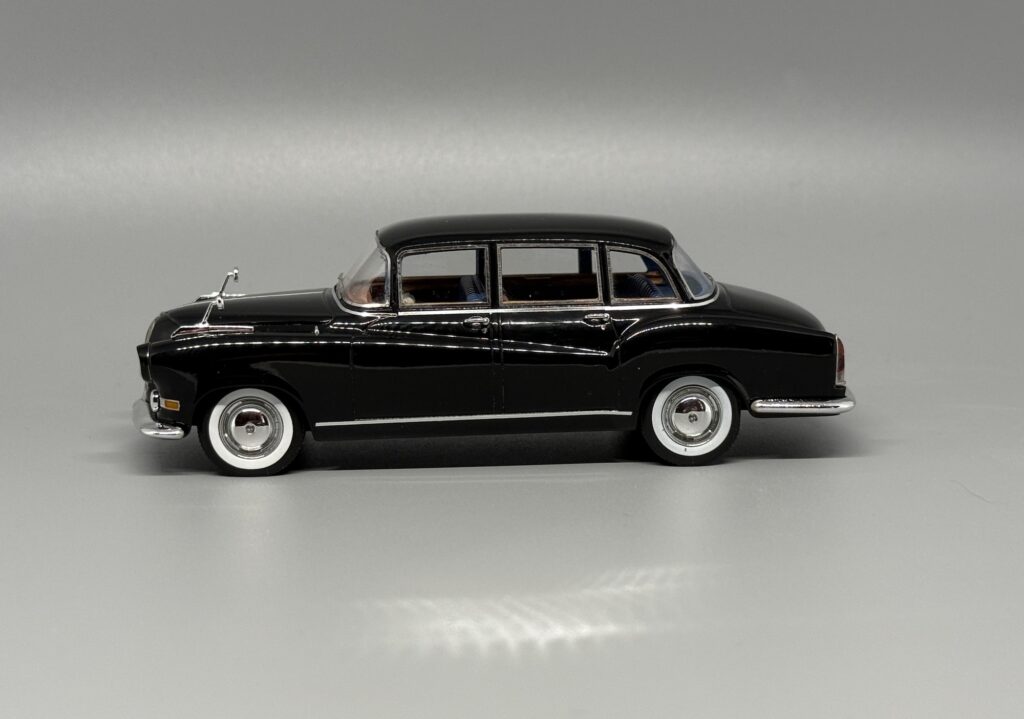
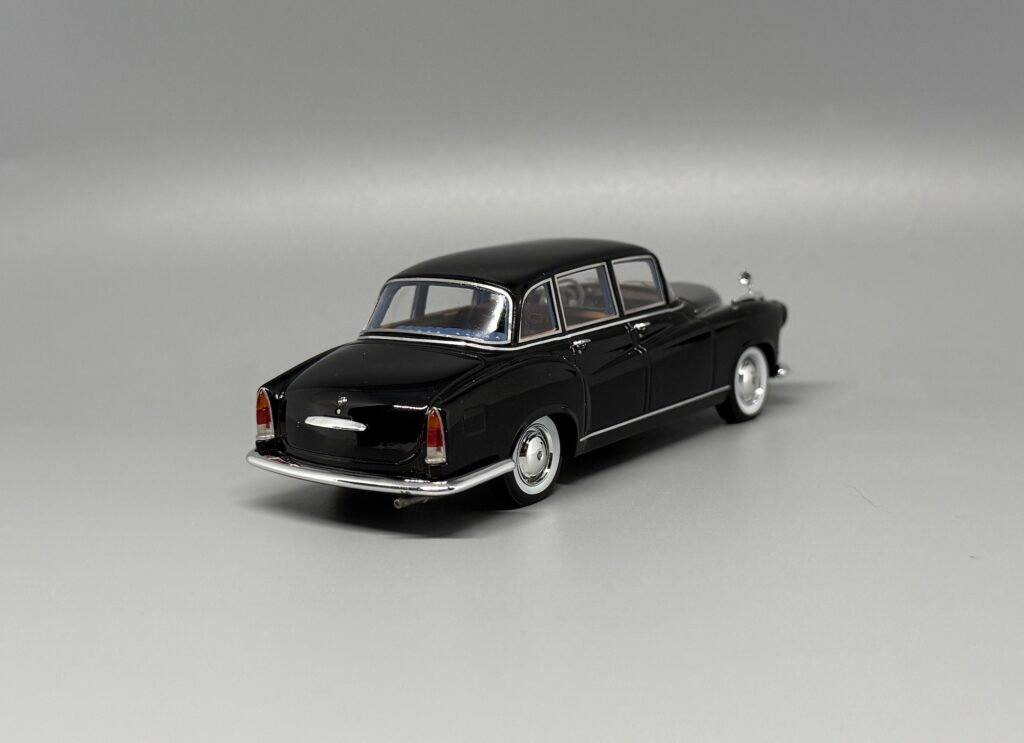
BMW 505 Pullman Ghia Aigle was one of BMW’s most ambitious prototypes of the 1950s. After the war, BMW had returned to automobile production with the large BMW 501 and 502 models and wanted to strengthen its position in the luxury-car market even further. The purpose of the 505 was to create an exceptionally prestigious chauffeur-driven Pullman limousine for heads of state, diplomats and senior business executives. BMW was also interested in offering the car as a potential official vehicle for German Chancellor Konrad Adenauer and in challenging the Mercedes-Benz 300 in this highly prestigious role.
Project Diplomat
BMW had been considering the creation of a large representative limousine since at least 1953. A design proposal for the 505 dated 17 April 1953 survives in the BMW Design Archive; it bears the signature of E. Palm and already shows strong similarities to the later completed car. The early working title for the project was 505 Diplomat, while by the time of its public presentation in 1955 the car had become known as the 505 Pullman. The BMW 502 was chosen as the technical basis, but its chassis was significantly lengthened to provide a truly spacious and separate rear passenger compartment.
Design by Giovanni Michelotti
The final design of the BMW 505 is attributed to Giovanni Michelotti, one of the most highly regarded Italian automotive designers of the 1950s. Michelotti worked closely with Ghia-Aigle in Switzerland during this period and created numerous cars for the company. With the BMW 505, he moved away from the rounded “Baroque Angel” styling of the BMW 501 and 502 and created a much straighter and more modern body. The headlamps were integrated into the front wings, the BMW kidney grille became smaller and the taller, squarer roofline provided additional headroom for rear-seat passengers.
Body construction in Italy and Switzerland
The BMW 505 was an international project. In the spring of 1955, BMW sent a lengthened BMW 502 rolling chassis to Ghia-Aigle, with sources identifying the chassis number as 59034. The basic body structure, however, was not built by Ghia-Aigle itself but by Martelleria Maggiora in Turin. In July 1955, the completed body was inspected there by Giovanni Michelotti, BMW sales director Oskar Kolk and BMW body-development manager Kurt Bredschneider. On 25 July, the car was sent on to Ghia-Aigle in Lugano, where further finishing and interior work took place. It then travelled to Munich, where BMW completed further work, including parts of the electrical installation. The 505 therefore combined BMW engineering, Michelotti’s Italian design, Turin coachbuilding and Ghia-Aigle’s Swiss craftsmanship.
Lengthened BMW 502 technical basis
The BMW 505 was based on the BMW 502, but its wheelbase was extended to more than three metres. Different sources give slightly different exact measurements, so a figure of approximately 3.1 metres is the safest description. Most of the additional length was devoted to the rear passenger compartment. Power came from BMW’s 3,168 cm³ V8 engine, producing 120 hp or 88 kW. This was one of BMW’s most important engines of the period and gave the large limousine suitably strong performance. Power was transmitted to the rear wheels, and the car was capable of approximately 170 km/h.
Pullman limousine interior
The most important part of the 505 was the rear passenger compartment. The driver and passengers were separated by a partition with an electrically operated glass panel, while an intercom system allowed communication with the driver when the partition was closed. The other windows were also electrically operated. The rear seats were upholstered in high-quality mohair fabric, while fine wood was used throughout the interior. Passengers had access to storage compartments, tables, reading lamps, separate heating and ventilation and even a bar. These details demonstrate that the 505 was not simply a lengthened BMW 502, but a fully developed hand-built luxury limousine.
Weight reduction and construction
The large body and extensive equipment made the BMW 505 relatively heavy, so lighter materials were used for some components. The bonnet and boot lid were made from aluminium, while the main body structure was steel. The total weight exceeded 1.5 tonnes. Despite its size, BMW attempted to retain a degree of technical elegance, while the V8 engine provided the smooth and quiet performance expected from a prestige limousine.
Public presentations in 1955
The BMW 505 was shown to the public in 1955, and Michelotti’s design attracted considerable attention. The car was exhibited at both the Turin Motor Show and the Frankfurt Motor Show. Swiss press reports particularly praised its luxurious interior, modern styling and representative character. For BMW, the 505 demonstrated that the company was capable of producing something far more exclusive than the standard BMW 502.
Konrad Adenauer and the famous hat story
The history of the BMW 505 is closely connected with Germany’s first Federal Chancellor, Konrad Adenauer. BMW hoped that the 505 could replace his existing Mercedes-Benz 300 official car. A famous story later emerged claiming that Adenauer struck his hat against the roof edge when getting out of the BMW and rejected the car for that reason. Reliable evidence for this story is lacking, however, and BMW archive material does not clearly establish that Adenauer personally drove in the 505 at all. The story should therefore be regarded more as part of the car’s later legend than as securely documented history.
Why did the 505 not reach production?
The BMW 505 did not fail to reach production solely because Adenauer continued using Mercedes-Benz. There were in fact other potential customers, but producing the coachwork in Switzerland or Italy would have made the car extremely expensive because of import duties at the time. BMW therefore looked for a way to manufacture the 505 in Germany and requested the necessary construction drawings from Ghia-Aigle in the autumn of 1955. However, BMW’s Munich factory had no spare capacity for such a specialist model alongside production of the BMW 503 and 507, while discussions with possible German coachbuilders failed to produce a workable solution. The 505 therefore remained a prototype.
A one-off and diplomatic use
Only one BMW 505 Pullman is known to have been completed. Although it never entered series production, the car was used on some official occasions. In 1956, visiting Italian President Giovanni Gronchi was driven in the 505 in Munich, showing that for at least a short time the car fulfilled exactly the diplomatic and representative role for which it had been conceived.
Later history
The BMW 505 survived and eventually returned to BMW ownership. Over the following decades, its appearance and use changed several times, and at one point it was even used as an advertising vehicle. The unique prototype was later comprehensively restored and today belongs to the BMW Group Classic historic collection. Its survival preserves an exceptionally rare example of BMW’s attempt in the 1950s to enter the very highest class of chauffeur-driven luxury automobiles.
Historical significance
The BMW 505 Pullman Ghia Aigle is important not only as a rare prototype, but also as evidence of BMW’s ambitions during the 1950s. The car brought together BMW 502 engineering, BMW’s V8 engine, Giovanni Michelotti’s Italian design, the coachbuilding expertise of Martelleria Maggiora and the luxury craftsmanship of Ghia-Aigle. Although series production never followed, the 505 demonstrated that BMW was already prepared in the mid-1950s to compete in the most prestigious segment of the European luxury-car market.
Model in the collection
The model in my collection was produced by Autocult and represents the 1955 BMW 505 Pullman Ghia Aigle prototype. It was produced in a limited edition of 333 examples.
Technical data in brief
Year completed: 1955
Technical basis: BMW 502
Design: Giovanni Michelotti
Basic body structure: Martelleria Maggiora, Turin
Final coachwork and finishing: Ghia-Aigle, Lugano
Final assembly: BMW, Munich
Body style: Pullman limousine
Engine: V8
Displacement: 3,168 cm³
Power: 120 hp / 88 kW
Drivetrain: rear-wheel drive
Wheelbase: approximately 3.1 m
Weight: over 1,500 kg
Top speed: approximately 170 km/h
Production: 1 prototype
Special feature: luxury Pullman prototype designed by Michelotti, with body construction involving both Martelleria Maggiora and Ghia-Aigle, created as BMW’s flagship representative limousine
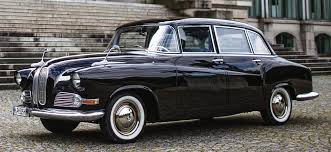
Photo of the real car. Source: autobild.de