BMW M3 (E30) is one of the most legendary performance models in BMW history and the car that established the entire M3 lineage. Unlike later generations of the M3, the original model was created directly from the requirements of motor racing. BMW Motorsport GmbH developed the car around FIA Group A touring-car regulations, which required at least 5,000 road-legal examples to be produced within twelve months for competition homologation.
The M3 was presented to the public at the Frankfurt IAA in 1985 and entered the market in 1986. Although it was technically derived from the E30 3 Series, it was far more than a standard 3 Series fitted with a more powerful engine. BMW Motorsport extensively modified the body, aerodynamics, chassis, brakes and powertrain because competition requirements were central to the car’s development from the outset.
A Group A homologation special
BMW Motorsport’s objective was to create a car capable of competing successfully in international touring-car racing. Group A regulations required close links between the racing car and a series-production road model, meaning that many of the technical features required for competition also had to be homologated through the road-going M3.
The initial requirement to build 5,000 cars soon became almost irrelevant as demand for the road-going M3 exceeded BMW’s expectations. What had primarily been conceived as the basis for a competition car quickly developed into a highly successful performance model in its own right.
A body extensively different from the standard E30
The M3 retained the basic visual identity of the E30, but its body was comprehensively altered for aerodynamic and competition requirements. According to BMW M’s own historical account, little more than the doors and roof were retained from the regular 3 Series, while the other major body components were newly developed or adapted.
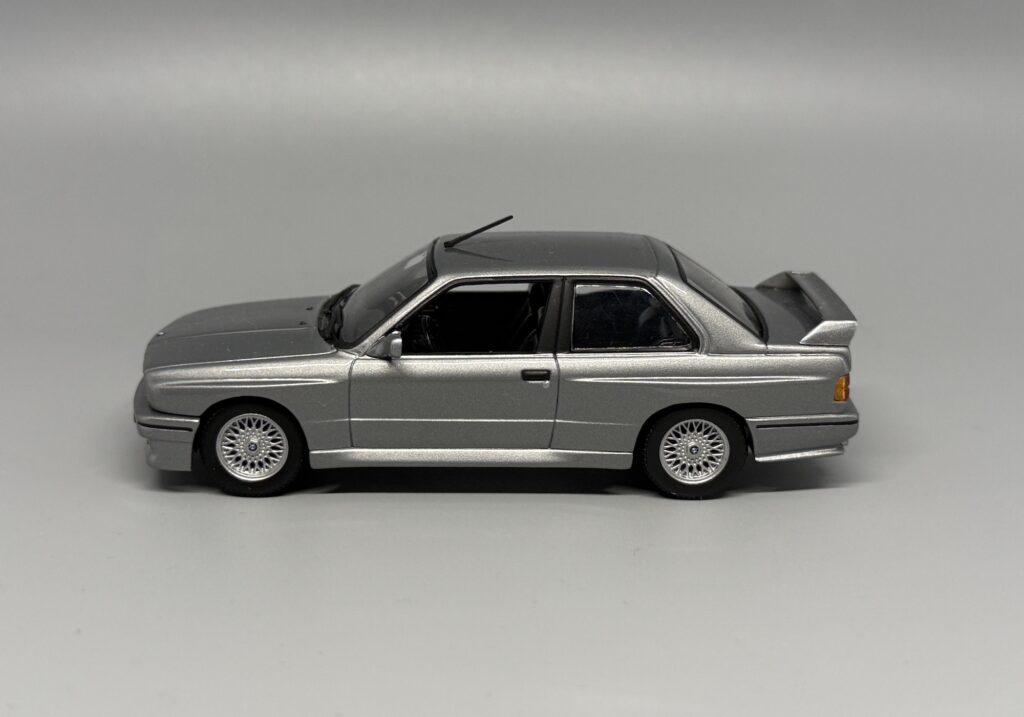
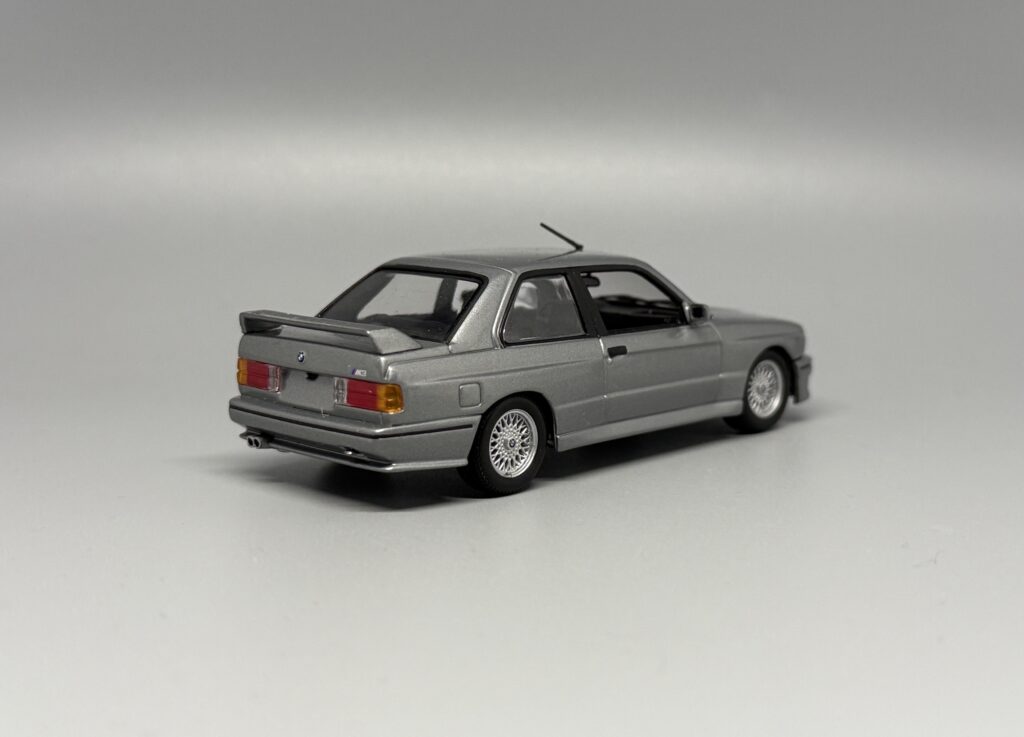
The most obvious differences were the strongly flared wheel arches, redesigned bumpers and side skirts, and the prominent rear spoiler. The M3’s C-pillars were flatter and wider than those of the regular E30, while the angle of the rear window was changed to improve airflow around the rear of the car. The boot lid and spoiler were also unique to the M3.
Weight reduction was another priority. The bumpers, side skirts and boot lid with integrated spoiler used lightweight materials. As a result, the road-going M3 weighed approximately 1,200 kilograms, contributing to both its performance and exceptional handling.
S14 – a four-cylinder developed for the M3
The M3 was powered by BMW Motorsport’s S14 four-cylinder engine. The naturally aspirated 2,302 cc S14B23 was based on the architecture of BMW’s M10 engine family but incorporated four-valve technology and a high-revving concept derived from BMW M competition engines. BMW M also links the cylinder-head concept to the six-cylinder engine of the BMW M1.
The use of a four-cylinder engine was deliberate. Its compact dimensions and lower moving masses made it lighter than a comparable six-cylinder unit and particularly suitable for development into a high-revving racing engine. In road form, this gave the M3 an immediate and exceptionally responsive character.
The original non-catalyst version produced 147 kW or 200 hp. When a catalytic-converter version was introduced to the German market in 1987, output was 144 kW or 195 hp. In September 1989, the catalytic-converter production model was upgraded to 158 kW or 215 hp.
Competition-influenced transmission and chassis
The BMW M3 used a five-speed manual gearbox, with European versions featuring a racing-style dogleg shift pattern in which first gear was located down and to the left. This arrangement placed second, third, fourth and fifth gears in a more convenient pattern for the changes most frequently required during sporting driving.
The chassis was extensively revised compared with a standard E30 to improve balance, traction and precision. The M3 featured ABS braking and ventilated front discs, while its suspension and damping were developed with motorsport requirements in mind without sacrificing everyday usability.
According to BMW M, the approximately 1,200 kg 200 hp version accelerated from 0 to 100 km/h in around 6.7 seconds and reached 235 km/h. The 195 hp catalytic-converter version achieved approximately 6.8 seconds and 230 km/h.
Continuous development throughout production
The M3 did not remain unchanged during its production life. Motorsport homologation requirements led BMW Motorsport to develop the car almost continuously, resulting in numerous special versions and evolution models.
The Evolution II of 1988 produced 220 hp and incorporated further technical and aerodynamic changes. Development culminated in the 1990 M3 Sport Evolution, whose S14 engine was enlarged to 2.5 litres and produced 175 kW or 238 hp. Only 600 Sport Evolution models were built.
Smaller-volume Europameister, Cecotto and Ravaglia editions were also produced. These models either celebrated the M3’s racing achievements or supported the homologation of further competition developments.
Exceptional success in motorsport
The E30 M3 achieved extraordinary success in competition. In 1987, Roberto Ravaglia won the World Touring Car Championship driving a BMW M3. The car went on to win numerous national and international championships, and BMW M states that the E30 M3 accumulated more than 1,400 race victories during its competition career.
BMW still describes the E30 M3 as the most successful touring car of all time. Its competition history extended beyond circuit racing into rallying, and its success permanently linked the M3 name with BMW Motorsport’s identity.
The beginning of the M3 legend
The significance of the E30 M3 extends well beyond its racing results. It established the basic idea behind the M3 name: a compact BMW whose engine, chassis and handling were developed to a significantly more sporting level than the regular 3 Series.
In the first M3, however, the relationship with motorsport was exceptionally direct. It was not simply a production car later adapted for racing; the road and competition versions were developed in parallel around the same objective. This gives the E30 M3 a unique position in BMW M history that no later M3 generation has repeated in quite the same way.
Model in the collection
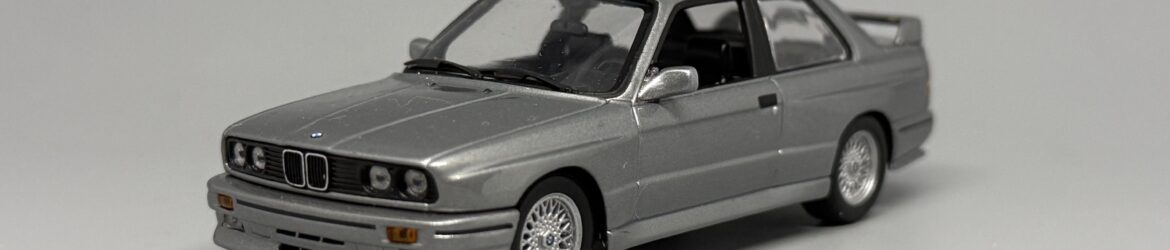
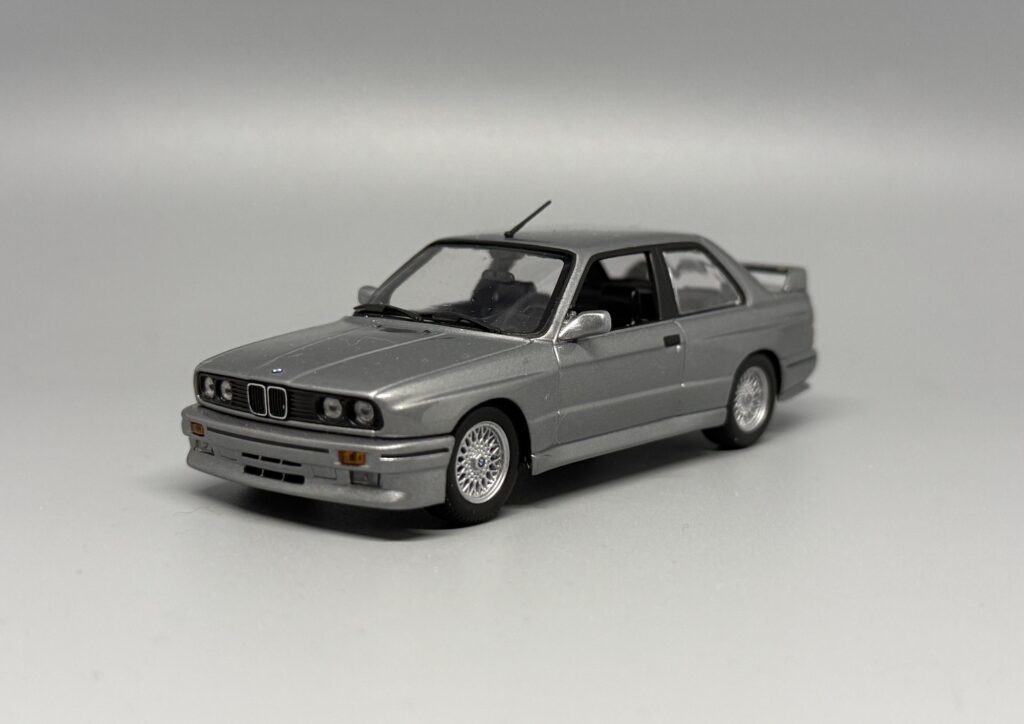
The 1:43-scale BMW M3 (E30) in my collection was produced by Minichamps. The miniature represents a 1987 road car and was released as a limited edition of 3,888 pieces.
The 1987 car represents an early stage in M3 production, when the German market had received the 195 hp catalytic-converter version while the non-catalyst M3 continued to produce 200 hp.
Technical data
Closed-body production: 09/1986–12/1990
Body style: two-door sedan
Engine: S14B23 naturally aspirated inline-four petrol engine
Displacement: 2,302 cc
1987 power output: 144 kW / 195 hp with catalytic converter or 147 kW / 200 hp without catalytic converter
Torque: approximately 230 Nm
Transmission: 5-speed manual
Drive: rear-wheel drive
Weight: approximately 1,200 kg
0–100 km/h: approximately 6.8 s / 6.7 s
Top speed: 230 km/h / 235 km/h
Closed-body E30 M3 production: 17,184 cars
Total E30 M3 production including Convertible: 17,970 cars
Special feature: the first BMW M3, developed as a Group A homologation model
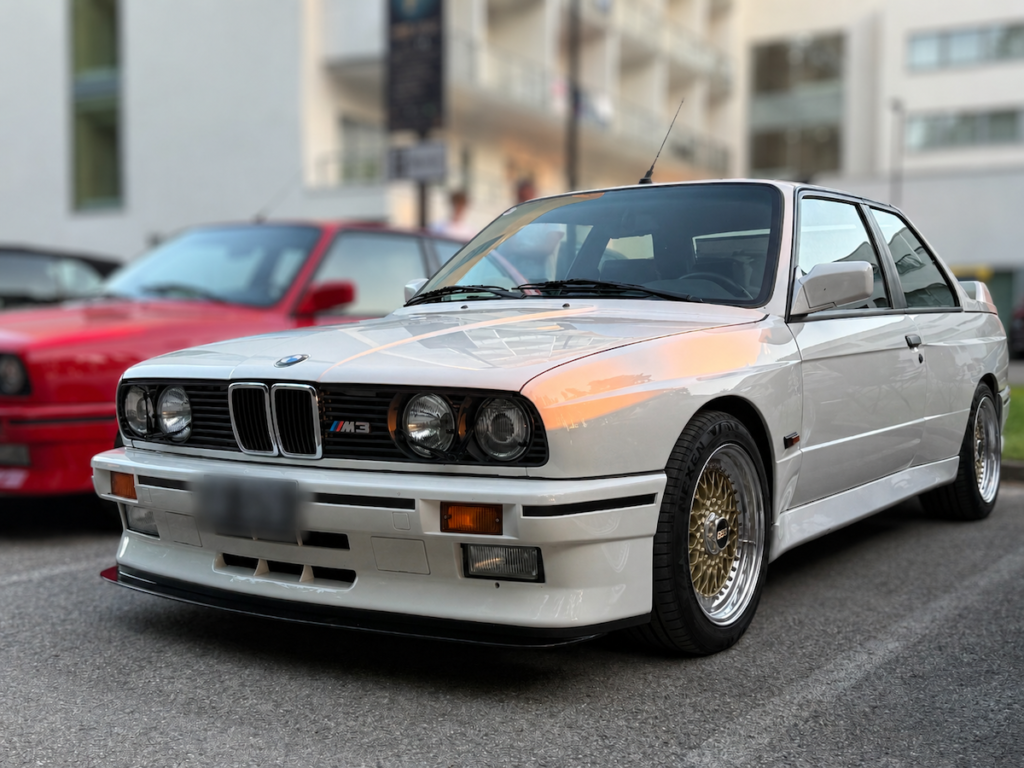
Photo of the real car. Photo: Sten-Patrick Kreek