
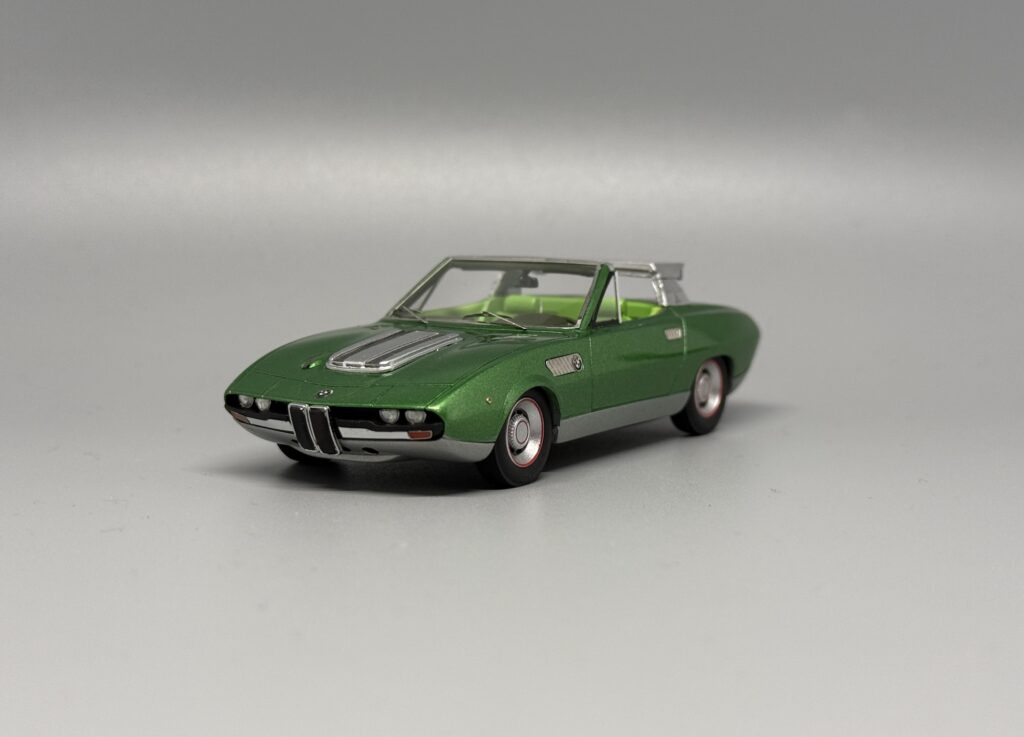
BMW 2800 Spicup Bertone was a unique concept car unveiled in 1969, combining BMW six-cylinder engineering with the bold design language of the Italian Bertone studio and its chief designer Marcello Gandini. The Spicup was created at a time when Bertone was exploring new ways of combining an open sports car with a closed coupé. The result was one of the most unusual BMWs ever created by Bertone – a low two-seat sports car whose metal roof could electrically disappear into the substantial rollover structure behind the passenger compartment.
BMW and Bertone
Bertone’s relationship with BMW dated back to the early 1960s. One of the most important earlier projects was the BMW 3200 CS, whose elegant body helped establish a long-term connection between the Munich manufacturer and the Turin design house. After Marcello Gandini became head of Bertone’s design department during the second half of the 1960s, the studio continued to develop new ideas for BMW.
For the 1969 Geneva Motor Show, Bertone decided to create a particularly striking BMW concept. BMW later described the Spicup as an attempt to combine the beauty and excitement of an open car with the qualities of a coupé, while its shape also contained references to Albrecht von Goertz’s celebrated BMW 507.
Spider and Coupé in one car
The name Spicup was derived from the words Spider and Coupé and directly described the central idea behind the car. With its metal roof closed, the Spicup functioned as a coupé; with the roof opened, it became an open sports car.
Unlike a conventional removable targa roof, the panels did not have to be removed by hand and stored separately. Two transverse metal roof panels were positioned above the passenger compartment. An electric mechanism first drew the smaller front panel into the larger rear section, after which both disappeared into the wide rollover structure behind the seats.
For 1969, this was an exceptionally ambitious solution. In principle, the Spicup represented an early attempt to create an automatically retractable metal roof decades before similar systems became common on production cars.
Designed by Marcello Gandini
The exterior was created by Marcello Gandini, Bertone’s chief designer and one of the most influential automotive designers of his generation. The Spicup clearly reflects Bertone’s transition during the late 1960s from softly rounded sports cars towards increasingly geometric and experimental forms.
The front was extremely low, with partially concealed headlights reminiscent of Gandini’s Alfa Romeo Montreal. BMW identity was nevertheless retained through the characteristic twin kidney grille, while vents in the front wings recalled details of the earlier BMW 507.
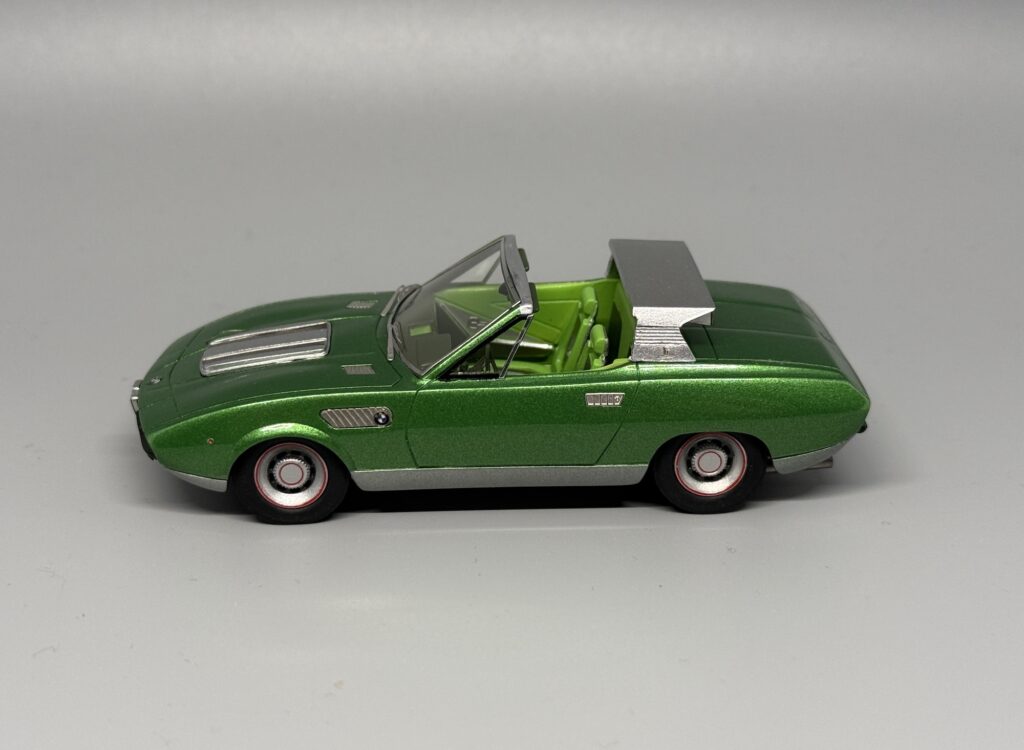
In profile, the car was dominated by its low nose, long bonnet, compact passenger compartment and the unusually broad rollover structure behind it. The dimensions of this structure were dictated directly by the roof mechanism, as it had to contain the complete retracted metal roof.
BMW 2500 chassis and 2800 engine
Despite its name, the Spicup was not based on the BMW 2800 Coupé. Its technical foundation was an E3-generation BMW 2500 sedan. According to BMW’s own historical information, Bertone shortened the 2500’s wheelbase from 269 centimetres to just 234 centimetres, transforming the large sedan chassis into the basis of a compact two-seat sports car.
The engine, however, came from the BMW 2800. The 2,788 cc naturally aspirated straight-six produced 125 kW or 170 hp at 6,000 rpm. It belonged to BMW’s new generation of six-cylinder engines that helped return the company to the market for larger, more powerful luxury cars at the end of the 1960s.
Packaging the large six-cylinder beneath Gandini’s exceptionally low bonnet created its own challenge. An additional raised section was required above the engine, becoming another distinctive feature of the Spicup’s design.
A one-off concept
Only a single BMW 2800 Spicup was built. It made its public debut at the 1969 Geneva Motor Show on the Bertone stand. Although the concept was technically fascinating, neither the Spicup nor its complicated roof system entered series production.
The retractable roof mechanism was complex and expensive, and it required a very substantial rollover structure to accommodate the metal panels. Achieving complete weather sealing was also difficult. Nevertheless, the Spicup explored a problem manufacturers would continue to address for decades: how to combine the freedom of an open car with the security and protection of a closed coupé.
The later life of the Spicup
Unlike many concept cars of its era, the Spicup was not destroyed after its show career. It was sold into private ownership and was subsequently used on public roads. Over the years both its exterior and interior were altered, and for a long period the car disappeared from public view.
The Spicup was rediscovered in the Netherlands in 2008 and underwent a comprehensive restoration intended to return it as closely as possible to its original 1969 specification. In 2009, forty years after its Geneva debut, the restored car was presented to the public again at the Concorso d’Eleganza Villa d’Este.
An important link among Bertone’s BMW concepts
The Spicup is also significant within the broader history of collaboration between BMW and Bertone. It was followed in 1970 by another BMW concept designed under Marcello Gandini – the Garmisch. Whereas the Spicup was an extravagant open sports car, the Garmisch explored a more restrained vision of a modern medium-sized BMW coupé.
Together, the two cars demonstrate how independent Italian design studios contributed ideas to BMW at a time when the company was developing the design identity that would define its following decades. The Spicup remained a one-off, but its rarity, Gandini styling and remarkable roof mechanism make it one of the most fascinating BMW concepts of the late 1960s.
Model in the collection
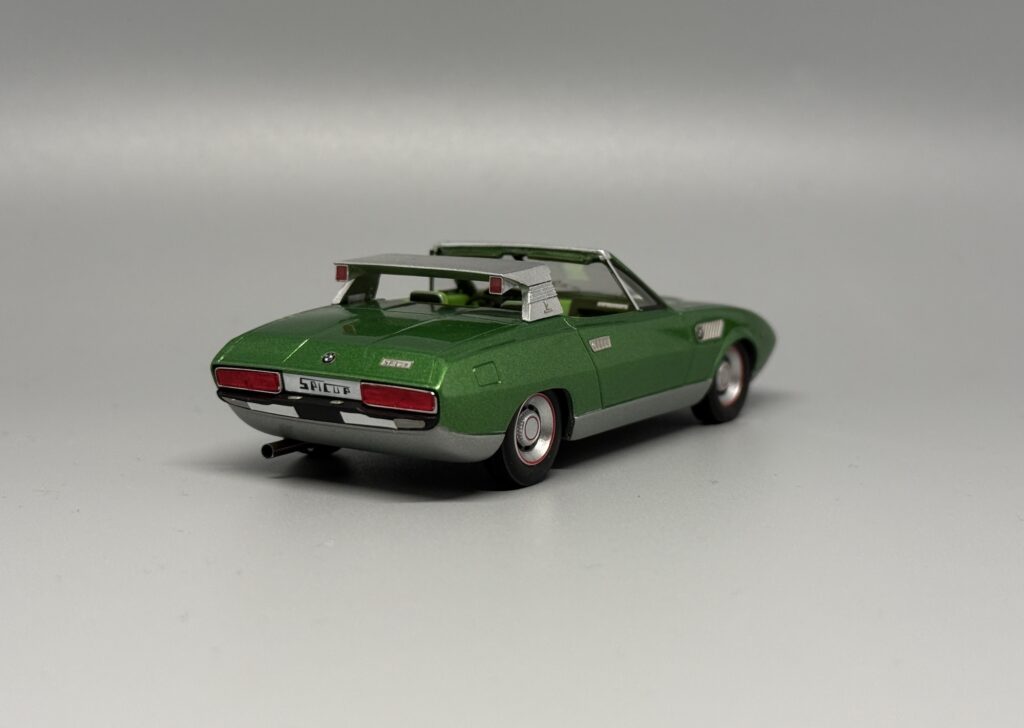
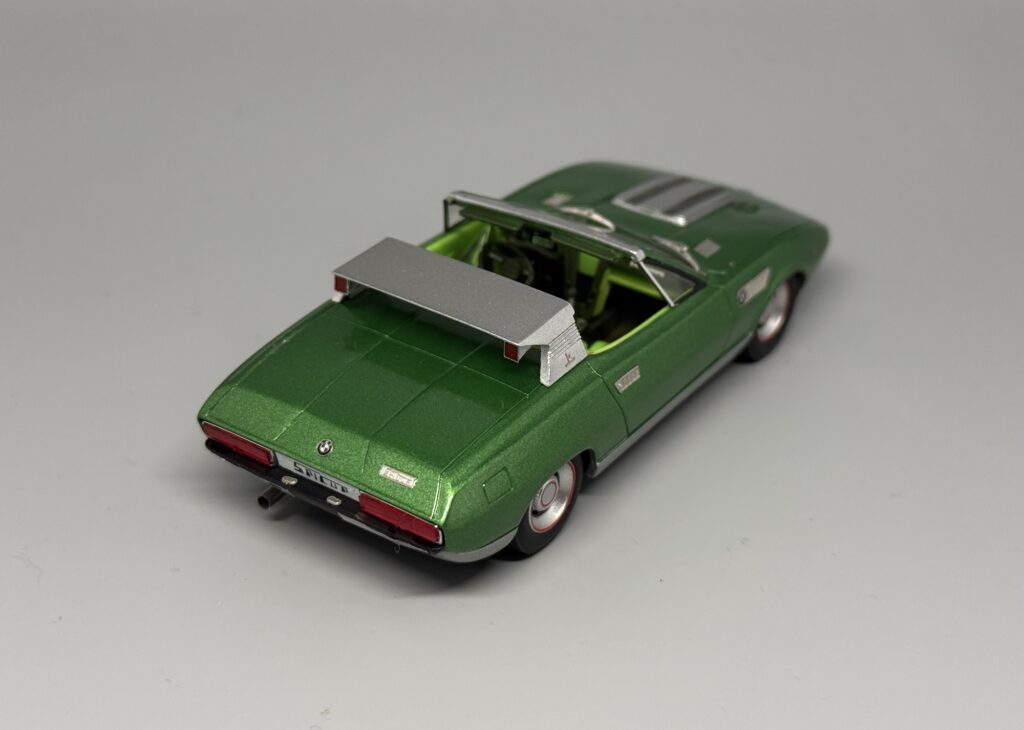
The 1:43-scale BMW 2800 Spicup Bertone in my collection was produced by Avenue 43, part of the AutoCult model range. The miniature represents the 1969 Bertone concept car and was released as a limited edition of just 333 pieces.
The model depicts the Spicup with its roof open, clearly showing the car’s most distinctive technical and stylistic feature – the metal roof designed to retract into the rollover structure, together with Marcello Gandini’s exceptionally low and unconventional body design.
Technical data
Unveiled: 1969 Geneva Motor Show
Production total: 1 car
Design: Marcello Gandini / Bertone
Coachbuilder: Bertone, Turin, Italy
Technical basis: BMW 2500 (E3)
Engine: BMW 2800 naturally aspirated straight-six petrol engine
Displacement: 2,788 cc
Power output: 125 kW / 170 hp at 6,000 rpm
Drive: rear-wheel drive
Wheelbase: 2,340 mm
Length: approximately 4,150 mm
Body style: two-seat Spider/Coupé concept car
Special feature: electrically operated two-piece metal roof retracting into the rollover structure
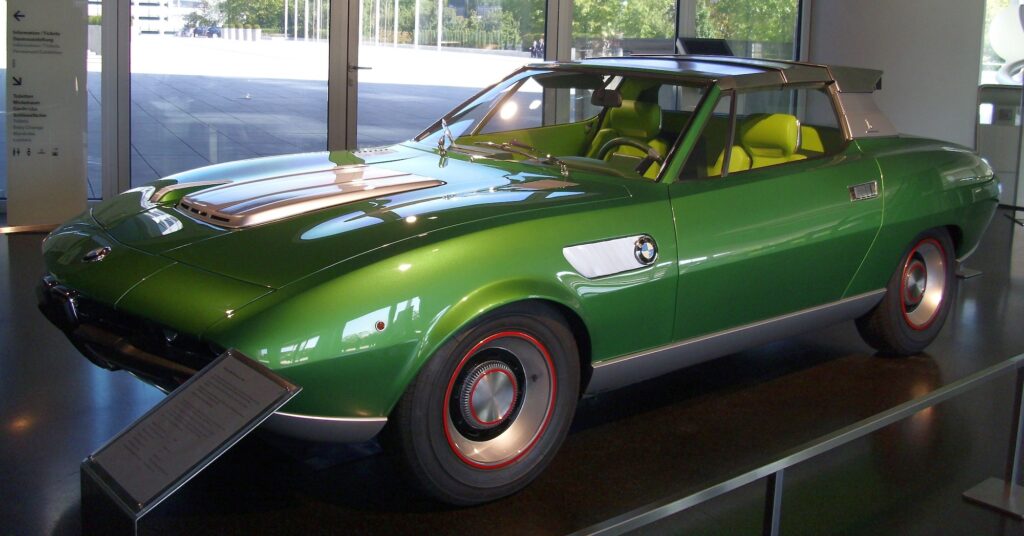
Photo of the real car. Photo: Buch-t / Wikimedia Commons, CC BY-SA 3.0 DE