
BMW M3 Convertible (E30) was the first series-production convertible from BMW M and one of the rarest versions of the first-generation M3. Presented at the Frankfurt IAA in 1987, it entered series production in 1988. The M3 Convertible combined the motorsport-derived engineering of the E30 M3 with a fully open four-seat body, creating an entirely new type of model for BMW M.
The first open-top BMW M
The E30 M3 had originally been developed as a homologation model for Group A touring-car racing, and its fundamental character was shaped by the requirements of motorsport. The M3 Convertible took the same technical concept into a very different environment, combining high performance and precise handling with the more relaxed and elegant character of an open car.
BMW M describes the E30 M3 Convertible as the first convertible in its history. It was the first time a series-production BMW M model combined a fully folding soft top with high-performance M engineering. The M3 and M4 Convertibles that followed all trace their origins back to this car.
Motorsport engineering with an open body
The M3 Convertible retained much of the technical character of the closed E30 M3. Its strongly flared wheel arches accommodated a wider track and wider wheels, while the chassis retained the same fundamentally motorsport-inspired approach.
Visually, however, the Convertible was more discreet than the closed M3. It did without the large rear wing of the sedan, and the open body gave the car a more elegant appearance. The muscular wheel arches, distinctive M3 bodywork and low stance nevertheless clearly separated it from a regular E30 Convertible.
Strengthening the convertible body
Removing the fixed roof required extensive structural reinforcement. The M3 Convertible used a self-supporting all-steel body strengthened specifically for open-top use. The additional structure and roof mechanism made it approximately 160 kilograms heavier than the closed M3.
The 1988 M3 Convertible weighed around 1,360 kilograms. Despite the additional weight, it retained the precise handling associated with the M3 and offered an impressive power-to-weight ratio for a four-seat convertible of its period.
The S14 four-cylinder engine
The M3 Convertible used the same 2,302 cc naturally aspirated S14 four-cylinder engine as the closed M3. It featured a 16-valve aluminium cylinder head, twin overhead camshafts and a design strongly influenced by BMW M’s motorsport experience.
In 1988, the catalytic-converter version produced 144 kW or 195 hp. A version without a catalytic converter developed 147 kW or 200 hp. The engine was highly responsive and eager to rev, giving the heavier Convertible much of the same immediate character as the closed M3.
In 1989, output was increased to 158 kW or 215 hp. This made the M3 Convertible one of the most powerful four-seat production convertibles of its time.
Exceptional performance for a 1980s convertible
According to BMW M, the original 195 hp M3 Convertible accelerated from 0 to 100 km/h in approximately 7.5 seconds and reached a top speed of 228 km/h. In 215 hp form, top speed increased to around 239 km/h.
These figures were exceptional for a four-seat convertible in the late 1980s. The M3 Convertible was not simply a luxurious open version of the 3 Series, but a genuine M car whose engine, chassis and braking system retained the competition-derived character of the M3 family.
A sophisticated soft-top mechanism
The M3 Convertible featured a powered fabric roof. Early cars used an electrohydraulic system, while from March 1990 BMW introduced a new electromechanical operating mechanism.
A removable hardtop was also available as an option. According to BMW Group Classic, only ten customers specified it, making an original E30 M3 Convertible equipped with the factory hardtop an exceptionally rare combination.
Only 786 cars
The M3 Convertible remained an extremely exclusive model throughout its production life. Production began in June 1988 and ended in June 1991, with only 786 cars built in total.
By comparison, more than 17,000 closed-body E30 M3s were produced. The Convertible therefore accounted for only a very small proportion of first-generation M3 production and is today one of the rarest series-production E30 variants.
An important model in BMW M history
The significance of the M3 Convertible extends beyond its low production volume. It was the first model to demonstrate that BMW M high-performance engineering could successfully be combined with a fully open body.
The concept continued with the E36 and E46 M3 Convertibles and later with the folding-hardtop E93. From the F83 generation onwards, the open high-performance model became the M4 Convertible. The historical starting point for all of them, however, was the E30 M3 Convertible of 1988.
Model in the collection
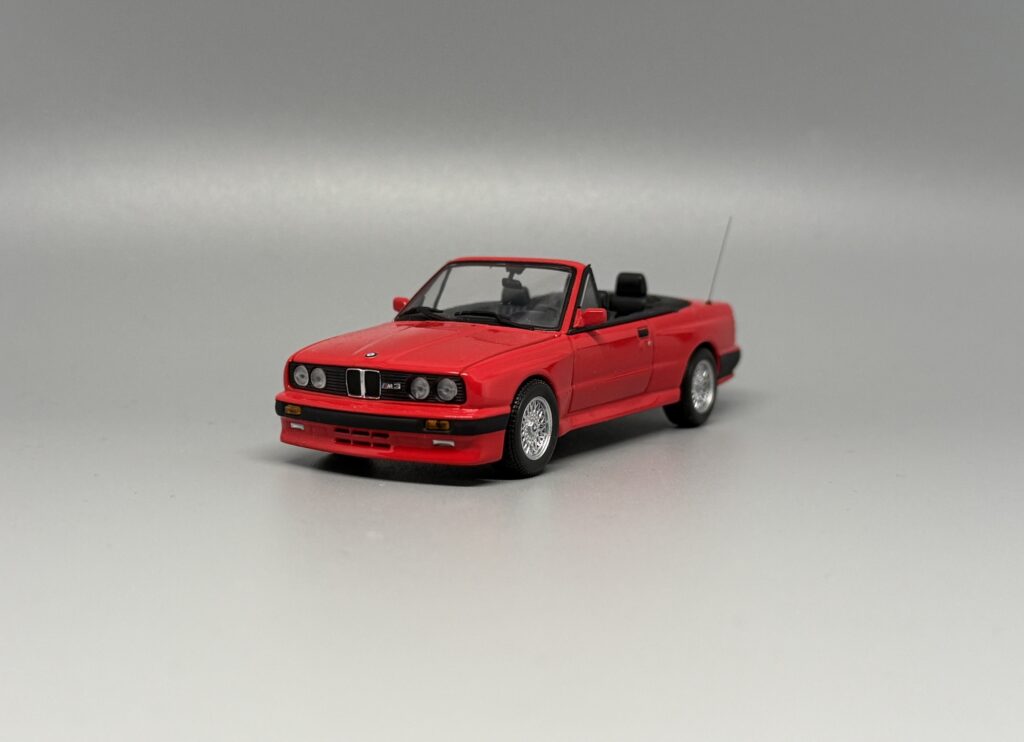
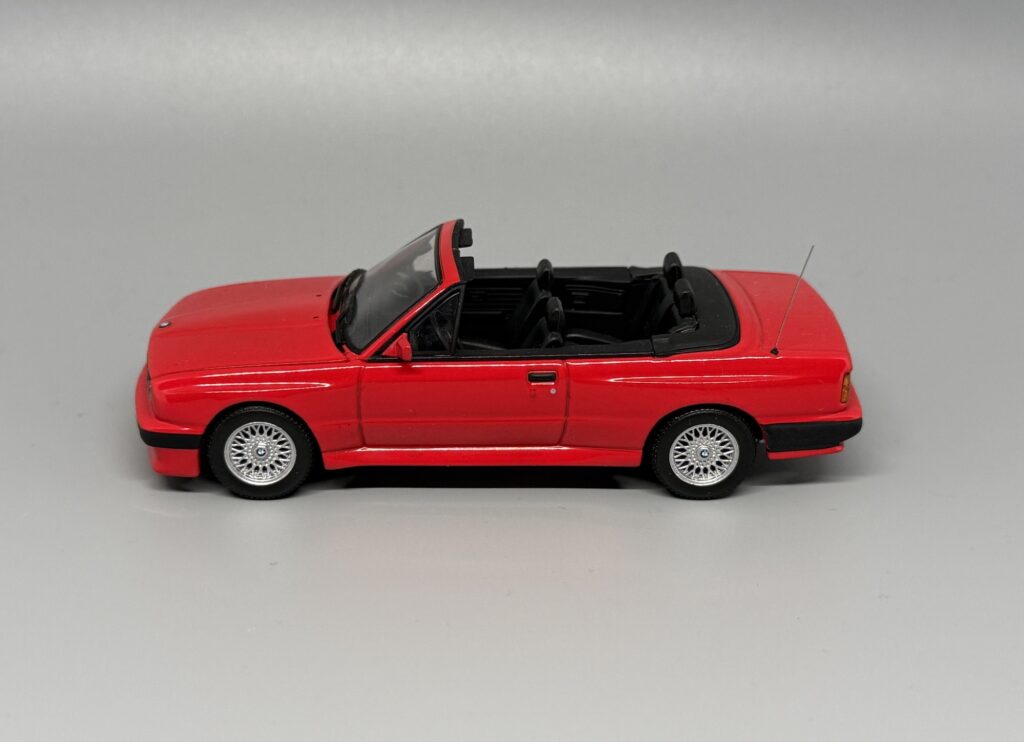
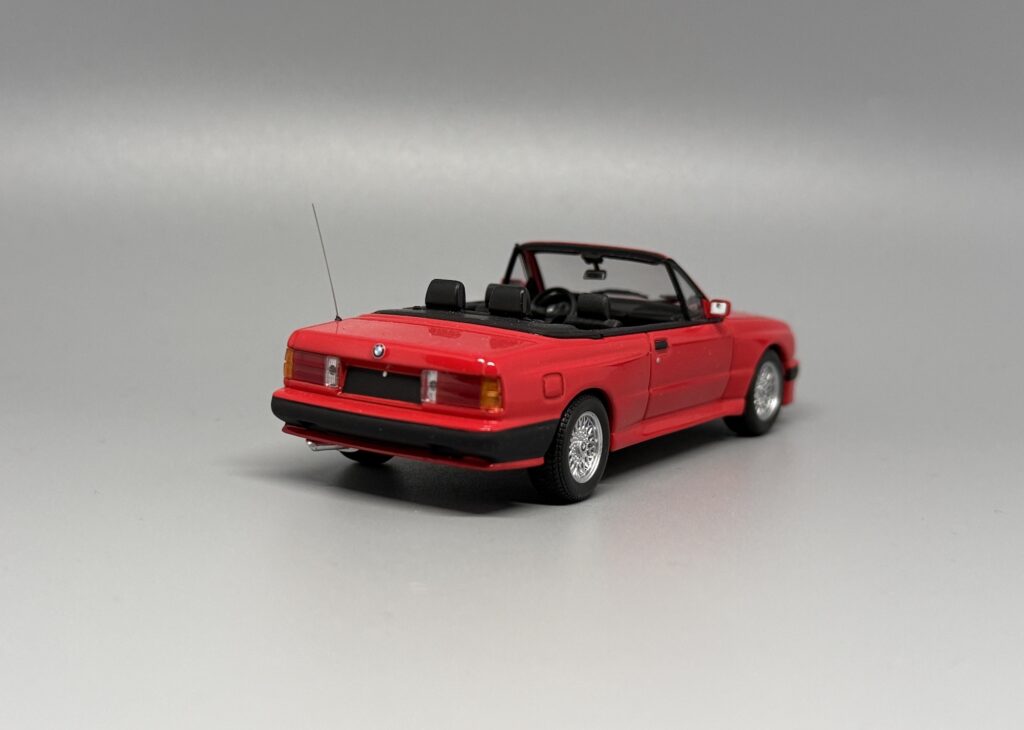
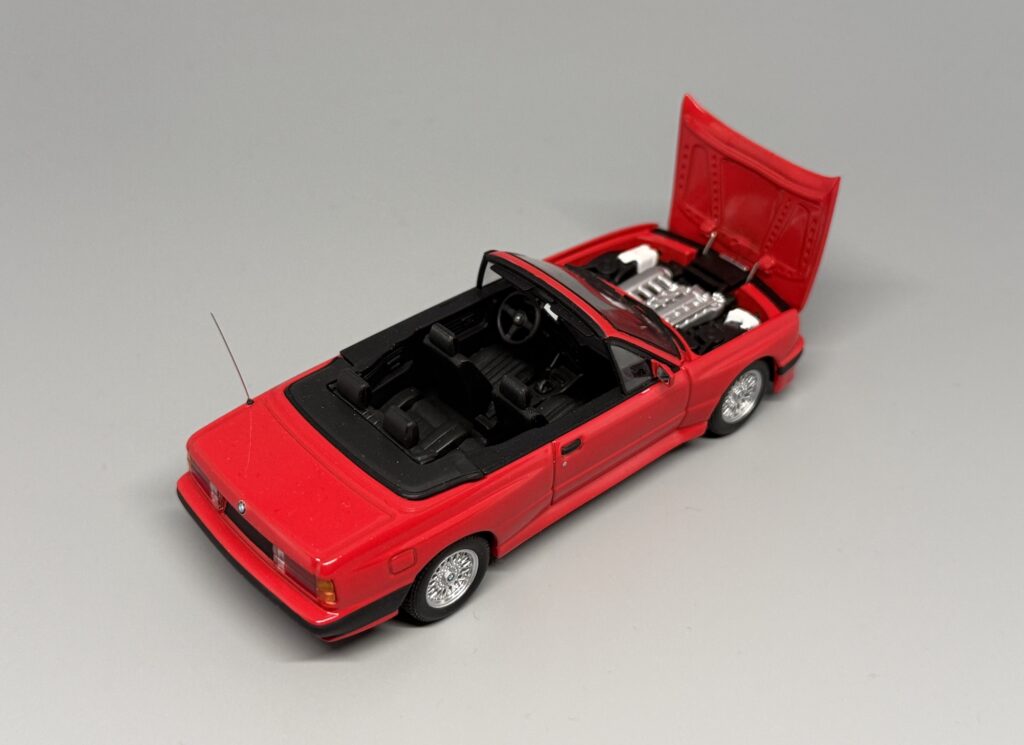
The 1:43-scale BMW M3 Convertible (E30) in my collection was produced by Minichamps. The miniature represents a 1988 car, the first production year of the M3 Convertible, and was released as a limited edition of 2,016 pieces.
The model therefore represents the earliest 195 hp version of the E30 M3 Convertible and the beginning of BMW M’s history of series-production open-top high-performance cars.
Technical data
Production: 06/1988–06/1991
Body style: two-door four-seat Convertible
Engine: S14B23 naturally aspirated inline-four petrol engine
Displacement: 2,302 cc
1988 power output: 144 kW / 195 hp with catalytic converter
Output without catalytic converter: 147 kW / 200 hp
Output from 1989: 158 kW / 215 hp
Transmission: 5-speed manual
Drive: rear-wheel drive
Weight: approximately 1,360 kg
0–100 km/h: approximately 7.5 seconds
Top speed: 228 km/h in original form, up to approximately 239 km/h with 215 hp
Production total: 786 cars
Special feature: the first series-production convertible in BMW M history
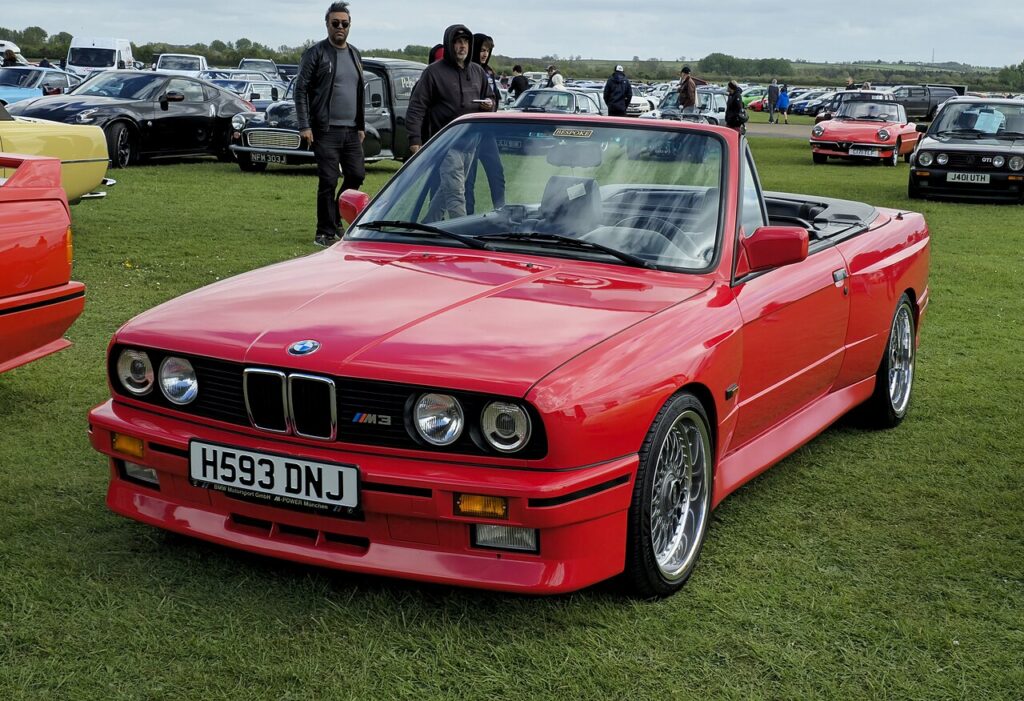
Photo of the real car. Photo: Calreyn88 / Wikimedia Commons, CC0