
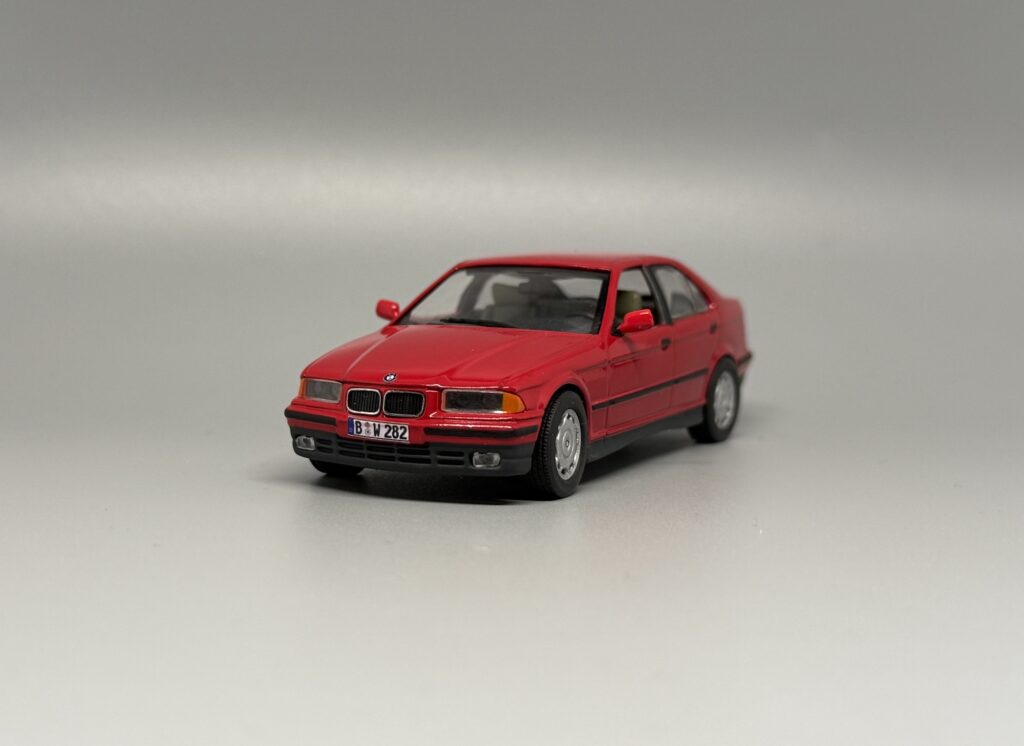
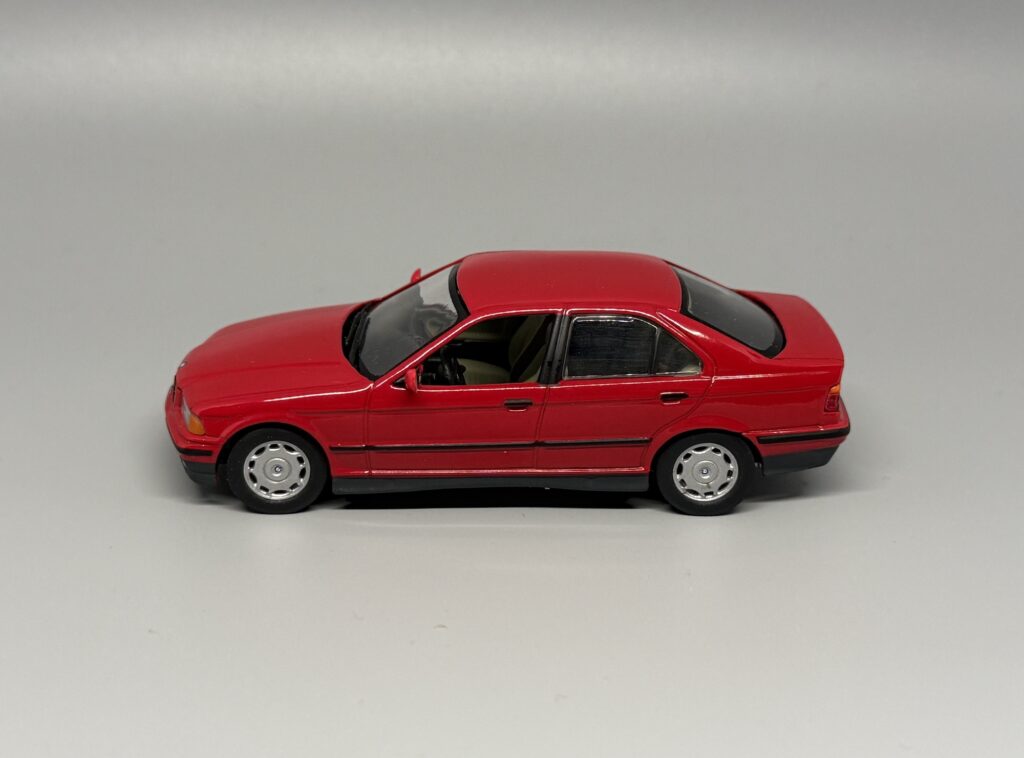
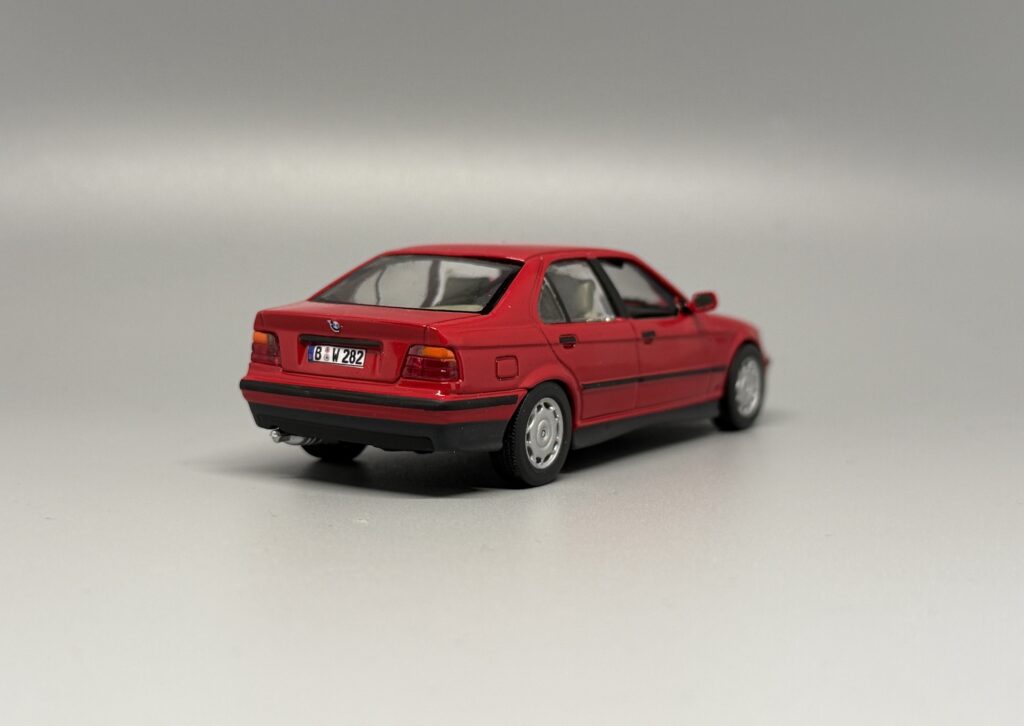
BMW 3 Series Sedan (E36) marked an important step forward in the development of BMW’s compact model family at the beginning of the 1990s. The third-generation 3 Series reached the market at the end of 1990 and, unlike its E30 predecessor, was designed from the outset primarily as a four-door sedan. The new model became larger, more spacious, more aerodynamic and technically more mature while retaining the rear-wheel-drive layout and driver-focused character traditionally associated with the 3 Series.
A new era for the 3 Series
The E36 was immediately distinguishable from its predecessor. The more upright and traditional shape of the E30 gave way to a lower, smoother body whose design placed considerably greater emphasis on aerodynamics. BMW’s traditional twin circular headlights remained, but for the first time each pair was positioned behind a common glass cover, giving the front end a cleaner and more modern appearance.
BMW increased the wheelbase by approximately 13 centimetres compared with the E30. The larger body provided noticeably more interior space, with BMW’s own historical account noting around 30 millimetres of additional rear knee room. Despite the increase in size, the classic BMW proportions of a long bonnet, short overhangs and a relatively rearward passenger compartment remained clearly visible.
The sedan became the core E36 body style
Whereas the E30 had initially been introduced as a two-door sedan with the four-door version following later, the E36 reversed this approach. The new 3 Series made its debut as a four-door sedan, which would become the highest-selling body style of the entire E36 generation.
In 1992, BMW introduced an independently styled two-door Coupé. This represented an important change in the history of the 3 Series: the two-door car was no longer simply a two-door version of the sedan but a separate, more sporting Coupé model. Convertible, Touring and Compact versions later broadened the E36 family still further.
A new rear axle and more mature handling
One of the most significant technical changes introduced with the E36 was its completely redesigned rear suspension. The semi-trailing-arm arrangement of the E30 was replaced by a more sophisticated multi-link design developed using experience gained from the BMW Z1.
The new rear axle provided better wheel control when cornering, improved directional stability and allowed BMW to combine more precise handling with increased ride comfort. For the first time in a 3 Series, the rear track was also wider than the front – a principle retained in later generations.
The steering remained characteristically direct, while rear-wheel drive continued to define the fundamental driving character of the 3 Series. ABS became standard across all variants from 1992, while ASC traction control also became available as an option.
A broad range of engines and models
At launch, the E36 Sedan was offered as the four-cylinder 316i and 318i and the six-cylinder 320i and 325i. The new M50 straight-six engines used twin overhead camshafts and four valves per cylinder, representing a major technical step forward from the M20 engine family of the E30 era.
The 2.0-litre 320i produced 150 hp, while the 2.5-litre 325i developed 192 hp. The range continued to evolve, and in 1995 the 325i was replaced by a new generation of six-cylinder models, the 323i and 328i. The most powerful regular E36 Sedan became the 2.8-litre 328i, whose lightweight-alloy straight-six produced 142 kW or 193 hp.
Diesel engines also became an important part of the range. The six-cylinder 325td and 325tds were joined in 1994 by the four-cylinder 318tds. The E36 therefore offered an unusually broad selection, ranging from economical everyday models to powerful six-cylinder sporting sedans.
A safer and more modern 3 Series
The development of the E36 also placed greater emphasis on occupant safety. Its larger and stronger body, improved deformation zones and the progressive introduction of airbags made it significantly more modern in safety terms than its predecessor.
BMW Group Classic also highlights the increasing importance of environmental protection and resource conservation during E36 development. Engine management became more sophisticated, exhaust treatment improved and greater attention was paid to fuel economy and efficient use of materials.
The backbone of the E36 family
The four-door Sedan remained the most important body style throughout the E36 generation. BMW Group Classic lists production from July 1990 until November 1998 and notes that most cars were manufactured at the Munich plant, although production also took place at other BMW facilities.
Widely documented BMW production data put total E36 Sedan production at approximately 1.55 million cars, making the four-door model by far the most numerous body style of the E36 family.
The significance of the E36 lies in the way it moved the 3 Series decisively into the modern era. Its multi-link rear suspension, more aerodynamic body, four-valve six-cylinder engines and much broader model range established technical and design principles that would continue to evolve in the following E46 generation.
Model in the collection
The 1:43-scale BMW 3 Series Sedan (E36) in my collection was produced by Minichamps. The miniature represents a 1992 car and therefore depicts the early production period of the E36 Sedan.
By 1992, the Sedan had already established the fundamental shape and character of the new 3 Series, while the separately styled Coupé was joining the range in the same year. The Minichamps model therefore represents the period when the E36 was beginning to develop from a sedan into a complete and highly diverse model family.
Technical data
Production: 07/1990–11/1998
Body style: four-door sedan
Main production location: BMW Munich plant, Germany
Drive: rear-wheel drive
Engines: four- and six-cylinder petrol and diesel engines
Early six-cylinder flagship: BMW 325i, 192 hp
Later regular flagship: BMW 328i, 193 hp
Total E36 Sedan production: approximately 1,552,663 cars
Special feature: core body style of the third-generation 3 Series, introducing more advanced aerodynamics and a new multi-link rear suspension
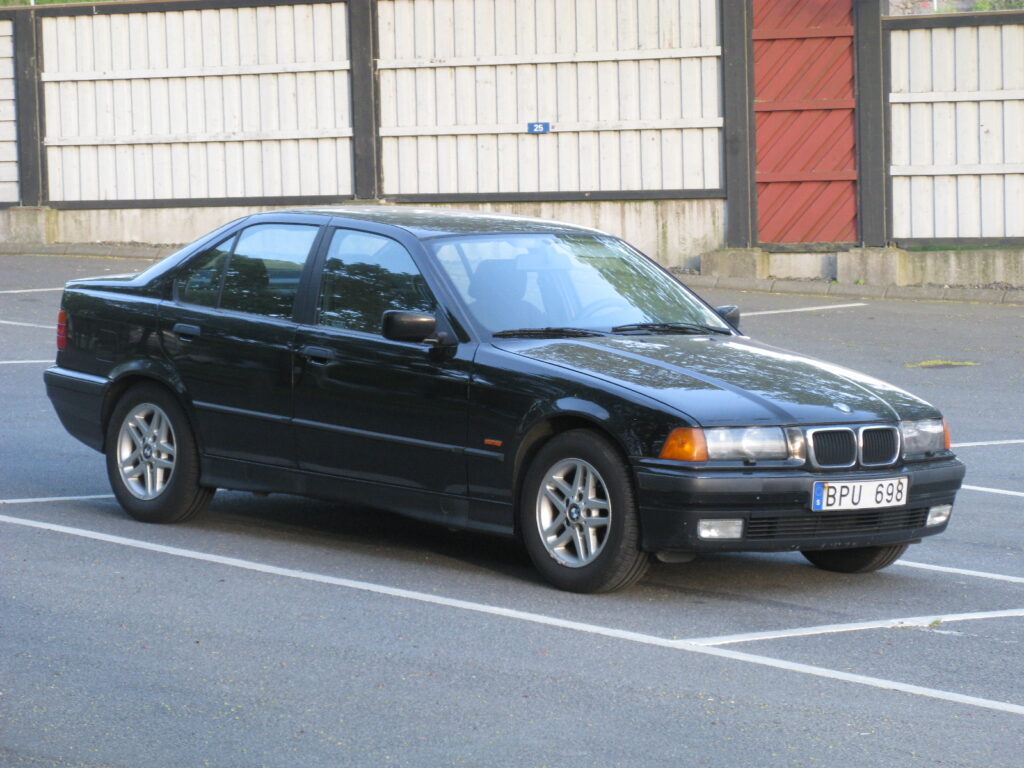
Photo of the real car. Photo: nakhon100 / Wikimedia Commons, CC BY 2.0