
Background
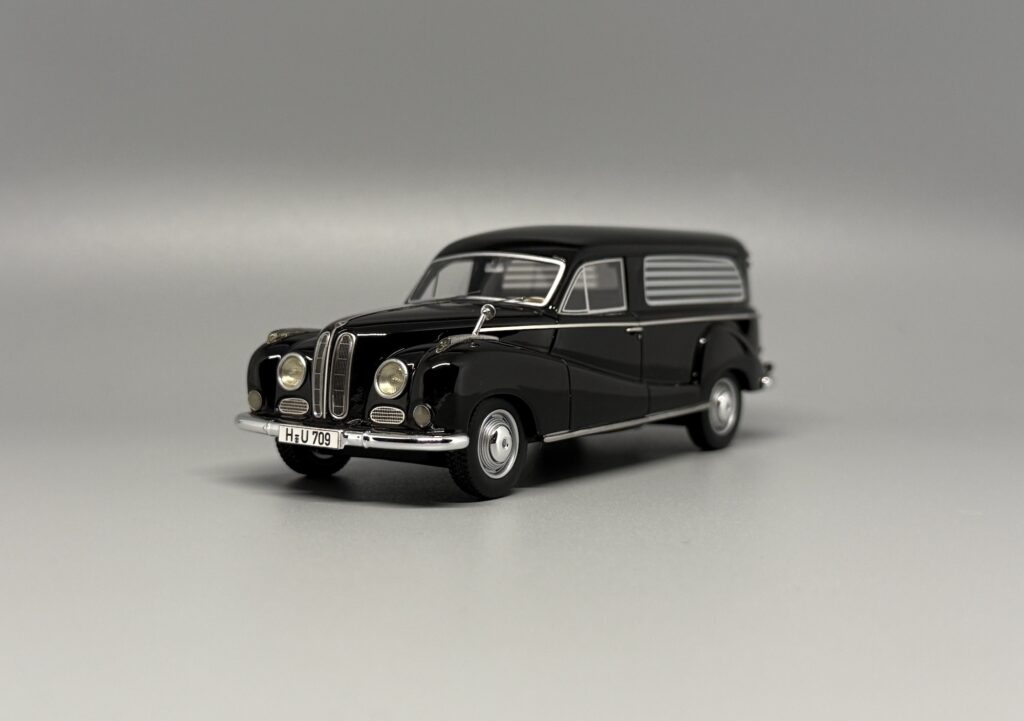
BMW 501 Hearse by Bierhake is one of the most unusual special-purpose vehicles created on the basis of the BMW 501/502 model family. The car did not leave the BMW factory as a hearse, but began its life as a conventional BMW 501 luxury saloon and was later converted by the independent German coachbuilder Bierhake. Vehicles such as this illustrate an interesting aspect of the German automotive industry of the 1950s: a production car with a strong separate chassis could be given an entirely new body and adapted for a highly specialised purpose.
Originally a BMW 501 8-Zylinder
According to surviving records researched by the BMW V8 Club, the base vehicle was a BMW 501 8-Zylinder with chassis number 53 584. BMW’s delivery records list the car as entering stock on 9 January 1956, which is regarded as the beginning of its production. Finished in black, with standard equipment and without a radio, the car was delivered to the Meierrose company in Osnabrück on 23 January 1956. Its original registration document listed V8 engine number 10 524 and a power output of 95 hp.
Conversion by Bierhake
In 1958, Bierhake, based in Babenhausen near Bielefeld, converted the car into a hearse. The company built two BMW V8 special vehicles with virtually identical bodies during the same year. The original chassis remained unchanged, but the rear section of the body was lengthened by approximately 20 centimetres. This provided the additional loading space required for funeral service while retaining the original BMW chassis and much of the standard mechanical equipment.
Two-door special body
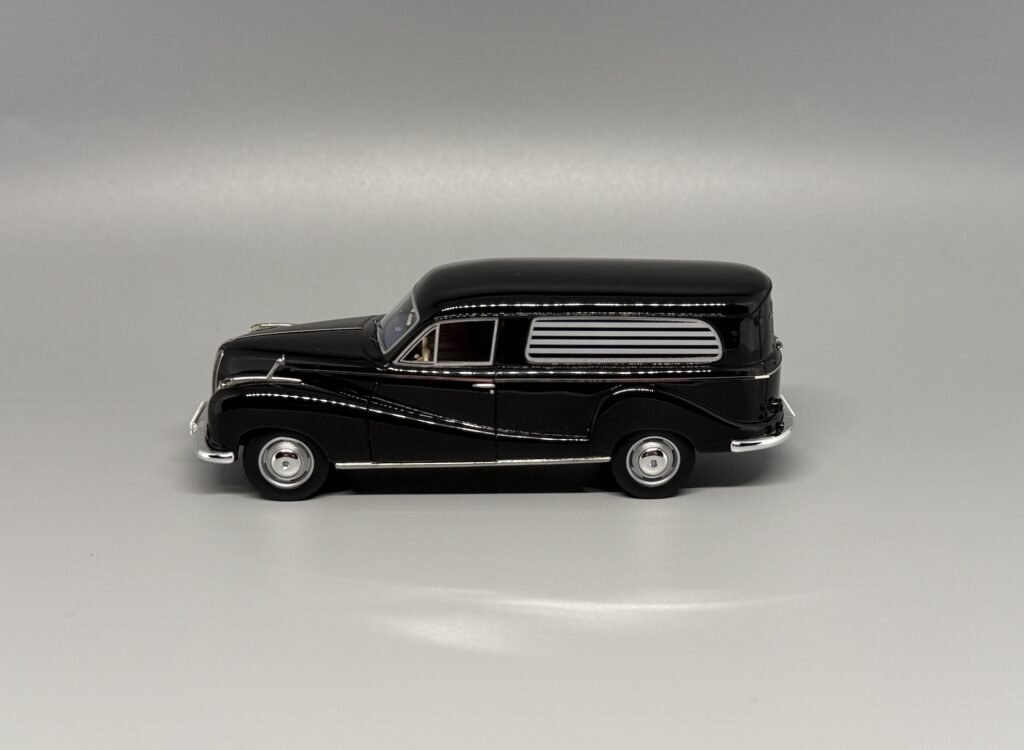
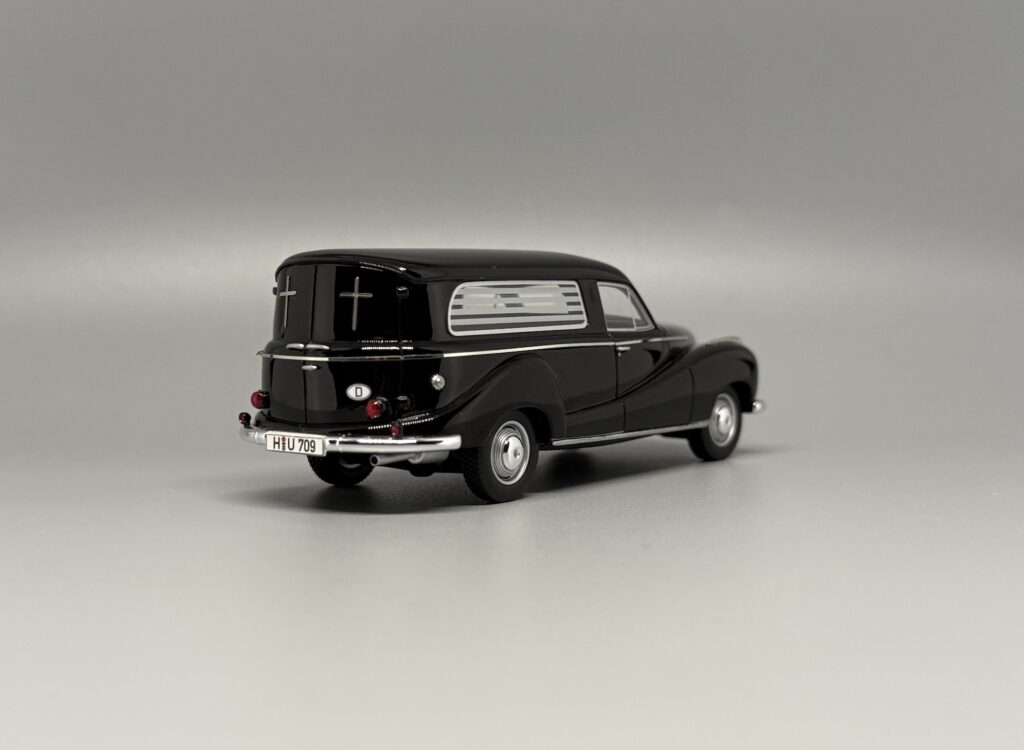
Hearses built on BMW 501/502 chassis were two-door vehicles. Unlike an ambulance, there was no requirement for additional side doors for medical staff or attendants, allowing the rear section to be designed entirely around its funeral-service purpose. The Bierhake body received a high, extended rear section and a double-leaf rear loading door. At the same time, the front of the car retained the characteristic appearance of the BMW 501/502 “Baroque Angel” family.
Practical and economical details
Bierhake reused several standard BMW components in order to keep the conversion relatively economical. The handles from the saloon’s rear doors were reused on the double-leaf loading doors. The outer sections of the front bumper were used to form the rear bumper, with only the centre section modified to accommodate the registration plate. The rear lights were also standard components rather than specially manufactured items: later motorcycle-style lamps were rotated through 90 degrees and adapted for use on the rear doors. These details give the vehicle a particularly practical and handcrafted character.
From V8 to six cylinders?
One of the most interesting uncertainties in the car’s history concerns its engine. The original registration document confirmed a 95 hp V8 engine, but a later replacement document listed a 72 hp six-cylinder engine. The usual modification entries were absent from the surviving paperwork. The BMW V8 Club considers it likely that the funeral director who owned the car had the V8 replaced with a more economical six-cylinder engine in order to reduce operating costs. This remains a reasonable interpretation rather than a fully documented fact.
Why a six-cylinder engine made sense
The operating requirements of a hearse did not demand high maximum performance. By comparison, many Opel Kapitän models converted into ambulances and hearses during the same period used engines producing around 75 hp. BMW’s smooth-running 72 hp six-cylinder engine would have provided sufficient performance while probably being more economical in everyday professional use than the V8. For a vehicle of this type, reliability, smoothness and operating costs were more important than outright speed.
Weight and payload
The conversion increased the vehicle’s weight significantly. A standard BMW 501 8-Zylinder weighed approximately 1,365 kg, while the completed Bierhake hearse had an unladen weight of 1,465 kg. As a result, the officially permitted payload was only 100 kg. The TÜV inspector also noted concerns about overloading the rear axle. Examination of the surviving vehicle suggests that the rear suspension and torsion bars were probably subjected to considerably greater loads in actual service than the official figures allowed.
Why so few BMW hearses were built
Although the separate chassis of the BMW 501 and 502 was strong and theoretically well suited to special-body construction, it also had disadvantages when used for hearses and ambulances. A large chassis crossmember over the rear axle forced the loading floor to remain relatively high, while the standard wheelbase offered only limited additional space behind the rear axle. BMW was also an expensive base vehicle compared with more common alternatives. These factors help explain why funeral cars based on BMW V8 models remained extremely rare.
Two Bierhake cars
In 1958, Bierhake built two BMW V8 special vehicles with the same basic body design. The car with chassis number 53 584 was one of these, and its history is unusually well documented thanks to surviving records and research by the BMW V8 Club. This makes it possible to distinguish the specific Bierhake vehicle from other BMW 501/502-based ambulances and hearses, many of which have much less clearly documented origins and mechanical histories.
Historical significance
The BMW 501 Hearse by Bierhake is a fascinating example of how the engineering of a BMW luxury saloon could be adapted for a completely different purpose. The car combines the technology of BMW’s post-war “Baroque Angel” family with the practical craftsmanship of a small independent coachbuilder. Its surviving individual history makes it even more interesting: the chassis number, original delivery, engine, conversion date and even details of the body construction are known. It is therefore far more than simply a BMW-based hearse – it is the story of a specific and unusually well-documented vehicle.
Model in the collection
The model in my collection was produced by Schuco. The manufacturer marketed it as the BMW 502 “Barockengel” Bestattungswagen, but surviving documentation of the real vehicle shows that its actual base car was a 1956 BMW 501 8-Zylinder converted into a hearse by Bierhake in 1958. The model belongs to Schuco’s Pro.R43 series and was produced in a limited edition of 1,000 examples.
Technical data in brief
Original base vehicle: BMW 501 8-Zylinder
Chassis number: 53 584
Base vehicle year: 1956
Conversion year: 1958
Coachbuilder: Bierhake, Babenhausen, Germany
Body style: two-door hearse
Body modification: rear section extended by approximately 20 cm
Original engine: V8
Original engine output: 95 hp
Engine listed in later documentation: six-cylinder, 72 hp
Drivetrain: rear-wheel drive
Weight of standard BMW 501 8-Zylinder: approximately 1,365 kg
Weight of hearse conversion: 1,465 kg
Official payload: 100 kg
Number of BMWs built by Bierhake with this body design: 2
Special feature: 1956 BMW 501 8-Zylinder converted by Bierhake into a hand-built hearse in 1958
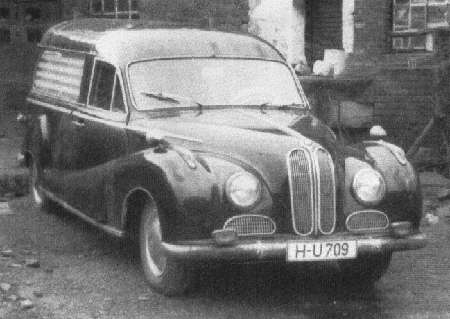
Photo of the real car. Source: bmw-v8-club.de