
Background
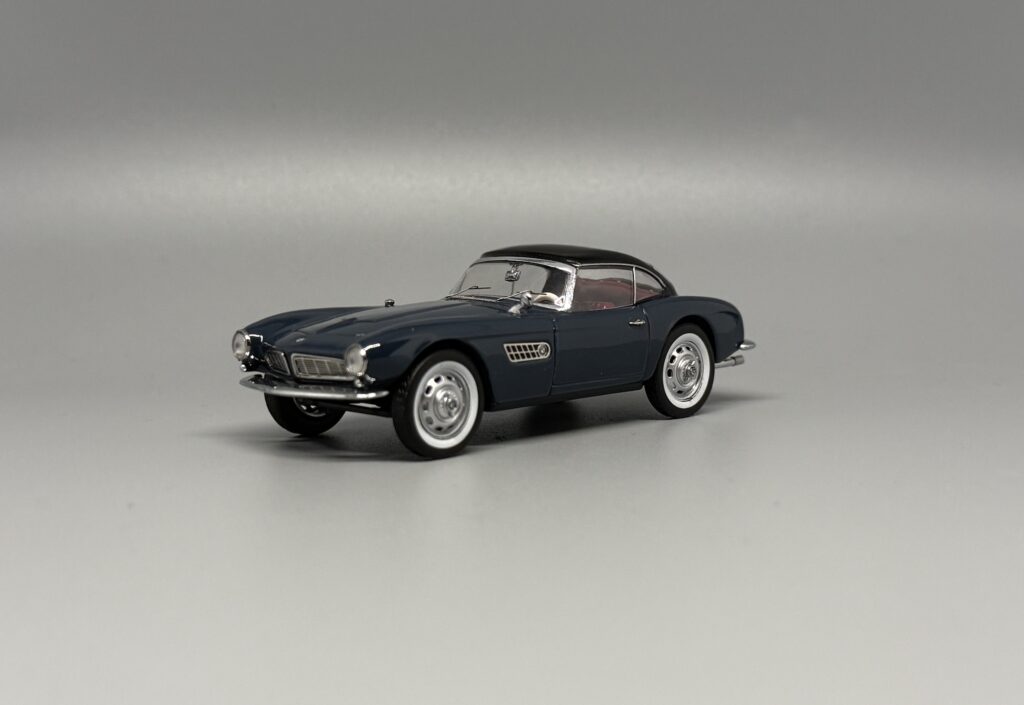
BMW 507 Hardtop is based on one of the most famous and elegant sports cars in BMW history. The BMW 507 was created in the mid-1950s with the aim of returning the brand to the international sports-car market and strengthening BMW’s reputation as a manufacturer of dynamic and exclusive automobiles. BMW had already begun considering a new sports car in 1953, with the first concepts taking shape the following year. Following discussions involving American BMW importer Max Hoffman, the final design was entrusted to Albrecht Graf Goertz, whose elegant styling turned the 507 into one of the most recognisable models in BMW history.
Debut in 1955
BMW presented the 507 to the public for the first time at the Frankfurt IAA Motor Show in 1955 alongside the BMW 503. The new sports car differed clearly from BMW’s earlier post-war models. Its long and low bonnet, rearward-positioned two-seat cockpit, short tail and flowing side profile gave it classic roadster proportions. Particularly distinctive was the wide horizontal BMW kidney grille, extending across almost the entire front of the car and becoming one of the 507’s most recognisable design features.
Design by Albrecht Graf Goertz
The exterior of the BMW 507 was created by Albrecht Graf Goertz, who had studied and worked within the sphere of influence of renowned American industrial designer Raymond Loewy. Goertz successfully combined traditional BMW design elements with a much lighter, lower and more international sports-car style. The 507 body was made from aluminium, and its smooth surfaces, long side lines and almost sculptural shape immediately attracted attention when the car was introduced. Today, the BMW 507 is widely regarded as one of the most beautiful cars in the company’s history.
From BMW 502 engineering to a sports car
The technical basis of the BMW 507 came from the BMW 502 luxury saloon, but it was extensively modified for the sports car. The wheelbase of the 502-derived chassis was shortened by approximately 35.5 centimetres, and a lightweight aluminium body was fitted. The result was a car that was considerably more compact and sporting than BMW’s large luxury saloons while retaining the strength and smoothness of their V8 engineering. This combination allowed BMW to use proven components in a model with an entirely different character.
3.2-litre V8
The BMW 507 was powered by a 3,168 cm³ light-alloy V8 engine producing 150 hp at 5,000 rpm. The engine was based on the BMW V8 family introduced with the BMW 502, but a higher compression ratio and other modifications increased the power output for the sports car. Power was transmitted to the rear wheels through a four-speed manual gearbox. The lightweight aluminium body, powerful V8 and rear-wheel drive gave the 507 very strong performance for its time.
Up to 220 km/h
BMW Group Classic gives the standard top speed of the BMW 507 as 205 km/h, but the car was available with three different final-drive ratios. Depending on the selected ratio, top speed ranged from approximately 190 to 220 km/h. With the highest-speed gearing, the 507 was therefore among the fastest production cars of the second half of the 1950s. BMW later also offered a limited number of more powerful engines producing around 165 hp.
Removable hardtop
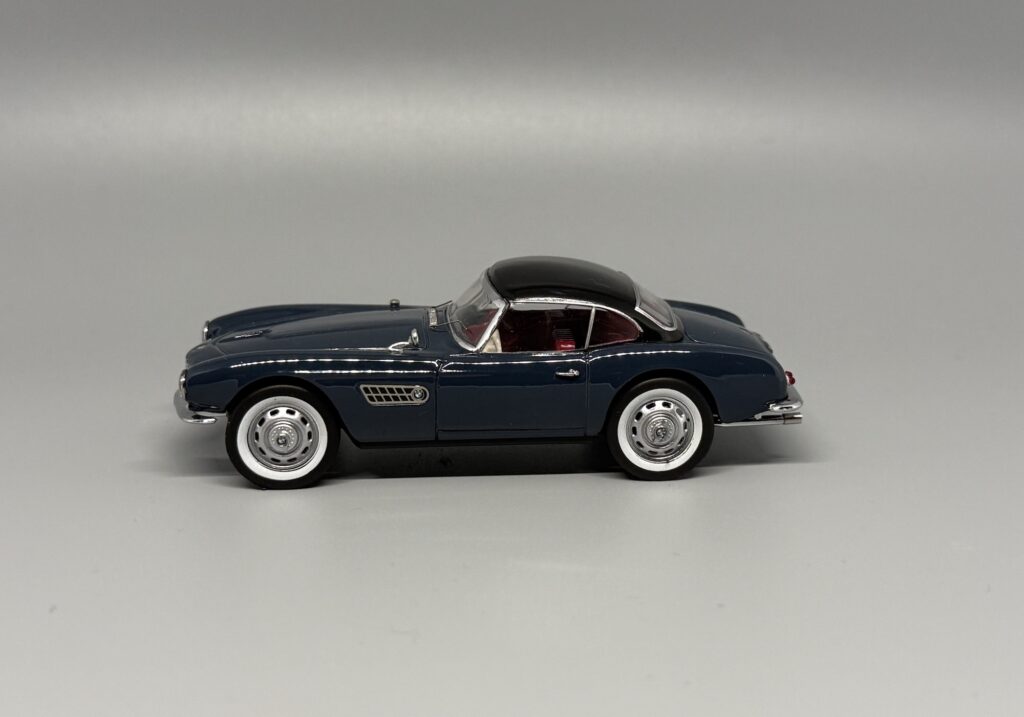
The BMW 507 was fundamentally a roadster, but it could be fitted with a removable hardtop. The hardtop changed the appearance of the car considerably, giving the low roadster an elegant and almost coupé-like silhouette. It was not a separate BMW 507 Coupé model – the hardtop was an additional roof for the roadster, and some cars are known to have been delivered from the factory with a removable hardtop. In this form, the 507 combined the character of an open sports car with the appearance and improved weather protection of a closed Gran Turismo.
The hardtop changes the character
With the roof removed, the BMW 507 appears above all as a light and elegant roadster, while the hardtop gives the same car a more formal and dignified appearance. The long, low roofline follows the shape of the rear body naturally and further emphasises the balanced proportions of Goertz’s design. This makes the hardtop-equipped 507 an especially interesting alternative to the conventional open version: technically it remains the same sports car, but visually it approaches the character of a classic luxury coupé.
Two production series
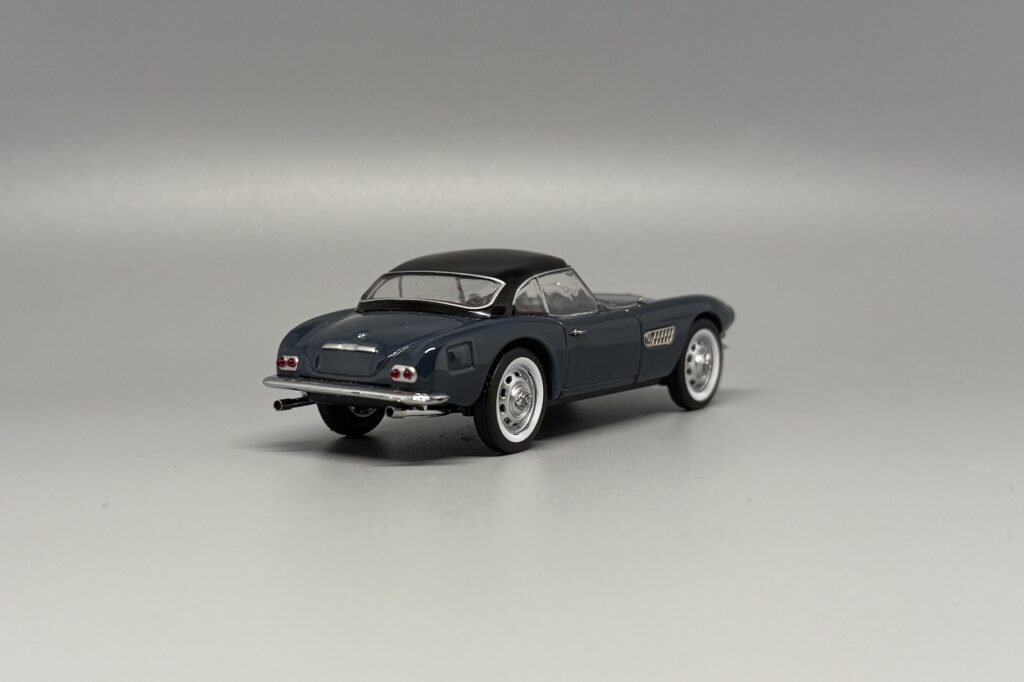
The BMW 507 was produced in two main series. Series II entered production in late 1957, and one of its most visible changes was the relocation of the fuel filler to the right rear wing. The dashboard and several smaller details were also revised. The basic aluminium body, 3.2-litre V8 and overall design remained unchanged. If the exact year of a particular model car is unknown, it is therefore more accurate to describe it generally as a BMW 507 Hardtop rather than assigning it to a specific production series.
A very expensive sports car
When new, the BMW 507 cost 26,500 Deutsche Mark in Germany. The car was expensive because of its complex aluminium body, labour-intensive construction and V8 engineering. BMW had originally hoped for significantly higher production volumes, especially for the American market, but manufacturing costs pushed the price to a level that limited the number of potential buyers. As a result, the 507 became financially problematic for BMW despite attracting enormous attention and prestige.
Only 251 cars
According to current BMW Group Archive figures, only 251 BMW 507s were produced between 1956 and 1959. Slightly different totals can be found in older BMW publications and other sources, but BMW Group Classic currently uses the figure of 251 cars. The very small production volume resulted from the car’s high price and labour-intensive construction, and this rarity has helped make the 507 one of the most valuable classic BMWs today.
More important for image than sales
The BMW 507 fell far short of the sales volumes the company had originally hoped to achieve. Nevertheless, its impact on BMW’s image was considerable. Its elegant design, aluminium body, V8 engine and international attention demonstrated that BMW was capable of building a sports car that belonged among the most exclusive European automobiles of its time. The 507 therefore became an image-building model whose historical significance ultimately proved far greater than its commercial success.
Legacy
The influence of the BMW 507 can also be seen in much later BMW sports cars. BMW returned particularly clearly to this historic model with the BMW Z8 developed in the late 1990s. Its long bonnet, low roadster body, side details and wide BMW kidney grille reinterpreted the design language of the 507 in a modern form. The very limited-production 507 therefore became one of the most important design icons in BMW sports-car history.
Historical significance
The importance of the BMW 507 in BMW history is far greater than its production total of 251 cars might suggest. The model did not bring the company the expected commercial success, but it created one of BMW’s strongest and most enduring design icons. Albrecht Graf Goertz’s aluminium body, the 3.2-litre V8 engine and exceptionally clean proportions have made the 507 one of the most highly regarded sports cars of the 1950s. The hardtop version adds another interesting dimension to the story, showing how the same roadster could be transformed with a removable roof into an almost coupé-like Gran Turismo.
Model in the collection
The model in my collection was produced by Schuco and represents a BMW 507 fitted with a removable hardtop. It was produced in a limited edition of 500 examples.
Technical data in brief
Production period: 1956–1959
Body style: two-door two-seat roadster with removable hardtop
Designer: Albrecht Graf Goertz
Body: aluminium
Technical basis: BMW 502 V8 model family
Engine: light-alloy V8
Displacement: 3,168 cm³
Power: 150 hp @ 5,000 rpm
Transmission: 4-speed manual
Drivetrain: rear-wheel drive
Top speed: 205 km/h in standard specification, up to 220 km/h depending on final-drive ratio
Price when new: 26,500 Deutsche Mark
Production: 251 cars according to current BMW Group Archive figures
Special feature: BMW 507 Roadster with removable hardtop, giving the car an elegant coupé-like silhouette
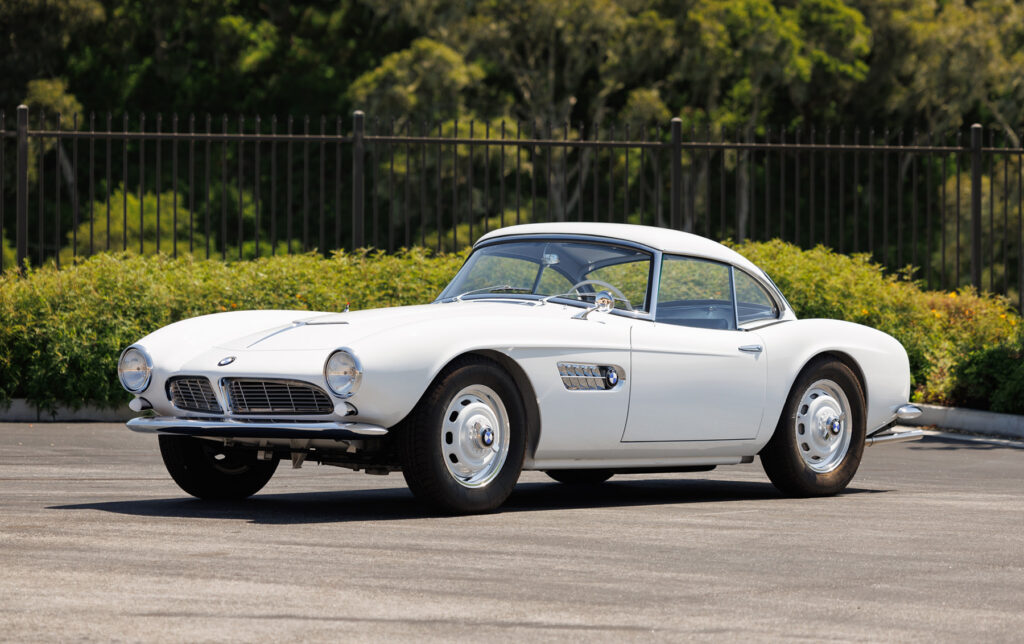
Photo of the real car. Source: goodingco.com