
Background
BMW 507 Roadster is one of the most legendary and exclusive sports cars in BMW history. Introduced in 1955 and shown at the Frankfurt IAA that same year, the open two-seater was intended to strengthen BMW’s position in the international luxury-car market, particularly in the United States, where European sports cars were attracting increasing attention. Although the 507 never achieved the sales success BMW had hoped for, it would eventually become one of the best-known and most valuable classic BMWs.
Influence of the American market
A key figure in the creation of the BMW 507 was Max Hoffman, the influential New York importer of European automobiles. Hoffman believed that BMW needed an elegant and powerful sports car for the American market and encouraged the company to develop a model aimed at wealthy US customers. He also helped bring designer Albrecht Graf Goertz to BMW’s attention. Initial expectations for sales were ambitious, but the labour-intensive construction and high production costs ultimately made the 507 far more exclusive than originally intended.
Designed by Albrecht Graf Goertz
The BMW 507 was designed by German-born designer Albrecht Graf Goertz, who was working in the United States and had earlier been associated with the renowned industrial designer Raymond Loewy. Goertz gave the 507 a low and elegant body, a long bonnet, muscular rear wings and a short tail. One of its most distinctive features was the wide and low interpretation of BMW’s kidney grille, which differed dramatically from the tall, narrow kidneys used on earlier models. The characteristic side vents and flowing body lines made the 507 instantly recognisable from almost any angle.
Hand-built aluminium body
The body of the 507 was largely formed by hand from aluminium. Its engineering was based on BMW’s 502, but the chassis was shortened by 35.5 centimetres for the sports car. Hand construction meant that individual bodies were not completely identical and also contributed significantly to production costs. The use of aluminium helped keep weight down, although the 507 remained a luxurious grand-touring roadster rather than an uncompromising lightweight racing car.
3.2-litre V8
Under the bonnet was a 3,168 cm³ light-alloy V8 engine derived from the unit used in BMW’s larger V8 saloons. A higher compression ratio increased output to 150 hp at 5,000 rpm. The engine was combined with a four-speed manual gearbox and rear-wheel drive. BMW’s light-alloy V8 was an advanced engine for the period and suited the combination of refinement and sporting performance that defined the 507.
Up to 220 km/h
BMW Group Classic lists the standard top speed of the BMW 507 as 205 km/h. However, the car could be ordered with three different rear-axle ratios, resulting in top speeds of approximately 190 to 220 km/h depending on specification. This explains why period BMW literature also quoted a maximum of 220 km/h. With 150 hp, the 507 offered impressive performance for a road car of the mid-1950s, while retaining the comfort and refinement expected of an exclusive long-distance sports car.
Series I and Series II
A number of changes were made during production, and the BMW 507 is generally divided into Series I and Series II versions. The revised second series appeared towards the end of 1957. One of the most visible changes was the relocation of the fuel filler to the right rear wing. The dashboard was also raised, making it easier to install a radio. The fundamental design and 3.2-litre V8 engine, however, remained unchanged.
Elvis Presley’s BMW 507
The exclusivity of the BMW 507 was reinforced by its association with several famous owners. Alain Delon, Ursula Andress and motorcycle and Formula One champion John Surtees were among those connected with the model. Its most famous owner, however, was Elvis Presley, who acquired a white 1957 BMW 507 while serving with the US Army in Germany. The car had previously been used by BMW works driver Hans Stuck. Elvis later had it painted red. Believed lost for decades, the car was eventually rediscovered in the United States and restored by BMW Group Classic to its original specification.
Too expensive to succeed
The greatest obstacle to the BMW 507’s commercial success was its price. In Germany it cost 26,500 Deutsche Mark, placing it among the most expensive cars of its era. The hand-built aluminium body and low-volume production prevented BMW from bringing the price down to the level originally envisaged. In the United States, the retail price approached 10,000 dollars, further restricting the number of potential buyers. The 507 generated enormous attention for BMW, but it was not a financial success.
Only 251 cars
Production of the BMW 507 lasted from 1956 until 1959. According to the current BMW Group Archive model-series record, only 251 cars were built. Its extremely low production volume, hand-crafted aluminium body, Goertz styling and famous owners have since made the 507 one of the most desirable classic BMWs. Surviving original examples are now among the most prestigious BMWs seen at major international concours events and classic-car auctions.
Historical significance
The BMW 507 failed to meet the commercial expectations placed upon it, but its influence on the image of BMW has proved far more enduring. It combined sporting performance, a powerful engine, luxury and elegant design in a way that would later become closely associated with the brand. The BMW Z8, introduced at the end of the 1990s, deliberately drew inspiration from the 507 and further reinforced its status as one of the great design icons in BMW history.
Model in the collection
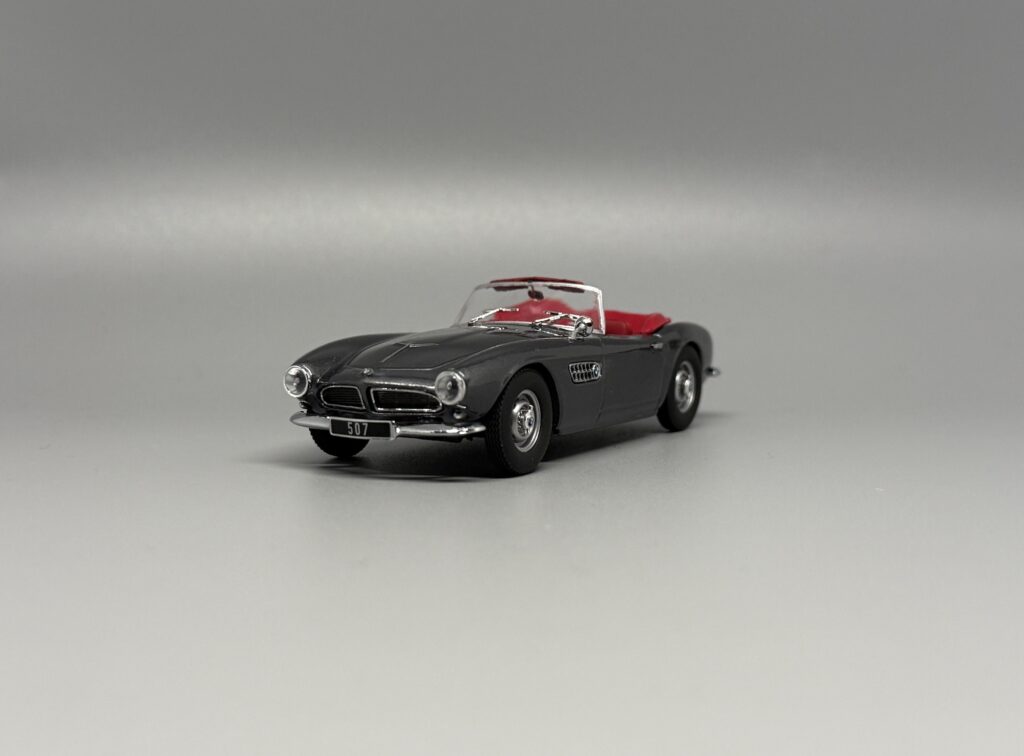
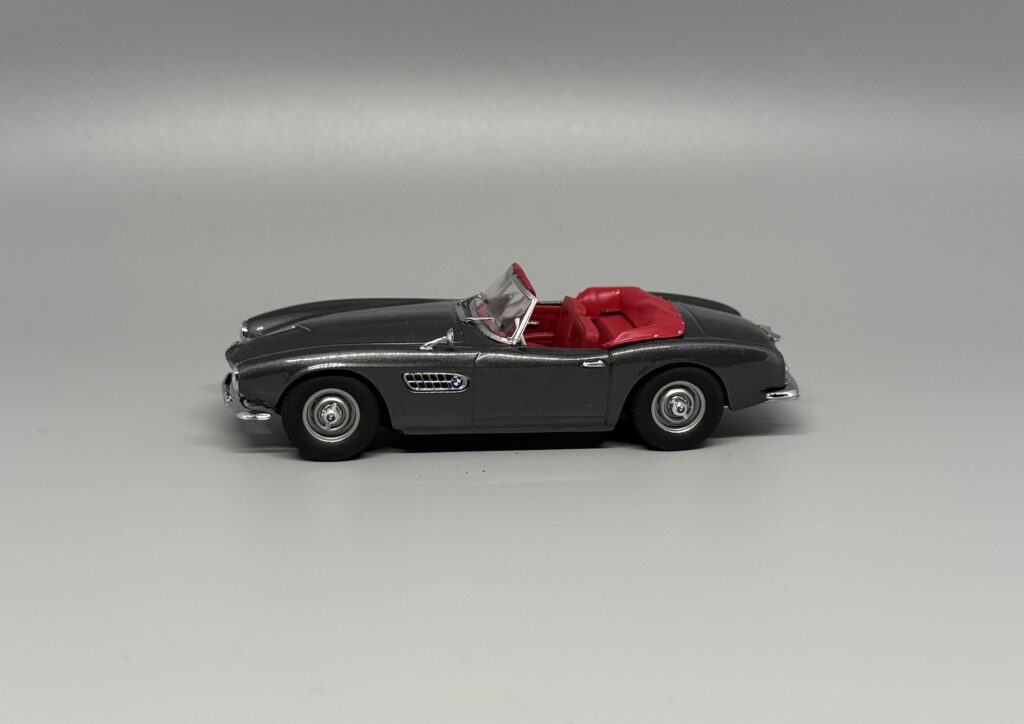
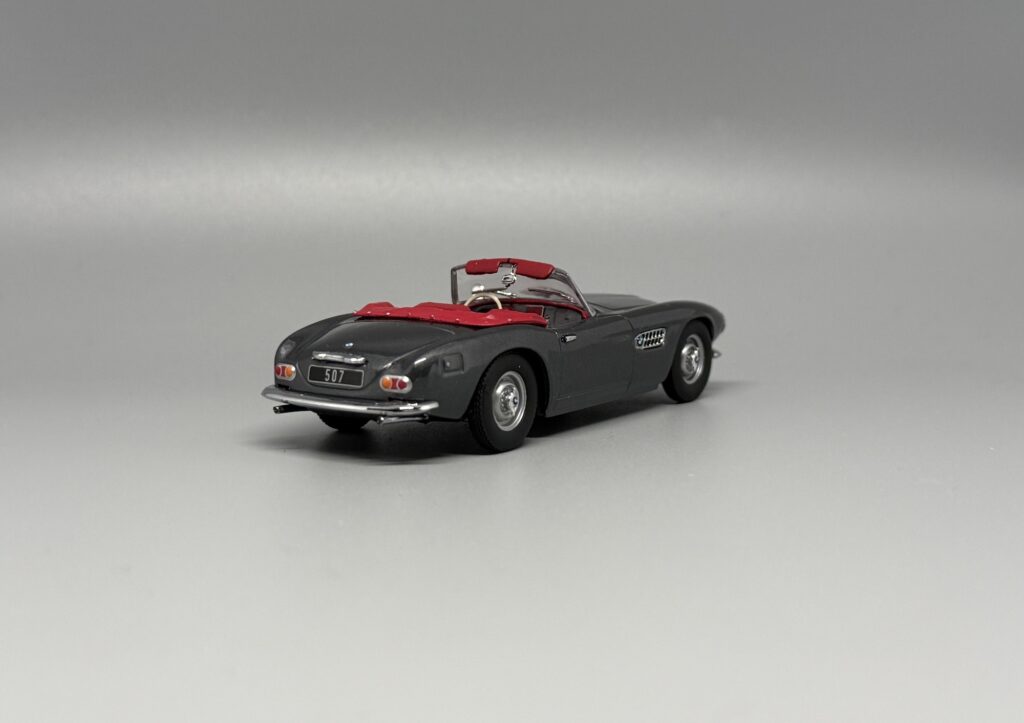
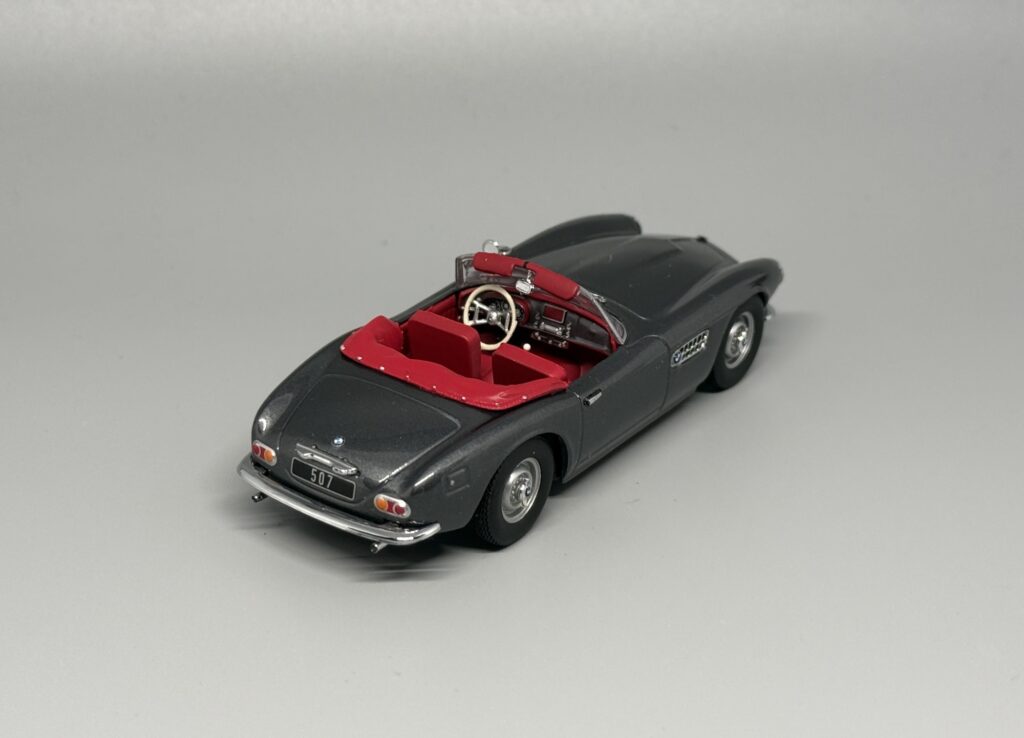
The BMW 507 Roadster in my collection was produced by Minichamps. It is an official BMW dealer promotional model, intended for display and promotional use by BMW dealers.
Technical data in brief
Production period: 1956–1959
Body style: two-seat roadster
Body: hand-built aluminium body
Engine: light-alloy V8
Displacement: 3,168 cm³
Power: 150 hp @ 5,000 rpm
Transmission: 4-speed manual
Drivetrain: rear-wheel drive
Top speed: 205 km/h, 190–220 km/h depending on final-drive ratio
Price when new: 26,500 Deutsche Mark
Production: 251 cars
Designer: Albrecht Graf Goertz
Special feature: one of the rarest and most celebrated classic BMW sports cars
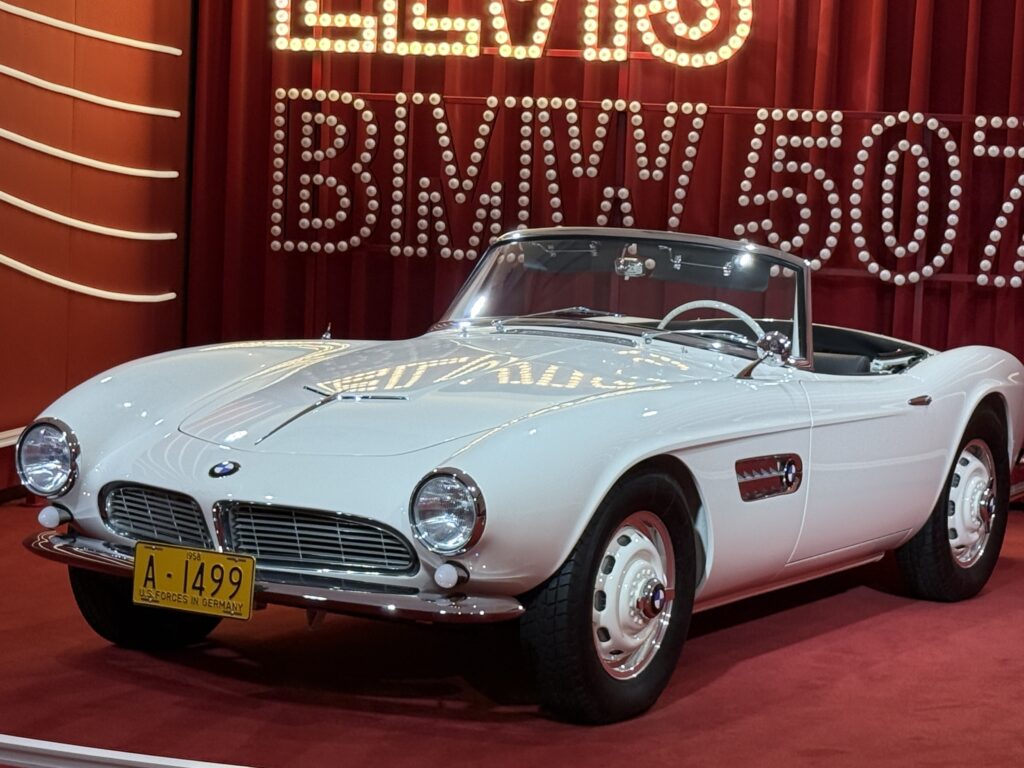
Photo of the real car: Elvis Presley’s 1957 BMW 507, BMW Museum. Photo: Sten-Patrick Kreek.