
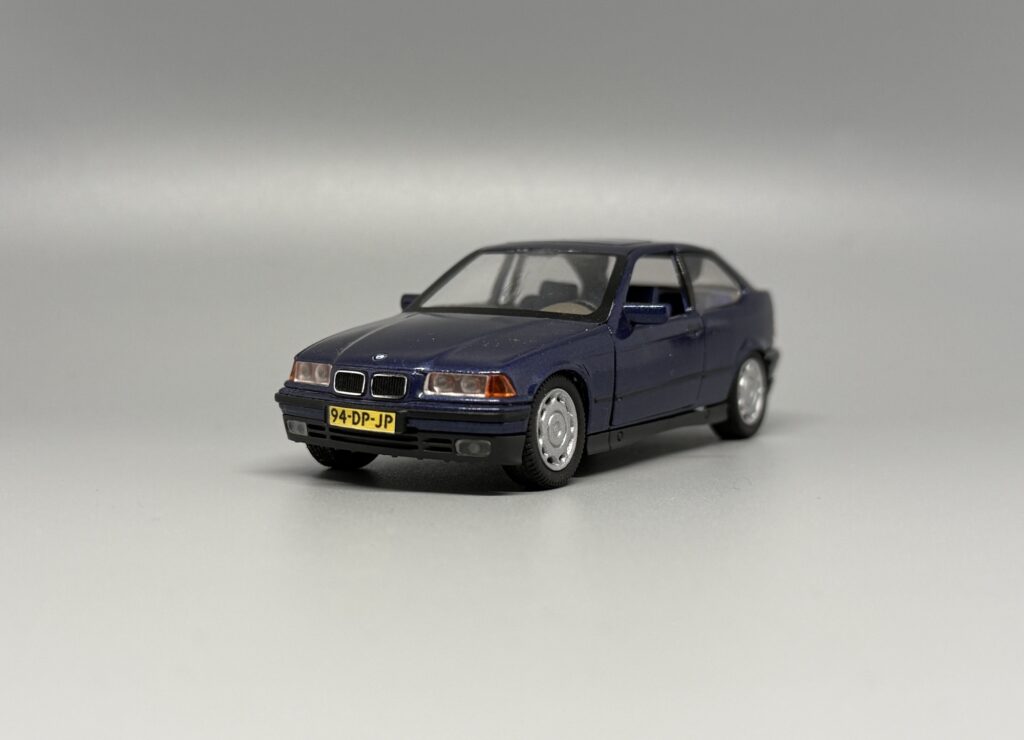
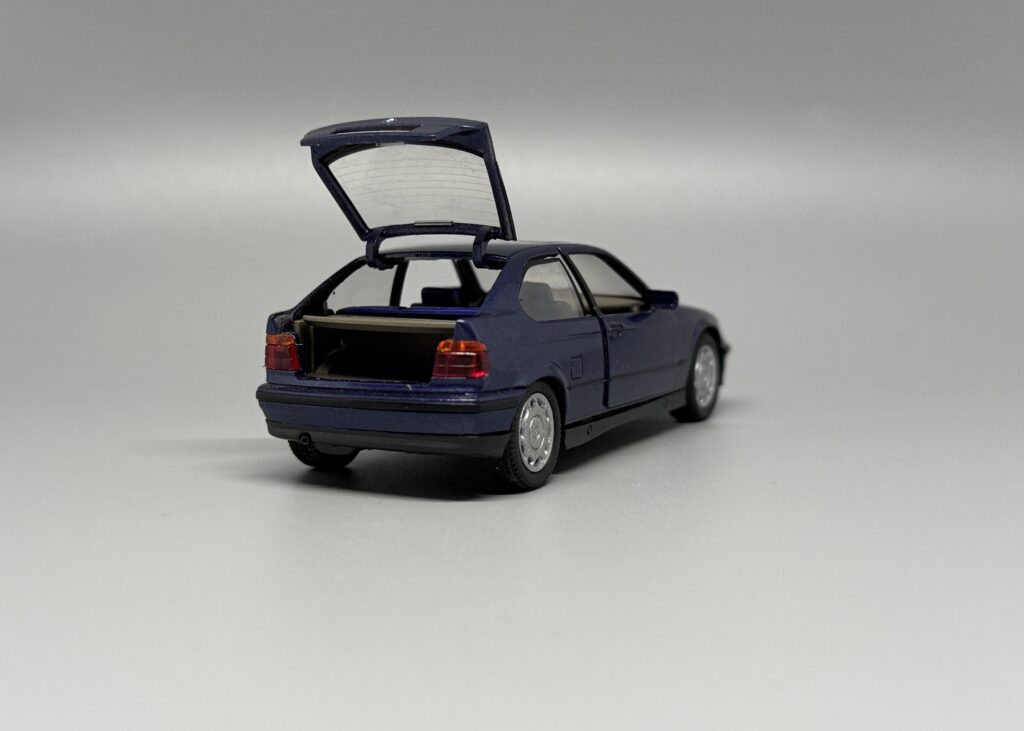
BMW 3 Series Compact (E36/5) was the shortest and most distinctive body variant of the third-generation 3 Series. Presented at the end of 1993 and arriving in showrooms in the spring of 1994, the Compact took BMW more directly into the market for smaller premium cars. It was aimed particularly at younger customers and buyers looking for BMW driving characteristics in a smaller and more affordable package.
The Compact differed from the rest of the E36 family through its sharply truncated rear body, large tailgate and overall length of just 4.21 metres. At the same time, it retained an important element of traditional BMW engineering – a longitudinally mounted front engine driving the rear wheels. This made the Compact highly unusual among small hatchbacks of the 1990s.
23 centimetres shorter than the Sedan
According to BMW Group Classic, the E36 Compact was approximately 23 centimetres shorter than the contemporary 3 Series Sedan. The front clearly belonged to the E36 family, while much of the body behind the A-pillars was specific to the Compact.
Behind its two long side doors, the body ended abruptly in an almost upright rear section with a large opening tailgate. The interior provided accommodation for four or five occupants, while the folding rear seat made the car considerably more practical than its compact exterior dimensions might suggest.
BMW’s objective was not simply to create a smaller 3 Series. The Compact was intended to be younger in character, agile and positioned as a new entry point into BMW ownership while retaining the sporting identity of the brand.
A different rear axle
One of the most interesting technical differences was hidden beneath the car. While the E36 Sedan, Coupé, Convertible and Touring used the generation’s more sophisticated new rear suspension, the Compact followed a different route.
The E36/5 used BMW’s HA1 semi-trailing-arm rear axle, an architecture also associated with the preceding E30 generation. The same rear-axle family was later used by the E36/7 Z3. BMW technical training material specifically distinguishes the E36/5 and E36/7 from the other E36 models in this respect.
Combined with the short body, relatively low weight and rear-wheel drive, this gave the Compact its own distinctive handling character, particularly in the more powerful versions.
Starting with the 316i and 318ti
The entry-level model was the 316i Compact. Its 1.6-litre four-cylinder petrol engine initially developed 75 kW or 102 hp. BMW Group Classic lists its original German price at DM 33,600.
The more sporting alternative was the 318ti Compact. Its four-valve 1.8-litre four-cylinder engine produced 103 kW or 140 hp and allowed a top speed of 209 km/h. Displacement later increased to 1.9 litres while output remained at 140 hp.
The “ti” designation also connected the Compact with an older BMW sporting tradition. The Turismo Internazionale name had previously appeared on dynamic BMW models of the 1960s and 1970s and was revived for the Compact range.
A diesel version as well
In 1995 the 318tds Compact joined the range. Its 1,665 cc four-cylinder turbo-diesel featured charge-air cooling and produced 66 kW or 90 hp.
The 318tds was not intended as a sporting flagship but added the practicality and rear-wheel-drive character of the Compact with substantially lower fuel consumption, broadening the appeal of BMW’s new smaller model.
The 323ti brought six-cylinder power
The most interesting regular version arrived in 1997. The BMW 323ti Compact received a 2,494 cc M52 straight-six producing 125 kW or 170 hp at 5,500 rpm.
Installing a straight-six in the short Compact body transformed the character of the car. BMW Group Classic describes this combination as a unique proposition at the time, and the 323ti was capable of 230 km/h.
The 323ti was produced from September 1997 until August 2000, with BMW recording slightly more than 15,000 examples. It remained a relatively rare member of the E36 Compact family and is particularly sought after today.
The M3 Compact that never reached production
The sporting potential of the Compact also attracted the attention of BMW M GmbH. In 1996 BMW created an M3 Compact prototype intended to explore the idea of offering younger customers a more accessible entry into the BMW M world.
The prototype retained the full 321 hp output of the 3.2-litre E36 M3 straight-six. With a weight of only around 1.3 tonnes, it was approximately 150 kilograms lighter than the regular M3. BMW has subsequently described the M3 Compact as, in some respects, a conceptual predecessor to the later BMW M2.
The M3 Compact never entered series production, leaving the 323ti as the most powerful production E36 Compact available to customers.
BMW’s new entry-level model
BMW Group Classic states that the Compact was aimed primarily at younger buyers and also as a second vehicle for couples and families. Its pricing positioned it as the new entry-level model for the BMW brand and placed it in direct competition with cars in the Volkswagen Golf class.
Unlike most competitors in that segment, however, BMW retained rear-wheel drive. Together with the longitudinal engine layout and driver-focused driving position, this gave the Compact a clear technical connection with the larger 3 Series models.
Almost 400,000 cars
BMW Group Classic lists E36 Compact production from January 1994 until August 2000, with cars reaching dealerships from April 1994. The Compact therefore remained in production after the E36 Sedan had already been replaced.
According to BMW’s own historical information, almost 400,000 E36 Compacts were sold. This made it one of the most successful E36 body variants after the Sedan and Coupé.
The frequently quoted figure of 371,498 relates to production statistics that end before the final 2000 production year and is therefore not best treated as the complete lifetime total.
Paving the way for the BMW 1 Series
The E36 Compact also had long-term importance for BMW. Its success led to another Compact in the E46 generation, but after the end of that model BMW separated its smaller car from the 3 Series entirely.
The first-generation BMW 1 Series, launched in 2004, effectively took over the Compact’s role as the smaller and more accessible BMW while initially retaining the traditional rear-wheel-drive layout. In this sense, the E36 Compact can be regarded as an important predecessor to the BMW 1 Series.
Model in the collection
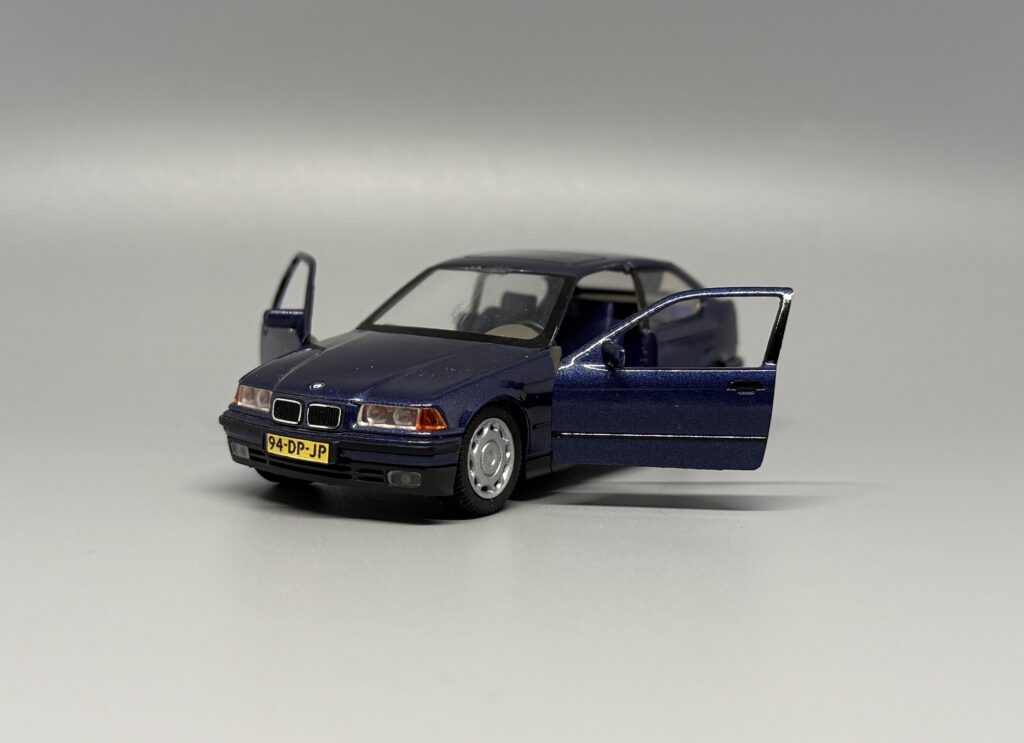
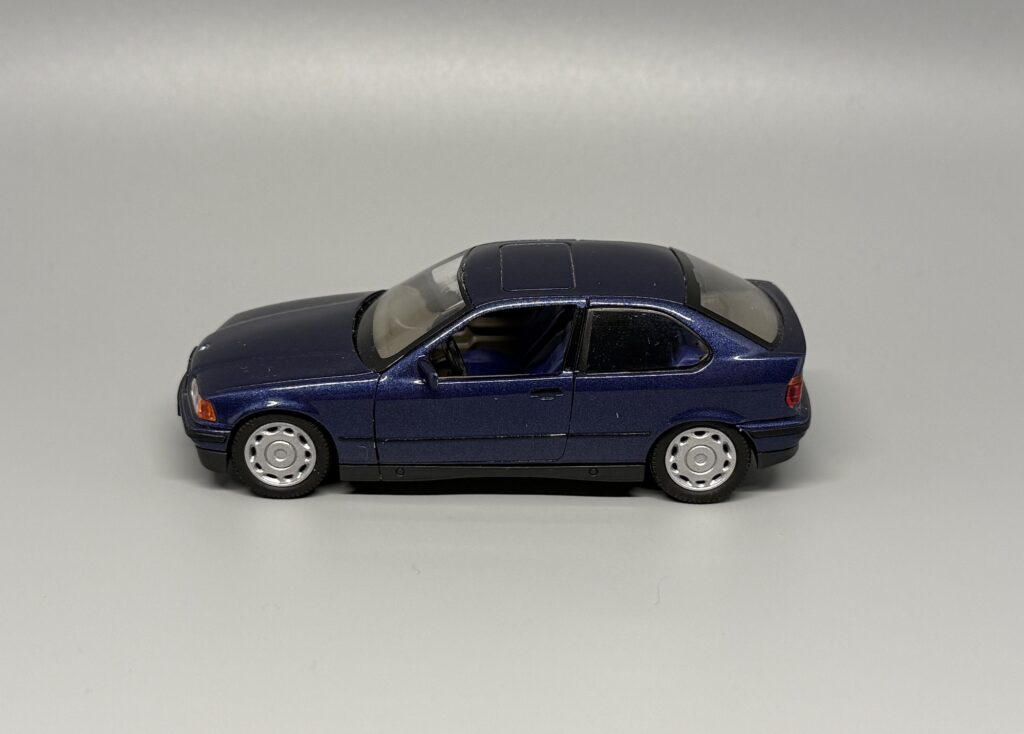
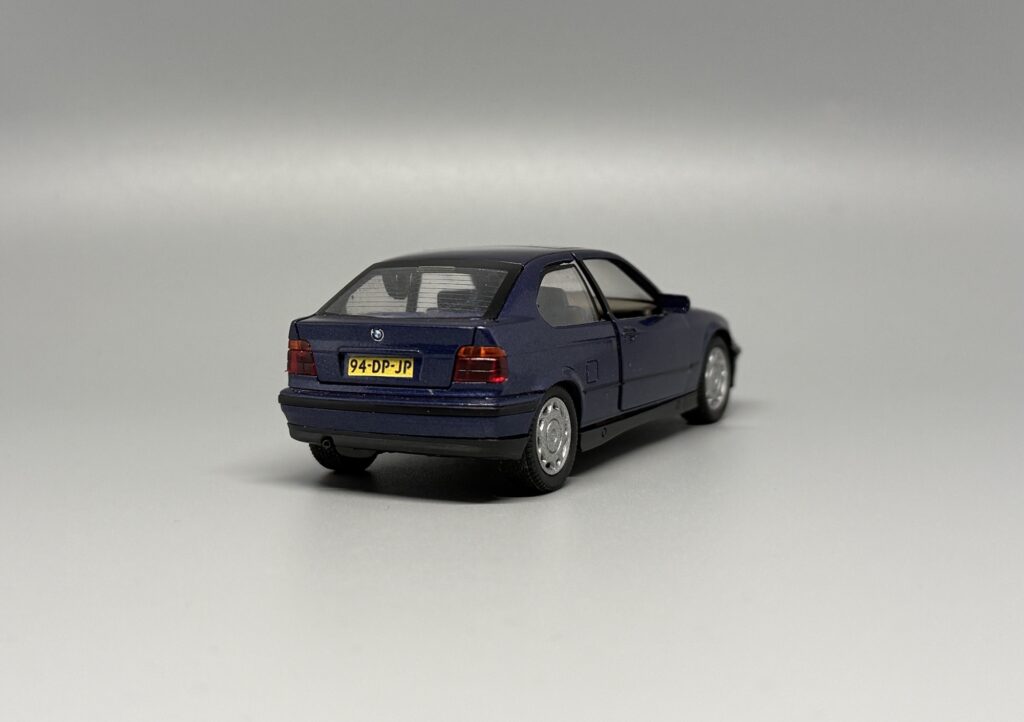
The 1:43-scale BMW 3 Series Compact (E36/5) in my collection was produced by Schuco. The miniature represents a 1994 car and therefore depicts the first year in which the E36 Compact reached customers.
The model clearly captures the Compact’s defining feature – the substantially shorter body and sharply truncated rear section with its large tailgate.
Technical data
Presented: late 1993
Production: 01/1994–08/2000
Market launch: 04/1994
Body style: two side doors with a large rear hatch
Length: approximately 4.21 m
Body: approximately 23 cm shorter than the E36 Sedan
Drive: rear-wheel drive
Rear suspension: HA1 semi-trailing-arm axle
Engines: four-cylinder petrol and diesel engines, plus a six-cylinder petrol engine in the 323ti
Most powerful production version: BMW 323ti Compact, 170 hp
BMW 323ti top speed: 230 km/h
Production volume: almost 400,000 cars according to BMW Group Classic
Special feature: compact rear-wheel-drive 3 Series that brought BMW into the Golf-size segment and helped pave the way for the later BMW 1 Series
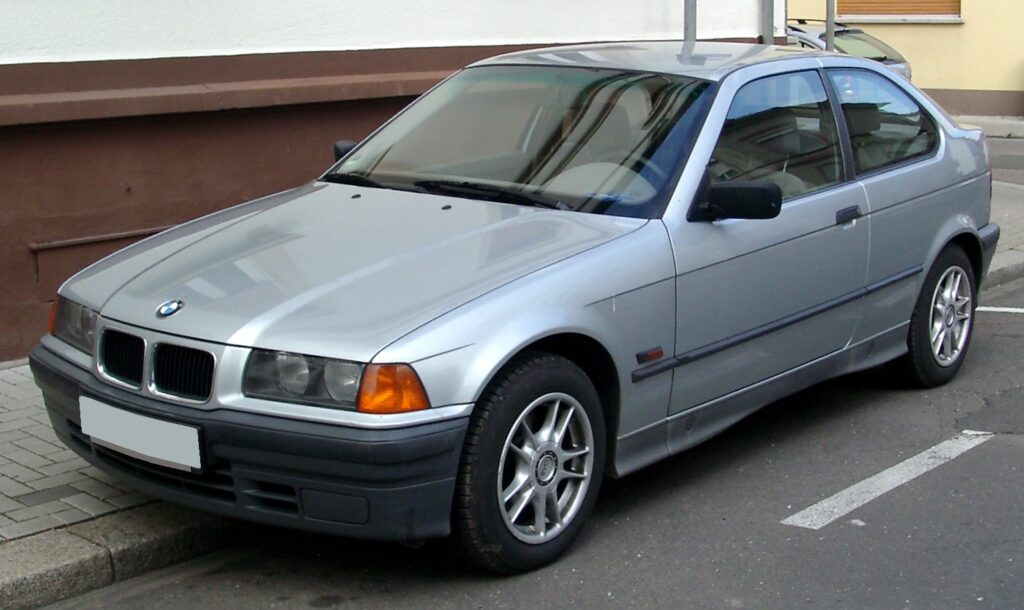
Photo of the real car. Photo: Rudolf Stricker / Wikimedia Commons, CC BY-SA 3.0