
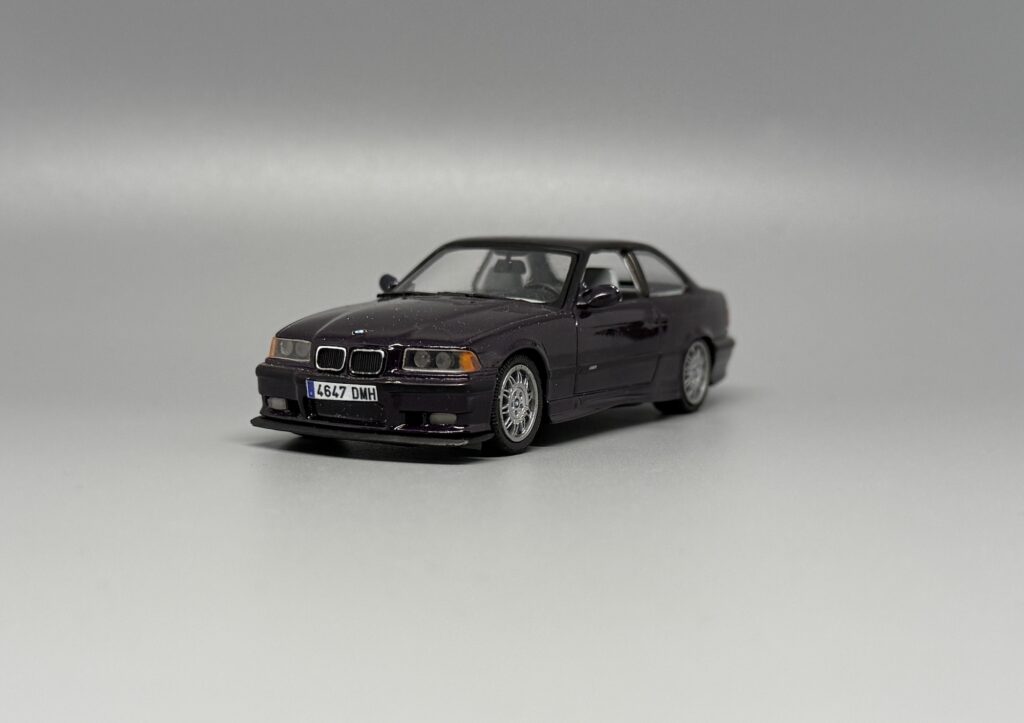
BMW M3 Coupé (E36) took the M3 into an entirely new era in 1992. While the first-generation E30 M3 had been created primarily as a homologation model for motorsport, its successor followed a different philosophy. The E36 M3 was designed to combine genuine sports-car performance and BMW M engineering with a much higher level of everyday usability.
The result was considerably more understated than the E30 M3. Wide wheel arches and a prominent rear wing were gone, and at first glance the E36 M3 could be mistaken for a regular 3 Series Coupé. Beneath its discreet body, however, was an entirely new high-revving six-cylinder M engine, a specially developed chassis and performance that was exceptional for its era.
The second-generation M3
The E36 was the second generation of the BMW M3 and the first to use an inline-six engine. BMW M describes this as an important change in the philosophy of the model: the car retained motorsport-inspired engineering but was no longer developed primarily as a road-going homologation special.
Instead, the E36 M3 became a fast and refined sports coupé that was equally capable of everyday use and highly dynamic driving. This combination would become one of the defining characteristics of every subsequent M3 generation.
The first six-cylinder M3
At the heart of the original 1992 M3 was the S50B30 developed by BMW Motorsport GmbH. The naturally aspirated straight-six displaced 2,990 cc and was based on BMW’s M50 engine family but extensively redesigned for high-performance use.
Maximum output was 210 kW or 286 hp at 7,000 rpm, with peak torque of 320 Nm. Specific output reached 95.7 hp per litre, an exceptional figure for a naturally aspirated production engine in the early 1990s.
The S50B30 featured six individual throttle bodies and, most importantly, BMW’s new VANOS variable camshaft timing system on the intake side. This helped combine strong torque at lower and medium engine speeds with impressive high-rpm performance.
Fast yet refined
The 3.0-litre M3 accelerated from 0–100 km/h in approximately 6.0 seconds and its top speed was electronically limited to 250 km/h. Power was delivered to the rear wheels through a five-speed manual transmission.
These figures placed the E36 M3 firmly among serious sports cars of the early 1990s, despite retaining a fully usable four-seat cabin, practical luggage compartment and the everyday versatility of the 3 Series.
A discreet “wolf in sheep’s clothing”
One of the defining characteristics of the E36 M3 was its restrained appearance. BMW M itself has described the car as a “wolf in sheep’s clothing”. The differences from a regular E36 Coupé were significant but far less dramatic than those of the E30 M3.
The M3 featured aerodynamically optimised M exterior mirrors, revised front and rear aprons, special 17-inch wheels and an M-specific suspension that lowered the car by around three centimetres. The lower centre of gravity improved both handling and the car’s visual stance.
Early 3.0-litre cars were also recognisable by their amber front indicator lenses. With the autumn 1995 model update, white indicator lenses and revised kidney grilles were introduced.
A different approach from the E30 M3
The body of the E30 M3 had been extensively modified from the regular 3 Series in order to satisfy motorsport homologation requirements. BMW followed a different route with the E36 M3. Its basic Coupé body remained much closer to the series-production car, with performance achieved primarily through the engine, chassis, brakes and aerodynamic details.
This changed the character of the M3 without reducing its sporting credentials. The E36 demonstrated that an M3 did not need to be an obvious homologation special to deliver genuine BMW M performance, a philosophy that became increasingly important to later generations.
The M3 becomes a model family
The E36 M3 initially reached the market as a Coupé. In 1994 it was joined by a Convertible and, for the first time in M3 history, a four-door Sedan. European 3.0-litre versions used the 286 hp S50B30 engine.
This transformed the M3 from a single body style into a complete model family. The Sedan was particularly significant, demonstrating that genuine M3 performance could also be combined with the practicality of a four-door car.
The M3 GT – a special 3.0-litre version
Before the arrival of the 3.2-litre M3, BMW M developed the M3 GT from the 3.0-litre model. Its modified S50B30 engine produced 217 kW or 295 hp.
Only 350 left-hand-drive European production cars were built, plus a small number of pre-production examples. Several technical developments used in the M3 GT previewed features that would appear in the forthcoming 3.2-litre M3.
The major 1995 update
In the autumn of 1995, BMW M extensively revised the E36 M3. The 3.0-litre S50B30 was replaced by the 3,201 cc S50B32, increasing output to 236 kW or 321 hp and maximum torque to 350 Nm.
The new engine adopted double VANOS and the five-speed transmission was replaced by a six-speed manual. Acceleration from 0–100 km/h improved to approximately 5.5 seconds. The exterior changes were much more subtle, with white indicator lenses and revised kidney grilles among the most visible differences.
The history of the E36 M3 Coupé can therefore be divided clearly into two stages: the original 3.0-litre 286 hp model produced from 1992 to 1995, followed by the 3.2-litre 321 hp version.
The M3 becomes a major sales success
According to BMW Group Classic, a total of 46,525 E36 M3 Coupés were built. This figure includes both 3.0- and 3.2-litre versions and cars for the various world markets. Coupé production took place in Regensburg, with additional cars assembled in Rosslyn, South Africa.
BMW records total E36 M3 production across the Coupé, Sedan and Convertible at 71,242 cars. Compared with the 17,970 examples of the preceding E30 M3, this demonstrated how the M3 had developed from a low-volume homologation special into a highly successful international high-performance model.
Model in the collection
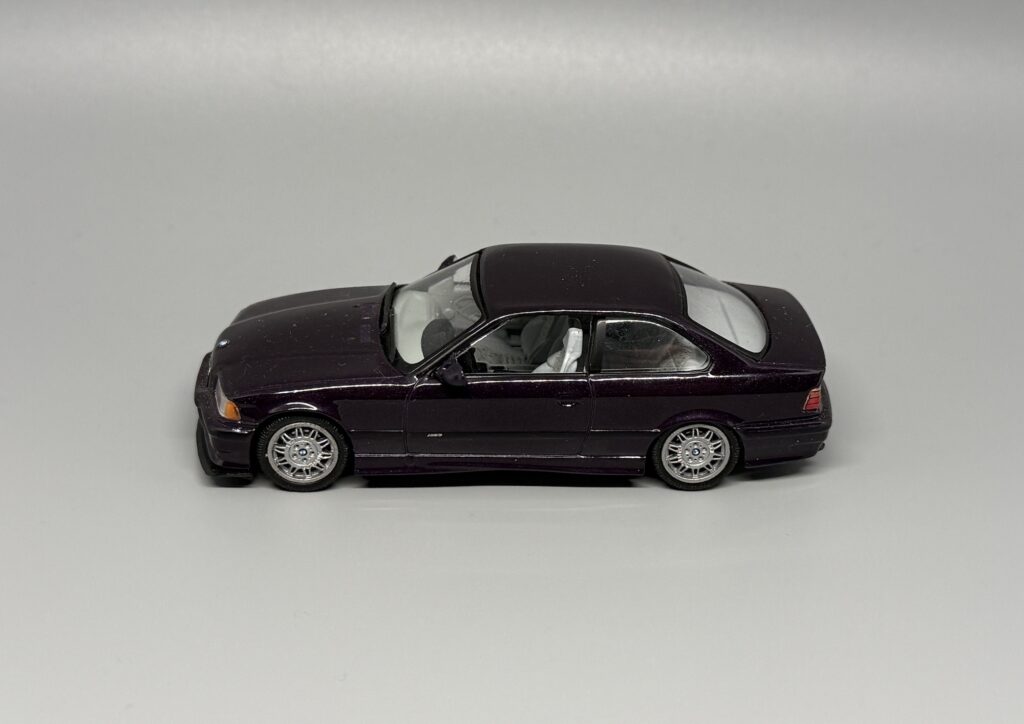
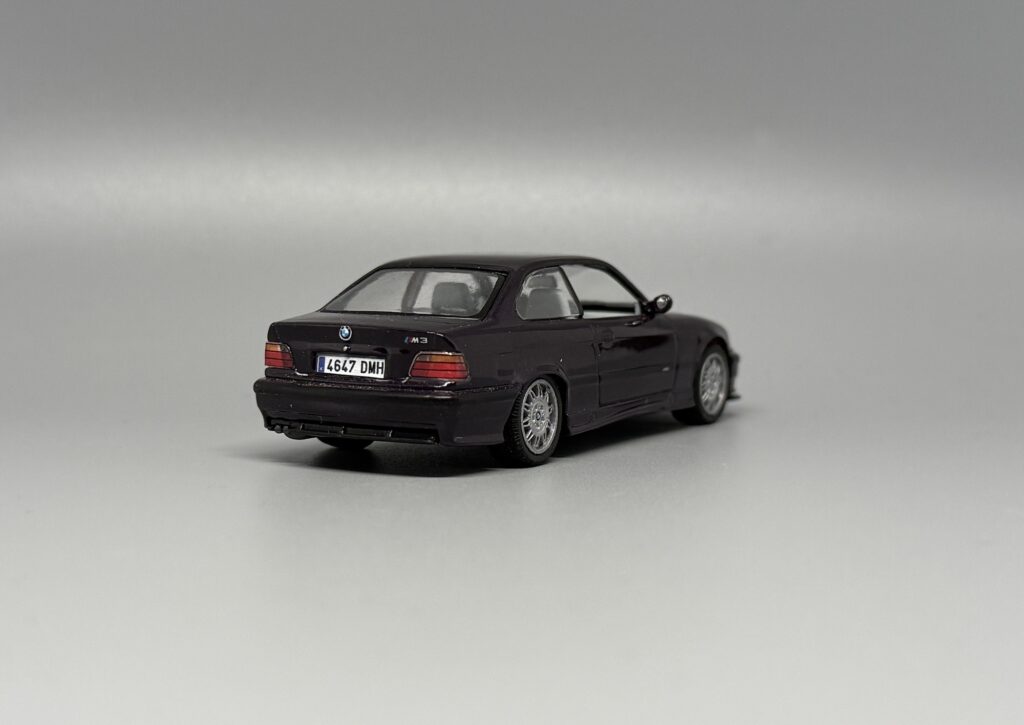
The 1:43-scale BMW M3 Coupé (E36) in my collection was produced by Minichamps. The miniature represents a 1992 car and therefore depicts the earliest 3.0-litre version of the E36 M3.
Details such as the amber front indicator lenses are appropriate to this early version and distinguish it from the later 3.2-litre model update, one of whose visible changes was the adoption of white indicator lenses.
Technical data
3.0-litre version production: 03/1992–08/1995
Body style: two-door Coupé
Engine: S50B30 naturally aspirated straight-six petrol engine
Displacement: 2,990 cc
Power output: 210 kW / 286 hp at 7,000 rpm
Maximum torque: 320 Nm
Transmission: 5-speed manual
Drive: rear-wheel drive
0–100 km/h: approximately 6.0 seconds
Top speed: 250 km/h, electronically limited
Original German price: DM 80,000
Total E36 M3 Coupé production: 46,525 cars, including 3.0- and 3.2-litre versions
Total E36 M3 production across all body styles: 71,242 cars
Special feature: the first six-cylinder BMW M3 and the second generation of the M3
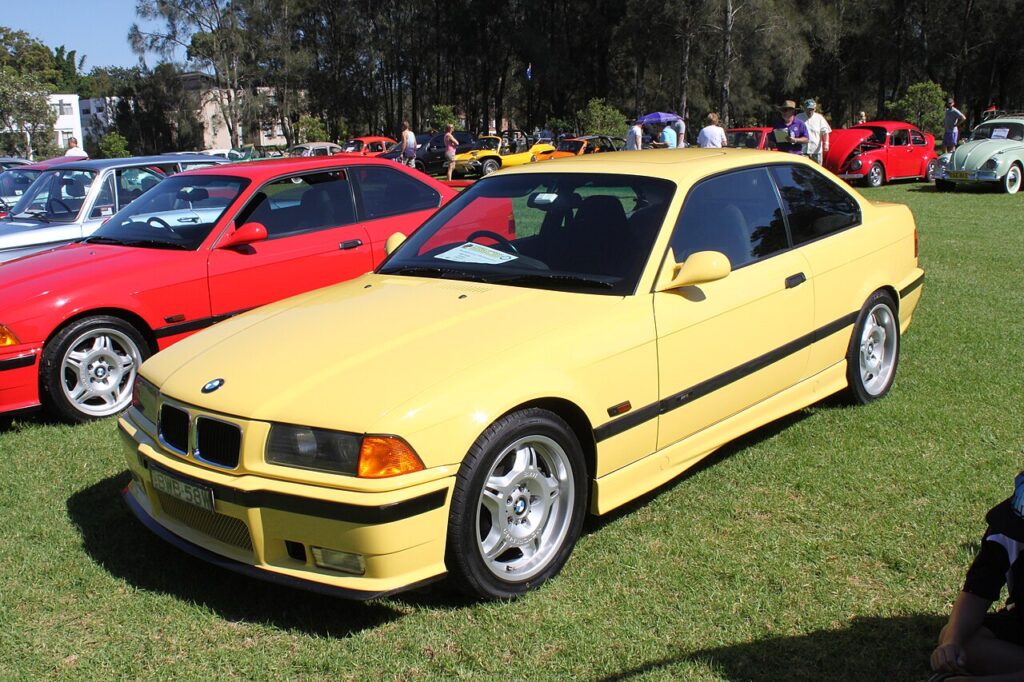
Photo of the real car. Author: Jeremy, source Flickr / Wikimedia Commons, licensed under CC BY 2.0.