
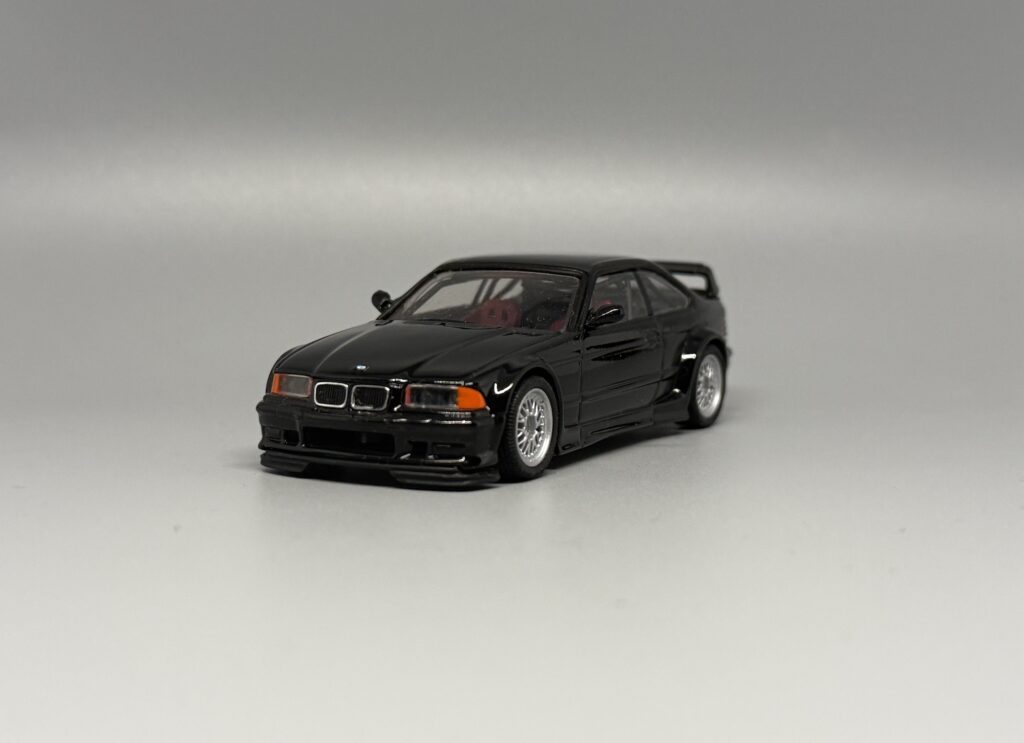
BMW M3 GTR Street (E36) is one of the rarest and least extensively documented derivatives associated with the E36-generation M3. Its origins are directly connected with BMW Motorsport’s 1993 competition programme, when the E36 M3 was transformed into a dramatically wider and more aggressive GTR racing car.
Whereas the standard E36 M3 had been developed primarily as a fast and usable road-going sports coupé, the GTR was a much more radical machine. The Street or Strassenversion represented the road-going homologation counterpart to this competition car and remained an exceptionally low-volume special.
Origins in an abandoned DTM project
The story of the E36 M3 GTR began when BMW planned to compete with the new E36 generation in the German DTM championship. Considerable development work had already been carried out, but disagreement over the technical regulations ultimately led BMW to abandon its DTM programme before the season began.
According to BMW’s own historical account, the work was not wasted. Motorsport GmbH adapted the project for the newly established Warsteiner ADAC GT Cup, creating the BMW M3 GTR.
The 1993 ADAC GT Cup
The BMW M3 GTR looked dramatically different from a normal E36 M3. Its very wide body, enlarged wheel arches, large wheels and much more pronounced aerodynamic components transformed the otherwise restrained E36 Coupé into an unmistakable competition car.
BMW’s official historical material states that the GTR’s six-cylinder engine produced 325 hp and that the racing car weighed 1,300 kilograms in accordance with the regulations.
Johnny Cecotto and Kris Nissen were the principal drivers associated with the M3 GTR in the 1993 ADAC GT Cup. Cecotto won several rounds and ultimately secured the championship, making the GTR highly successful despite its relatively short works competition career.
A Street version for homologation
The GTR competition programme was also associated with a road-legal Street or Strassenversion. Unlike the later and extensively documented E46 M3 GTR Strassenversion, comparatively little factory information about the E36 road car has survived or is currently published by BMW.
Specialist BMW historical sources nevertheless document it as a road-going homologation derivative of the competition car. It retained the GTR’s dramatically widened bodywork, large wheel arches and competition-inspired aerodynamic components, making it far more radical than a standard E36 M3.
Essentially a racing car with number plates
The Street version was not merely a normal luxury M3 fitted with a GTR-style body kit. The BMW M Registry describes it essentially as a competition car made road legal, with a stripped interior, roll cage and weight-saving construction.
Its most obvious exterior features included the dramatically widened fenders, accommodation for 18-inch wheels and adjustable aerodynamic devices at the front and rear.
As a result, the E36 M3 GTR Street was fundamentally different in character from the standard M3 Coupé. Everyday comfort was secondary, while its engineering remained closely connected with the racing car.
S50 straight-six power
The GTR was based around the six-cylinder S50 engine of the E36 M3. The standard European M3 introduced in 1992 used the 2,990 cc S50B30 producing 286 hp.
Detailed specialist sources generally quote approximately 300 hp for the road-going GTR. Supercar Nostalgia describes its engine as a further-developed S50B30 enlarged to 3,018 cc, while BMW’s own historical material confirms 325 hp for the competition version.
As no complete contemporary factory specification for the E36 GTR Street has been located in BMW Group Classic or BMW M’s currently available historical material, it is appropriate to distinguish between the officially documented racing-car figures and specifications published by specialist historical sources for the Street version.
The exact production number remains uncertain
Historical sources do not fully agree on how many E36 M3 GTR Street cars were built. The BMW M Registry records two road-legal examples, while other detailed historical sources describe a single Strassenversion created for homologation purposes.
What is clear is that this was never a conventional series-production model. The Street version was produced in an extremely small quantity and existed in connection with the GTR competition programme rather than as a normal addition to the M3 road-car range.
Not to be confused with the E46 M3 GTR
The E36 M3 GTR Street is often overshadowed by the later E46 M3 GTR. The 2001 E46 became famous for its purpose-built four-litre V8 engine and American Le Mans Series programme, with BMW producing ten road-going Strassenversion cars for homologation.
The E36 GTR was an earlier, straight-six project. Both cars shared the concept of linking a competition M3 with an extremely limited road-going homologation version, but technically and historically they were completely separate generations.
One of the most extreme forms of the E36 M3
The significance of the E36 M3 GTR Street lies in demonstrating how far the basic E36 M3 concept could be developed for competition. The restrained “wolf in sheep’s clothing” character of the normal M3 was replaced by a dramatically wider body, larger wheels and a clearly track-focused appearance.
Its limited documentation also makes the model particularly intriguing today. Unlike the regular M3 or even the M3 GT, the GTR Street was not a limited edition intended for general customers but an exceptionally low-volume car associated with a specific motorsport programme.
Model in the collection
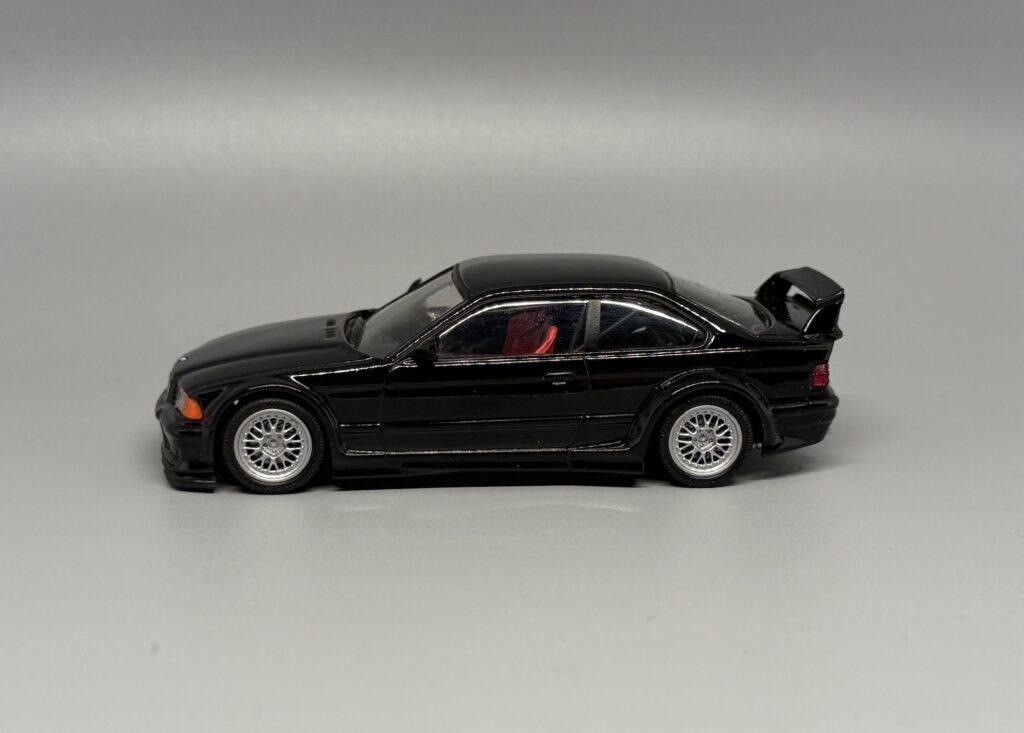
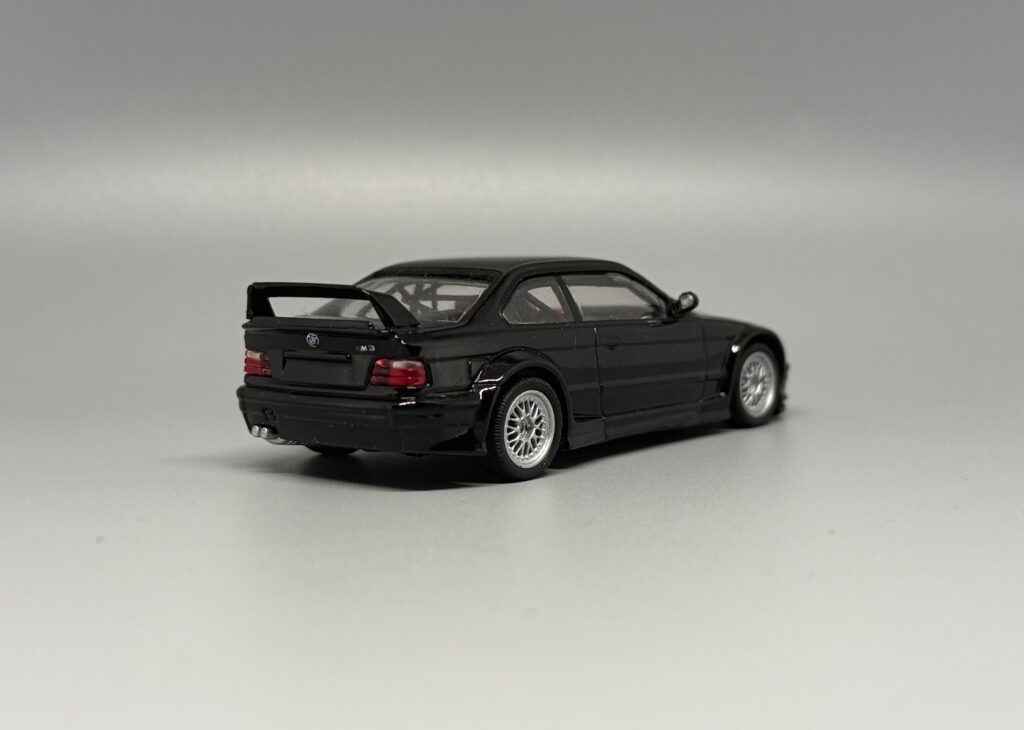
The BMW M3 GTR Street (E36) in my collection was produced by Minichamps. The manufacturer identifies the model as a 1993 car and labels the version Street.
Minichamps produced both 1993 ADAC GT Cup racing versions and Street versions using the distinctive E36 M3 GTR body. The model in the collection represents the latter – the road-going interpretation with the competition car’s widened bodywork and aggressive aerodynamics.
Technical data
Basis: BMW M3 Coupé (E36)
Body style: wide-body two-door Coupé
Engine: S50B30-based naturally aspirated straight-six petrol engine
Street-version displacement: approximately 3.0 litres according to specialist sources; one detailed source lists 3,018 cc
Street-version output: approximately 300 hp according to specialist historical sources
GTR racing version output: 325 hp according to BMW
GTR racing version weight: 1,300 kg according to BMW
Drive: rear-wheel drive
Street-version production: not conclusively established; historical sources record between one and two road-legal examples
Special feature: extremely limited road-going homologation derivative associated with BMW’s 1993 M3 GTR competition programme