
Background
BMW Isetta 250 Export was one of the models that played a much greater role in BMW’s history than its modest dimensions might suggest. At a time when BMW’s range was dominated by expensive luxury cars built in relatively small numbers, the company needed an affordable vehicle that could be sold in much larger volumes. The solution came from the Isetta microcar developed by the Italian company Iso. BMW acquired the production rights, adapted the car to its own technical requirements and introduced the BMW Isetta in 1955. The little “bubble car” quickly became a sales success and one of the best-known symbols of post-war German motorisation.
From Standard to Export
The first BMW Isetta was the Standard version introduced in 1955, characterised by its early multi-piece side-window arrangement. At the end of 1956, BMW introduced the substantially revised Isetta Export. The name did not simply refer to a version intended for foreign markets; Export became the official designation for the updated Isetta in BMW’s model range. It differed noticeably from its predecessor in both appearance and several construction details, and this version became the most familiar form of the Isetta.
New roofline and window design
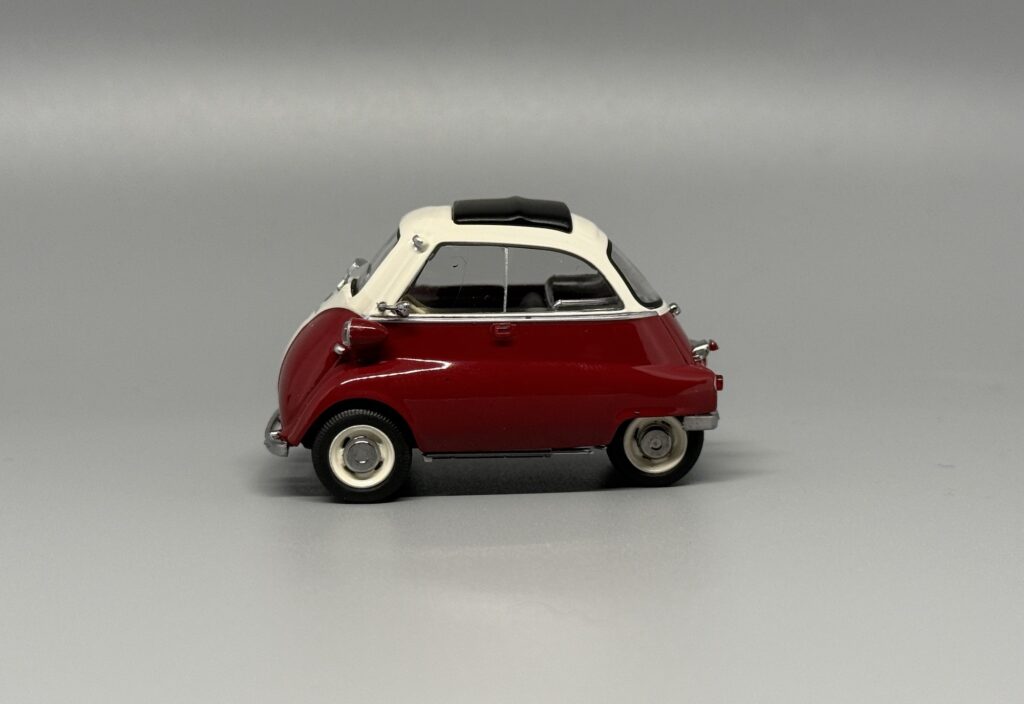
The most obvious difference between the Export and the Standard was the new, more continuous coupé-like roofline. This allowed larger side windows and practical sliding windows to be fitted. The characteristic multi-piece “bubble window” arrangement of the earlier Standard disappeared, giving the car a cleaner, longer and more modern side profile. Although the basic proportions of the Isetta remained unchanged, the new roof and window design gave the Export a clearly different appearance.
One door at the front
The Isetta’s most distinctive feature remained unchanged on the Export version. Instead of conventional side doors, almost the entire front of the car opened forward as one large front door. The steering column moved with the door, making it easier for the two occupants to enter and leave the cabin. This unusual arrangement allowed the available interior space to be used very efficiently within a body only about 2.3 metres long and gave the Isetta an appearance that was almost impossible to confuse with any other car.
245 cm³ BMW engine
The BMW Isetta 250 Export used the same 245 cm³ single-cylinder four-stroke engine as the earlier Isetta 250 Standard. The engine was based on BMW motorcycle technology and remained essentially unchanged when the Export version was introduced. It produced 12 hp at 5,800 rpm. For the small and lightweight Isetta, this was sufficient to reach a top speed of approximately 85 km/h.
Simplicity and economy
The purpose of the Isetta was not sporting performance, but inexpensive and economical personal transport. Its two-seat cabin offered much better protection from rain, cold and wind than a motorcycle or scooter, while purchase and running costs remained considerably lower than those of a conventional passenger car. The engine was mounted at the rear, while the closely spaced rear wheels allowed a simple drivetrain without the need for a conventional differential.
Isetta 250 and 300 Export
The Export-bodied Isetta was available with both 250 and 300 cm³ engines. The Isetta 250 Export retained the 12 hp engine, while the larger Isetta 300 Export used a 298 cm³ engine producing 13 hp. The main advantage of the larger engine was not a higher top speed, which remained around 85 km/h, but improved torque and better low-speed performance. The 300 Export eventually became the most popular individual Isetta version, although the 250 Export was also a major commercial success.
47,636 cars
According to BMW Group Classic, a total of 47,636 BMW Isetta 250 Exports were produced between November 1956 and May 1962. Together with more than 51,000 Isetta 300 Exports, almost 100,000 Isettas were built with the Export body style. This demonstrates how successful the 1956 update proved to be and how important the Isetta became for BMW at a time when the company needed a high-volume model aimed at a broad customer base.
An affordable BMW
When new, the BMW Isetta 250 Export cost 2,750 Deutsche Mark. This was slightly more than the 2,550 Deutsche Mark charged for the earlier Isetta 250 Standard, but still considerably less than a conventional passenger car. In both price and usability, the Isetta occupied a position between a motorcycle and a full-size car, and this combination made it particularly attractive to many buyers in the late 1950s.
An important model in BMW’s survival story
The Isetta is often described as the car that saved BMW from bankruptcy. In reality, the situation was more complex: no single model solved all of the company’s financial problems, and BMW remained in a difficult position at the end of the 1950s. Nevertheless, the Isetta brought BMW much-needed sales volume, cash flow and an entirely new group of customers. Between 1955 and 1962, BMW produced around 161,000 Isettas, making the model an undeniably important part of the company’s recovery before the success of the Neue Klasse in the 1960s.
A symbol of post-war Europe
The significance of the BMW Isetta extends beyond BMW’s own history. In 1950s Europe, microcars gave many people their first opportunity to travel in a four-wheeled vehicle protected from the weather. The Isetta’s distinctive appearance, front-opening door and tiny dimensions made it one of the best-known representatives of the entire microcar era. The updated Export body style became the form most commonly associated today with BMW’s famous “bubble car”.
Historical significance
The BMW Isetta 250 Export was more than just a visual update of the Standard. Its new roofline, larger sliding windows and more modern overall appearance gave the model renewed appeal and helped keep the little BMW in production until 1962. With 47,636 examples produced, the 250 Export was a very successful model in its own right, and together with the 300 Export it helped secure the Isetta’s place as one of the most recognisable microcars in both BMW history and post-war European motoring.
Model in the collection
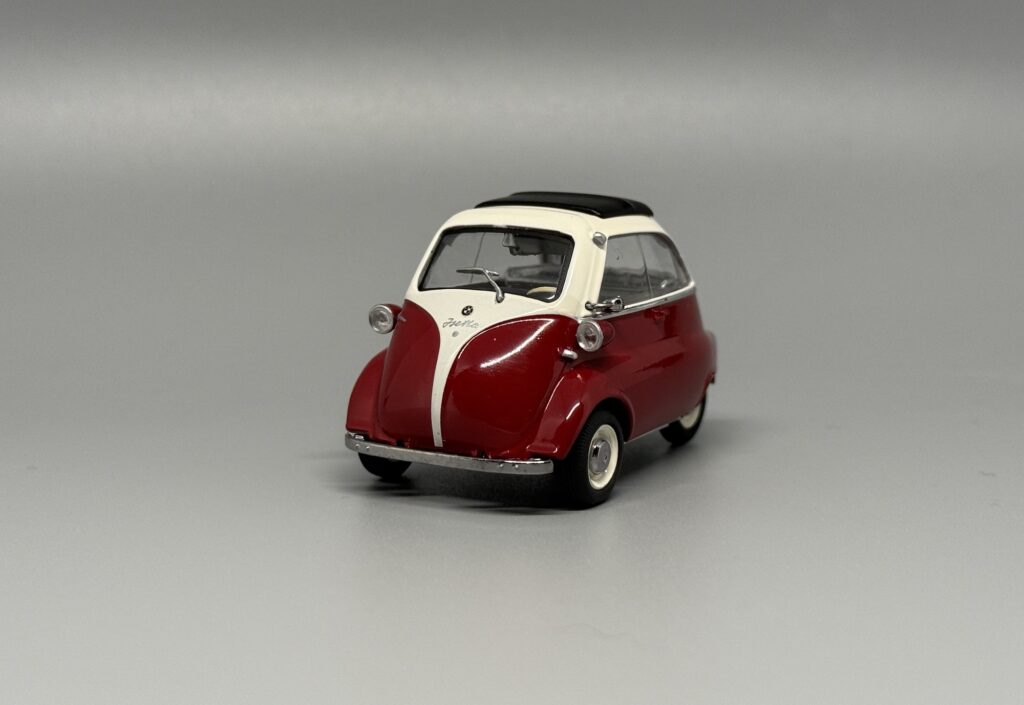
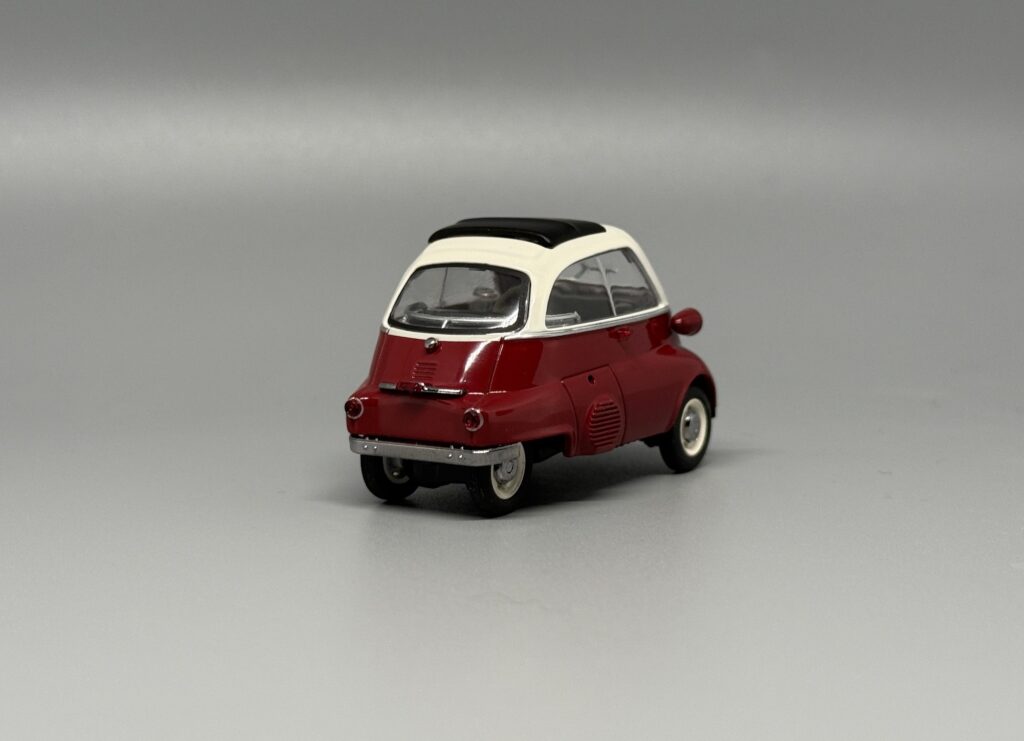
The model in my collection was produced by Schuco and represents the BMW Isetta 250 Export.
Technical data in brief
Production period: November 1956 – May 1962
Body style: two-seat microcar
Engine: single-cylinder four-stroke engine
Displacement: 245 cm³
Power: 12 hp @ 5,800 rpm
Drivetrain: rear-wheel drive
Top speed: 85 km/h
Price when new: 2,750 Deutsche Mark
Production: 47,636 cars
Special feature: updated Isetta 250 Export version with a coupé-like roofline and larger sliding side windows
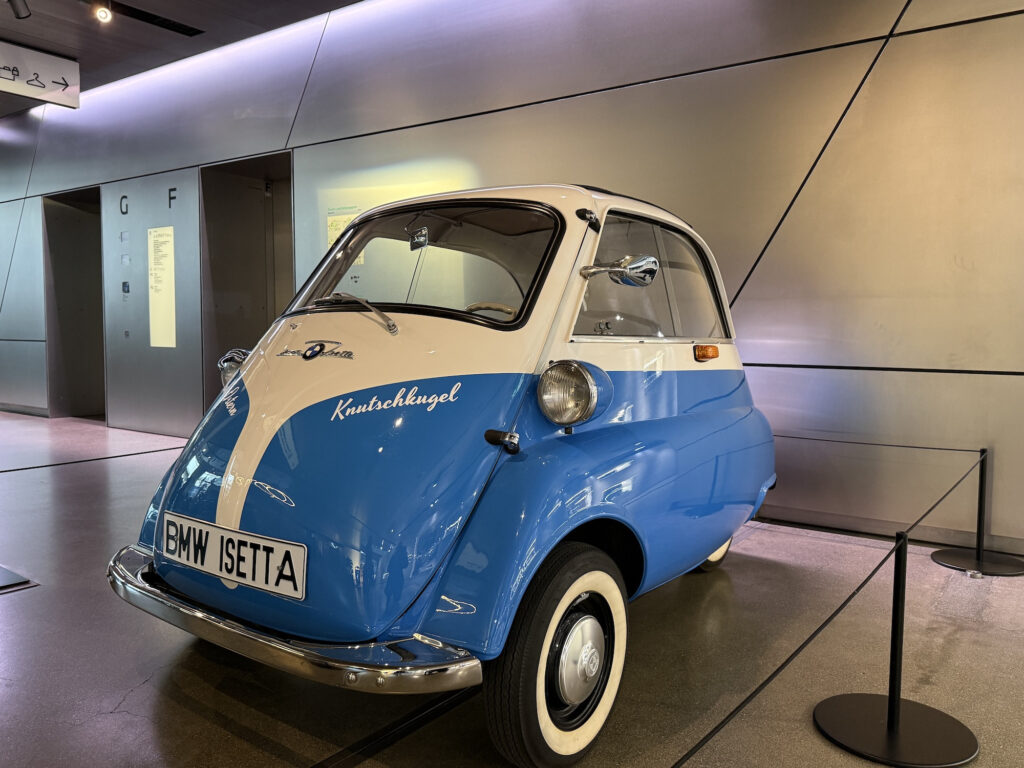
Photo of the real car, BMW Museum. Photo: Sten-Patrick Kreek