
Background
BMW 600 was BMW’s attempt to develop the successful Isetta concept into a small but more practical vehicle capable of carrying four people. Introduced in 1957, the car occupied a position in BMW’s range between the Isetta and conventional larger passenger cars. Its appearance and several construction details clearly reflected its Isetta origins, but a longer wheelbase, four-seat interior, larger engine and more conventional four-wheel chassis made the BMW 600 considerably more practical. BMW Group Classic describes the 600 as a direct link between the Isetta and the later BMW 700.
A four-seat Isetta
The resemblance between the BMW 600 and the Isetta was so obvious that the car has often been described as a “four-seat Isetta”. The front section, including the large forward-opening door, was directly derived from the Isetta concept, but the body was considerably longer. The extended wheelbase allowed two rows of seats to be installed and provided space for four occupants. BMW therefore attempted to retain the compact dimensions and economy of the Isetta while developing the concept into a practical small family car.
Two doors – but in an unusual arrangement
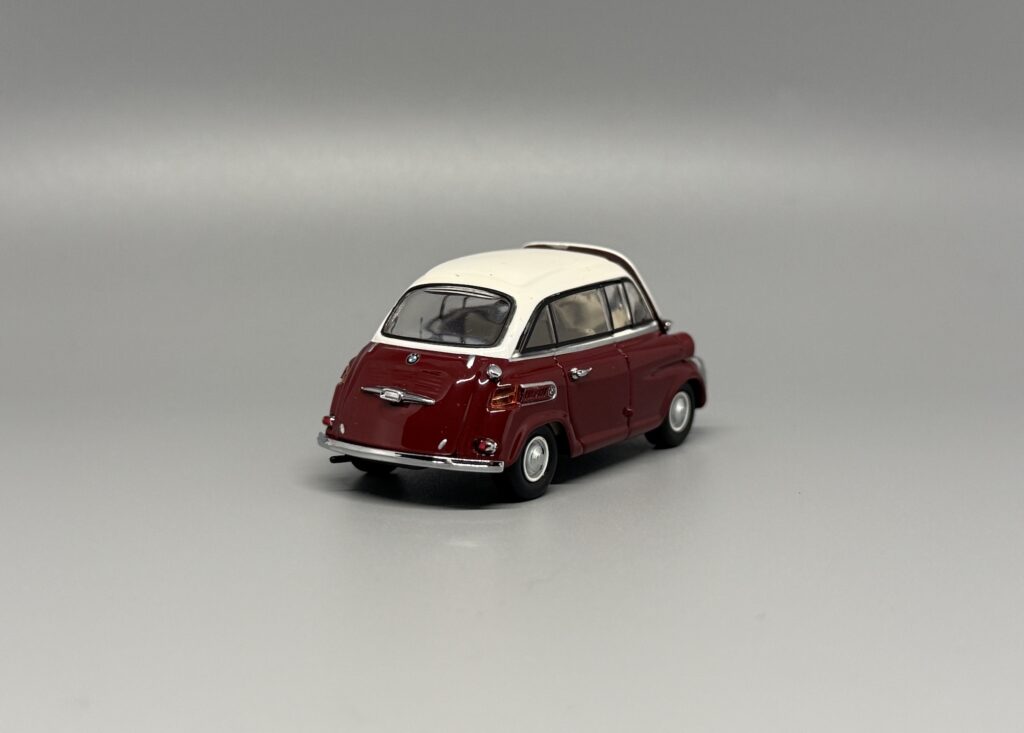
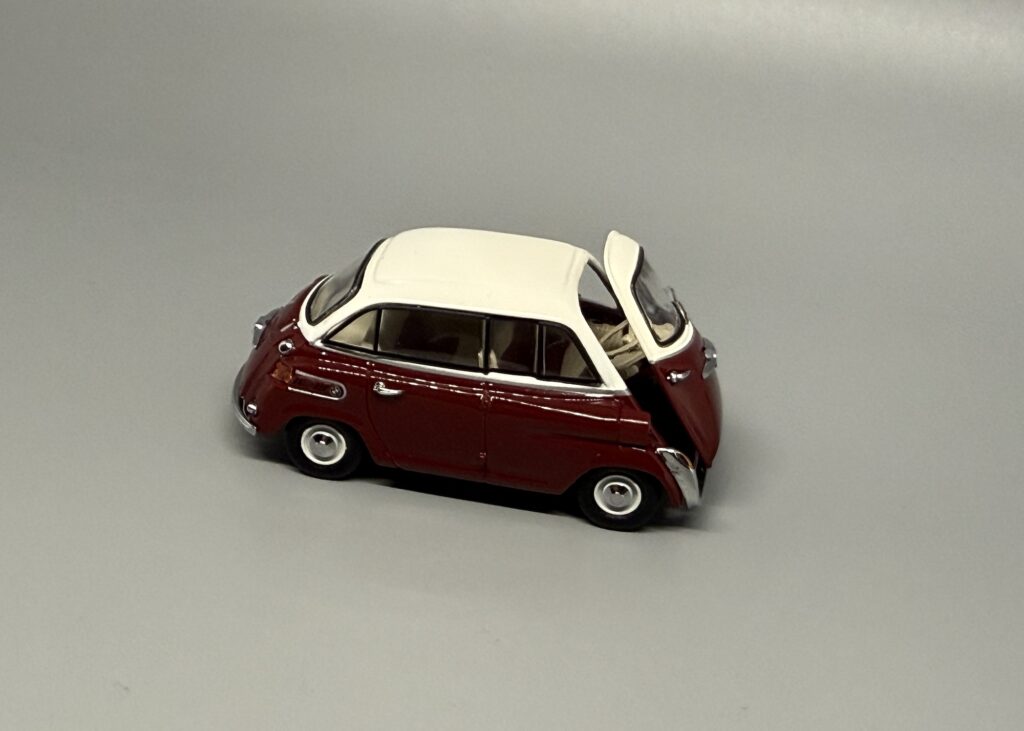
The BMW 600 retained the Isetta’s most famous feature: the large front door, with the steering column moving together with the door. To provide access to the rear seats, BMW added a conventional side door on the right-hand side of the car. No corresponding door was fitted on the left, partly in order to maintain structural rigidity. This combination – one large front door and a single side door for the rear passengers – gave the BMW 600 one of the most unusual door arrangements of any production BMW.
New chassis and suspension
Although the BMW 600 was developed from the Isetta concept, it was much more than simply a stretched microcar. Carrying four occupants required a new and stronger chassis as well as a different rear suspension. BMW fitted the 600 with independent semi-trailing-arm rear suspension, giving the little car remarkably good handling for its time. BMW Group Classic highlights both its capable chassis and surprisingly spacious interior as important strengths of the model.
585 cm³ boxer engine
The BMW 600 was powered by a 585 cm³ two-cylinder four-stroke boxer engine with its roots in BMW motorcycle engineering. The engine produced 19.5 hp at 4,500 rpm. Compared with the Isetta’s single-cylinder engine, the twin-cylinder boxer provided noticeably better performance and smoother operation, both of which were essential for the larger and heavier four-seat car.
100 km/h
With 19.5 hp, the BMW 600 could reach a top speed of 100 km/h. Power was transmitted to the rear wheels through a four-speed manual gearbox. Its performance was comparable with other small cars of the period, and the BMW 600 was significantly more capable than the Isetta both in urban traffic and on longer journeys. It was not a sporting car, but for its size and engine capacity it offered entirely respectable performance.
BMW’s attempt to create a “real” small car
With the 600, BMW hoped to enter the rapidly growing market for affordable small cars. The Isetta had been a successful microcar, but customer expectations were changing by the late 1950s. Buyers increasingly wanted a small vehicle with the practicality and appearance of a conventional passenger car. Although the BMW 600 offered four seats and a sophisticated chassis, its Isetta-derived front door and single side door still made it appear too unconventional to many potential customers.
34,813 cars
Production of the BMW 600 lasted from September 1957 until November 1959. During this period, exactly 34,813 cars were built. Despite its good build quality, capable handling and surprisingly spacious interior, the BMW 600 did not achieve the commercial success the company had hoped for. In this size class, customers increasingly preferred small cars with more conventional styling and layouts.
Price and market position
When new, the BMW 600 cost 3,890 Deutsche Mark. This positioned it above the Isetta while still placing it firmly in the affordable small-car segment. The problem was that at this price BMW was competing with more conventional cars featuring normal side doors, a traditional bonnet and an appearance that buyers associated with a “proper car”. The unusual concept of the BMW 600 therefore increasingly became a disadvantage rather than an advantage.
The road to the BMW 700
Although the BMW 600 did not achieve the expected sales success, its technical legacy was extremely important. The model formed a direct development link between the Isetta and the BMW 700. The 700 carried over several technical ideas associated with the 600 but placed them beneath a completely conventional passenger-car body. This combination proved much more successful in the market. The BMW 600 can therefore be regarded as an important transitional model through which BMW moved from microcars back towards conventional compact automobiles.
Historical significance
The BMW 600 remained in production for only a little over two years and never matched the commercial success of the Isetta. Nevertheless, it occupies an important place in BMW history. It was a genuine four-seat car that combined the Isetta’s unusual concept with a much more advanced chassis, a boxer engine and a more practical interior. At the same time, its limited sales demonstrated that the era of the microcar was beginning to fade and that buyers increasingly expected small cars to resemble conventional automobiles. BMW applied this lesson directly to the development of the subsequent BMW 700.
Model in the collection
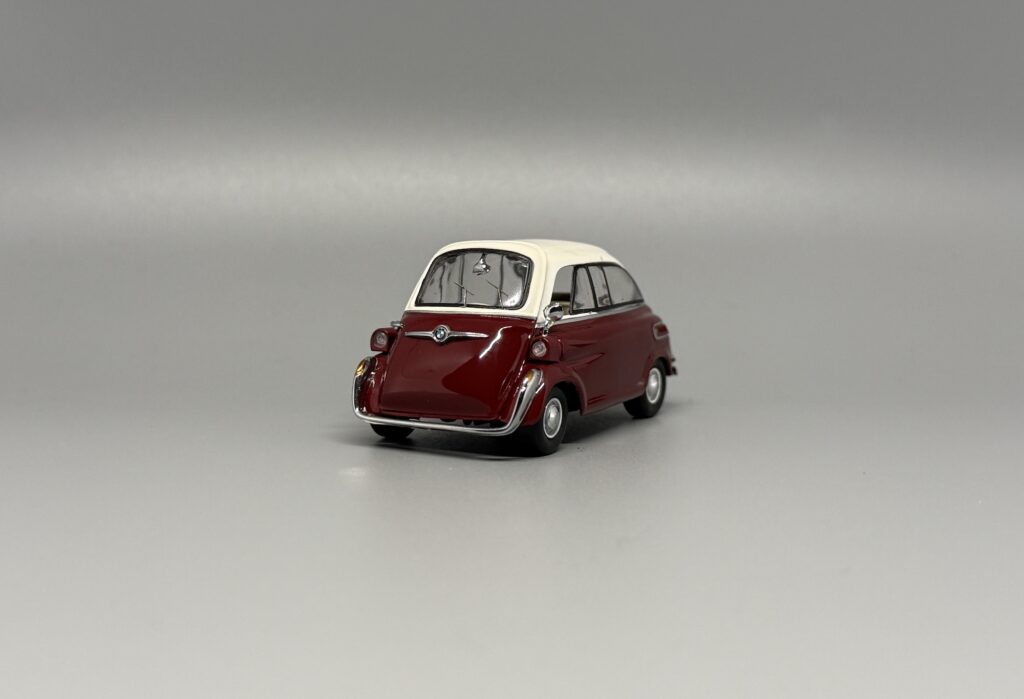
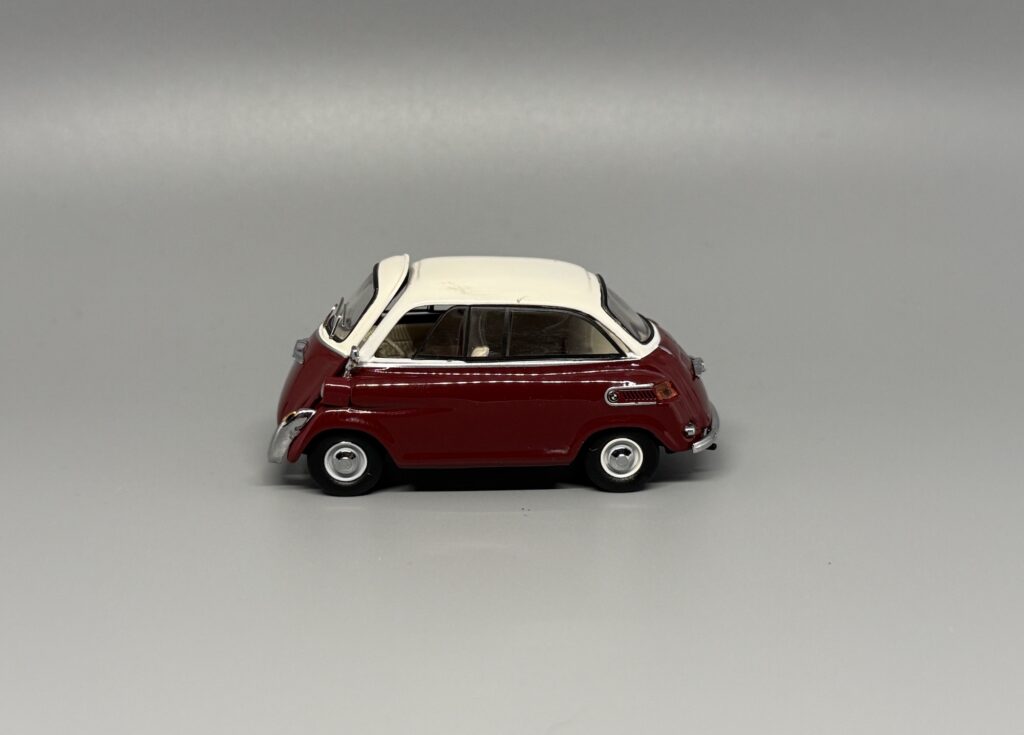
The model in my collection was produced by Schuco. It was made in a limited edition of 750 examples.
Technical data in brief
Production period: September 1957 – November 1959
Body style: four-seat small car
Doors: front door and one right-hand side door
Engine: two-cylinder four-stroke boxer engine
Displacement: 585 cm³
Power: 19.5 hp @ 4,500 rpm
Transmission: 4-speed manual
Drivetrain: rear-wheel drive
Top speed: 100 km/h
Price when new: 3,890 Deutsche Mark
Production: 34,813 cars
Special feature: four-seat model bridging the gap between the Isetta and BMW 700, combining the Isetta-style front door with a new chassis, boxer engine and a single right-hand side door
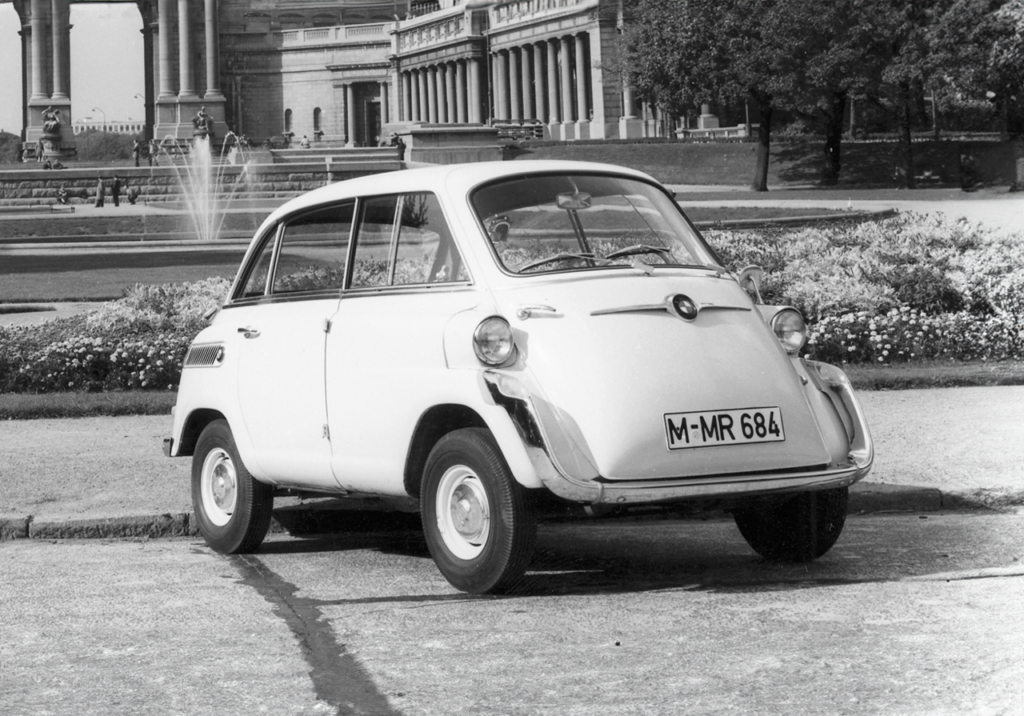
Photo of the real car. Source: bmwgroup-classic.com