
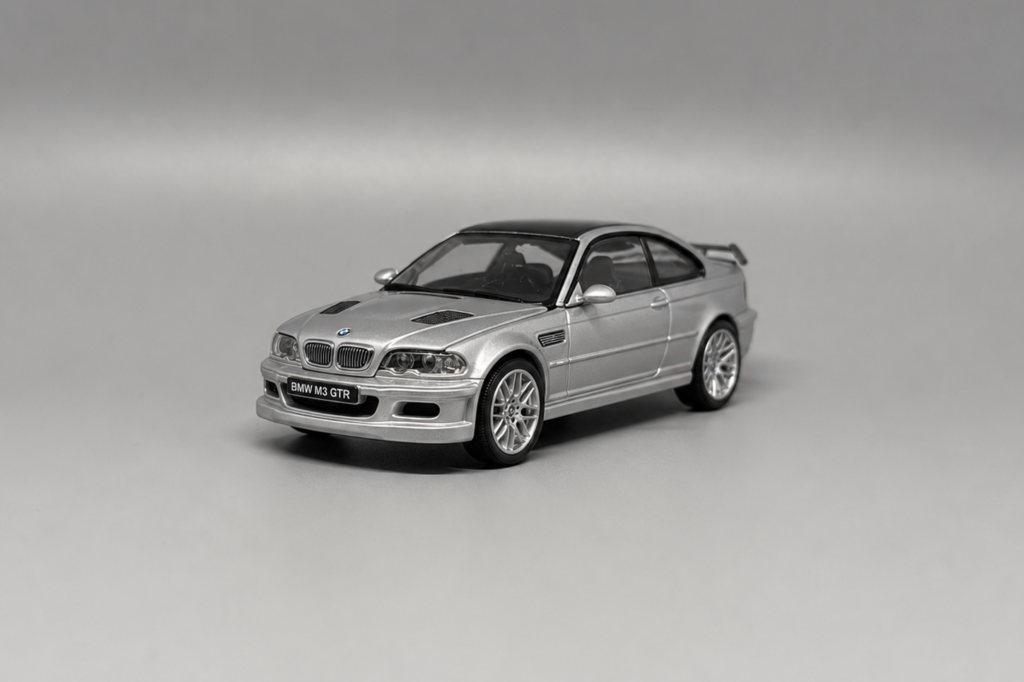

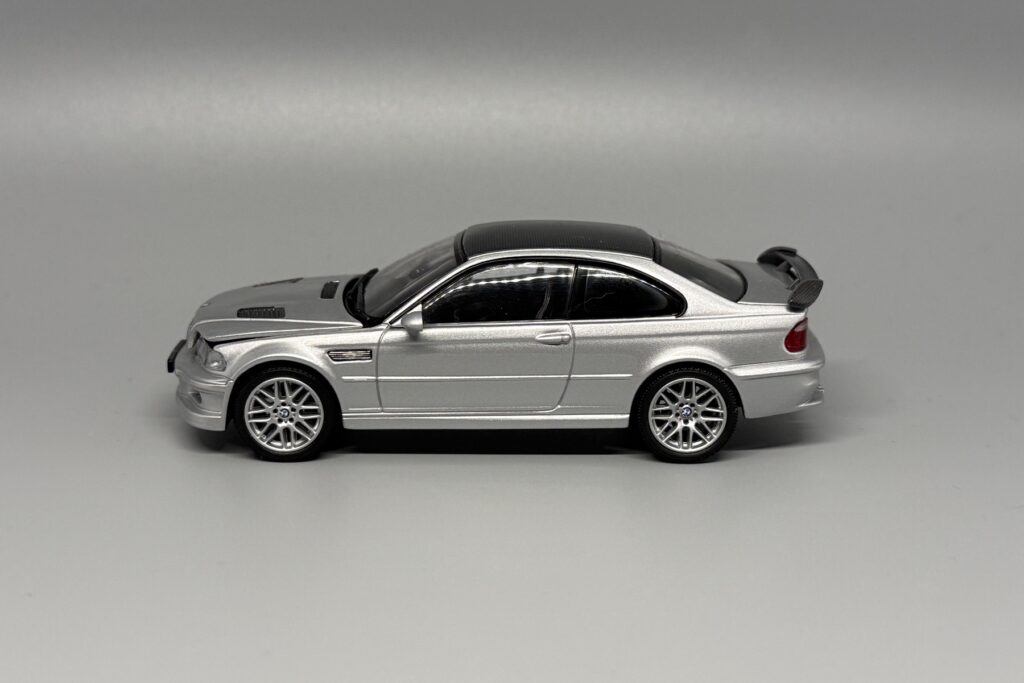
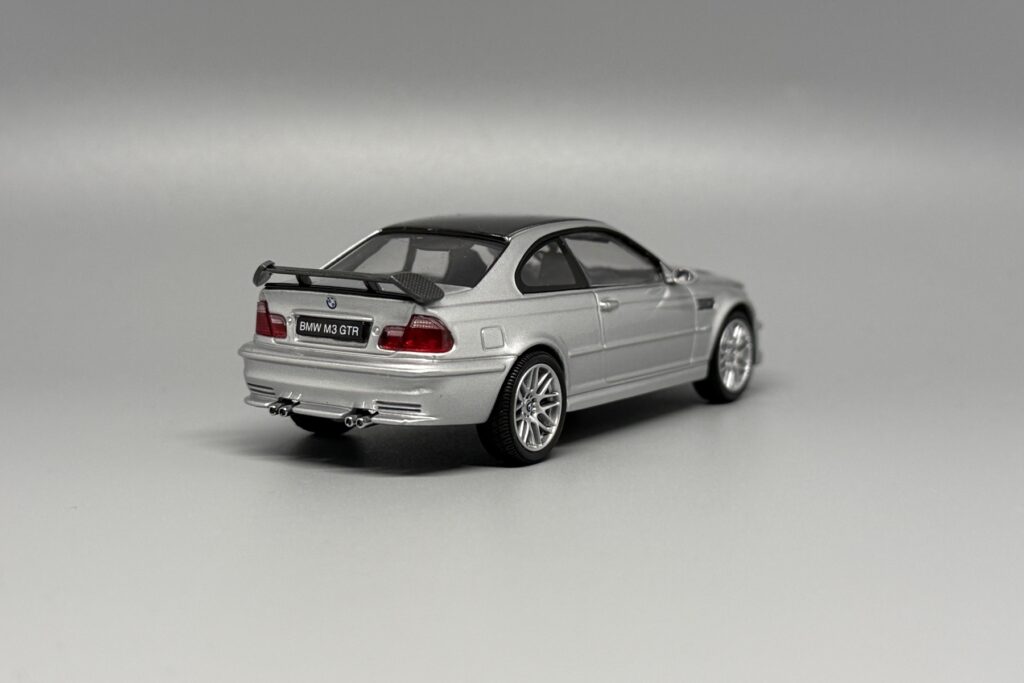
BMW M3 GTR Street (E46) is one of the rarest road-going cars in BMW M history. Created in 2001, it was born directly from motorsport: BMW Motorsport needed a road-legal version of the V8-powered M3 GTR to homologate its GT-class racing car for the American Le Mans Series. Although much of its engineering was derived from the competition car, the M3 GTR Street had a considerably more restrained appearance and retained the recognisable basic shape of the E46 M3. It is this exceptionally rare road-going version that is represented by the Kyosho model.
A road car born from racing
The BMW M3 GTR was developed to challenge the Porsche 911 GT3 in the 2001 American Le Mans Series. BMW Motorsport considered the regular E46 M3’s 3.2-litre S54 straight-six to offer insufficient potential for the programme and developed an entirely new four-litre V8 for the racing car. Because this engine was not used in any production M3, the regulations required BMW to manufacture a road-going homologation version. According to BMW M, the required ten cars were completed and the M3 GTR Street made its debut during the Petit Le Mans event in 2001.
P60 – an extraordinary V8 for the E46 M3
The most important difference between the M3 GTR Street and the regular E46 M3 was beneath the bonnet. The 3,997 cc P60 V8 was an aluminium racing engine developed specifically by BMW Motorsport, featuring a 90-degree cylinder-bank angle, four overhead camshafts, four valves per cylinder and dry-sump lubrication. In racing specification it produced more than 450 hp, but for the road car it was adapted to comply with noise and emissions requirements. The M3 GTR Street therefore produced 258 kW, or 350 hp, together with maximum torque of 365 Nm.
More restrained than the racing car
The M3 GTR Street was not simply an ALMS racing car fitted with number plates. Its body remained clearly recognisable as an E46 M3, although it incorporated several functional modifications. Characteristic features included large ventilation openings in the bonnet, extended front and rear aprons, a fixed rear wing and a roof and aerodynamic components made from carbon-fibre-reinforced plastic. Compared with the racing M3 GTR and its very wide wheel arches and competition aerodynamics, the road car had a cleaner and considerably more restrained appearance.
1,350 kilograms
To keep the road car as close as possible to its competition counterpart, weight was reduced wherever possible. The rear seats were removed and both air conditioning and the audio system were omitted. Carbon-fibre components helped keep the car’s weight to approximately 1,350 kilograms – according to BMW M, 185 kilograms less than the regular manual-transmission M3 of the same generation. The result was an exceptionally light and uncompromising V8-powered sports car.
Six-speed manual transmission
Unlike the racing car with its sequential transmission, the M3 GTR Street used a six-speed manual gearbox. The drivetrain also incorporated a twin-disc motorsport clutch and a variable M limited-slip differential. Its 350 hp may appear relatively modest by modern standards, but combined with its low weight, specialised chassis and direct drivetrain, the M3 GTR Street was far closer in character to a racing car than to a conventional high-performance road-going M3.
295 km/h
BMW M gives the M3 GTR Street a top speed of 295 km/h. This was considerably higher than the regular E46 M3, whose maximum speed was electronically limited to 250 km/h. The purpose of the GTR was not to provide maximum comfort but to retain as much as possible of the competition car’s performance and engineering character while meeting the requirements for road use.
Ten homologation cars
BMW M confirms that ten road-legal M3 GTRs were produced to satisfy the homologation requirement. The price was set at an extraordinary €250,000, making it one of the most expensive BMW M cars of its era. For 2002, the ALMS regulations were changed and at least 100 road cars would have been required instead of ten. BMW chose not to continue the programme under the revised rules, leaving the M3 GTR Street as one of the lowest-production BMW M models ever created.
The legacy of the M3 GTR Street
The M3 GTR Street was the first V8-powered M3 and one of the clearest examples of BMW Motorsport competition technology being transferred directly to a road car. Its P60 engine was never used in another production BMW model, while the production run of only ten cars made it an exceptional chapter in the history of the E46 M3. Today it is regarded as one of BMW M’s most legendary homologation specials, with its rarity and close connection to the successful M3 GTR racing programme giving it a unique place in BMW history.
Model in the collection
The BMW M3 GTR Street (E46) model in my collection was produced by Kyosho as part of its Museum Collection. The model represents the road-going M3 GTR and was released as a special edition for the 2006 Nuremberg International Toy Fair. Production was limited to a total of 504 pieces.
Technical data at a glance
Production period: 2001
Body style: two-door, two-seat Coupé
Engine: naturally aspirated P60 90° V8 petrol engine
Displacement: 3,997 cc
Power output: 258 kW / 350 hp @ 7,250 rpm
Maximum torque: 365 Nm @ 5,000 rpm
Engine block and cylinder heads: aluminium
Lubrication system: dry sump
Transmission: 6-speed manual
Clutch: twin-disc motorsport clutch
Drive: rear-wheel drive
Differential: variable M limited-slip differential
Weight: 1,350 kg
Top speed: 295 km/h
Original price: €250,000
Production total: 10 cars
Special feature: an ultra-rare V8-powered E46 M3 road car created for ALMS homologation.