
BMW M3 GTR Street (E46) was one of the most radical and rare BMW M road cars ever created. Developed in 2001, it was born directly from motorsport because BMW Motorsport needed a road-legal version of the V8-powered M3 GTR to homologate its GT-class racing car for the American Le Mans Series. Although based on the E46 M3, it differed from the regular model through its four-litre V8, extremely low suspension, race-derived aerodynamics and extensive weight reduction. The result was a road-legal sports car whose character remained remarkably close to that of a competition machine.
An M3 created for homologation
BMW Motorsport developed the M3 GTR for the 2001 American Le Mans Series season to compete against the strongest cars in the GT class. Instead of the S54 straight-six used in the regular E46 M3, an entirely new compact and lightweight four-litre V8 was developed for the racing car. Since this engine was not fitted to any production M3, the homologation regulations required BMW to manufacture road-legal cars as well. According to BMW M, ten M3 GTR Street cars were completed and the model made its debut during the Petit Le Mans event in 2001.
P60 V8 derived from racing
At the heart of the M3 GTR Street was the naturally aspirated 3,997 cc P60 V8 developed for BMW Motorsport’s racing programme. The all-aluminium engine featured a 90-degree cylinder-bank angle, four overhead camshafts, four valves per cylinder and dry-sump lubrication. In racing form the P60 produced more than 450 hp, while the road-going version was adapted to meet noise and emissions requirements. It still delivered more than 258 kW, or 350 hp, at 7,250 rpm and maximum torque of 365 Nm at 5,000 rpm.
Racing aerodynamics for the road
The M3 GTR Street was immediately distinguishable from a regular E46 M3 by its dramatic appearance. Extended front and rear aprons, a prominent fixed rear wing and large cooling openings in the bonnet were functional features designed to improve aerodynamics and V8 cooling. The roof, rear wing and front and rear aprons were made from carbon-fibre-reinforced plastic to reduce weight. Combined with the extremely lowered suspension, these features gave the car an unmistakably competition-inspired stance.
1,350 kilograms and two seats
BMW took weight reduction considerably further with the M3 GTR Street than with the standard M3. The car was a two-seater, with the rear seats, air conditioning, audio system and other comfort equipment removed. Together with its carbon-fibre body components, this reduced weight to approximately 1,350 kilograms – according to BMW M, 185 kilograms less than a regular manual-transmission E46 M3. The objective was clearly not luxury or everyday comfort, but the most direct driving experience possible.
Six-speed manual and M differential
Instead of the racing car’s sequential transmission, the road-going version used a six-speed manual gearbox. It was connected to the engine through a twin-disc sports clutch, while power reached the rear wheels through a variable M limited-slip differential. The car also received an extensively stiffened body and an extremely sporting suspension setup derived from the racing version. MacPherson struts were used at the front, with BMW’s central-link multi-link arrangement at the rear.
295 km/h
Low weight, the compact V8 and a competition-derived chassis gave the M3 GTR Street exceptional performance. BMW M quotes a top speed of 295 km/h, compared with the electronically limited 250 km/h of the standard E46 M3. The GTR Street was not simply a faster M3: its entire construction, lightweight interior and aerodynamics were designed to retain as much of the racing car’s character as possible.
Success in the American Le Mans Series
The M3 GTR racing programme that led to the creation of the road car proved highly successful in 2001. BMW Motorsport secured the American Le Mans Series GT-class drivers’, teams’ and manufacturers’ championships. Its success also prompted opposition from rival manufacturers, and the homologation rules were tightened for the following season. Instead of ten road cars, at least 100 would have been required, leading BMW to end its ALMS programme, although the M3 GTR later continued a successful competition career in Europe.
€250,000 and only ten cars
The exclusivity of the M3 GTR Street was reflected in its price. BMW quoted approximately €250,000 in 2001, making it many times more expensive than a conventional M3. According to BMW M, ten road-legal cars were produced for homologation. The subsequent history of every example is not fully known, and BMW itself notes that it is unclear whether all of the cars were ever registered for road use by private owners.
The legacy of the M3 GTR Street
The M3 GTR Street remains a unique link between BMW Motorsport’s racing programme and the road-going M3. It was the first V8-powered M3, and its P60 engine was never used in any other series-production BMW model. A production run of only ten cars, its direct connection with one of BMW’s most successful GT programmes and its uncompromising engineering have made it one of the most desirable BMWs of the E46 era. Its fame has since been reinforced by appearances in racing games, most notably the Need for Speed series.
Model in the collection
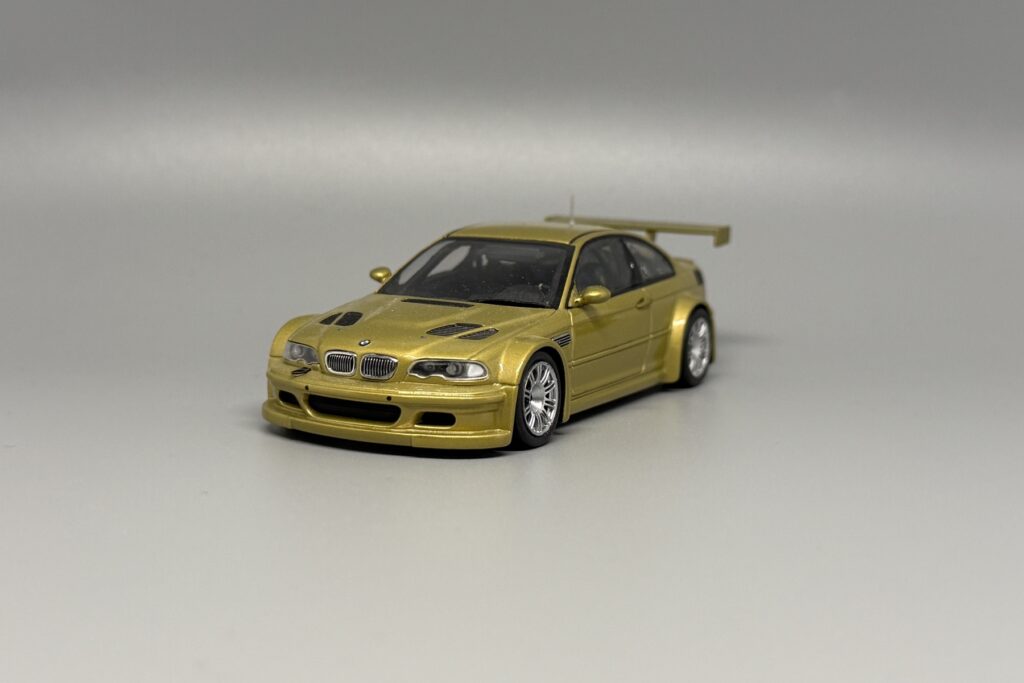
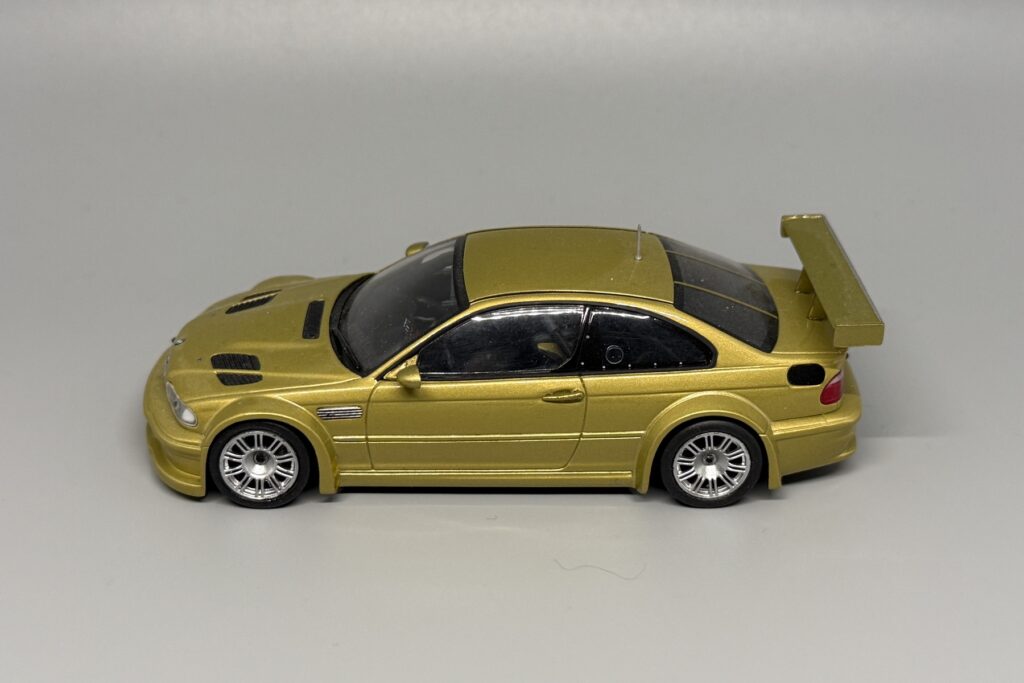
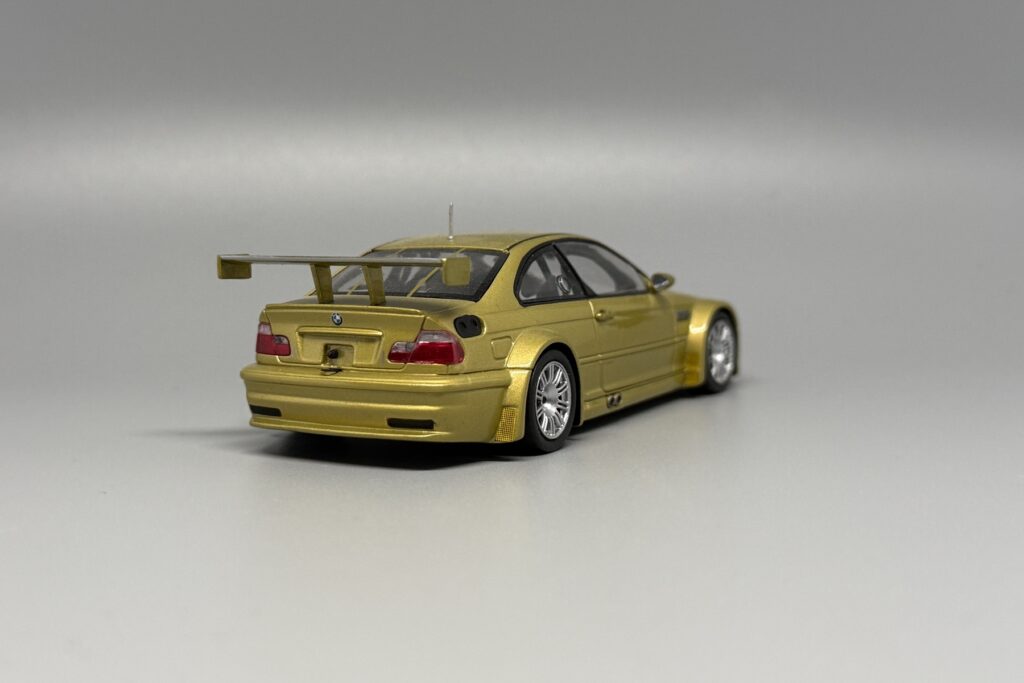
The BMW M3 GTR Street (E46) model in my collection was produced by Minichamps. The model represents a 2001 car and particularly emphasises the competition-inspired character of the GTR Street with its very low stance, purposeful aerodynamics, vented bonnet and prominent rear wing. Production was limited to a total of 3,504 pieces.
Technical data at a glance
Production period: 2001
Body style: two-door, two-seat Coupé
Production location: BMW Regensburg Plant, Germany
Engine: naturally aspirated P60B40 90° V8 petrol engine
Displacement: 3,997 cc
Power output: more than 258 kW / 350 hp @ 7,250 rpm
Maximum torque: 365 Nm @ 5,000 rpm
Engine block and cylinder heads: aluminium
Lubrication system: dry sump
Transmission: 6-speed manual
Clutch: twin-disc sports clutch
Drive: rear-wheel drive
Differential: variable M limited-slip differential
Weight: approximately 1,350 kg
Top speed: 295 km/h
Original price: approximately €250,000
Production total: 10 cars
Special feature: an ultra-rare road-going version of the V8-powered M3 GTR created for ALMS homologation.