
BMW 3 Series (E90) introduced the fifth generation of one of BMW’s most important model ranges in 2005 and represented a significant step forward from its predecessor. Compared with the E46, the new Saloon was larger, more spacious and technologically more advanced, while retaining the essential 3 Series formula – a longitudinally mounted engine, rear-wheel drive, balanced weight distribution and a strong focus on the driver. The E90 combined greater refinement, comfort and safety with the sporting handling traditionally associated with the 3 Series and quickly became one of BMW’s most important models.
The fifth generation of the 3 Series
The E90 made its world debut at the 2005 Geneva Motor Show and went on sale in Germany on 5 March. Compared with the E46 Saloon, the new car was 49 mm longer and 78 mm wider, while its wheelbase increased by 35 mm. The additional dimensions improved passenger space and safety, yet lightweight construction meant that the larger body did not result in a significant increase in weight. The Saloon was the first member of the new model family, followed by the E91 Touring, E92 Coupé and E93 Convertible.
New chassis and greater body rigidity
The E90 received an entirely new chassis, with an aluminium double-pivot strut front axle and a five-link rear suspension. The longer wheelbase and wider track improved both stability and ride comfort, while body torsional rigidity increased significantly compared with its predecessor. Active Steering was available as an option on selected six-cylinder models. Despite the additional technology, steering precision and the balanced rear-wheel-drive chassis remained among the E90’s defining characteristics.
Four- and six-cylinder engines
The European E90 range in 2005 included both four- and six-cylinder petrol and diesel engines. Petrol models included the 318i, 320i, 325i and 330i, while the diesel range comprised the 318d, 320d and 330d. The flagship 330i used a 3.0-litre straight-six with a magnesium-aluminium construction and produced 258 hp. The range expanded further during the model’s life, with the 306 hp twin-turbocharged 335i eventually bringing regular 3 Series performance close to the level previously associated with M models.
Rear-wheel drive and xDrive
Most E90 models retained the classic BMW layout, with the engine mounted longitudinally at the front and power sent to the rear wheels. A six-speed manual gearbox was standard, while a six-speed automatic was available on many versions. Selected six-cylinder models could also be ordered with xDrive all-wheel drive. The broad engine range allowed the E90 to serve very different roles, from an economical everyday Saloon to a genuinely rapid performance model such as the 335i.
A new design language
The E90’s styling marked a clear departure from the softer forms of the E46. Short overhangs, a higher shoulder line, more pronounced wheel arches and sharper front and rear styling gave the car a stronger and more contemporary stance. At the same time, the long bonnet and rearward-set passenger compartment retained familiar BMW proportions. The interior also changed significantly, with a more horizontal dashboard and, when fitted with navigation, the introduction of BMW’s iDrive control system to the 3 Series.
World Car of the Year 2006
The E90 was very well received by the market. By the end of 2005, BMW had already delivered almost 230,000 examples of the new 3 Series Saloon, and in 2006 the model was named World Car of the Year in New York. Its success demonstrated that BMW had been able to modernise the 3 Series substantially without losing the combination of performance, practicality and driving dynamics that had defined earlier generations.
The 2008 model update
In 2008, the E90 received a substantial model update. Changes included revised front styling, rear lights, bumpers and numerous exterior details, while the cabin gained an updated iDrive system with a new controller. The engine range also continued to evolve, and BMW’s EfficientDynamics measures reduced fuel consumption and emissions. Despite these developments, the fundamental concept of the E90 remained unchanged throughout its production life.
The legacy of the E90
Production of the E90 Saloon ended in 2011 as the F30 generation took its place. The model remains an important stage in 3 Series history, combining the traditional rear-wheel-drive BMW layout with increasingly sophisticated electronic and comfort technology. The E90 generation also produced distinctive derivatives such as the WTCC-homologation 320si and the V8-powered 420 hp M3. In its regular form, however, the E90 became one of the most recognisable and successful BMW models of the 2000s.
Model in the collection
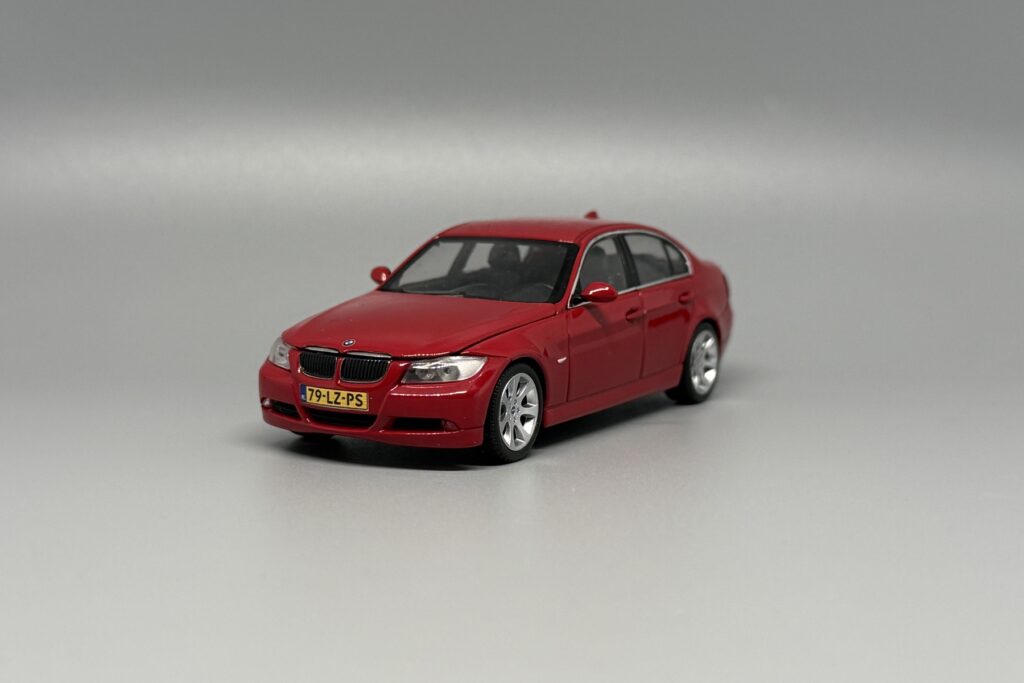
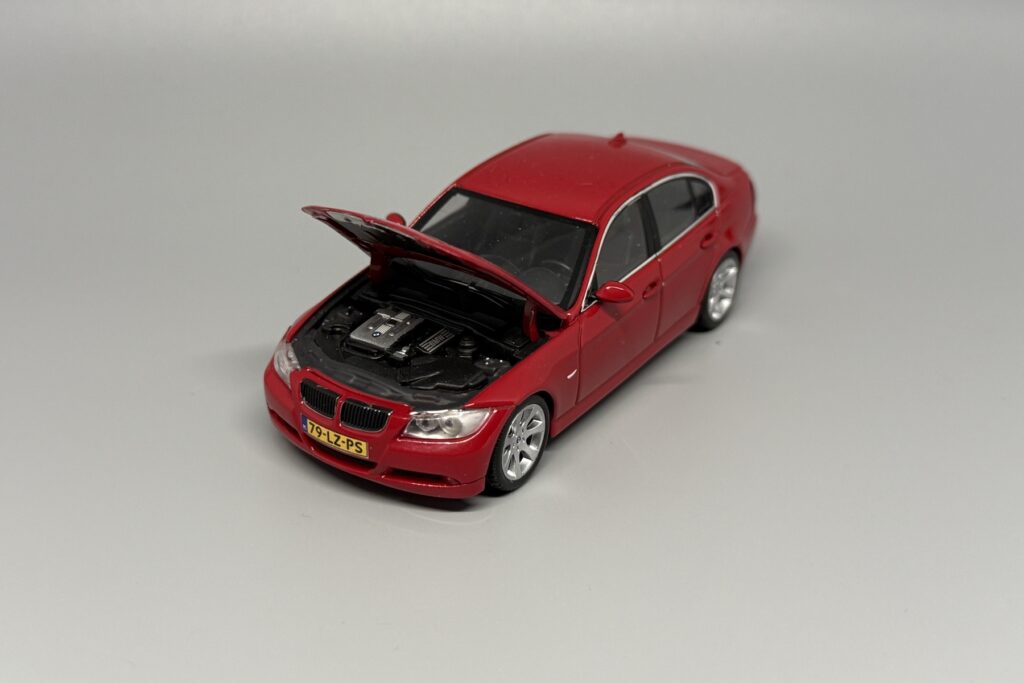
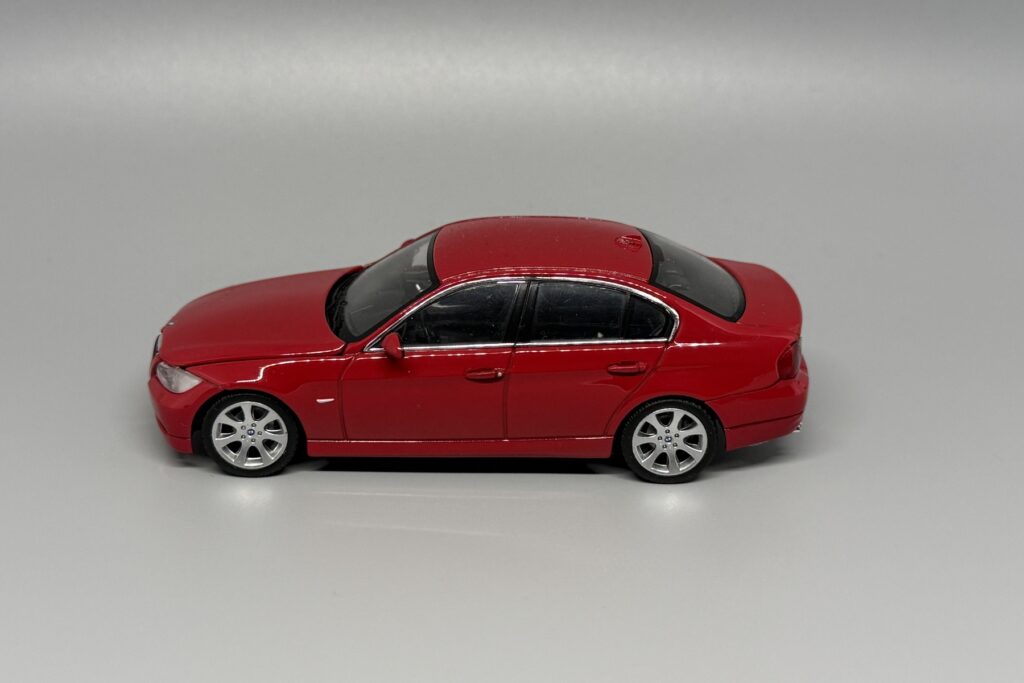
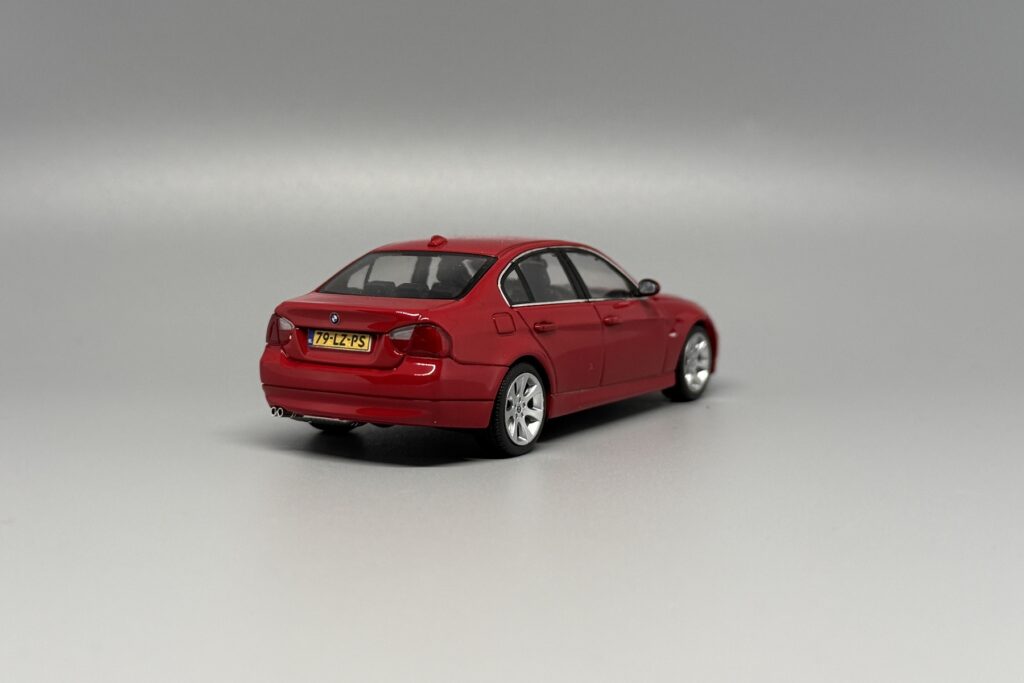
The BMW 3 Series (E90) model in my collection was produced by Minichamps. It represents a 2005 car, the first model year of the E90 Saloon. Minichamps did not identify it as a particular engine version, presenting the model simply as the BMW 3 Series. Production was limited to a total of 2,016 pieces.
Technical data at a glance
Production period: 2005–2011
Body style: four-door, five-seat Saloon
Main production locations: Munich, Regensburg and Leipzig, Germany; Rosslyn, South Africa
Engines: four- and six-cylinder petrol and diesel engines
Power output: 122–306 hp depending on version, excluding the M3
Transmission: 6-speed manual or 6-speed automatic
Drive: rear-wheel drive; xDrive all-wheel drive on selected versions
Wheelbase: 2,760 mm
Market launch: 5 March 2005
Special feature: the first body style of the fifth-generation 3 Series and the 2006 World Car of the Year
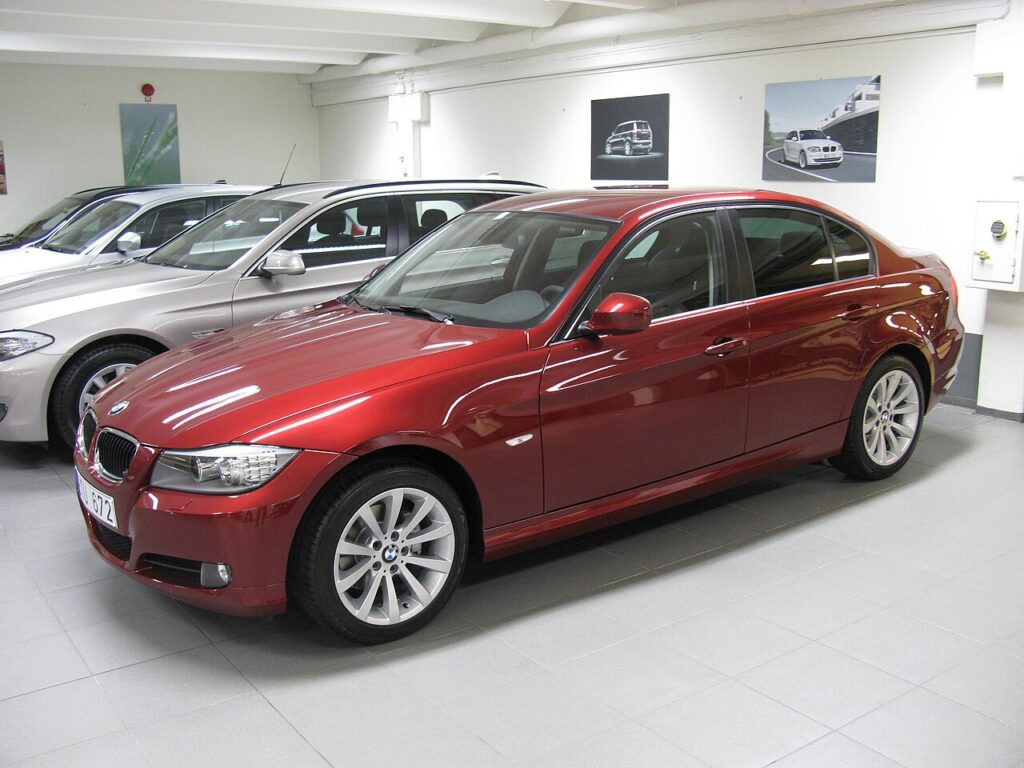
Photo of the real car. Photo: nakhon100 / Flickr / Wikimedia Commons, CC BY 2.0