
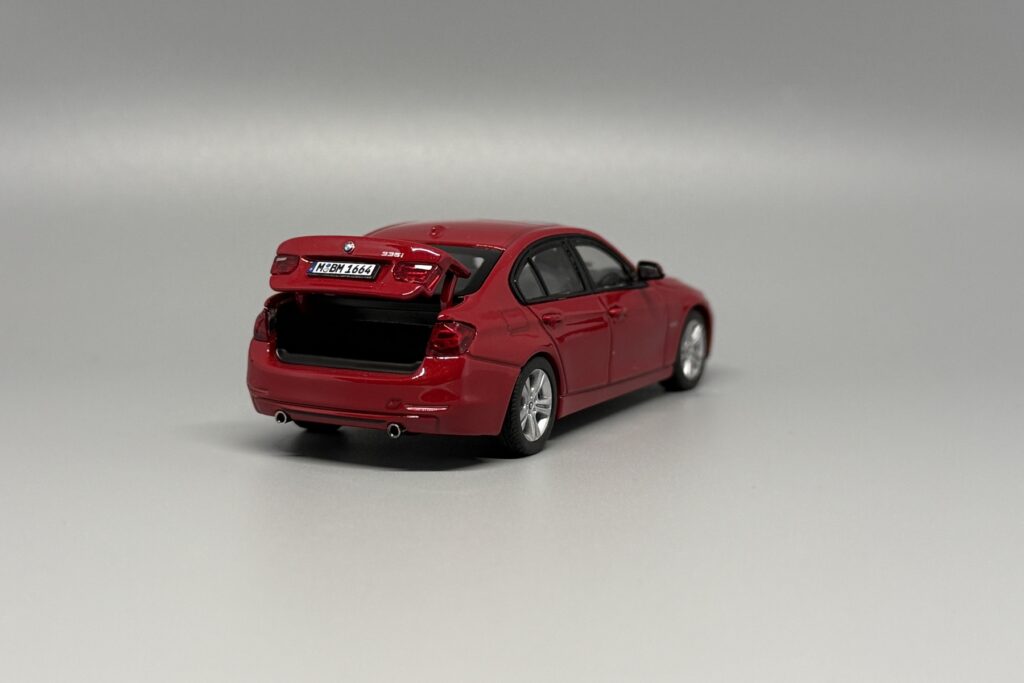
BMW 335i Sedan (F30) was one of the key petrol models of the sixth-generation 3 Series and the most powerful regular petrol version in the original F30 range. Entering production in late 2011 and reaching the market in early 2012, the new 3 Series was larger and more spacious than the E90 it replaced, yet intelligent lightweight construction allowed it to be around 40 kilograms lighter. The 335i combined the new generation’s more advanced technology with a classic BMW straight-six, rear-wheel drive and balanced handling, remaining the range-topping petrol model until the arrival of the 340i.
The sixth generation of the 3 Series
The F30 represented the sixth generation of the BMW 3 Series and officially reached the market in February 2012. Compared with the E90, the new Sedan was 93 millimetres longer and its wheelbase increased by 50 millimetres, providing noticeably more rear-seat space. Despite its larger dimensions, it retained traditional BMW proportions with a long bonnet, short front overhang and rearward-set passenger compartment. The F30 generation also marked the point at which the Coupé and Convertible were separated from the 3 Series to form the new BMW 4 Series range.
335i – the original range-topping petrol model
At launch, the 335i was the most powerful petrol model in the F30 range. It was joined by the four-cylinder 328i and the 320d and 320d EfficientDynamics Edition diesels. At a time when BMW was increasingly moving its smaller models towards turbocharged four-cylinder engines, the 335i retained the straight-six layout that had long been associated with the marque. It therefore formed a bridge between traditional BMW six-cylinder engineering and the new turbocharged era.
N55 TwinPower Turbo straight-six
The 335i was powered by the 2,979 cc N55B30M0 straight-six. BMW TwinPower Turbo technology combined a single TwinScroll turbocharger with High Precision Injection direct fuel injection, Double VANOS variable camshaft timing and fully variable Valvetronic valve lift. The engine produced 225 kW, or 306 hp, at 5,800 rpm and maximum torque of 400 Nm from just 1,200 rpm. Peak torque remained available all the way to 5,000 rpm, giving the 335i particularly strong and flexible performance across a wide engine-speed range.
306 hp and 250 km/h
The rear-wheel-drive 335i accelerated from 0 to 100 km/h in approximately 5.5 seconds and reached an electronically limited top speed of 250 km/h. This placed it firmly at the sporting end of the regular 3 Series range while preserving the practicality, comfort and five-seat accommodation of a conventional Sedan. With a DIN weight of 1,510 kilograms, the 306 hp straight-six provided an effective balance between strong performance and everyday usability.
Manual or eight-speed automatic
The 335i was available with a six-speed manual transmission, while an eight-speed Steptronic automatic was offered as an alternative. The wider spread of eight ratios allowed the automatic to combine rapid acceleration with lower engine speeds and improved efficiency during motorway driving. BMW later also offered the 335i with xDrive all-wheel drive, while the rear-wheel-drive version retained the most traditional BMW drivetrain layout.
50:50 weight distribution and a new chassis
The F30 chassis was comprehensively redesigned while retaining the near-50:50 weight distribution traditionally associated with the 3 Series. The front axle used an aluminium-intensive double-joint strut design, while a five-link multi-link arrangement was employed at the rear. Electromechanical power steering replaced the previous hydraulic system to improve efficiency. Adaptive M Sport suspension and Variable Sport Steering were also available to give the 335i an even more sporting character.
Sport Line, Luxury Line and Modern Line
The F30 introduced a new approach to equipment and personalisation. Alongside the standard model, BMW offered Sport Line, Luxury Line and Modern Line versions with distinctive exterior and interior details, followed later by the M Sport package. Technology also advanced significantly compared with the E90, with options including a full-colour Head-Up Display, Surround View, adaptive cruise control, lane-departure warning and an expanding range of BMW ConnectedDrive functions.
45,690 cars
BMW did not publish a separate official worldwide production total for the F30 335i, but VIN-range-based production data compiled by RealOEM lists 25,709 rear-wheel-drive 335i Sedans and a further 19,981 335i xDrive Sedans. This gives an estimated total of approximately 45,690 BMW 335i F30 Sedans. As the figure is derived from VIN ranges rather than a published BMW factory total, it may differ slightly from BMW’s internal production records.
Replaced by the 340i in 2015
The 335i remained in the F30 range until the 2015 model update, when it was replaced by the 340i. The new model introduced BMW’s B58-generation 3.0-litre turbocharged straight-six together with increased power. The 335i therefore became the characteristic range-topping petrol model of the early F30 years and the final 3 Series Sedan to use the 335i designation. Its N55 engine subsequently became one of BMW’s best-known turbocharged straight-six power units.
The legacy of the F30 335i
The 335i represents a period in the development of the 3 Series when the classic straight-six still occupied a central role in BMW’s high-performance regular models, even though naturally aspirated engines had already given way to turbocharging. The F30 was larger, more efficient and considerably more technologically advanced than its predecessor, yet the 335i retained many of the qualities traditionally associated with BMW sports sedans – the smoothness of a six-cylinder engine, strong performance and rear-wheel-drive handling.
Model in the collection
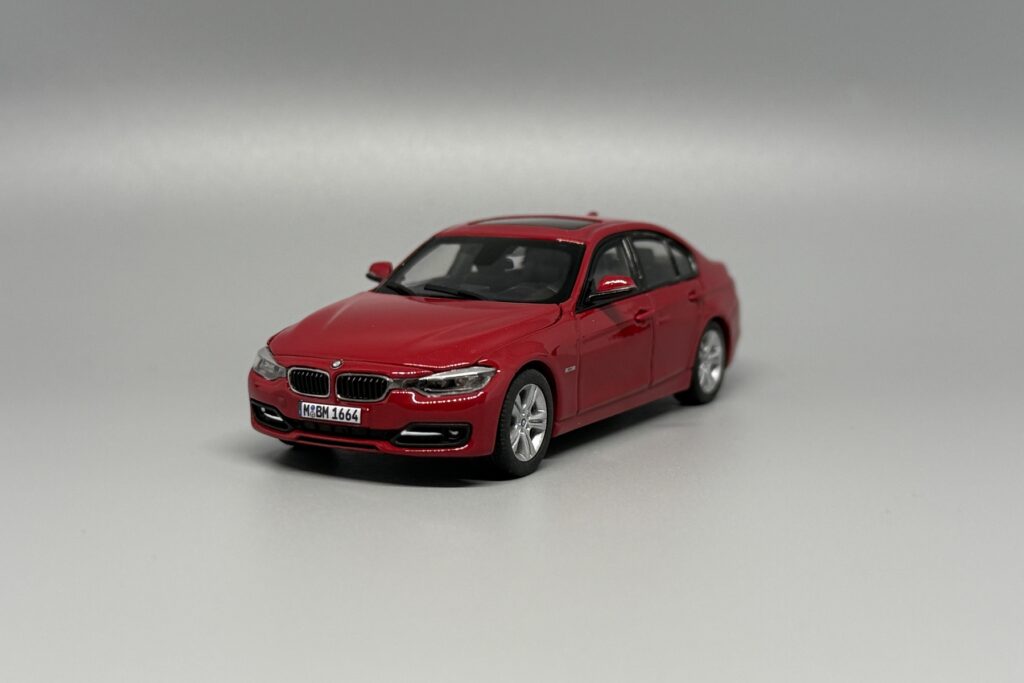
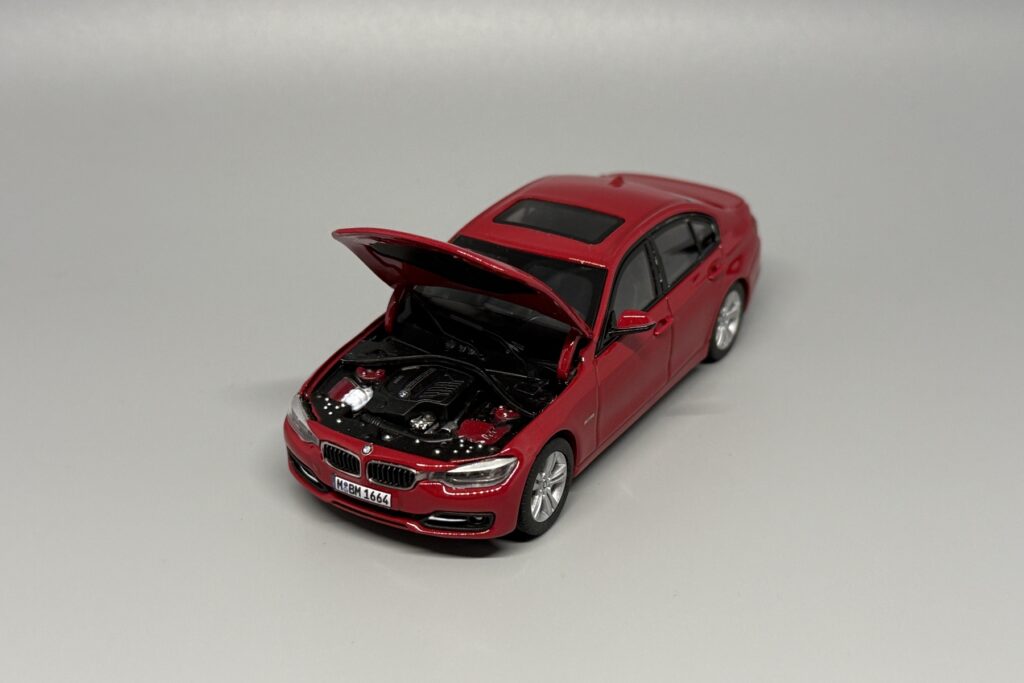
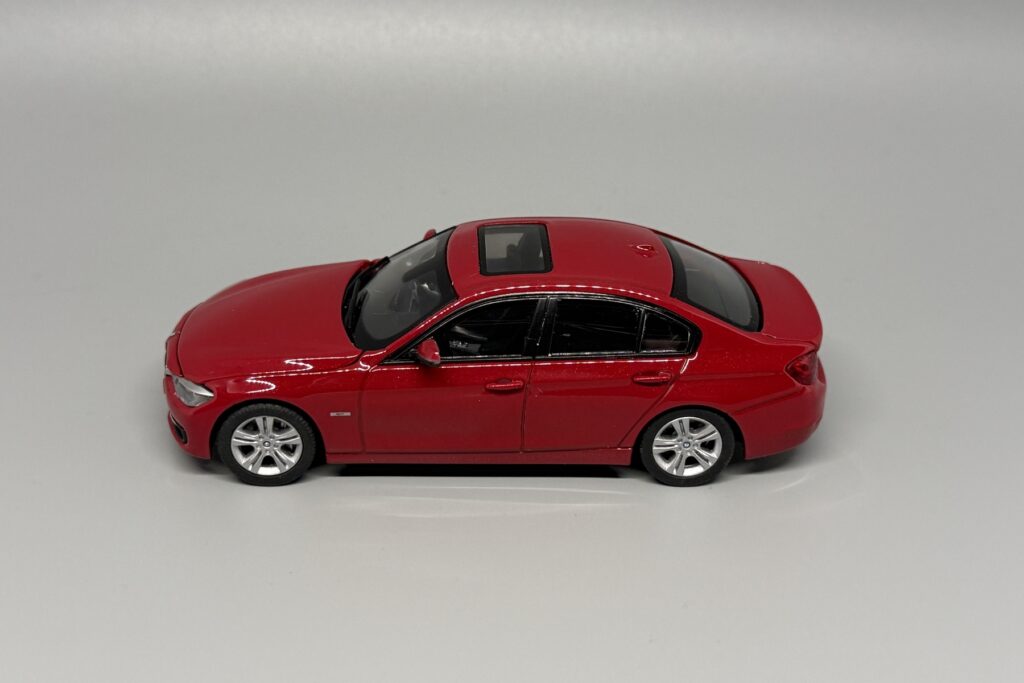
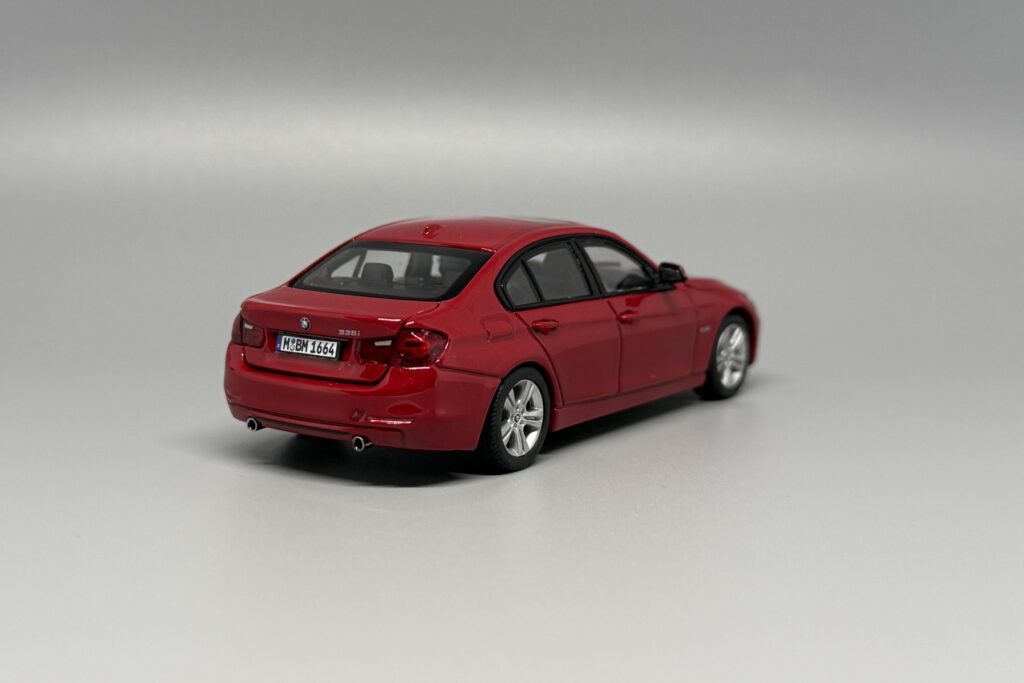
The BMW 335i Sedan (F30) model in my collection was produced by iScale. It is an official BMW dealer model representing the F30-generation 335i Sedan.
Technical data at a glance
Production period: 2011–2015
Body style: four-door, five-seat Sedan
Production: BMW international production network, including Germany
Engine: N55B30M0 TwinPower Turbo straight-six petrol engine
Displacement: 2,979 cc
Power output: 225 kW / 306 hp @ 5,800 rpm
Maximum torque: 400 Nm @ 1,200–5,000 rpm
Transmission: 6-speed manual or 8-speed Steptronic automatic
Drive: rear-wheel drive; xDrive all-wheel drive also available
Weight: 1,510 kg DIN, rear-wheel-drive manual version
Acceleration 0–100 km/h: approximately 5.5 sec
Top speed: 250 km/h, electronically limited
Wheelbase: 2,810 mm
Luggage capacity: 480 litres
Production total: approximately 45,690 cars – 25,709 rear-wheel drive and 19,981 xDrive (VIN-based estimate)
Special feature: the range-topping regular petrol model of the early F30 years, combining the N55 turbocharged engine with classic BMW straight-six character
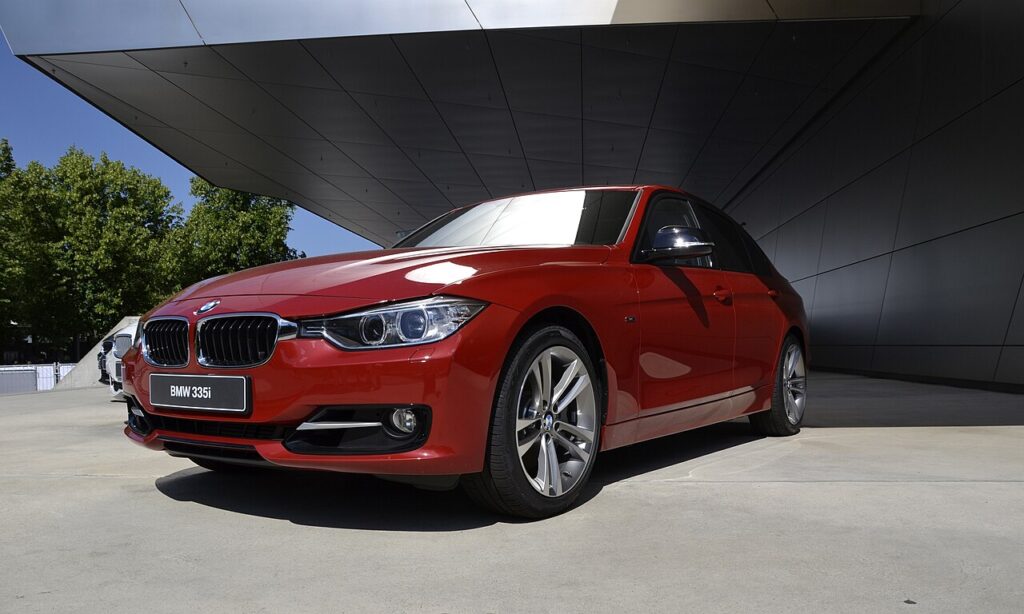
Photo of the real car. Photo: High Contrast / Wikimedia Commons, CC BY 3.0 DE