
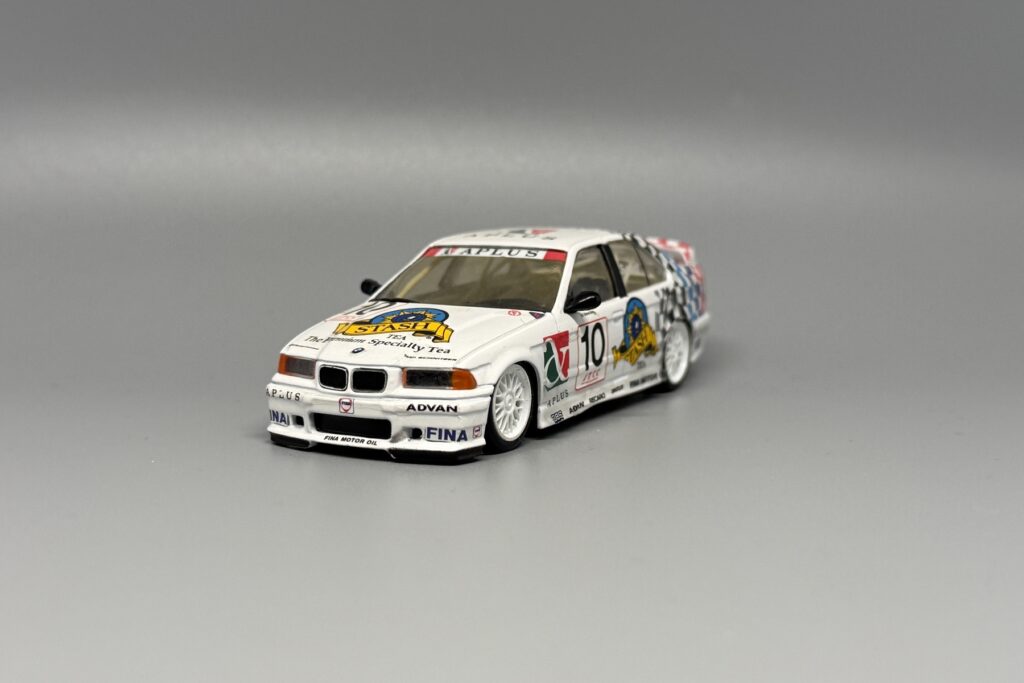
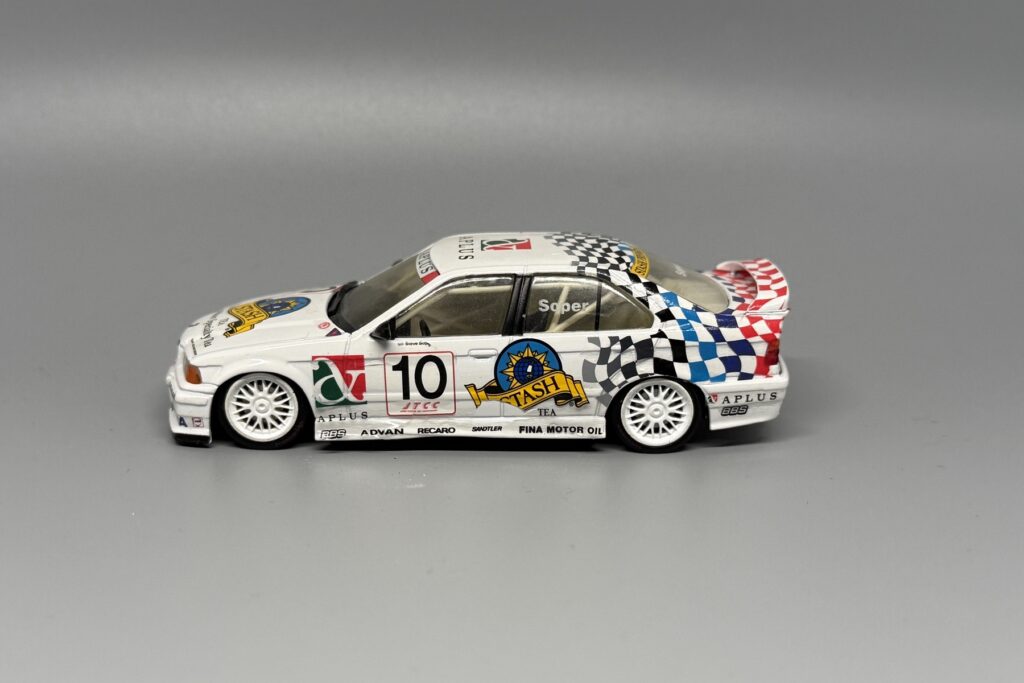
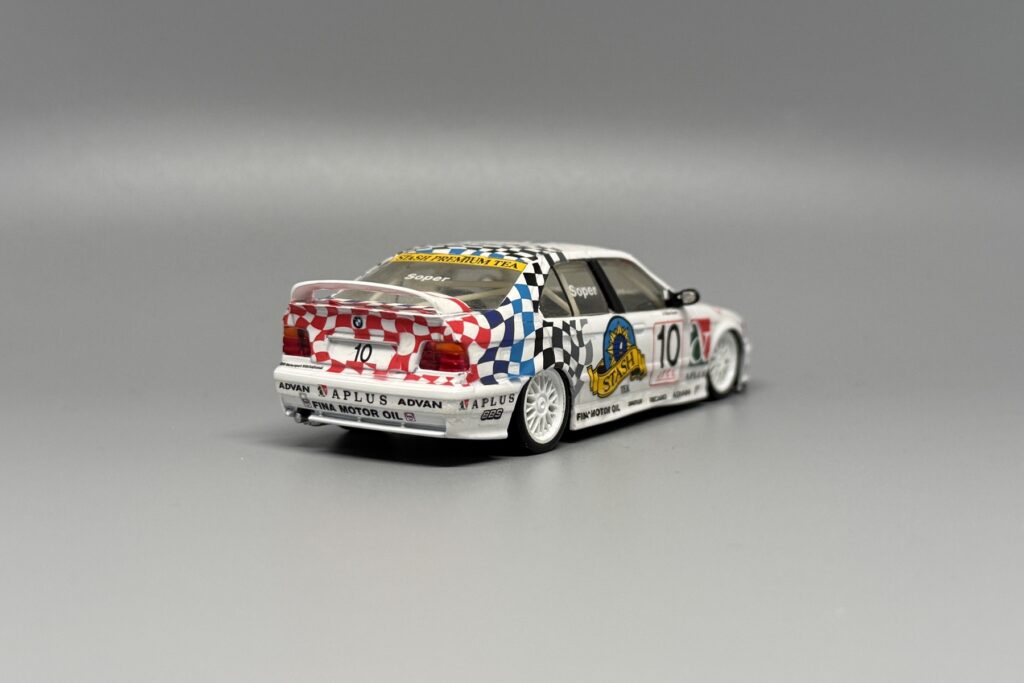
BMW 318iS/4 (E36) was one of BMW’s most successful touring car racing models of the 1990s, continuing the international competition tradition established by the BMW M3. Developed from the four-door E36-generation 3 Series, the car competed under FIA Class 2, commonly known as Super Touring, and combined a high-revving four-cylinder engine with extensively modified suspension and sophisticated racing aerodynamics. In Japan, the BMW Motorsport-supported Schnitzer team entered the car in the 1994 All Japan Touring Car Championship. British driver Steve Soper competed with racing number 10, achieving five race victories and finishing third in the championship. One year later, Soper won the Japanese Touring Car Championship in a further-developed version of the same BMW racing model, confirming the important place of the E36 generation in BMW motorsport history.
A new generation of BMW 3 Series racing cars
The third-generation BMW 3 Series (E36) was introduced in the early 1990s, representing a significant development in BMW’s range of sporting compact executive cars. Its new body was more aerodynamic and structurally rigid than that of its predecessor, while its chassis offered improved handling and stability. By this time, BMW had achieved considerable international success with the E30-generation M3, whose racing versions had won numerous touring car championships. However, new two-litre touring car regulations were being introduced in several countries, allowing manufacturers to compete without developing large-capacity performance models. BMW decided to use the four-door E36 body as the basis for a specialised racing car. The resulting BMW 318is, also identified as the 318iS/4 in certain competition and homologation documents, became one of the manufacturer’s most important international touring cars during the mid-1990s.
FIA Class 2 and the Super Touring era
Super Touring became one of the most popular categories of international circuit racing during the 1990s. FIA Class 2 regulations required racing cars based on production four-door vehicles, with engines limited to two litres. Compared with earlier Group 1 and Group A touring cars, the rules permitted extensive modifications to engines, transmissions and suspension, while the general appearance of the production body had to be retained. This technical framework attracted manufacturers including BMW, Alfa Romeo, Toyota, Nissan, Honda, Ford and Vauxhall. Competition became extremely close, with success often depending as much on chassis setup, tyre performance and aerodynamic efficiency as on maximum engine output. The BMW 318is was distinctive because it retained rear-wheel drive at a time when many of its competitors used front-wheel-drive layouts.
BMW Motorsport and Team Schnitzer
The technical development of BMW’s E36 Super Touring cars was directed by BMW M GmbH, which had adopted its new official name in 1993 after previously being known as BMW Motorsport GmbH. One of its most important racing partners was Schnitzer Motorsport, whose long-standing relationship with BMW had already produced numerous victories during the 1970s and 1980s. Schnitzer’s extensive experience with the BMW M3 and other competition models was particularly valuable in developing the new two-litre touring cars. BMW also made its 318is racing technology available to independent teams, allowing the model to compete in numerous national championships. In 1993, Joachim Winkelhock won the British Touring Car Championship in a Schnitzer-prepared BMW 318i, demonstrating the potential of the E36 racing programme. The following year, the Japanese Touring Car Championship became one of BMW’s most important international racing commitments.
The BMW 318iS/4 and homologation
The BMW 318iS/4 designation was associated with the four-door E36-generation 318is, whose FIA Group A homologation became effective in July 1994. The homologated production model used a 1,796 cc four-cylinder engine, but Super Touring racing versions were not restricted to the standard engine’s displacement or power output. FIA Class 2 permitted specially developed racing engines with a maximum capacity of two litres, featuring technical specifications substantially different from those of road-going cars. The BMW 318is competition programme demonstrated how extensively a compact production saloon could be developed while retaining its fundamental body shape. The four-door E36 provided a particularly effective starting point thanks to its aerodynamic efficiency, rigid body structure and the possibility of mounting specialised racing components as low and as centrally as practical.
The high-revving two-litre racing engine
The BMW 318is Super Touring racing cars used naturally aspirated four-cylinder engines with a displacement of approximately two litres. According to BMW’s official 1994 technical documentation, the competition engine produced 285 hp at 8,300 rpm and had a displacement of 1,996 cc. It was a specialised racing development derived from the BMW M3’s S14 engine and featured four valves per cylinder. At the same time, BMW was testing a new two-litre competition engine based on the M42 engine family, with a displacement of 1,998 cc and an estimated output of approximately 285 hp. Japanese registration records for 1995 identify the Schnitzer cars with M42 engines, although exact engine configurations changed during the preceding racing season. Consequently, BMW’s official 1994 performance figures should be regarded as representative specifications of the racing model family rather than definitive proof of the engine installed in every chassis used by Steve Soper.
The six-speed sequential gearbox
One of the most important technical developments introduced for the 1994 BMW 318is racing car was a six-speed sequential gearbox developed by BMW M GmbH in cooperation with the Australian transmission specialist Holinger. Unlike a conventional manual gearbox with an H-pattern shift, the sequential system allowed gears to be selected in a fixed order, substantially reducing the time required for gear changes. Engine power was transmitted to the rear wheels through a limited-slip differential, while different final-drive ratios could be selected to suit individual circuits. According to BMW’s official figures, the 1994 competition car could accelerate from 0 to 100 km/h in approximately five seconds and reach a top speed of up to 280 km/h, depending on gearing. These figures illustrate the technical sophistication of the BMW 318is, although acceleration and corner-exit performance were often more important than outright maximum speed on Japan’s shorter circuits.
Competition bodywork and chassis
The BMW 318iS/4 retained the basic four-door body structure of the production E36, but its engineering was extensively modified for professional racing. The body was reinforced with a comprehensive roll cage, while the driver’s seating position, steering wheel, instruments and safety equipment were adapted specifically for competition. According to BMW’s 1994 factory documentation, the racing car was approximately ten centimetres lower than the standard production model. Although its suspension retained the basic principles of the E36 front and rear axles, individual components, mounting points and spring and damper settings were developed specifically for racing. The car featured large ventilated disc brakes, lightweight centre-lock racing wheels and wide competition tyres. The regulatory weight of the 1994 racing version was 1,025 kg, while aerodynamic equipment included a front spoiler and rear wing. Unlike the radical Group 5 silhouette racers of the previous decade, the Super Touring BMW was required to preserve the clearly recognisable appearance of the production car.
The 1994 Japanese Touring Car Championship
In 1994, the Japanese Touring Car Championship, or JTCC, adopted new Super Touring technical regulations. The previous Group A era gave way to four-door competition cars with engines of up to two litres, making the series increasingly attractive to international manufacturers. BMW Team Schnitzer entered several E36 racing cars, driven by competitors including Steve Soper, Joachim Winkelhock and Prince Leopold of Bavaria. Their rivals included the Toyota Corona, Nissan Primera, Honda Civic, Alfa Romeo 155 and Opel Vectra. Japanese racing circuits presented widely differing challenges. Suzuka demanded excellent chassis balance, Fuji rewarded higher maximum speeds, and circuits such as Mine and Sugo placed particular emphasis on responsive handling. This varied calendar gave BMW an opportunity to demonstrate the E36’s competitive strengths under different racing conditions.
Steve Soper and racing number 10
British racing driver Steve Soper was among BMW’s most experienced touring car competitors during the early 1990s. He had achieved considerable success with the BMW M3 before continuing his career in the E36-generation racing cars. In the 1993 British Touring Car Championship, Soper finished second in a BMW 318i, behind his Schnitzer teammate Joachim Winkelhock. During 1994, he competed for BMW Team Schnitzer in the Japanese championship, where his principal racing number was 10. Soper was known for precise car control, assertive but calculated racing tactics and an ability to make effective use of tyre grip and chassis performance. These qualities helped him adapt to the demands of Japanese circuits and challenge leading local drivers throughout the season.
Five victories during the 1994 season
Steve Soper achieved five race victories in the 1994 Japanese Touring Car Championship driving the BMW carrying number 10. His first win came at Sugo in May, followed by two consecutive victories at the Mine circuit in July. An especially memorable result followed at Sendai Highland in September, where Soper won both races during the same event weekend. These achievements confirmed the competitiveness of the BMW 318is and Schnitzer’s ability to adapt the car to the demands of different circuits. Despite winning five races, Soper was unable to claim the championship title, as retirements and less successful results at several rounds affected his overall points total. He eventually finished third in the drivers’ championship, behind Toyota drivers Masanori Sekiya and Tom Kristensen. BMW Team Schnitzer nevertheless secured the teams’ championship, highlighting the success of the E36 racing programme beyond Europe.
The 1995 Japanese championship title
Steve Soper continued competing for BMW Team Schnitzer in the Japanese Touring Car Championship in 1995, once again carrying racing number 10. Competition from Toyota, Nissan, Honda and Opel remained extremely strong, but the further-developed BMW 318is proved sufficiently fast and reliable to challenge for the championship throughout the season. Soper won races at Suzuka, Nishi-Sendai and Fuji Speedway, finishing the championship with 124 counted points. His closest rival, Masanori Sekiya, finished second with 117 points. Soper therefore became the 1995 Japanese Touring Car Champion, while BMW Team Schnitzer also retained the teams’ title. It was one of the most important achievements of Soper’s racing career. Although the Minichamps model carrying number 10 represents the 1994 season according to catalogue records, the championship victory in 1995 forms an essential continuation of the same BMW E36 racing programme.
The legacy of the BMW 318iS/4
The BMW 318iS/4 (E36) represented an era when BMW’s success in touring car racing no longer depended exclusively on six-cylinder M3 models. Its high-revving four-cylinder engine, sequential gearbox, precisely developed chassis and sophisticated aerodynamics allowed the E36 to achieve success across several continents. BMW 318is competition versions won national championships in Europe, Asia, Australia and other markets during the 1990s, confirming the manufacturer’s strength in the international Super Touring category. Steve Soper’s five race victories in Japan during 1994 and his championship title in 1995 represent one of the most memorable chapters in this history. Today, the E36 racing car remains an important part of BMW’s motorsport heritage, representing a period when vehicles that looked relatively close to production cars concealed remarkably sophisticated racing technology.
Model in the collection
The BMW 318iS/4 (E36) model in my collection was produced by Minichamps. It represents Steve Soper’s BMW Team Schnitzer racing car carrying number 10 in the 1994 Japanese Touring Car Championship. The model reproduces the four-door E36 Super Touring body, lowered racing suspension, specialised aerodynamic components, competition wheels and authentic period sponsorship markings. It was released as a limited edition of 1,824 pieces.
Technical data
Competition year: 1994
Racing series: All Japan Touring Car Championship (JTCC)
Competition category: FIA Class 2 (Super Touring)
Base vehicle: BMW 318is, 3 Series (E36)
Body style: four-door racing saloon
Vehicle origin: BMW, Germany
Racing car development: BMW M GmbH
Racing team: BMW Team Schnitzer
Driver: Steve Soper, Great Britain
Racing number: 10
Engine: naturally aspirated inline-four petrol engine
Displacement: approximately 2.0 litres; BMW’s published 1994 racing engine specification was 1,996 cc
Valve gear: twin overhead camshafts, four valves per cylinder
Power output: 207 kW / 285 hp at 8,300 rpm according to BMW’s 1994 racing specification; exact individual car configuration unconfirmed
Maximum torque: 240 Nm at 7,000 rpm in BMW’s 1994 competition specification
Engine position: longitudinal front engine
Transmission: 6-speed Holinger sequential racing gearbox
Drive: rear-wheel drive
Differential: limited-slip differential
Body construction: reinforced BMW E36 unitary body with competition roll cage
Suspension: specially developed independent racing suspension
Brakes: ventilated disc brakes
Weight: 1,025 kg according to the 1994 BMW racing specification
Top speed: up to 280 km/h depending on gearing, according to BMW’s 1994 figures
Major results in 1994: five race victories, 3rd in the JTCC drivers’ championship
1994 team result: championship title for BMW Team Schnitzer
Later achievement: Steve Soper’s 1995 JTCC drivers’ championship title in a BMW 318i
Competition cars produced: exact total unconfirmed
Special feature: two-litre BMW Super Touring racing car prepared by Schnitzer, driven by Steve Soper to five race victories and third place in the 1994 Japanese Touring Car Championship