
BMW 700 RS was an exceptionally lightweight racing car developed in 1961, demonstrating that a small engine did not necessarily mean modest performance. Based on the technical principles of the BMW 700 production car but developed specifically for competition, the two-seat sports racer combined a tubular steel spaceframe, lightweight aluminium bodywork and a high-revving air-cooled flat-twin engine. Despite a displacement of just 697 cc, the engine produced 70 hp, enabling the car to compete successfully against considerably more powerful rivals thanks to its low weight and excellent handling. Only two examples were built, making the 700 RS one of BMW’s most unusual racing cars of the early 1960s. Its history is closely associated with the legendary hill-climb driver Hans Stuck.
The BMW 700 and a new beginning
The BMW 700 was introduced in 1959, at a time when the company was facing serious financial difficulties. The small rear-engined car quickly became a commercial success, helping BMW avoid a possible takeover and regain its financial independence. Designed by Giovanni Michelotti, the BMW 700 Coupé also proved surprisingly sporting despite its modest engine capacity. The first examples were already competing in rallies and circuit races during 1959, and several important victories followed in 1960. The success of the BMW 700 demonstrated that a lightweight car with good handling could outperform competitors equipped with more powerful engines. These achievements encouraged BMW’s racing department to develop increasingly specialised competition versions, concentrating particularly on hill-climb events and circuit racing.
From the 700 GT to the 700 RS
BMW began developing specialised factory competition cars in 1960 with the BMW 700 GT. This was followed in 1961 by the much more radical BMW 700 RS, which differed substantially from the regular production model. Development focused on reducing weight, lowering the centre of gravity and achieving exceptionally precise handling. The RS designation, standing for Rennsport, identified a purpose-built racing car rather than a production sports model intended for everyday use. BMW constructed only two examples for its works racing programme. Although the 700 RS carried the same model number as the production BMW 700, their shared engineering components were largely limited to suspension, steering and certain other mechanical principles. The RS was effectively an independent competition design developed to exploit the advantages of a small and lightweight vehicle.
Lightweight tubular chassis and aluminium body
At the heart of the BMW 700 RS was a delicate tubular steel spaceframe covered by exceptionally light aluminium bodywork. The compact two-seat Roadster measured just 3,465 mm in length and 1,460 mm in width, with a remarkably short wheelbase of only 2,000 mm. Its low windscreen, shallow front end and smoothly rounded body surfaces reduced aerodynamic drag while helping to keep the centre of gravity as low as possible. During a 2014 road test, Auto Bild Klassik measured the BMW 700 RS at just 493 kg, while BMW’s official historical documentation describes the car as weighing less than 600 kg. The differing figures may reflect variations in equipment and measurement conditions. In either case, the 700 RS was an exceptionally lightweight racing machine whose construction allowed it to make highly effective use of its relatively modest engine output.
The high-revving 70 hp flat-twin
The BMW 700 RS was powered by a specially developed 697 cc air-cooled two-cylinder boxer engine. With a bore of 78 mm and a stroke of 73 mm, the engine was designed to operate at exceptionally high speeds for its era. Its most distinctive technical feature was the use of overhead camshafts driven by vertical shafts, commonly known as king shafts. This arrangement provided accurate valve timing even at very high engine speeds. Maximum output was 52 kW or 70 hp at 8,000 rpm, representing a specific output of approximately 100 hp per litre. By comparison, the original production BMW 700 developed just 30 hp, while the later 700 Sport offered 40 hp. The RS engine was therefore considerably more sophisticated and powerful than the standard unit, demonstrating the expertise of BMW’s racing engineers in extracting exceptional performance from a small-capacity engine.
A mid-mounted engine for better balance
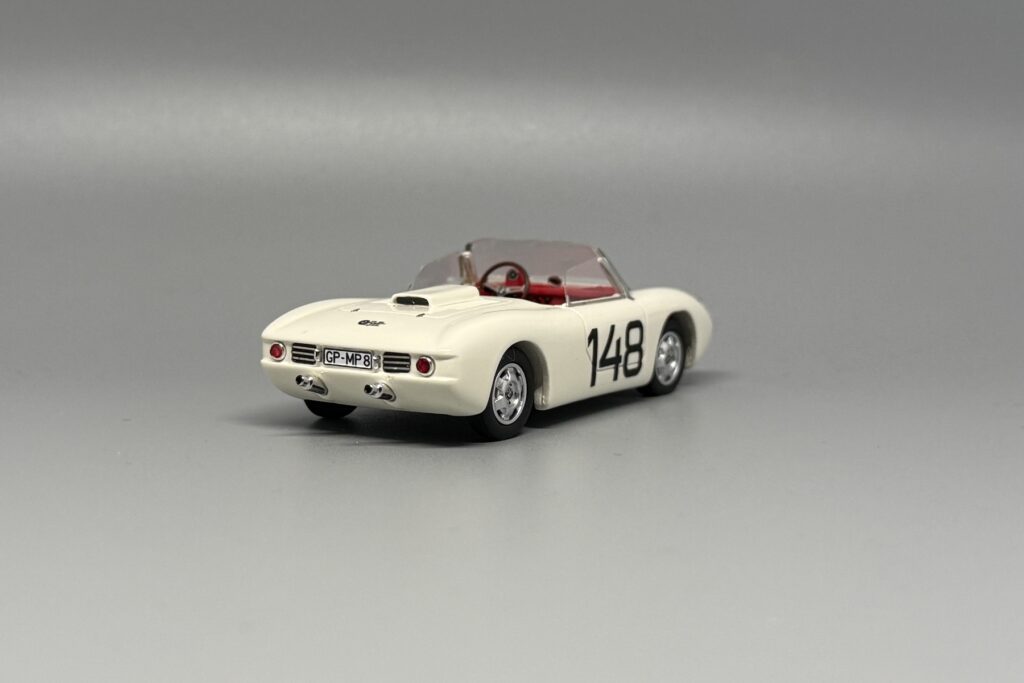
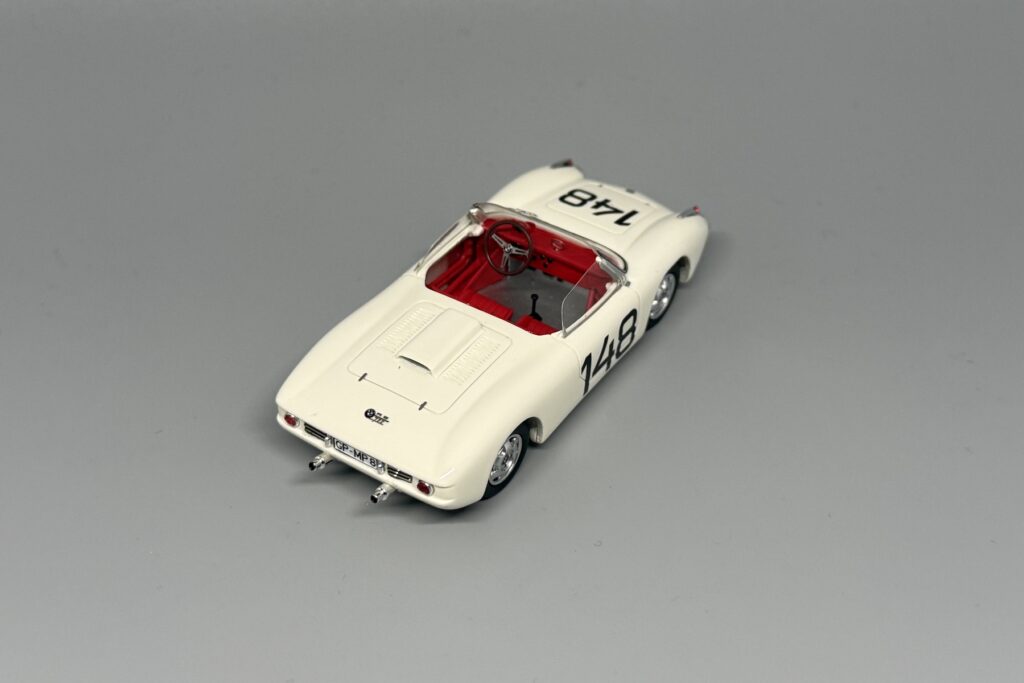
One of the most important engineering differences between the BMW 700 RS and the regular BMW 700 was the position of the engine. While the production car featured a conventional rear-engine layout, the RS placed its flat-twin ahead of the rear axle, creating the weight distribution associated with a mid-engined sports car. This reduced the tendency towards instability during rapid changes of direction and improved traction when accelerating out of corners. The exceptionally short wheelbase and low weight made the car highly responsive to steering inputs. Suspension components drew on existing BMW 700 engineering, including independent front suspension and a modified rear suspension arrangement. The rack-and-pinion steering and basic braking concept were also derived from the production model. This deliberate combination of specialised racing construction and proven series-production components helped maintain mechanical reliability while delivering exceptional agility.
Racing debut at Roßfeld in 1961
The BMW 700 RS made its official competition debut on 18 June 1961 at the Roßfeld hill climb in Bavaria. The car was driven by Hans Stuck, already one of Europe’s most celebrated hill-climb specialists. BMW initially presented the new machine as an experimental project intended to explore the handling capabilities of the BMW 700 concept at higher speeds. The 700 RS competed in the sports-car category for engines up to 1,600 cc, where its rivals included considerably more powerful Porsche Spyders and Porsche RSKs. This represented a formidable challenge for the small BMW with its 697 cc engine. Nevertheless, the car quickly demonstrated the advantages of its low weight, precise handling and favourable power-to-weight ratio, confirming the effectiveness of the engineering approach chosen by BMW.
Hans Stuck – the legendary Bergkönig
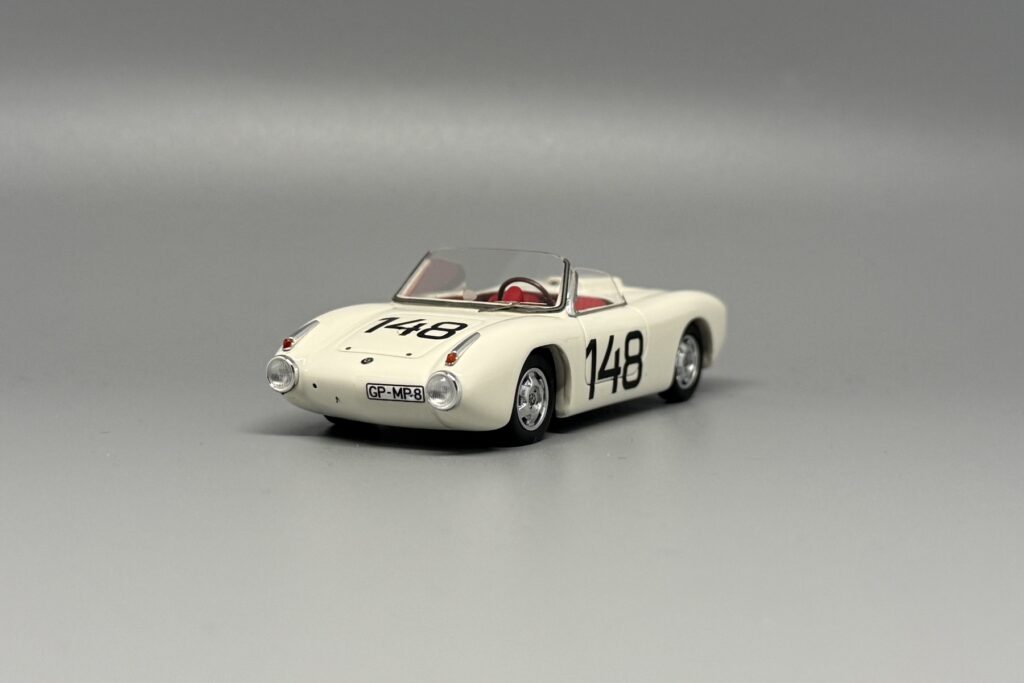
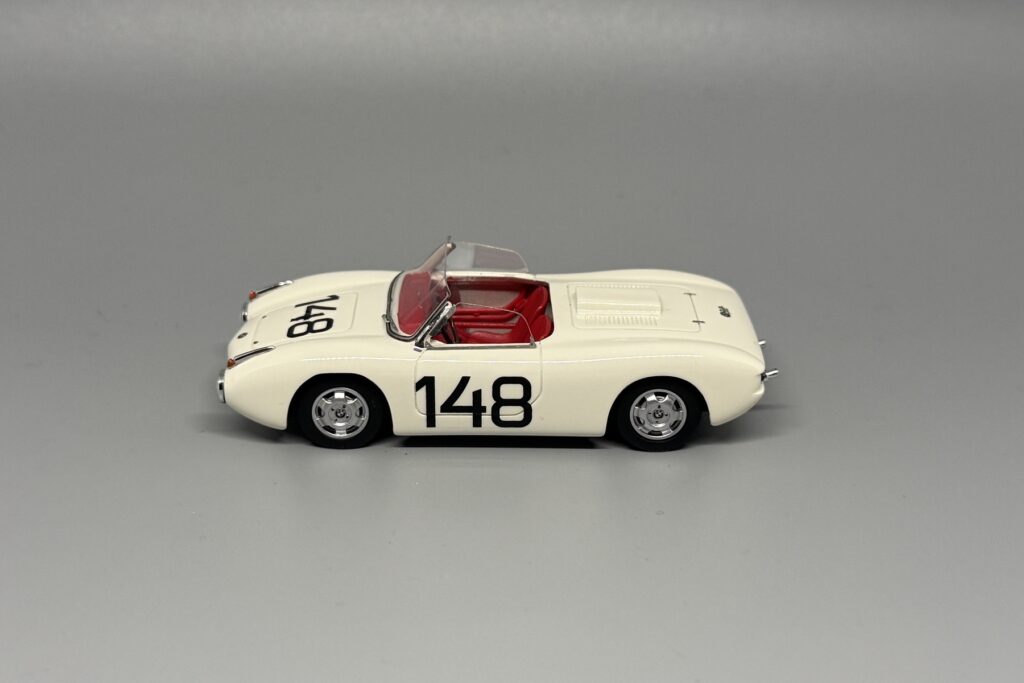
The racing history of the BMW 700 RS is closely associated with Hans Stuck senior, widely known as the Bergkönig, or King of the Mountains. Born in 1900, Stuck had already achieved international fame during the 1920s and 1930s, competing in powerful Grand Prix cars, including those produced by Auto Union. After the Second World War, he continued his motorsport career and won the German Hill-Climb Championship in 1960 driving a BMW 700, at the age of 60. The following year, he began competing with the newly developed BMW 700 RS. BMW’s historical archive contains a photograph of Stuck driving a BMW 700 RS carrying racing number 148 at an Austrian hill-climb event in 1961. This photograph is among the best-known period images of the rare competition car and provides a direct connection between Stuck and BMW’s early-1960s racing programme.
Walter Schneider and racing from 1961 to 1964
The BMW 700 RS was not driven exclusively by Hans Stuck. Other notable competitors associated with the two cars included Walter Schneider, Herbert Linge, Heinz Eppelstein and Alexander von Falkenhausen. The 1961 season proved particularly successful, with Schneider achieving important results in both circuit racing and hill-climb competitions. According to BMW’s official historical account, Schneider secured the German Circuit Racing Championship that year, while other sources also document his success in mountain events in Germany, Austria and Switzerland. The BMW 700 RS remained active between 1961 and 1964, appearing at well-known hill climbs including Roßfeld, Gaisberg and Schauinsland. Its compact dimensions and exceptional agility made it especially effective on narrow, winding mountain roads, where low weight and precise handling could be more important than outright engine power.
150–200 km/h depending on gearing
The maximum speed of the BMW 700 RS depended heavily on the transmission ratios selected for a particular event. According to BMW’s historical documentation, the car was capable of approximately 150–200 km/h, depending on its gearing. Shorter ratios were particularly useful for hill climbs, providing stronger acceleration and allowing the engine to remain within its high-revving power band, while longer ratios were better suited to faster circuits. AutoCult’s historical account describes a four-speed racing transmission, although other technical sources refer to a five-speed sports gearbox. These differences may reflect the individual competition specifications and later modifications of the two cars. Despite its comparatively modest power output, the RS delivered impressive acceleration thanks to its exceptionally low weight, while contemporary and later driving impressions praised its outstanding responsiveness and handling precision.
Only two examples
Only two BMW 700 RS racing cars were constructed. Unlike the regular BMW 700, the RS was never intended for series production but was developed as a specialised factory competition project. Designed primarily for hill-climb racing, its lightweight construction and small-capacity engine suited the technical requirements of contemporary sports-car classes. BMW continued using the cars over several seasons, adapting their equipment to different competition requirements. One surviving example eventually became part of BMW’s historical collection in Munich, while the other entered a private collection in the United States. Both rare cars have survived into the modern era. Their significance lies not merely in their limited production but also in their sophisticated engineering and contribution to the development of BMW’s post-war motorsport activities.
The legacy of the BMW 700 RS
The BMW 700 RS represented a period in which BMW was rebuilding both its financial strength and sporting reputation. While the regular BMW 700 helped the company recover from its economic difficulties, the 700 RS demonstrated how far the basic technical concept could be developed for competition. Its high-revving 70 hp boxer engine, mid-engine layout, tubular spaceframe and lightweight aluminium body created a highly effective racing machine capable of challenging cars with considerably larger engines. The 700 RS belonged to the final phase of BMW’s small-capacity specialist racing projects before Neue Klasse saloons and larger engines became increasingly important in the marque’s motorsport activities. Its production total of just two cars, connection with Hans Stuck and unusual engineering make it one of BMW’s most fascinating competition models of the early 1960s.
Model in the collection
The BMW 700 RS model in my collection was produced by AutoCult. It represents Hans Stuck senior’s racing car carrying number 148, photographed at an Austrian hill-climb event in 1961. The model reproduces the compact, low-profile Roadster body, open cockpit and characteristic details of the historic competition car. It was released as a limited edition of 333 pieces.
Technical data
Year of construction: 1961
Competition period: 1961–1964
Body style: two-seat open racing Roadster (Spyder)
Developer: BMW racing department, Munich, Germany
Base vehicle: special construction derived from the BMW 700 engineering concept
Engine: naturally aspirated air-cooled flat-twin petrol engine
Displacement: 697 cc
Bore × stroke: 78 × 73 mm
Power output: 52 kW / 70 hp at 8,000 rpm
Valve gear: overhead camshafts with king-shaft drive
Engine location: mid-mounted, longitudinally ahead of the rear axle
Drive: rear-wheel drive
Transmission: racing gearbox, described as four- or five-speed in different sources
Chassis: tubular steel spaceframe
Bodywork: lightweight aluminium construction
Front suspension: independent suspension
Rear suspension: independent suspension
Steering: rack-and-pinion
Brakes: drum brakes
Weight: less than 600 kg according to BMW; 493 kg measured by Auto Bild Klassik
Top speed: 150–200 km/h depending on gearing
Length: 3,465 mm
Width: 1,460 mm
Height: 1,060 mm
Wheelbase: 2,000 mm
Racing debut: 18 June 1961, Roßfeld hill climb
Notable drivers: Hans Stuck senior, Walter Schneider, Herbert Linge, Heinz Eppelstein and Alexander von Falkenhausen
Major achievements: Walter Schneider’s 1961 German championship title and successful hill-climb appearances
Production total: 2 cars
Special feature: purpose-built lightweight BMW racing car combining a high-revving 697 cc boxer engine, mid-engine layout and aluminium bodywork to achieve exceptional performance
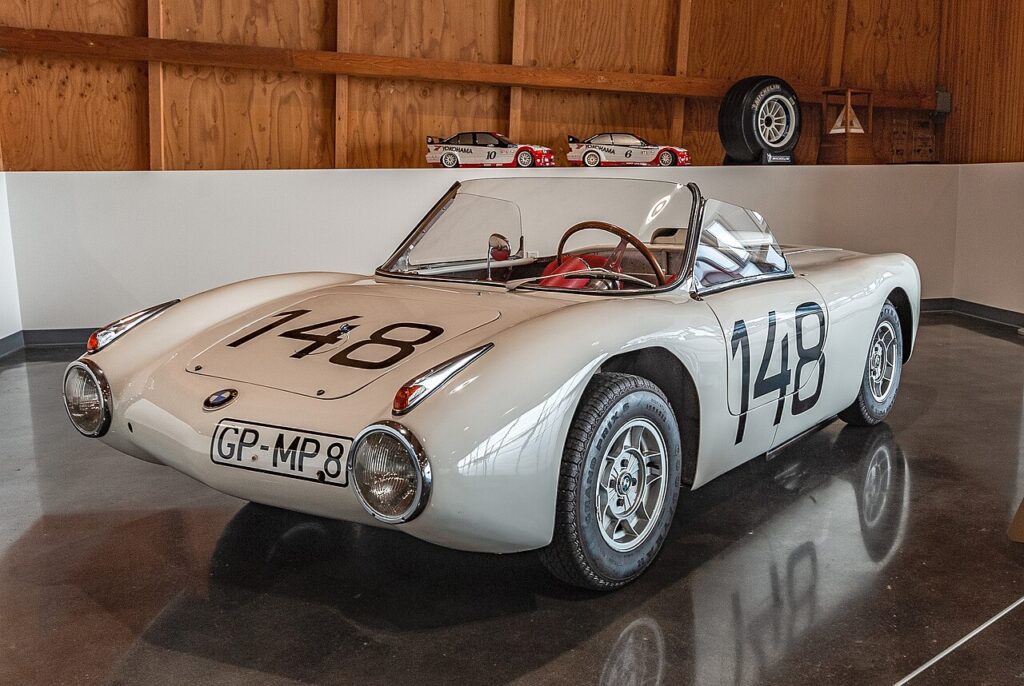
Photo of the real car. Photo: Aaron Headly / Wikimedia Commons, CC BY-SA 4.0