
BMW 328 Rennversion was the competition-prepared version of the legendary BMW 328 sports car, whose success helped establish BMW as one of Europe’s leading manufacturers of sporting automobiles. Making its racing debut in 1936, the two-seat Roadster combined lightweight construction, precise handling and exceptional reliability at a time when many competitors relied primarily on greater engine power. Over the following years, racing versions of the BMW 328 became increasingly powerful and aerodynamically advanced, achieving remarkable success at the Nürburgring, Mille Miglia and Le Mans. The model became one of the most successful sports cars of the 1930s and an important symbol of BMW’s pre-war motorsport history.
A BMW born on the racing circuit
The history of the BMW 328 began on the racing circuit rather than at a motor show. The model made its public debut on 14 June 1936 at the Eifelrennen on the Nürburgring, where Ernst Jakob Henne, already famous for setting motorcycle speed records with BMW, drove the new car to victory in the class for unsupercharged sports cars up to two litres. The result was particularly impressive because the 328 could also compete with considerably more powerful supercharged cars. BMW had developed the new sports car in secrecy, and the public saw it for the first time during the race weekend. Initially, only three competition-prepared prototypes were built, but their success laid the foundations for the model’s future. Series production did not begin until spring 1937, by which time the 328 had already demonstrated its exceptional abilities on European racing circuits.
Rudolf Schleicher and Fritz Fiedler
Two engineers played central roles in the development of the BMW 328: Rudolf Schleicher and Fritz Fiedler. Schleicher concentrated primarily on engine development, while Fiedler was responsible for vehicle construction and chassis engineering. Their approach was based on the principle that a successful sports car depended not merely on engine output but also on low weight, balanced handling and efficient design. Existing BMW engineering components were carefully developed and improved to create the new model. Despite relatively limited development resources, the result was an exceptionally well-balanced sports car. The BMW 328 did not need a large supercharged engine to compete with more powerful rivals, because its strength lay in the efficiency and harmony of the entire vehicle.
The remarkable two-litre straight-six
The BMW 328 was powered by a 1,971 cc six-cylinder in-line engine developed from the existing two-litre unit used in the BMW 326. A newly designed aluminium-alloy cylinder head significantly improved the engine’s breathing characteristics. Its inclined valves were operated by a block-mounted camshaft through pushrods and a special arrangement of rocker and reversing levers, allowing efficient cylinder filling without a complex overhead-camshaft drive. In standard production form, the engine developed 80 hp at 4,500 rpm, but racing engines underwent continuous development over the following years. Changes included revised engine settings, reinforced internal components and improvements to the valve gear and crankshaft. By 1940, highly specialised competition engines were producing between 130 and 136 hp. These figures represented different stages of development and should not be interpreted as the output of every BMW 328 Rennversion.
Lightweight tubular chassis and precise handling
One of the BMW 328’s greatest technical advantages was the lightweight tubular chassis developed by Fritz Fiedler. Its principal structure consisted of two longitudinal steel tubes with circular cross-sections, tapering towards the front of the car and connected by additional cross-members. Compared with the heavier chassis constructions commonly used at the time, this arrangement reduced weight while maintaining good structural rigidity. The front suspension used independently suspended wheels with an upper transverse leaf spring, while the rear featured a rigid axle supported by longitudinal leaf springs. Hydraulic drum brakes provided stopping power. The standard Roadster weighed approximately 780 kg, and competition preparation placed similar emphasis on weight reduction and balanced weight distribution. These qualities allowed the 328 to maintain high cornering speeds and make highly effective use of its available engine power.
A Roadster prepared for competition
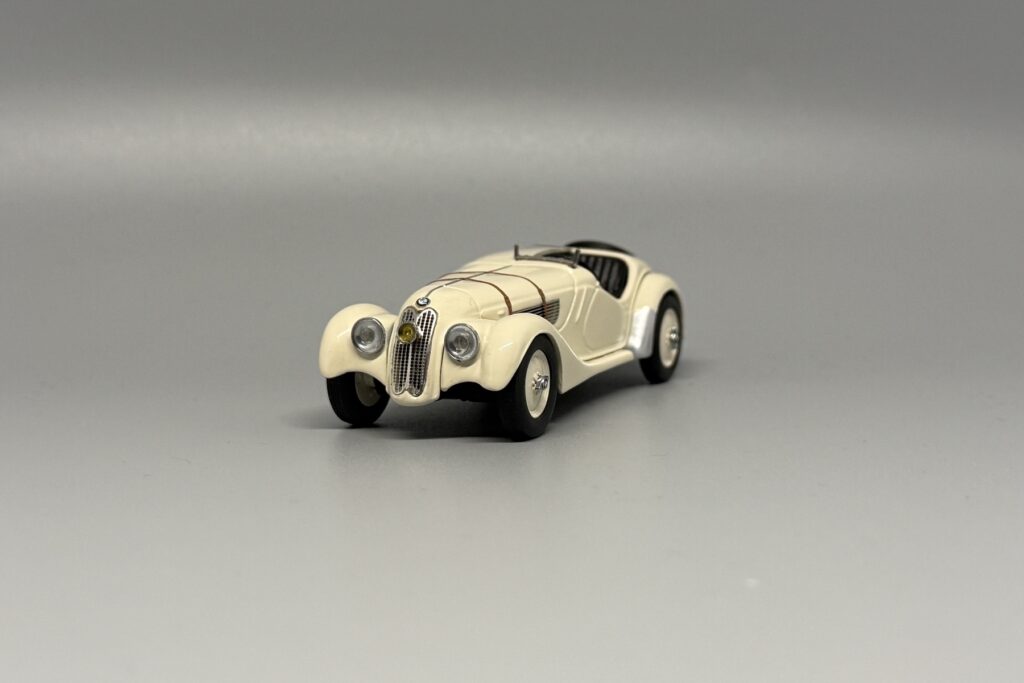
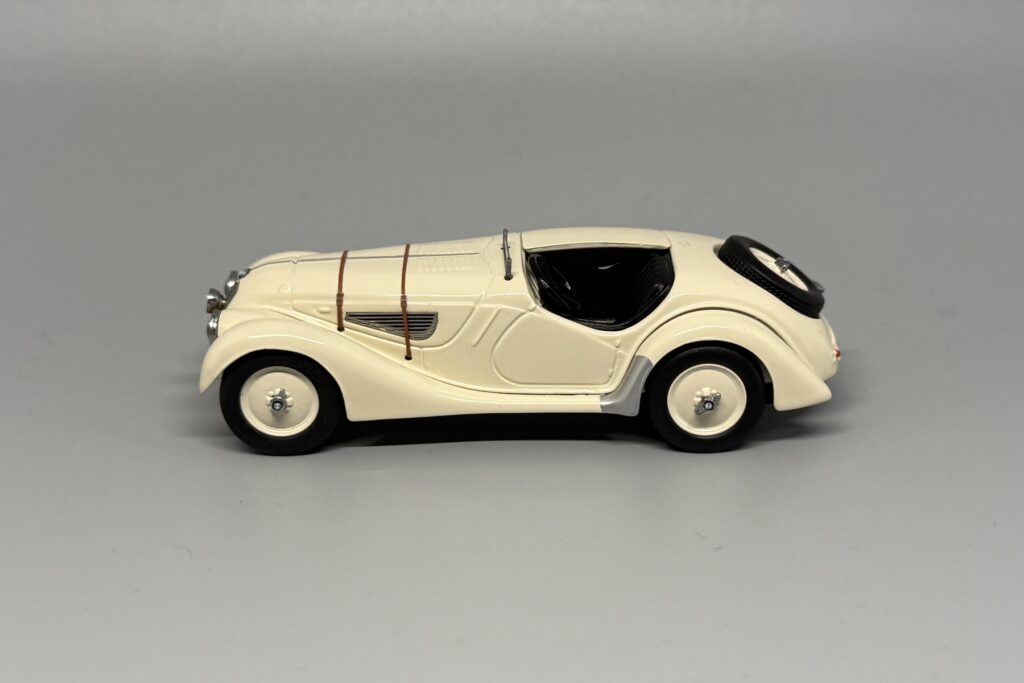
Early BMW 328 competition cars retained much of the flowing body shape of the standard Roadster, but their equipment was adapted to the demands of motor racing. The first three prototypes had no conventional doors or rear spare-wheel mountings and featured low, single-piece windscreens. Later production Roadsters, by contrast, were equipped with doors, two-piece folding windscreens and a rear-mounted spare wheel. Racing versions could be fitted with simplified interior equipment and other weight-saving modifications according to their intended use. Characteristic details included the low body, flowing wings, narrow BMW kidney grille, disc-style wheels and bonnet secured by two leather straps. Compared with many contemporary racing cars, the 328 was relatively small and visually understated, but its carefully designed bodywork and excellent handling proved to be major advantages on the circuit.
Racing victories from 1936 to 1938
The BMW 328’s first victory at the Nürburgring in 1936 marked the beginning of a remarkable sequence of racing successes. During the same year, the three prototypes competed successfully in several European events. Cars entered as Frazer-Nash-BMWs for the British market achieved a clean sweep of the leading positions in their class at the Tourist Trophy in Northern Ireland. When the first production cars were delivered in spring 1937, private competitors also began racing the model. Nine BMW 328s were already entered in the Eifelrennen that year. The model’s major international breakthrough came at the 1938 Mille Miglia, where a BMW 328 won the two-litre class and finished eighth overall. Three further BMW 328s finished tenth, eleventh and twelfth overall, demonstrating the model’s speed, reliability and ability to maintain a competitive pace over demanding long-distance road races.
Le Mans and aerodynamic racing cars
By the late 1930s, BMW engineers recognised that further increases in engine power alone would not be sufficient to overcome increasingly strong competition. Reducing aerodynamic drag became the next major development priority. Working with the Milanese coachbuilder Carrozzeria Touring, BMW created the lightweight 328 Touring Coupé with its distinctive Superleggera body construction for the 1939 racing season. Its streamlined aluminium body offered significantly lower aerodynamic resistance than the conventional Roadster. At the 1939 24 Hours of Le Mans, Max zu Schaumburg-Lippe and Hans Wencher drove the car to fifth place overall and victory in the two-litre sports-car class. Development of the 328 racing Roadsters continued alongside the coupé programme, with further improvements to engines, chassis and bodywork. The Touring Coupé was not the same vehicle as the early BMW 328 Rennversion, but a later development of the same successful racing family.
The 1940 Mille Miglia triumph
The development of the BMW 328 racing programme reached its peak at the Mille Miglia held on 28 April 1940. Unlike the traditional event, the race followed a 1,503-kilometre route around a circuit connecting Brescia, Cremona and Mantua. BMW entered five specially prepared 328 racing cars, comprising three streamlined Roadsters, the Touring Coupé and the Kamm-Coupé. Fritz Huschke von Hanstein and Walter Bäumer secured overall victory in the Touring Coupé, achieving an average speed of 166.7 km/h. The BMW 328 Roadsters finished third, fifth and sixth, helping the marque secure the team award as well. The Kamm-Coupé was forced to retire with mechanical problems. The victorious Touring Coupé and the Kamm-Coupé represented the most advanced stages of BMW 328 racing development, continuing the engineering tradition established by the original competition Roadster in 1936.
464 cars and numerous racing variants
Only 464 examples of the BMW 328 were produced between 1936 and 1940. According to BMW’s historical records, 403 received the standard Roadster body, while the remaining chassis were used for competition vehicles or specially commissioned coachbuilt versions. The term Rennversion did not refer to a single production model with one fixed specification or manufacturing total. Instead, it could describe different BMW 328 Roadsters prepared for competition during the late 1930s, with variations in engine output, body construction and technical equipment. Consequently, no single power figure, weight or production total can accurately represent every BMW 328 Rennversion. The small number of original racing cars and their remarkable competition history make surviving examples exceptionally significant today.
The legacy of the BMW 328 Rennversion
The BMW 328 Rennversion became one of the cars that established BMW’s lasting reputation for sporting performance and motorsport engineering. Its success demonstrated the importance of a balanced technical concept in which lightweight construction, structural rigidity, efficient aerodynamics and a reliable engine could prove more decisive than outright power alone. The victorious Roadster of 1936, the Mille Miglia class winner of 1938 and the streamlined racing cars of 1939–1940 formed one of the most remarkable development programmes in BMW’s early history. Although the Second World War brought this successful racing era to an end, the engineering principles and achievements of the BMW 328 remained an important influence on later generations of sports cars.
Model in the collection
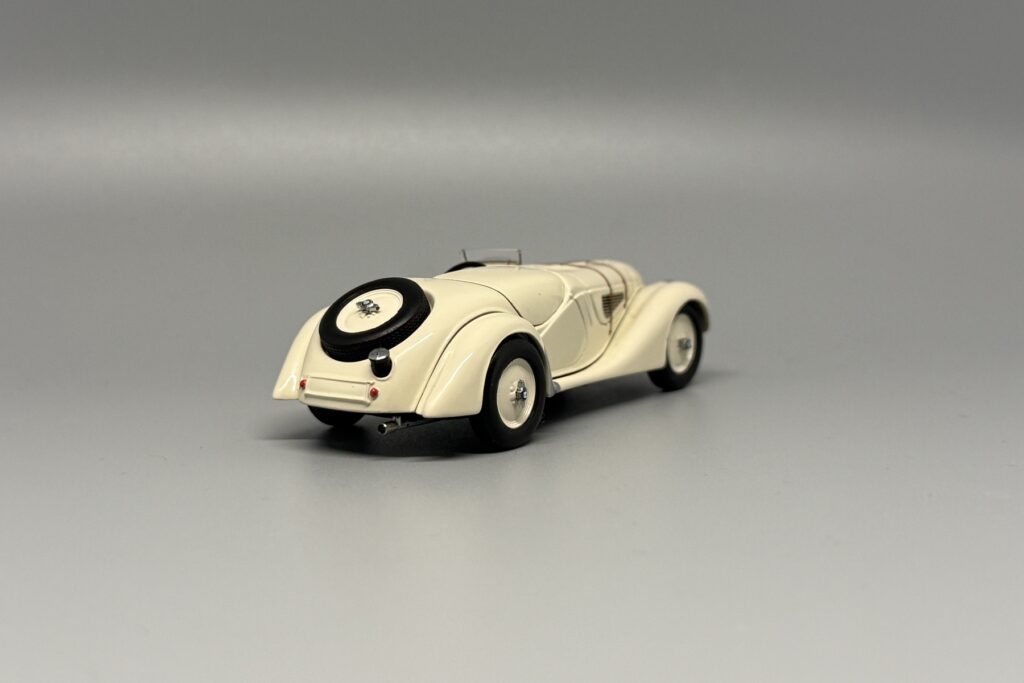
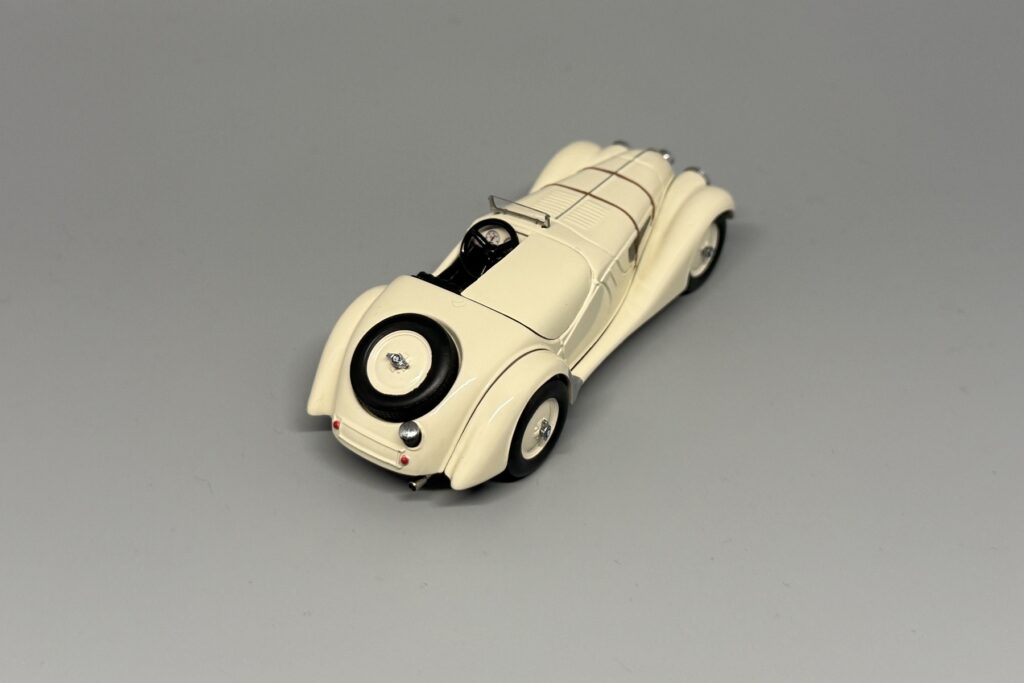
The BMW 328 Rennversion model in my collection was produced by Schuco. It represents a 1937 competition-prepared BMW 328 Roadster, featuring distinctive details such as the low windscreen, leather bonnet straps, streamlined open bodywork and disc-style wheels. The model was released as a limited edition of 1,500 pieces.
Technical data
BMW 328 production period: 1936–1940
Series production began: spring 1937
Racing debut: 14 June 1936, Nürburgring
Body style: two-seat open racing Roadster
Production location: BMW Eisenach plant, Germany
Engine: naturally aspirated six-cylinder in-line petrol engine
Displacement: 1,971 cc
Bore × stroke: 66 × 96 mm
Cylinder head: aluminium alloy with inclined valves
Standard engine output: 80 hp at 4,500 rpm
Competition engine output: varied according to preparation; 130–136 hp in specialised 1940 racing cars
Transmission: 4-speed manual
Drive: rear-wheel drive
Chassis: lightweight tubular-steel construction
Front suspension: independent suspension with transverse leaf spring
Rear suspension: rigid axle with longitudinal leaf springs
Brakes: hydraulic drum brakes
Weight: approximately 780 kg for the standard Roadster; varied according to competition specification
Top speed: approximately 155 km/h for the standard Roadster; 200–220 km/h for the 1940 racing cars
Total BMW 328 production: 464 cars, including 403 with standard Roadster bodies
Rennversion production total: no separate comprehensive production figure
Major achievements: Eifelrennen class victory in 1936, Mille Miglia two-litre class victory in 1938, and Le Mans class victory in 1939 and Mille Miglia overall victory in 1940 by later members of the BMW 328 racing family
Special feature: lightweight competition Roadster combining a tubular chassis, highly developed straight-six engine and exceptional handling, laying the foundations for BMW’s international pre-war motorsport success
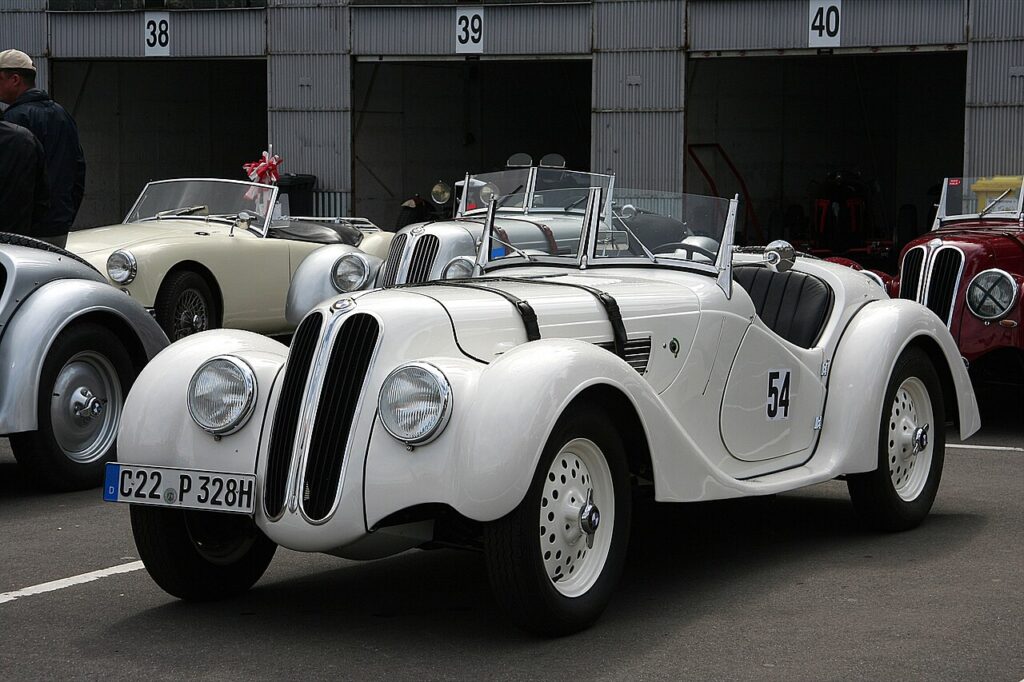
Photo of the real car. Photo: Lothar Spurzem / Wikimedia Commons, CC BY-SA 2.0 DE