
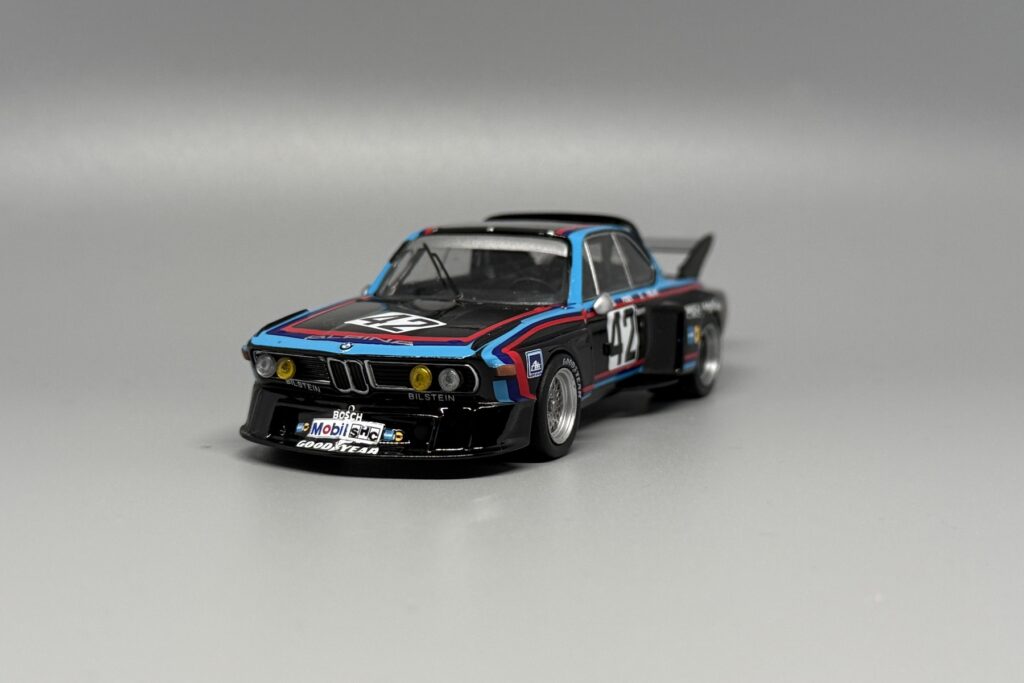
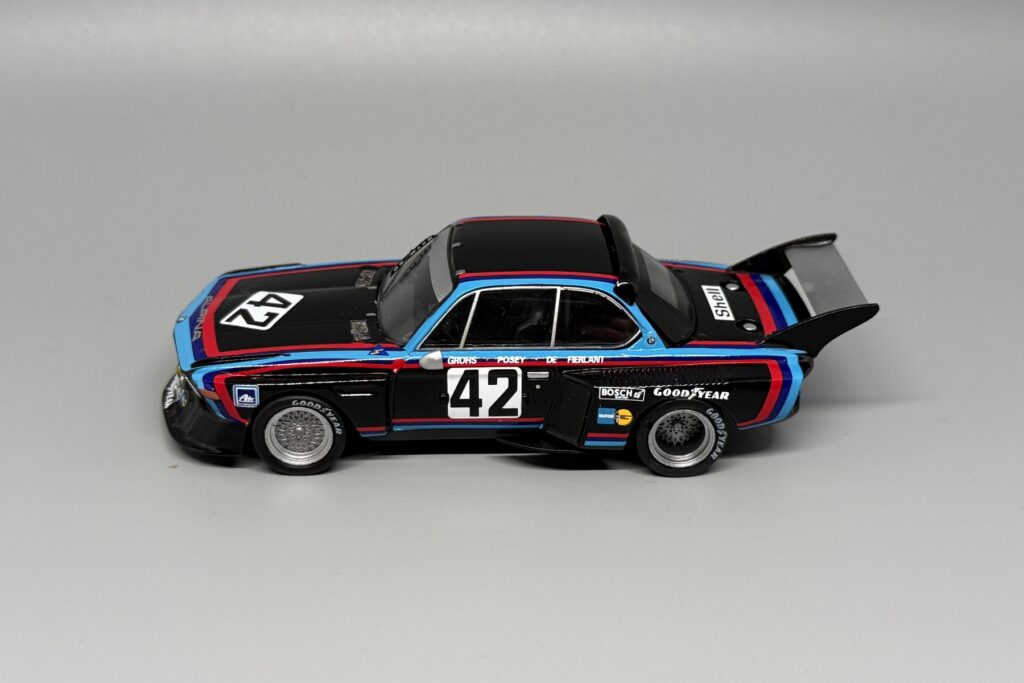
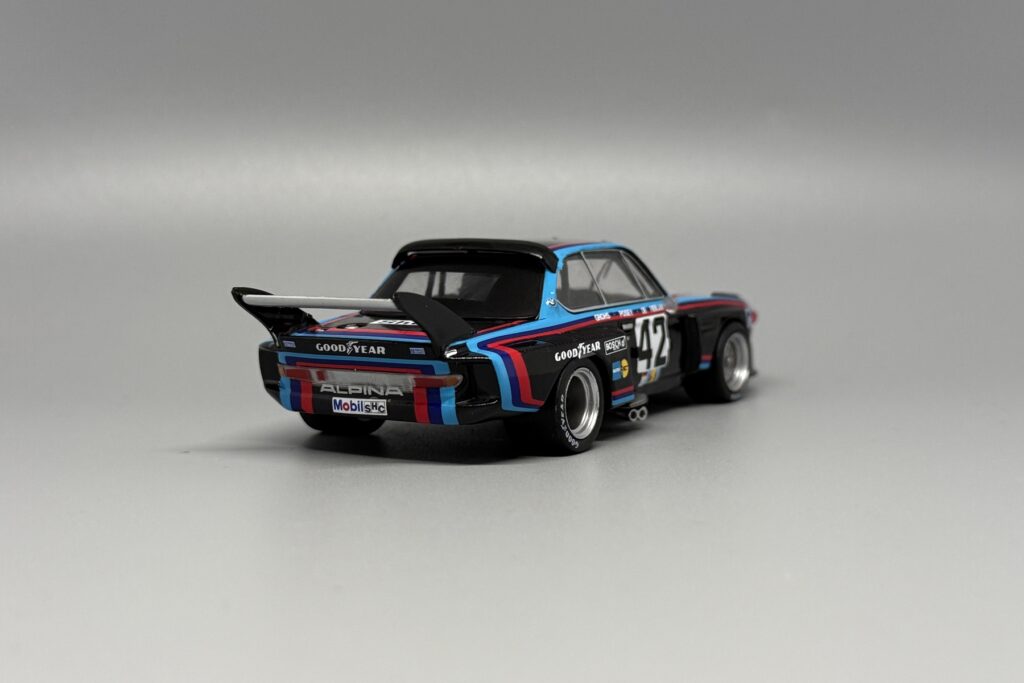
BMW 3.5 CSL Le Mans 1976 was one of BMW’s most dramatically styled racing cars of the 1970s, representing the development of the E9 coupé into a Group 5 silhouette racer. With its extremely wide wheel arches, deep front spoiler, enormous rear wing and powerful six-cylinder engine, the car differed substantially from the elegant BMW 3.0 CS production coupé on which its development was originally based. At the 1976 24 Hours of Le Mans, the Alpina-prepared BMW carried racing number 42 and was driven by Sam Posey, Harald Grohs and Hughes de Fierlant. The team completed the demanding endurance race in tenth place overall and fourth in Group 5. It was the only BMW 3.5 CSL in its class to reach the finish that year.
From the BMW 3.0 CSL to a racing machine
The history of the BMW 3.5 CSL began with the BMW E9 coupé, whose sporting derivatives became some of Europe’s most successful touring cars during the early 1970s. Introduced in 1972, the BMW 3.0 CSL was developed primarily for motorsport homologation, with the CSL designation identifying a lightweight sports coupé. Aluminium components, reduced weight and competition-oriented engineering made it an ideal starting point for the BMW Motorsport GmbH racing programme. Competition versions of the CSL quickly achieved success in the European Touring Car Championship, where their excellent handling and the development potential of BMW’s six-cylinder engines made them formidable opponents. Over the following years, engine capacities increased, chassis engineering became more sophisticated and aerodynamic features grew increasingly prominent. By 1976, the BMW 3.5 CSL had reached a stage of development where its construction and appearance were dictated almost entirely by racing requirements.
The new Group 5 regulations for 1976
New international Group 5 regulations introduced in 1976 created a category of highly modified racing cars commonly known as silhouette racers. These machines were required to retain the recognisable general outline of the production model but could incorporate extensive modifications to their bodywork, engines, suspension and aerodynamic equipment. For BMW, the regulations created an opportunity to develop an even faster competition car from the E9 coupé. Compared with earlier CSL racing versions, the body featured dramatically widened wheel arches, exceptionally broad racing tyres, a deep front spoiler and an enormous rear wing. Engine development also continued in an attempt to challenge the Porsche 935, which would become the dominant force in the new category. The revised regulations transformed the appearance of production-based racing cars, and the 1976 BMW 3.5 CSL became one of the most recognisable examples of this spectacular silhouette era.
Alpina and BMW Motorsport working together
The BMW 3.5 CSL racing programme involved both BMW Motorsport GmbH and independent BMW competition specialists, including Alpina and Schnitzer. Alpina, founded by Burkard Bovensiepen, had been developing high-performance BMW engines and chassis since the 1960s and had achieved considerable success in circuit racing. During the 1976 season, Alpina cooperated with the Essen-based BMW dealer Faltz in several major international endurance events. The BMW 3.5 CSL carrying number 42 at Le Mans was an Alpina-prepared car, while the official entry documentation listed BMW Motorsport GmbH as the entrant. In historical race records, the car is also identified as a BMW Alpina. This arrangement illustrates the organisation of BMW motorsport during the period, when factory support, independent preparation specialists and international racing teams worked closely together to develop competitive machinery.
The racing history of chassis 2275988
The BMW 3.5 CSL that competed at Le Mans with number 42 carried chassis number 2275988. It was not a car created for a single race but a competition machine with an extensive history. According to racing records, the same chassis had already appeared in the 1975 24 Hours of Daytona as a BMW 3.0 CSL driven by Sam Posey and Hans-Joachim Stuck. During 1976, it continued racing in the more extensively modified 3.5-litre Group 5 configuration. In March, Posey and Harald Grohs finished tenth in the six-hour race at Mugello. The following month, Posey, Grohs and Hughes de Fierlant achieved second place at the 6 Hours of Vallelunga, while Grohs and de Fierlant finished fourth at Silverstone in May. Shortly before Le Mans, the same car competed in the Nürburgring 1000 km race but was forced to retire following an accident. These results demonstrate that the Le Mans entry was part of an established racing programme rather than an isolated appearance.
The 3.5-litre M49/3 competition engine
The BMW 3.5 CSL was powered by the specially developed 3,498 cc M49/3 inline-six racing engine. Derived from BMW’s large six-cylinder engine family, the competition unit differed significantly from its road-going counterparts. It featured twin overhead camshafts and four valves per cylinder, improving breathing efficiency and allowing high power output at elevated engine speeds. Mechanical fuel injection provided the precise fuel delivery required for sustained racing performance. The M49/3 was naturally aspirated, unlike the turbocharged engines used in certain other BMW CSL racing projects of the period. A power output of approximately 440 hp has been published for the same Alpina 3.5 CSL in its 1976 Silverstone specification, although some general accounts of Group 5 CSL engines give higher figures. The precise engine output of car number 42 in its Le Mans configuration has not been independently confirmed. Power was transmitted to the rear wheels through a five-speed Getrag racing gearbox.
The most radical evolution of the Batmobile
The BMW 3.0 CSL had already earned the nickname Batmobile during the early 1970s because of its distinctive aerodynamic additions. The 1976 3.5 CSL took this appearance to an entirely new level. Enormous wheel-arch extensions covered the wide racing wheels, while the deep front spoiler helped control airflow beneath the vehicle. A high-mounted rear wing generated additional downforce over the rear axle, improving stability and traction at racing speeds. A louvred rear-window covering and side-exit exhaust pipes added to the car’s unmistakable competition appearance. These features were developed for aerodynamic performance rather than visual effect alone. Although the car retained the long bonnet and basic cabin profile of the original E9 coupé, its extensive modifications made it a fundamentally different machine. In this form, the BMW 3.5 CSL became one of the most dramatic and recognisable racing cars in BMW’s motorsport history.
The 1976 Le Mans and Porsche’s dominance
The 44th running of the 24 Hours of Le Mans took place on 12–13 June 1976, with 55 cars starting the race. The introduction of the revised Group 5 and Group 6 regulations created a diverse field of advanced racing machinery. Specially developed Group 6 sports prototypes competed for overall honours, while Group 5 featured heavily modified production-based cars. The principal contender in the latter category was the turbocharged Porsche 935, whose substantial engine power gave it a major advantage. BMW challenged the Porsche entries with the latest versions of the 3.5 CSL. Several CSLs prepared by different teams were entered, including Alpina and Schnitzer machines. BMW Motorsport also entered an unusual turbocharged CSL featuring bodywork designed by American artist Frank Stella. Part of the BMW Art Car programme, this car was technically distinct from the naturally aspirated Alpina BMW carrying number 42.
Car number 42 – three experienced drivers
The BMW Alpina carrying racing number 42 was shared by American driver Sam Posey, German driver Harald Grohs and Belgian driver Hughes de Fierlant. All three had extensive international motorsport experience, although their backgrounds differed. Posey had competed in American and European sports-car racing and had also made appearances in the Formula One World Championship. Grohs was closely associated with BMW competition cars and had established a strong reputation in touring-car and endurance racing. De Fierlant was an experienced Belgian driver who had participated in numerous international sports-car events. The trio had already competed together in the same BMW at Vallelunga in April, achieving second place in the six-hour race. This experience was valuable at Le Mans, where driver consistency and familiarity with the car were particularly important during the demanding 24-hour event.
Tenth place after 24 hours
BMW 3.5 CSL number 42 started the 1976 Le Mans race from 18th position, having recorded a qualifying lap of 4 minutes and 4.4 seconds. Throughout the event, the team needed to balance outright speed with mechanical preservation, as the highly developed Group 5 cars placed considerable demands on their engines and transmissions. Posey, Grohs and de Fierlant avoided the major mechanical problems that ended the races of several rivals and completed 299 laps, covering approximately 4,080 kilometres. They finished tenth overall and fourth in Group 5. The Group 5 victory went to the Porsche 935, with two additional Porsche entries finishing ahead of the BMW in the category. Although the result did not bring a podium position, completing the entire event was a significant achievement, particularly as the other BMW 3.5 CSL entries competing in the same category failed to finish.
The endurance challenge at Le Mans
The 1976 race demonstrated the difficulties of transforming an extremely powerful silhouette racer into a reliable 24-hour endurance machine. Several other BMW 3.5 CSL entries encountered serious mechanical problems. The Schnitzer-prepared car number 43, driven by Dieter Quester, Albrecht Krebs and Alain Peltier, retired following an engine failure and subsequent fire. The separately developed turbocharged BMW Art Car number 41 was also forced to withdraw. By contrast, the Alpina-prepared BMW number 42 proved sufficiently durable to complete the demanding race distance. Its performance underlined one of the essential principles of endurance racing: outright speed means little if a car cannot remain mechanically reliable until the finish. Posey, Grohs and de Fierlant’s tenth-place result demonstrated that BMW could still achieve a respectable performance in the face of intense competition from Porsche.
The car’s subsequent racing career
Chassis 2275988 continued racing after the 1976 Le Mans. Just two weeks later, it competed in the six-hour race at Zeltweg in Austria, driven by Harald Grohs, Hughes de Fierlant and Swedish Formula One driver Ronnie Peterson. The BMW qualified third but retired with clutch failure. In September, the same car appeared in the six-hour race at Dijon, where Gunnar Nilsson, Harald Grohs and Alain Peltier finished ninth. Racing records also document further appearances of the chassis in the United States during 1977, with drivers including George Follmer and Milt Minter. This extensive history illustrates the long competitive life of the BMW that carried number 42 at Le Mans. It was a racing machine developed and used over several seasons, adapting to changing regulations and the requirements of different international circuits.
The legacy of the BMW 3.5 CSL
The BMW 3.5 CSL represented one of the final and most radical stages in the evolution of the E9 competition coupé. Having achieved major success in European touring-car racing during the early 1970s, the CSL had developed by 1976 into an extremely powerful and aerodynamically sophisticated silhouette racer. Although Porsche’s 935 dominated the new Group 5 category, the BMW 3.5 CSL remained competitive in international endurance racing. The programme also helped BMW Motorsport GmbH develop the engineering knowledge and racing experience that would influence later competition models. The Alpina-prepared number 42 car brings together three defining aspects of this era: cooperation between BMW and specialist racing teams, the development of highly sophisticated six-cylinder engines and the ability to complete one of the world’s most demanding endurance races. For these reasons, the 1976 Le Mans BMW 3.5 CSL remains an important part of BMW’s motorsport heritage.
Model in the collection
The BMW 3.5 CSL Le Mans 1976 model in my collection was produced by Spark. It represents the Alpina-prepared BMW carrying racing number 42 in the 1976 24 Hours of Le Mans, driven by Sam Posey, Harald Grohs and Hughes de Fierlant. The car finished tenth overall and fourth in Group 5. The model reproduces the exceptionally wide wheel arches, deep front spoiler, large rear wing and historic racing livery characteristic of the 1976 silhouette racing specification.
Technical data
Racing specification: 1976
Base vehicle: BMW 3.0 CSL (E9)
Body style: two-door enclosed racing coupé
Racing category: FIA Group 5 (silhouette racing cars)
Vehicle origin: BMW, Germany
Competition preparation: BMW Motorsport GmbH in cooperation with Alpina
Chassis number: 2275988
Engine: BMW M49/3 naturally aspirated inline-six
Displacement: 3,498 cc
Valve gear: twin overhead camshafts, four valves per cylinder
Fuel delivery: mechanical fuel injection
Power output: approximately 440 hp reported for the same car at Silverstone in 1976; exact Le Mans specification unconfirmed
Engine position: longitudinal front engine
Transmission: 5-speed Getrag manual racing gearbox
Drive: rear-wheel drive
Bodywork: extensively modified E9 coupé racing body
Aerodynamics: extended wheel arches, deep front spoiler and large rear wing
Tyres: Goodyear racing tyres
Race: 24 Hours of Le Mans, 12–13 June 1976
Team: BMW Alpina; officially entered by BMW Motorsport GmbH
Racing number: 42
Drivers: Sam Posey, Harald Grohs and Hughes de Fierlant
Starting position: 18th
Best qualifying lap: 4 min 04.4 sec
Laps completed: 299
Distance covered: approximately 4,080 km
Result: 10th overall, 4th in Group 5
Production total: limited number of specialised 3.5 CSL racing cars; exact total unconfirmed
Special feature: Alpina-prepared BMW 3.5 CSL that was the only Group 5 BMW 3.5 CSL to finish the 1976 24 Hours of Le Mans