
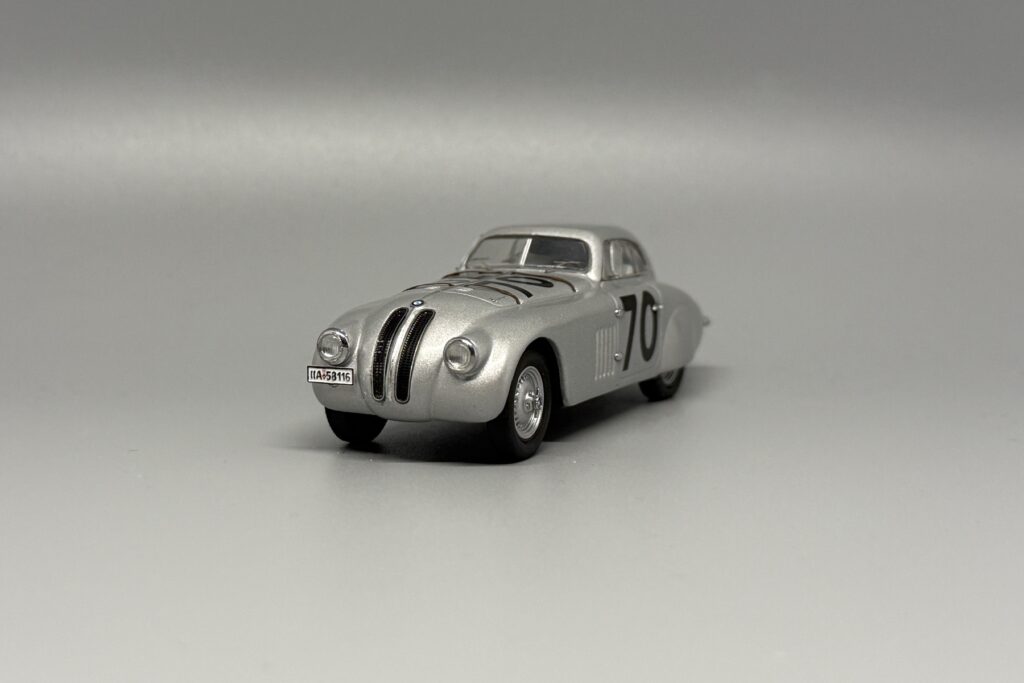
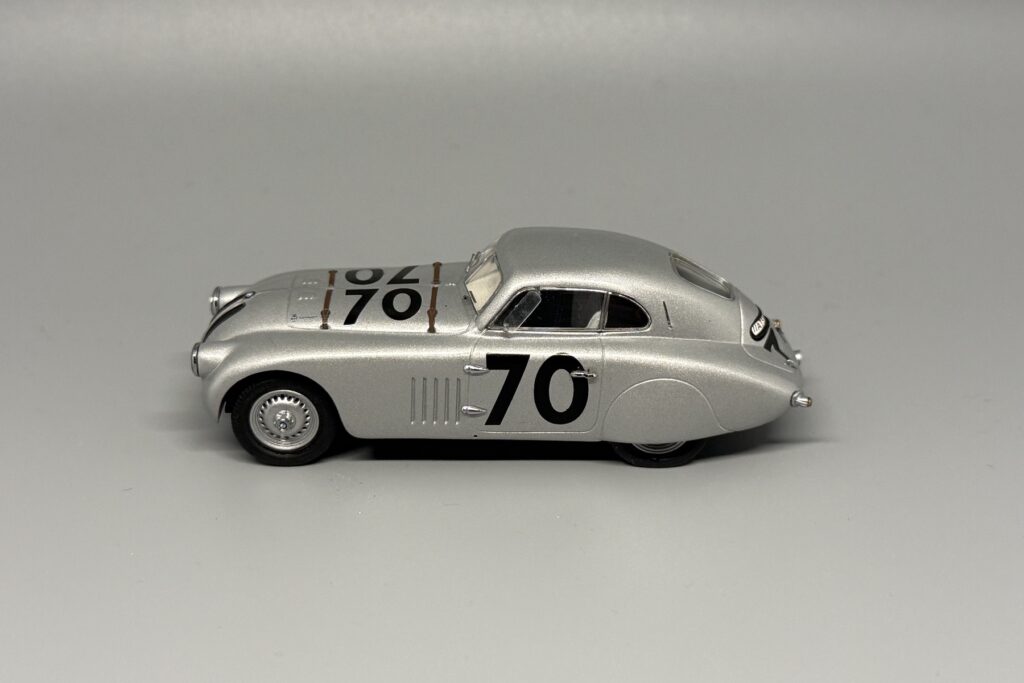
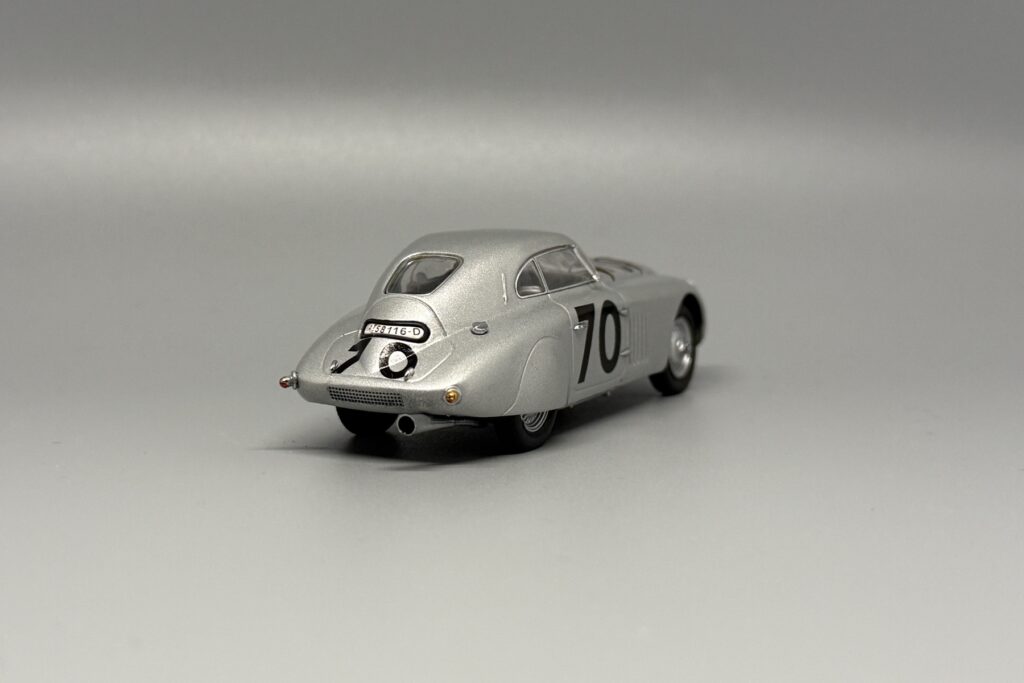
BMW 328 Coupé Mille Miglia is one of the most famous cars in BMW’s motorsport history and represents the most remarkable achievement of the entire BMW 328 development programme. Completed in 1939, the streamlined racing coupé combined the lightweight engineering of the BMW 328, a powerful six-cylinder engine and an aerodynamic Superleggera body built by Carrozzeria Touring in Milan. On its first competitive appearance at the 1939 24 Hours of Le Mans, the car won the two-litre sports-car class. One year later, the same coupé, driven by Fritz Huschke von Hanstein and Walter Bäumer, achieved overall victory in the 1940 Mille Miglia. Carrying racing number 70, the BMW recorded an average speed of 166.7 km/h, setting a record that was never surpassed in the history of the event. This unique racing car became one of the most celebrated symbols of BMW’s pre-war motorsport heritage.
The pinnacle of BMW 328 racing development
The racing history of the BMW 328 began in June 1936 at the Nürburgring, where Ernst Jakob Henne immediately secured a class victory in the Eifelrennen with the new two-seat sports car. Featuring a lightweight tubular chassis, well-balanced suspension and an 80 hp six-cylinder engine, the 328 proved exceptionally successful on racing circuits and in demanding long-distance road events. In 1938, a BMW 328 won the two-litre class at the Mille Miglia and finished eighth overall. This success encouraged BMW’s racing department to develop an even faster car capable of competing against larger-engined Alfa Romeos and other European racing machines. As there were limits to the power that could be extracted from the existing engine, particular attention was directed towards reducing aerodynamic drag. This led to the development of streamlined BMW 328 competition cars, of which the Touring Coupé became one of the most important achievements.
Carrozzeria Touring and the Superleggera body
BMW commissioned the renowned Milanese coachbuilder Carrozzeria Touring to create the body for its new racing coupé. Touring specialised in lightweight and aerodynamically efficient coachwork. The car was completed in 1939 on BMW 328 chassis number 85368, while its body carried Touring’s construction number 2312. The famous Superleggera method used a supporting framework of thin steel tubes covered with lightweight aluminium panels. This construction allowed complex streamlined body shapes to be created while keeping weight to a minimum. The low front end, integrated headlights, long flowing side panels and enclosed rear wheels significantly reduced aerodynamic resistance compared with the open BMW 328 Roadster. Although the finished car was exceptionally elegant, its shape was determined primarily by aerodynamic requirements. Only one Touring Coupé of this particular design was built, making it distinct from the later BMW 328 Mille Miglia Roadsters and BMW’s separately developed Kamm Coupé.
The 136 hp competition engine
The BMW 328 Touring Coupé was powered by a naturally aspirated 1,971 cc inline-six engine based on the unit used in the standard BMW 328. The production engine’s original output of 80 hp was substantially increased through racing development, with particular attention paid to cylinder-head breathing, compression and mechanical reliability. Its aluminium-alloy cylinder head featured inclined valves operated by a block-mounted camshaft through pushrods and a special arrangement of rocker and reversing levers. According to BMW Classic, the engine produced 100 kW or 136 hp at 6,000 rpm in its 1940 racing specification. This represented an increase of almost 70 percent over the standard BMW 328 while retaining the same displacement and naturally aspirated configuration. Power was delivered to the rear wheels through a four-speed manual gearbox. The combination of relatively high specific output, low vehicle weight and efficient aerodynamics gave the compact engine exceptional performance capabilities.
780 kilograms and 220 km/h
Despite its enclosed body and the equipment required for endurance racing, the BMW 328 Touring Coupé weighed just 780 kg in running condition. The lightweight Superleggera construction and aerodynamic bodywork enabled it to reach a top speed of 220 km/h, an extraordinary achievement for a naturally aspirated two-litre sports car in the late 1930s. The BMW 328 chassis featured a lightweight tubular frame, independent front suspension and a rigid rear axle. The racing coupé was equipped with Alfin drum brakes featuring ventilated magnesium-alloy backing plates to improve heat dissipation. This was particularly important during endurance events, where repeated braking from high speeds placed considerable demands on the braking system. The Touring Coupé’s performance therefore resulted from the efficiency of the entire vehicle rather than engine output alone.
Victory at Le Mans in 1939
The BMW 328 Touring Coupé made its racing debut at the 24 Hours of Le Mans on 17–18 June 1939. Driven by Prince Max zu Schaumburg-Lippe and Hans Wencher, it faced competitors equipped with considerably larger and more powerful engines. The new streamlined BMW demonstrated both speed and mechanical reliability, finishing fifth overall and winning the two-litre sports-car class with a new class record. The result confirmed that the combination of efficient aerodynamics and balanced engineering allowed a relatively small-capacity car to compete successfully against much more powerful machinery. The victory at Le Mans represented an important international breakthrough for BMW and provided valuable confidence for the company’s ambition to challenge for outright victory at the following year’s Mille Miglia.
The unusual 1940 Mille Miglia
The race held on 28 April 1940 was officially known as the I Gran Premio Brescia delle Mille Miglia. With the Second World War already underway in Europe, the traditional Brescia–Rome–Brescia road route was not used. Instead, competitors completed nine laps of an approximately 167-kilometre circuit connecting Brescia, Cremona and Mantua, covering a reported total distance of 1,503 kilometres. The relatively flat course, with numerous long straights, allowed unusually high average speeds and increased the importance of aerodynamic efficiency. BMW prepared five specially developed BMW 328 competition cars for the event: the Touring Coupé, Kamm Coupé and three streamlined Roadsters. One of the Roadsters was the Munich-built Bügelfalte, while the bodies of the other two were completed by Carrozzeria Touring in Milan. BMW’s objective was no longer simply another class victory but its first outright Mille Miglia triumph.
Car number 70 – von Hanstein and Bäumer
The BMW 328 Touring Coupé carried racing number 70 in the 1940 Mille Miglia. Its drivers were Fritz Huschke von Hanstein and Walter Bäumer, both experienced BMW competitors. Von Hanstein had become German Sports Car Hillclimb Champion in 1938 driving a BMW 328, while his aggressive driving style earned him the nickname Rennbaron, or Racing Baron. BMW racing director Ernst Loof developed a strategy in which the two coupés were expected to challenge for overall victory, while the Roadsters focused on finishing reliably. The race began at 6:40 in the morning, and von Hanstein immediately established the Touring Coupé at the front of the two-litre category. The car maintained an exceptional pace throughout the event, outperforming Italian rivals with substantially larger engines. The Kamm Coupé initially remained close to the leaders but was eventually forced to retire with mechanical problems.
A historic overall victory
After 8 hours, 54 minutes and 46 seconds, the BMW 328 Touring Coupé carrying number 70 crossed the finish line in first place. Fritz Huschke von Hanstein and Walter Bäumer secured both overall victory and first place in the two-litre class with an average speed of 166.723 km/h. The fastest lap of the race was completed at an average of 174.102 km/h. BMW’s victory was emphatic: the second-placed Alfa Romeo 6C 2500 SS, driven by Nino Farina and Paride Mambelli, finished more than fifteen minutes behind. BMW’s streamlined Roadsters completed the event in third, fifth and sixth places, also securing the team classification for the marque. The winning car’s average speed established a Mille Miglia record that was never exceeded by subsequent winners. However, the unusual circuit used in 1940 differed considerably from the traditional Mille Miglia road route, an important distinction when comparing performances across different editions of the event.
A last-minute change of drivers
One of the most memorable stories associated with the 1940 Mille Miglia victory concerns the change of drivers shortly before the finish. Fritz Huschke von Hanstein was so determined to secure victory that he repeatedly postponed the planned handover to his co-driver Walter Bäumer. Eventually, BMW’s team management intervened to ensure that Bäumer would also have an opportunity to drive the winning car. Shortly before reaching the finish, von Hanstein stopped the Touring Coupé at the roadside and handed the steering wheel to Bäumer, who then drove the BMW across the finish line. Their substantial lead over the nearest competitor allowed this unusual manoeuvre without endangering the result. Both drivers were officially credited with the victory, and the episode became one of the best-known stories in BMW’s early motorsport history.
The winning car’s post-war history
Following the victory in 1940, BMW attempted to protect its valuable racing cars from wartime destruction by moving them away from Munich to safer storage locations. The Touring Coupé survived the war but eventually found its way to the United States during the upheaval of the post-war period. Over the following decades, it passed through several owners, and its historical significance was not always fully appreciated. During the 1980s, American classic-car collector Jim Proffit discovered the rare coupé and began an extensive restoration. Much of the original engineering and racing history was preserved, and the restored car subsequently appeared at historic motoring events, concours exhibitions and classic-car competitions. In October 2002, BMW Group Mobile Tradition acquired the car from Proffit and returned it to Munich. One of BMW’s most important competition cars had finally come back into the manufacturer’s historical collection after more than half a century abroad.
New victories in the historic Mille Miglia
The historical importance of the BMW 328 Touring Coupé was reinforced in the 21st century when the original winning car returned to the event bearing the Mille Miglia name. Unlike the original race, the modern Mille Miglia Storica is a regularity competition for historic vehicles, where success depends on precise timing rather than maximum speed. In 2004, Giuliano Cané and his wife and co-driver Lucia Galliani drove the same BMW 328 Touring Coupé to victory in the historic event. It became the first car to win both the original Mille Miglia and its modern historical revival. In 2010, exactly 70 years after the victory of von Hanstein and Bäumer, Cané and Galliani repeated their success. This exceptional continuity further strengthened the Touring Coupé’s reputation as one of the most valuable and historically significant racing cars in BMW’s heritage collection.
The legacy of a unique Touring Coupé
Only one BMW 328 Touring Coupé of this design was built, and the original car survives today. Although Carrozzeria Touring also constructed two streamlined Roadster bodies for the BMW 328 racing programme, these differed significantly from the closed Touring Coupé in both design and purpose. BMW simultaneously developed the separate Kamm Coupé, featuring a different aerodynamic approach, but outright victory in the 1940 Mille Miglia belonged to the Touring Coupé. The car represented an extraordinary combination of engineering progress and motorsport experience, demonstrating that relatively small engine displacement did not necessarily mean limited performance. Lightweight construction, a 136 hp straight-six engine and carefully developed aerodynamics allowed it to defeat considerably more powerful competitors. Today, the BMW 328 Coupé Mille Miglia remains one of the most iconic pre-war European racing cars and an enduring symbol of BMW’s sporting heritage.
Model in the collection
The BMW 328 Coupé Mille Miglia model in my collection was produced by Schuco. It represents the overall winner of the 1940 Mille Miglia, carrying racing number 70, driven by Fritz Huschke von Hanstein and Walter Bäumer. The model reproduces the streamlined Touring Superleggera bodywork, enclosed rear wheels and characteristic details of the historic racing car. It was released as a limited edition of 1,000 pieces.
Technical data
Year of construction: 1939
Competition period: 1939–1940
Body style: two-seat enclosed racing coupé
Base vehicle: BMW 328
Chassis origin: BMW, Germany
Coachbuilder: Carrozzeria Touring, Milan, Italy
Chassis number: 85368
Touring body number: 2312
Body construction: Touring Superleggera, tubular-steel framework with aluminium panels
Engine: naturally aspirated inline-six petrol engine
Displacement: 1,971 cc
Bore × stroke: 66 × 96 mm
Power output in 1940 racing specification: 100 kW / 136 hp at 6,000 rpm
Transmission: 4-speed manual
Drive: rear-wheel drive
Chassis: lightweight tubular-steel construction
Front suspension: independent suspension with transverse leaf spring
Rear suspension: rigid axle with longitudinal leaf springs
Brakes: hydraulic Alfin drum brakes with ventilated backing plates
Weight: 780 kg in running condition
Top speed: 220 km/h
Length: 3,900 mm
Width: 1,520 mm
Height: 1,320 mm
Le Mans 1939: 5th overall, 1st in the two-litre sports-car class
Le Mans drivers: Prince Max zu Schaumburg-Lippe and Hans Wencher
Mille Miglia 1940: overall victory and two-litre class victory
Mille Miglia racing number: 70
Mille Miglia drivers: Fritz Huschke von Hanstein and Walter Bäumer
Mille Miglia winning time: 8 h 54 min 46 s
Mille Miglia average speed: 166.723 km/h
Mille Miglia fastest lap average: 174.102 km/h
Production total: 1 car
Special feature: unique BMW 328 racing coupé with Touring Superleggera bodywork, built in 1939, winner of the two-litre class at Le Mans in 1939 and outright winner of the 1940 Mille Miglia carrying racing number 70
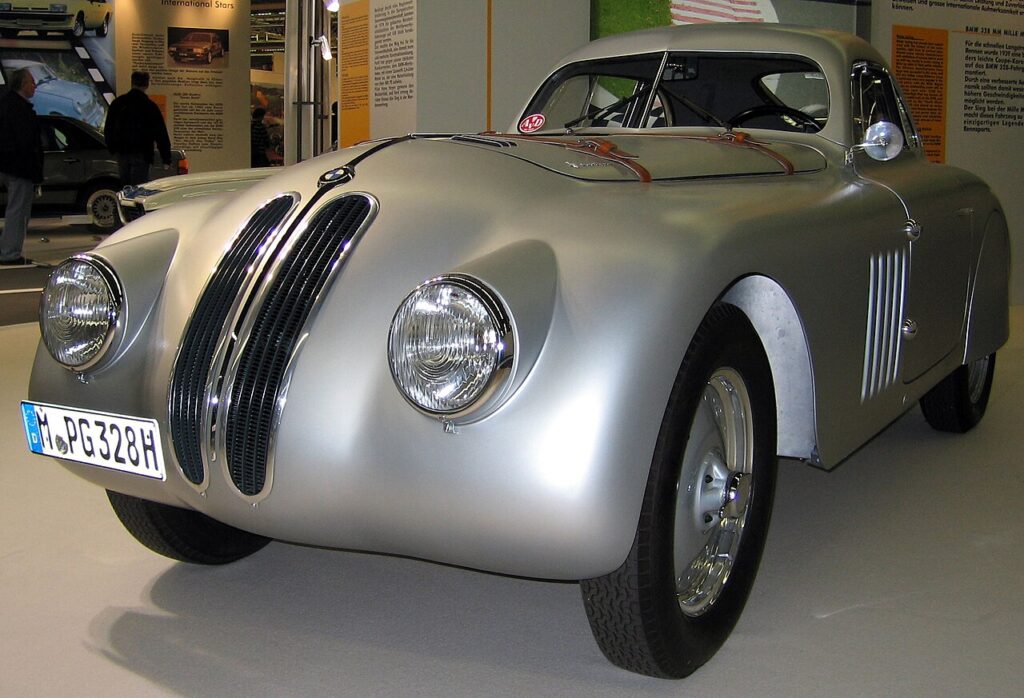
Photo of the real car. Photo: LSDSL / Wikimedia Commons, CC BY-SA 2.0 DE