
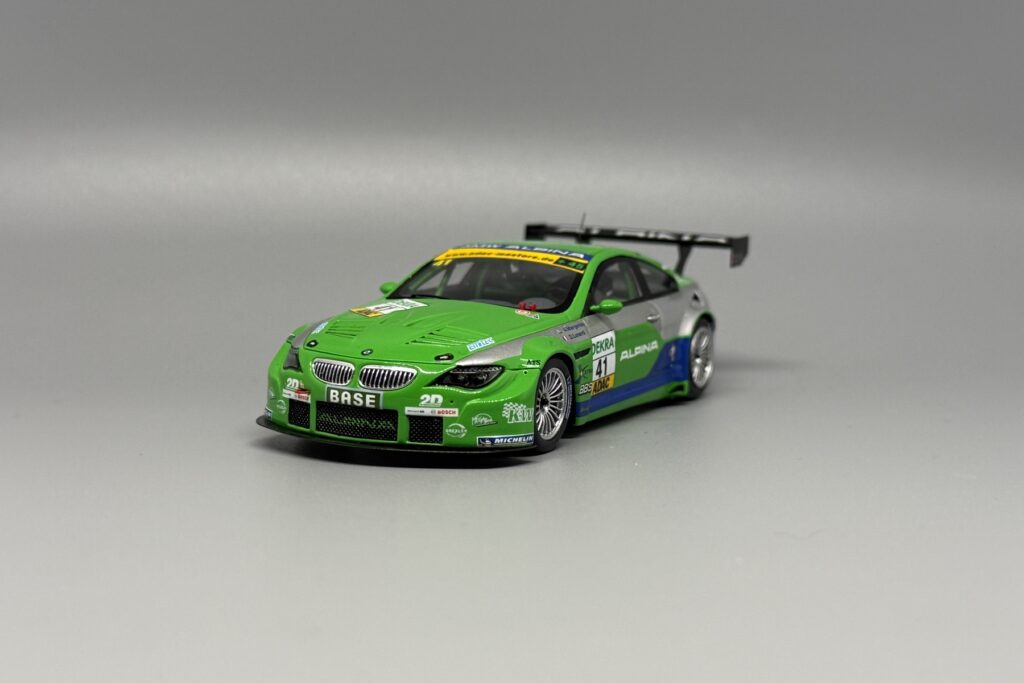
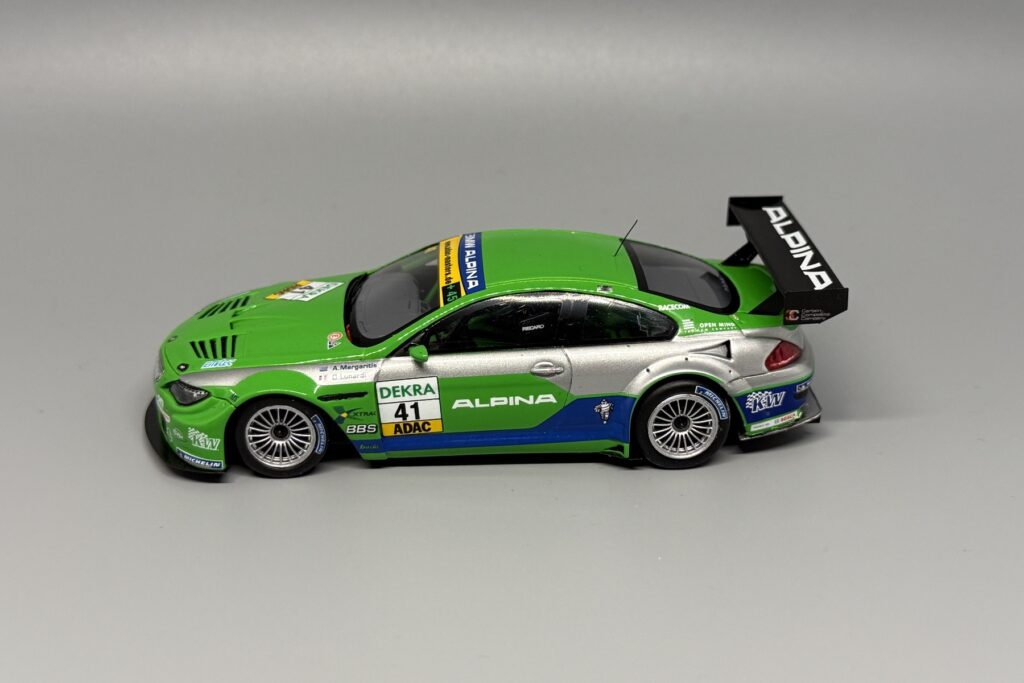
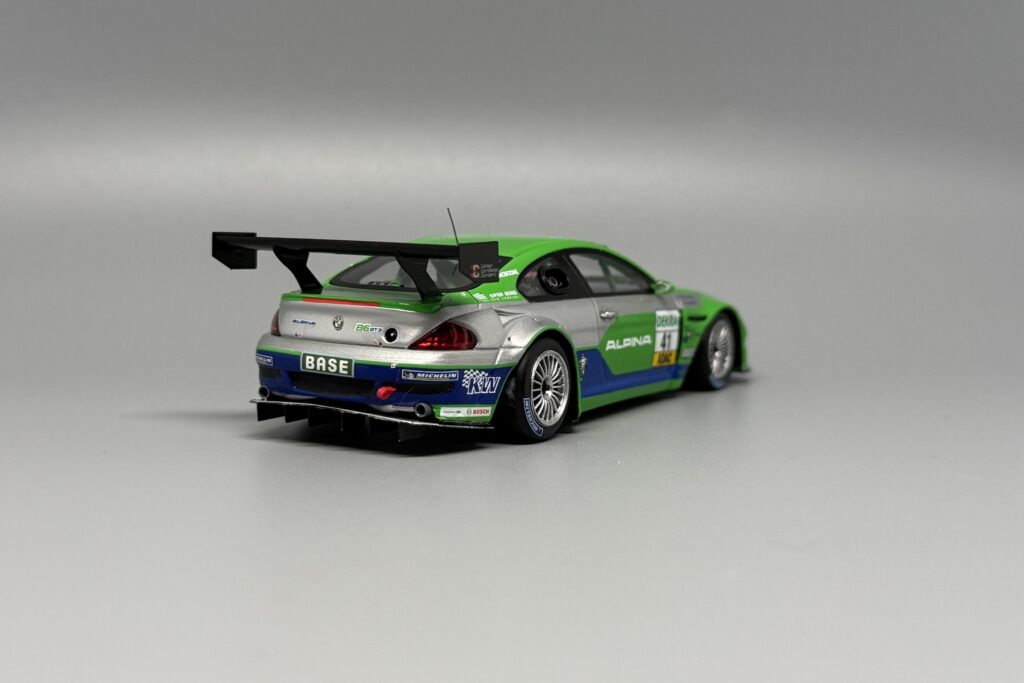
BMW Alpina B6 GT3 (E63) was an extensively developed GT3 racing car introduced for the 2011 season, when Alpina achieved one of the most important victories in its modern motorsport history. Based on the E63-generation BMW 6 Series coupé, the car combined a powerful naturally aspirated V8 engine with specialised racing suspension and sophisticated aerodynamics. During the third season of Alpina’s renewed motorsport programme, the B6 GT3 reached its competitive peak when Dino Lunardi and Alexandros Margaritis won the 2011 ADAC GT Masters drivers’ championship. Their BMW, carrying racing number 41 and prepared by LIQUI MOLY Team Engstler, achieved four race victories during the season. The success demonstrated that a relatively small specialist manufacturer could develop a racing car capable of defeating established international competitors in the highly competitive GT3 category.
Alpina’s long motorsport tradition
Alpina’s history has been closely associated with BMW competition cars since the 1960s. Founded by Burkard Bovensiepen, the company initially specialised in improving BMW engines and soon became one of the marque’s most important independent racing specialists. During the 1970s, Alpina achieved considerable success in the European Touring Car Championship, with famous drivers including Niki Lauda, Hans-Joachim Stuck and James Hunt competing in its cars. Over time, the company based in Buchloe increasingly concentrated on producing exclusive high-performance road cars combining sporting characteristics with exceptional comfort. After an absence of approximately twenty years from active motorsport, Alpina decided to return to racing in 2009. The new programme was based on the large BMW 6 Series coupé, which was developed into a competition car meeting FIA GT3 regulations. The resulting B6 GT3 continued Alpina’s tradition of combining BMW engineering, independent technical development and international racing experience.
From the BMW 6 Series to a GT3 racing car
The BMW Alpina B6 GT3 was based on the second-generation BMW 6 Series coupé, designated E63. The production model was known for its long bonnet, low roofline and elegant sporting appearance. The road-going Alpina B6 featured a supercharged 4.4-litre V8 engine, combining substantial performance with the refinement expected of an exclusive grand touring car. For the GT3 programme, the basic vehicle concept was retained but extensively modified for professional circuit racing. The competition car received a reinforced body, roll cage, specialised suspension and brakes, and significantly more aggressive aerodynamic bodywork. Widened wheel arches, a deep front spoiler and a large rear wing gave it a dramatic appearance. Alpina’s engineers aimed to exploit the aerodynamic potential of the large coupé and its powerful engine to create a competitive machine suitable for both shorter GT3 races and demanding endurance events.
The 2009 comeback and early victories
The BMW Alpina B6 GT3 made its competition debut in 2009, marking the manufacturer’s return to international motorsport after a lengthy absence. The car appeared in the ADAC GT Masters and other European GT championships. Its original specification featured a supercharged 4.4-litre V8 producing approximately 530 hp. Although the B6 GT3 demonstrated impressive speed, the relatively heavy engine and its substantial torque contributed to excessive tyre wear and made handling difficult under certain conditions. Nevertheless, the car achieved five ADAC GT Masters race victories across the 2009 and 2010 seasons, together with a victory in the French GT Championship. These results confirmed its competitive potential, but Alpina’s engineers recognised that further improvements were necessary to challenge consistently for a championship. Better weight distribution, reduced fuel consumption and improved chassis balance therefore became the main objectives of the extensive development programme undertaken for 2011.
The extensively revised B6 GT3 Evo
The BMW Alpina B6 GT3 Evo was introduced for the 2011 season, incorporating the experience gained during the previous two years of competition. Its most significant change was the replacement of the original supercharged 4.4-litre engine with a new naturally aspirated five-litre V8. Eliminating the supercharger and intercooler reduced the weight acting on the front axle by approximately 70 kilograms and improved fuel consumption by around 15 percent. The new power unit was mechanically simpler and better suited to the reliability demands of endurance racing. Alpina also revised the gearbox ratios and gearshift management, modified the suspension settings and adopted larger-diameter front tyres. An optimised rear-wing profile maintained the required downforce while reducing aerodynamic drag. Together, these improvements made the B6 GT3 Evo better balanced, more consistent and easier to drive quickly over an entire race distance.
The 530 hp naturally aspirated V8
The BMW Alpina B6 GT3 Evo was powered by a 4,941 cc naturally aspirated 90-degree V8 engine producing 530 hp and a maximum torque of 530 Nm. The engine was derived from proven BMW racing technology used in the American Grand-Am series, where a related power unit had helped Chip Ganassi Racing achieve a one-two finish at the 2011 24 Hours of Daytona. Alpina further developed the engine specifically for GT3 competition, incorporating Bosch MS4 Sport engine management, dry-sump lubrication and a competition exhaust system. Compared with the earlier supercharged engine, the naturally aspirated V8 offered more progressive power delivery and reduced mechanical complexity. Although maximum power remained at the same level, the lighter engine and improved weight distribution helped reduce tyre wear and increase the car’s cornering performance. This engine development became one of the most important technical reasons behind the success of the 2011 championship-winning car.
Competition chassis and aerodynamics
The BMW Alpina B6 GT3 Evo was developed to meet FIA GT3 regulations, with a chassis extensively modified from its road-going origins. It used a six-speed XTrac sequential racing gearbox with steering-wheel-mounted paddle shifters operated through a Megaline system. Power was transmitted to the rear wheels, preserving the traditional BMW and Alpina drivetrain layout. The 2011 Evo weighed 1,230 kg, with more than half of its weight distributed over the rear axle according to Alpina’s technical documentation. The improved weight distribution enabled revised spring and damper settings, reducing understeer in slower corners. Larger Michelin front tyres measuring 30/68-18 replaced the previous specification, while the rear tyres remained at 31/71-18. Aerodynamic development focused particularly on the rear wing, whose revised profile provided comparable downforce with less drag. These improvements made the large coupé more agile and efficient, particularly during longer races where tyre performance was essential.
LIQUI MOLY Team Engstler
In 2011, Alpina did not operate its own factory racing team in the ADAC GT Masters, instead concentrating on supporting professional customer teams. Its principal partner was LIQUI MOLY Team Engstler, managed by experienced racing driver and team owner Franz Engstler. The team was based in Wiggensbach, relatively close to Alpina’s headquarters in Buchloe, making technical cooperation between engineers and mechanics particularly convenient. Engstler entered two B6 GT3 Evo racing cars during the season. The number 41 car was shared by Alexandros Margaritis and Dino Lunardi, while number 40 was driven by several competitors, including Florian Spengler and Alexander Plenagl. Alpina provided technical support and continued developing the cars using feedback from the races. The partnership demonstrated how a specialist manufacturer could compete successfully against larger racing organisations by combining a highly developed customer racing car with an experienced and professional team.
Alexandros Margaritis and Dino Lunardi
The championship-winning BMW carrying number 41 was shared by two drivers with very different racing backgrounds. Alexandros Margaritis, born in Germany and competing under the Greek flag, had previously raced in international single-seater categories and the DTM with Mercedes-Benz. His strengths included qualifying speed and assertive racecraft. Dino Lunardi was a French driver with extensive experience in GT and endurance racing. He had achieved success in Peugeot one-make championships before competing with several established international GT teams. Although the two drivers met only shortly before the start of the 2011 season, they quickly formed a highly effective partnership. Alpina managing director Andreas Bovensiepen later emphasised that their lap times were remarkably similar, while their different personalities and racing styles complemented each other. This combination helped the team achieve strong performances in qualifying and consistent results during the races.
Four victories in the 2011 ADAC GT Masters
The 2011 ADAC GT Masters season consisted of eight race weekends and sixteen individual races. Margaritis and Lunardi began their campaign strongly by winning the opening race at Oschersleben in April. A second victory followed at Zolder in Belgium in June, before the pair won again at Assen in the Netherlands in September. Their fourth and final race victory came at Hockenheim during the closing weekend in October, where they secured the championship title. Achieving four race victories was an exceptional result in a fiercely competitive GT3 field. In addition to their wins, Margaritis and Lunardi collected valuable championship points through other strong finishes. Their performance demonstrated that the revised B6 GT3 Evo combined the speed, handling and reliability required for success at different circuits. LIQUI MOLY Team Engstler also finished second in the teams’ championship, confirming the strength of its overall racing programme.
The 2011 championship title
On 2 October 2011, the fifth ADAC GT Masters season concluded at Hockenheim, with Dino Lunardi and Alexandros Margaritis crowned drivers’ champions. It was Alpina’s most important achievement since returning to motorsport in 2009. The title carried particular significance because the B6 GT3 had to compete against established GT racing cars including the Lamborghini Gallardo, Audi R8 LMS, Mercedes-Benz SLS AMG GT3 and Porsche 911. Alpina’s success was based not simply on maximum engine power but on the comprehensive development of the car. Its lighter engine, improved weight distribution, reduced tyre wear and more efficient aerodynamics enabled the team to maintain a competitive pace on a variety of circuits. The championship also confirmed that Alpina’s decision to replace the heavier supercharged engine with a simpler naturally aspirated V8 had been the correct engineering choice.
The legacy of the BMW Alpina B6 GT3 Evo
The BMW Alpina B6 GT3 Evo became one of the most significant competition cars in Alpina’s modern racing history. It combined the manufacturer’s successful motorsport tradition of the 1970s with the sophisticated engineering of twenty-first-century GT3 racing. The B6 GT3 programme demonstrated that Alpina was much more than a producer of exclusive high-performance road cars, proving its ability to develop a competitive international racing machine. The comprehensive technical changes introduced for 2011 were crucial, transforming an already fast but demanding car into a better-balanced and more reliable competitor. Margaritis and Lunardi’s four race victories and ADAC GT Masters championship title confirmed the success of this development programme. Today, the B6 GT3 Evo occupies a special place in both Alpina and BMW motorsport heritage, representing an era when a racing car based on a large luxury coupé could successfully challenge the leading purpose-developed GT3 sports cars.
Model in the collection
The BMW Alpina B6 GT3 (E63) model in my collection was produced by Minichamps. It represents the 2011 ADAC GT Masters championship-winning car carrying racing number 41, driven by Alexandros Margaritis and Dino Lunardi for LIQUI MOLY Team Engstler. The drivers achieved four race victories and secured the championship title. The model reproduces the B6 GT3 Evo’s wide racing bodywork, aerodynamic components, prominent rear wing, competition numbers and authentic period sponsorship markings. It was released as a limited edition of 750 pieces.
Technical data
Competition version: BMW Alpina B6 GT3 Evo 2011
Base vehicle: BMW Alpina B6 Coupé (E63)
Original B6 GT3 introduction: 2009
Evo version introduced: 2011
Body style: two-door enclosed GT racing coupé
Competition category: FIA GT3
Developer: Alpina Burkard Bovensiepen GmbH, Buchloe, Germany
Engine: naturally aspirated 90-degree V8
Displacement: 4,941 cc
Power output: 530 hp / approximately 390 kW
Maximum torque: 530 Nm
Engine management: Bosch MS4 Sport
Lubrication: dry sump
Engine location: longitudinal front engine
Transmission: 6-speed XTrac sequential racing gearbox
Gear selection: Megaline system with steering-wheel-mounted paddle shifters
Drive: rear-wheel drive
Body construction: competition-reinforced steel body based on the BMW E63
Suspension: independent suspension developed for racing
Weight: 1,230 kg
Acceleration 0–100 km/h: 3.9 seconds
Top speed: 285 km/h
Tyres: Michelin, front 30/68-18 and rear 31/71-18
Fuel tank capacity: 120 litres
Racing series: 2011 ADAC GT Masters
Racing team: LIQUI MOLY Team Engstler
Racing number: 41
Drivers: Alexandros Margaritis and Dino Lunardi
Race victories: Oschersleben, Zolder, Assen and Hockenheim
Season result: 2011 ADAC GT Masters drivers’ championship title
Team championship result: 2nd place
Competition cars produced: exact total unconfirmed
Special feature: extensively revised 2011 Alpina GT3 racing car that achieved four race victories and won the ADAC GT Masters drivers’ championship
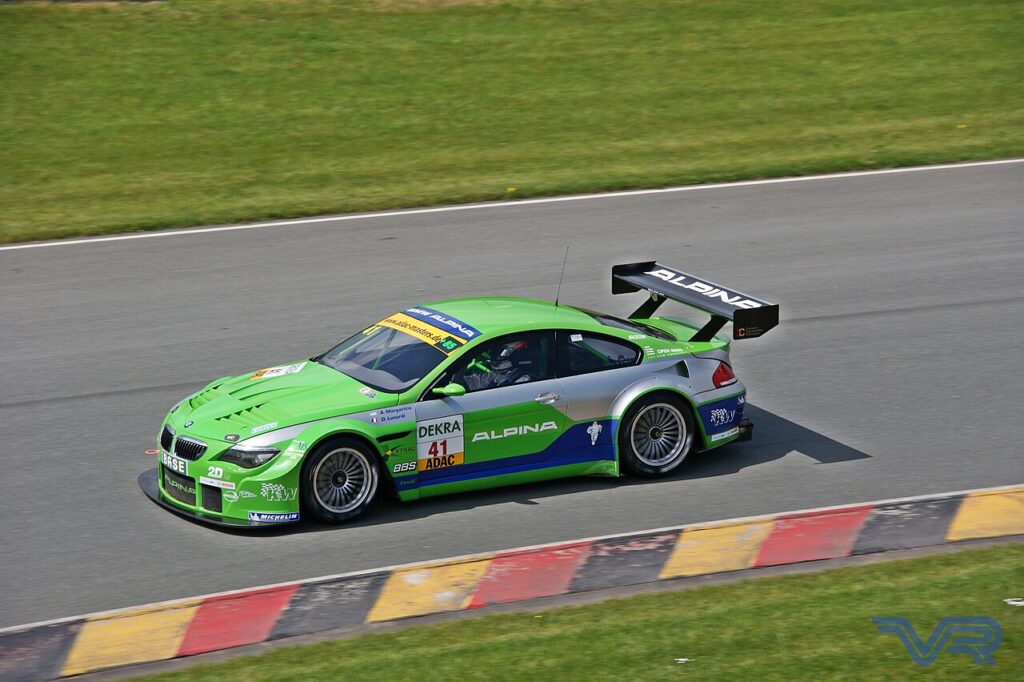
Photo of the real car. Photo: Neuwieser / Wikimedia Commons, CC BY-SA 2.0