
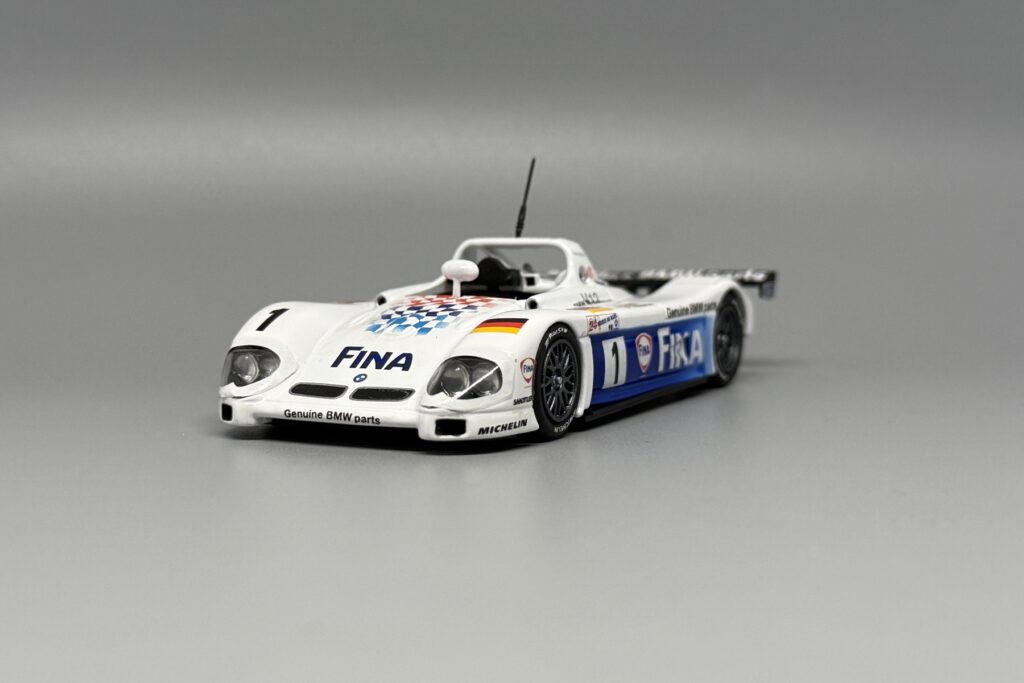
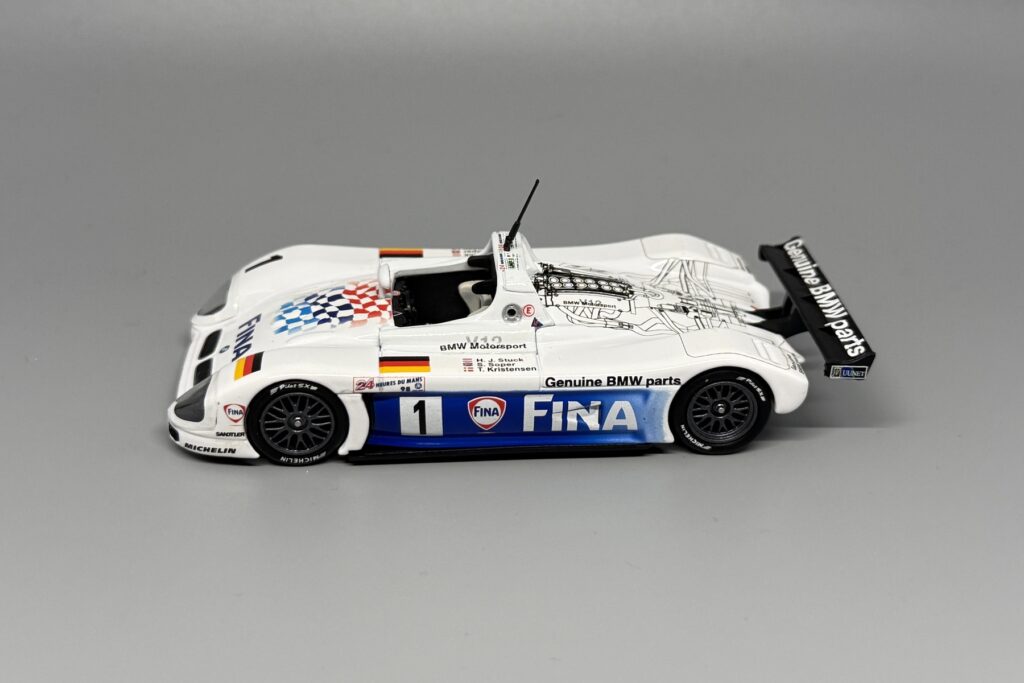
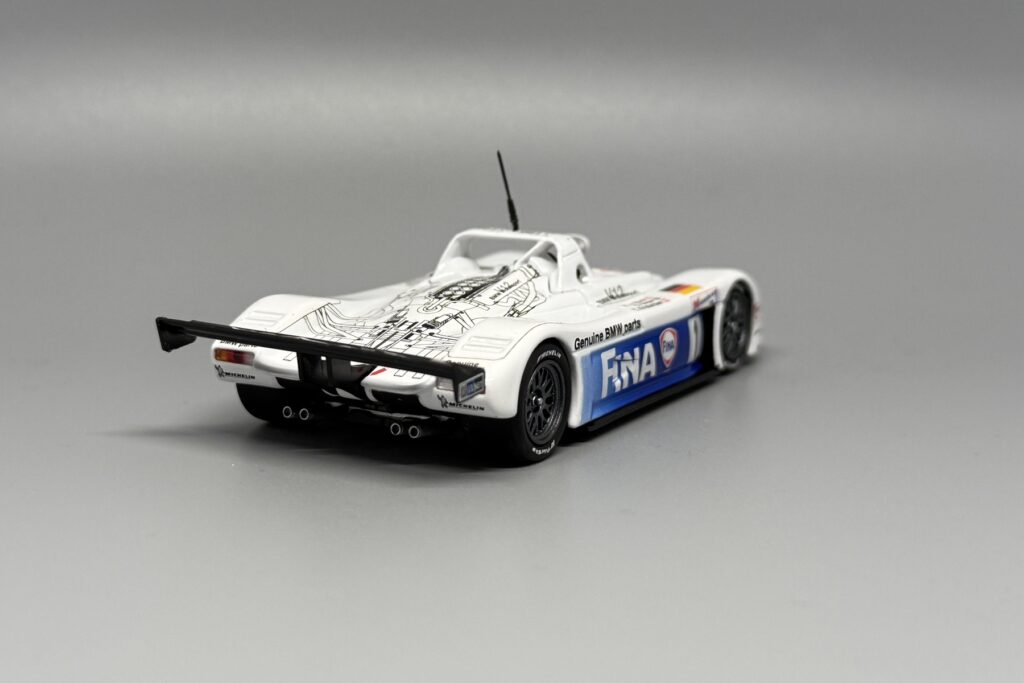
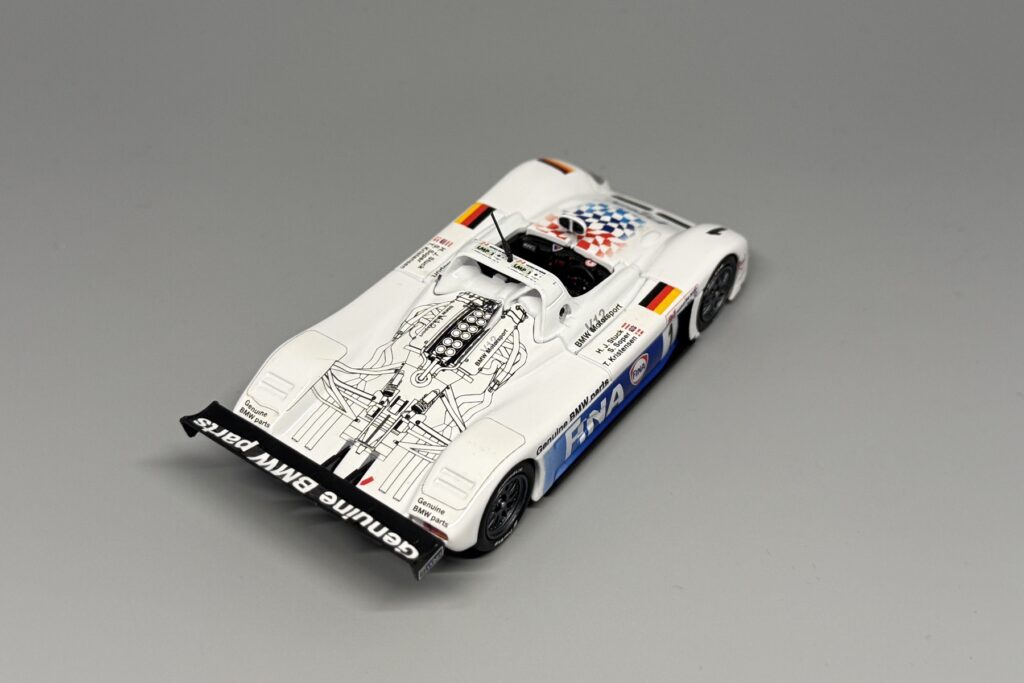
BMW V12 LM was an open-cockpit sports racing prototype developed in 1998, marking the beginning of a new chapter in BMW’s history at the 24 Hours of Le Mans. Created in cooperation with engineers from the Williams Formula One team, the car combined a carbon-fibre monocoque, a mid-mounted engine and a powerful six-litre V12. BMW entered two V12 LMs in the 1998 Le Mans race, with car number 1 driven by Hans-Joachim Stuck, Tom Kristensen and Steve Soper. Both cars demonstrated competitive performance during the early stages but were forced to retire because of technical problems involving their wheel bearings. Despite its unsuccessful debut, the BMW V12 LM became an important milestone in the manufacturer’s motorsport history. The experience gained during its development provided the foundation for the BMW V12 LMR, which achieved overall victory at Le Mans in 1999.
BMW’s return to Le Mans prototype racing
By the mid-1990s, BMW had already achieved major international success in endurance racing, although primarily as an engine supplier to other manufacturers. Its most notable achievement was overall victory in the 1995 24 Hours of Le Mans with the McLaren F1 GTR, powered by a V12 engine developed by BMW Motorsport. The McLaren-BMW partnership continued over the following seasons, and in 1997 the BMW-supported Schnitzer team competed in the FIA GT Championship. As the McLaren racing programme approached its conclusion, BMW decided to take its endurance racing activities to a new level by developing a Le Mans prototype carrying its own name. Unlike production-based GT cars, the new vehicle would be a purpose-built racing machine with no direct connection to a BMW road car. The result was the BMW V12 LM, designed specifically to challenge for overall victory in the world’s most prestigious endurance race.
A joint project with Williams
Development of the BMW V12 LM was undertaken through a partnership between BMW Motorsport and the British Williams engineering team. Williams was already one of Formula One’s most successful constructors, and its experience in carbon-fibre chassis construction, aerodynamics and racing-car development made it a valuable technical partner. Work on the project began in September 1997 under project director John Russell, leaving relatively little time before the 1998 Le Mans race. Jason Somerville was responsible for aerodynamics, while BMW designers also contributed to the car’s external appearance. Williams used its Formula One wind tunnel to develop a body capable of combining low aerodynamic drag with sufficient downforce for high-speed racing. However, the short development schedule meant that the prototype arrived at Le Mans with very limited testing experience. Several important engineering solutions had not yet been fully evaluated under sustained racing conditions.
The six-litre BMW S70/3 V12
The BMW V12 LM was powered by a 5,990 cc naturally aspirated S70/3 V12 engine, developed from the same BMW Motorsport engine family used in the McLaren F1 GTR. The 60-degree V12 featured aluminium-alloy construction, twin overhead camshafts for each cylinder bank and a total of 48 valves. Electronic fuel injection and a dry-sump lubrication system enabled the engine to operate reliably under high cornering loads while allowing it to be mounted as low as possible in the chassis. Technical sources quote an output of approximately 550 hp at 6,500 rpm and maximum torque of 670 Nm at 4,500 rpm. Despite having no turbocharger or supercharger, the engine delivered exceptional performance through its large displacement and the smooth power delivery of twelve cylinders. Considerable attention was also given to fuel efficiency and mechanical durability, as long intervals between refuelling stops could provide an important advantage in endurance racing.
Mid-engine layout and carbon-fibre monocoque
Unlike BMW’s earlier touring cars, the V12 LM was designed from the outset as an open-cockpit, mid-engined racing prototype. Its main structure consisted of a carbon-fibre composite monocoque reinforced with aluminium honeycomb, providing exceptional stiffness while keeping weight relatively low. The V12 engine was mounted longitudinally behind the cockpit and ahead of the rear axle, giving the car a weight distribution suitable for high-speed competition. A six-speed XTrac sequential racing gearbox was installed behind the engine, transmitting power to the rear wheels. The aerodynamic body featured a low nose, carefully shaped air intakes and a rear wing mounted close to the bodywork. A full-width roll bar extended across the cockpit behind the occupants, distinguishing the original V12 LM from the later V12 LMR. Although the Williams wind tunnel programme achieved promising results, the final 1998 bodywork produced less downforce than the engineers had originally intended, particularly at the front of the car.
Racing suspension and braking system
The BMW V12 LM featured independent double-wishbone suspension at both ends, with springs and dampers operated through pushrods and rocker mechanisms. This arrangement allowed the suspension components to be positioned for aerodynamic efficiency while providing the adjustability required for professional prototype racing. The front suspension incorporated a relatively complex system designed to control ride height and maintain a stable aerodynamic platform at high speeds. Braking was provided by AP Racing calipers and carbon-based racing discs intended to withstand the demanding conditions of endurance competition. The car ran on Michelin racing tyres. The V12 LM was designed for the prototype category with a minimum weight of 900 kg, although the actual 1998 cars were initially reported to be as much as approximately 30 kg heavier. This illustrated another difficulty faced during the programme’s compressed development schedule, as not all of the original weight targets had been achieved.
The highly competitive 1998 Le Mans
The 1998 24 Hours of Le Mans took place on 6–7 June and featured one of the strongest fields of racing cars of the decade. Major contenders included the Porsche 911 GT1-98, Toyota GT-One, Mercedes-Benz CLK LM and Nissan R390 GT1. BMW entered two V12 LM prototypes in the LMP1 category, carrying racing numbers 1 and 2. Both cars were run by Team BMW Motorsport, whose principal objective was to establish a competitive prototype programme and gain valuable experience for future development. Although the BMWs were not regarded as the principal favourites for victory, the performance of their V12 engines and the Williams-designed chassis suggested considerable potential. However, the limited testing completed before the race meant that the team was entering one of motorsport’s most demanding events with several important aspects of the car’s reliability still unproven.
Car number 1 – Stuck, Kristensen and Soper
The BMW V12 LM carrying racing number 1 was chassis 001/98 and was driven by three highly experienced international competitors. German driver Hans-Joachim Stuck had already won the 24 Hours of Le Mans in 1986 and 1987 with Porsche and was one of BMW’s best-known endurance racing drivers. Britain’s Steve Soper had enjoyed considerable success in BMW’s touring car programmes and possessed extensive experience in international GT and endurance racing. Danish driver Tom Kristensen had won Le Mans on his first appearance in 1997 and would later become the most successful driver in the event’s history. The choice of such an experienced line-up demonstrated BMW’s determination to establish itself among the leading prototype manufacturers. The car qualified 12th on the grid for the 1998 race, setting a best lap time of 3 minutes and 41.599 seconds.
Retirement after 60 laps
Despite its experienced drivers and powerful engine, the BMW V12 LM’s first Le Mans campaign ended in disappointment. Car number 1 was forced to retire after completing just 60 laps, approximately five hours into the race. The sister V12 LM, number 2, driven by Pierluigi Martini, Joachim Winkelhock and Johnny Cecotto, had already encountered difficulties and retired after 43 laps. Both cars suffered problems involving wheel bearings and severe vibrations in the drivetrain. According to later explanations by Williams project director John Russell, a design problem meant that the wheel-bearing seals did not function as intended. Damage to the bearings created a potentially dangerous situation, and the team decided to withdraw both prototypes. BMW’s new Le Mans programme therefore ended its first race without a finish, even though the V12 engine itself had demonstrated encouraging reliability and performance.
Lessons from the first season
The unsuccessful 1998 Le Mans appearance provided BMW and Williams with valuable technical information. The wheel-bearing problems were addressed during the subsequent development programme, but the engineers also recognised the need to improve aerodynamic efficiency, weight and ease of maintenance. The original V12 LM had been developed under considerable time pressure and incorporated several complicated solutions that failed to deliver the expected advantages in racing conditions. Williams engineers considered the car’s aerodynamic drag acceptable but identified insufficient front downforce as a significant weakness. For the following season, BMW decided to redesign the prototype extensively rather than simply repair its immediate technical problems. Development focused on a simpler and more reliable suspension system, improved airflow over the body and faster access to mechanical components during pit stops. The lessons of 1998 therefore shaped the entire engineering philosophy of the next BMW endurance racing car.
The same chassis finishes fifth at Le Mans in 1999
Although BMW introduced the new V12 LMR in 1999, the original V12 LM prototypes remained active in international competition. Chassis 001/98, which had carried number 1 at Le Mans in 1998, was subsequently used by the privateer Price & Bscher team. Following further development and the correction of its original reliability problems, the car returned to major endurance racing. At the 1999 24 Hours of Le Mans, the same chassis carried racing number 18 and was driven by Thomas Bscher, Bill Auberlen and Steve Soper. This time the mechanical components proved sufficiently reliable for the BMW to finish fifth overall. It was an impressive achievement for a year-old prototype competing against BMW’s new factory car and the latest machinery from other manufacturers. Chassis 001/98 subsequently continued racing in Europe and the United States and made another appearance at Le Mans in 2000. The car’s later success demonstrated that the original V12 LM had considerable competitive potential once its initial problems had been resolved.
The BMW V12 LMR and overall victory
The lessons learned from developing the original V12 LM led directly to the creation of the new BMW V12 LMR for 1999. Although the underlying engineering concept and V12 engine came from the same programme, the new prototype was extensively redesigned. Its body was aerodynamically more efficient, a single roll hoop replaced the previous full-width structure, and the suspension was simplified to improve reliability and handling. According to BMW’s official figures, engine output increased to approximately 580 hp. The V12 LMR achieved its first major victory at the 12 Hours of Sebring in March 1999, before BMW fulfilled its ultimate objective at Le Mans. On 13 June 1999, Pierluigi Martini, Yannick Dalmas and Joachim Winkelhock won the 24 Hours of Le Mans outright in the BMW V12 LMR carrying number 15. It was BMW’s first overall victory at Le Mans with a factory-entered racing car carrying its own name. The achievement confirmed that the difficulties experienced with the original V12 LM had provided the knowledge necessary to develop a winning prototype.
The legacy of the BMW V12 LM
The historical significance of the BMW V12 LM lies primarily in the manufacturer’s transition from supplying engines for successful GT cars to developing its own Le Mans racing prototypes. Cooperation between Williams engineers, BMW Motorsport and the racing team produced a major technological step forward, even though the first season’s results fell short of expectations. The V12 LM combined a powerful naturally aspirated engine, carbon-fibre chassis construction and modern prototype aerodynamics, but also demonstrated the essential importance of mechanical reliability in endurance racing. With only two examples constructed, the model remained an exceptionally rare competition car. The subsequent fifth-place finish of chassis 001/98 at Le Mans in 1999 proved that the original design was capable of strong results after further development. Today, the BMW V12 LM is an important transitional model in the marque’s endurance racing heritage, directly associated with the programme that achieved overall victory at Le Mans in 1999.
Model in the collection
The BMW V12 LM model in my collection was produced by Minichamps. It represents the Team BMW Motorsport prototype carrying racing number 1 at the 1998 24 Hours of Le Mans, driven by Hans-Joachim Stuck, Tom Kristensen and Steve Soper. The model reproduces the low open-cockpit bodywork, distinctive roll bar, large rear wing, FINA sponsorship markings and other characteristic details of the historic competition car.
Technical data
Year of construction: 1998
Body style: two-seat open racing prototype
Competition category: LMP1
Developed by: BMW Motorsport and Williams, Germany / United Kingdom
Chassis construction: carbon-fibre composite and aluminium-honeycomb monocoque
Chassis number: V12LM-001/98
Engine: BMW S70/3 naturally aspirated 60-degree V12
Displacement: 5,990 cc
Bore × stroke: 86 × 85.9 mm
Valve gear: four overhead camshafts, four valves per cylinder
Fuel delivery: electronic fuel injection
Lubrication: dry sump
Power output: approximately 410 kW / 550 hp at 6,500 rpm
Maximum torque: approximately 670 Nm at 4,500 rpm
Engine position: longitudinally mid-mounted, ahead of the rear axle
Transmission: 6-speed XTrac sequential racing gearbox
Drive: rear-wheel drive
Suspension: independent double-wishbone suspension with pushrod-operated springs and dampers
Brakes: competition braking system with carbon-based discs
Tyres: Michelin
Weight: 900 kg class minimum; the actual 1998 cars were heavier
Wheelbase: 2,790 mm
Production total: 2 cars
Race: 24 Hours of Le Mans, 6–7 June 1998
Team: Team BMW Motorsport
Racing number: 1
Drivers: Hans-Joachim Stuck, Tom Kristensen and Steve Soper
Starting position: 12th
Best qualifying lap: 3 min 41.599 sec
Laps completed: 60
Result: retired because of wheel-bearing problems
Later result of the same chassis: 5th overall at Le Mans in 1999, Price & Bscher, racing number 18
Special feature: the first BMW V12 LM prototype developed jointly by BMW and Williams, providing essential development experience for the BMW V12 LMR that won Le Mans in 1999
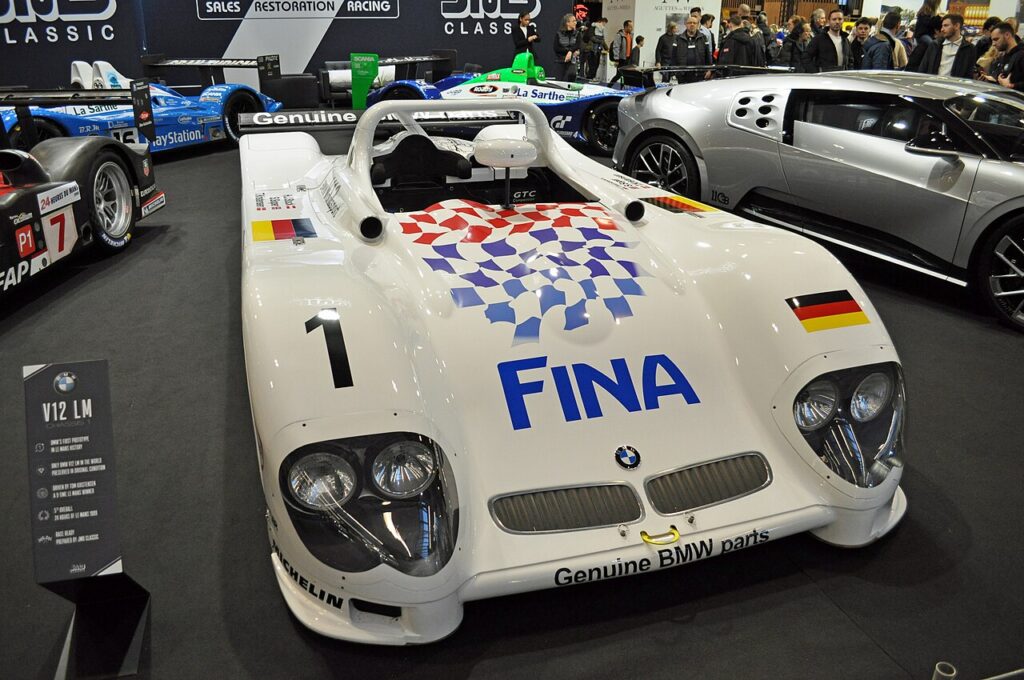
Photo of the real car. Photo: Eric Salard / Wikimedia Commons, CC BY-SA 4.0