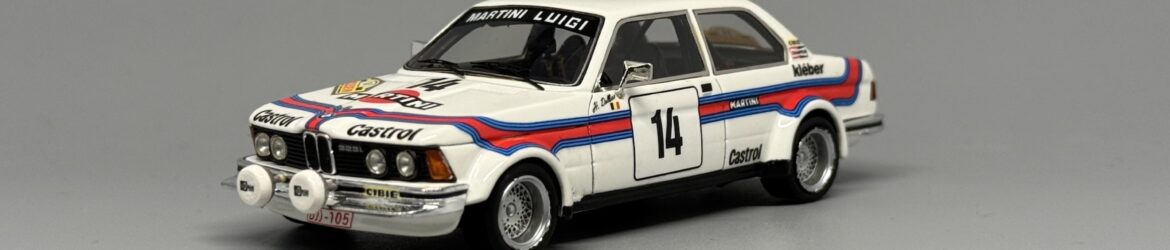
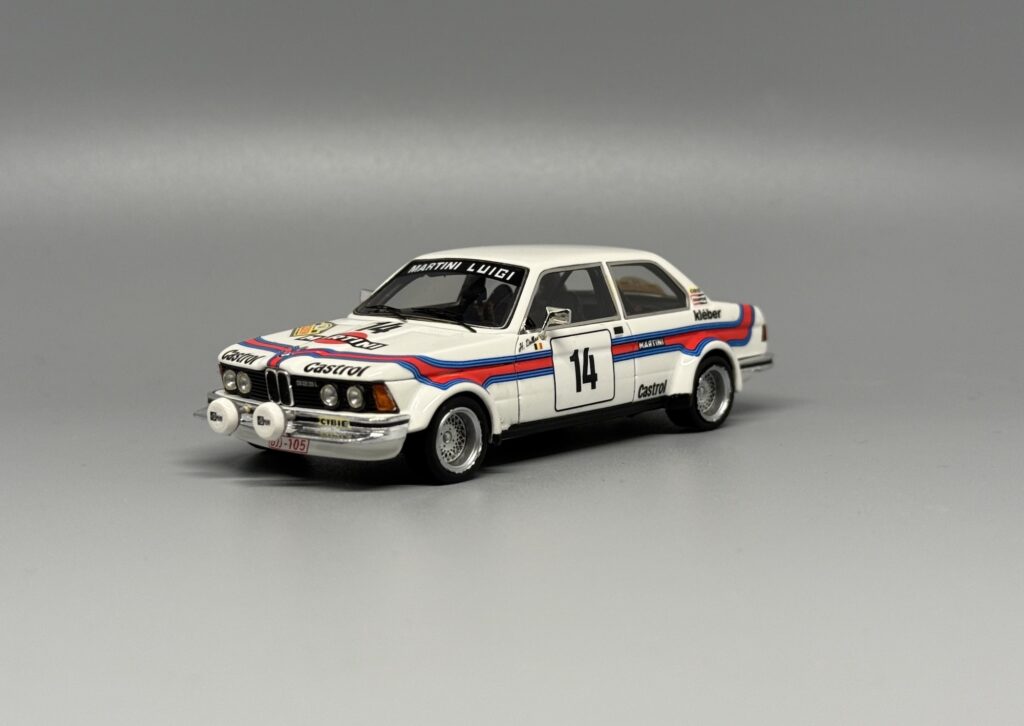
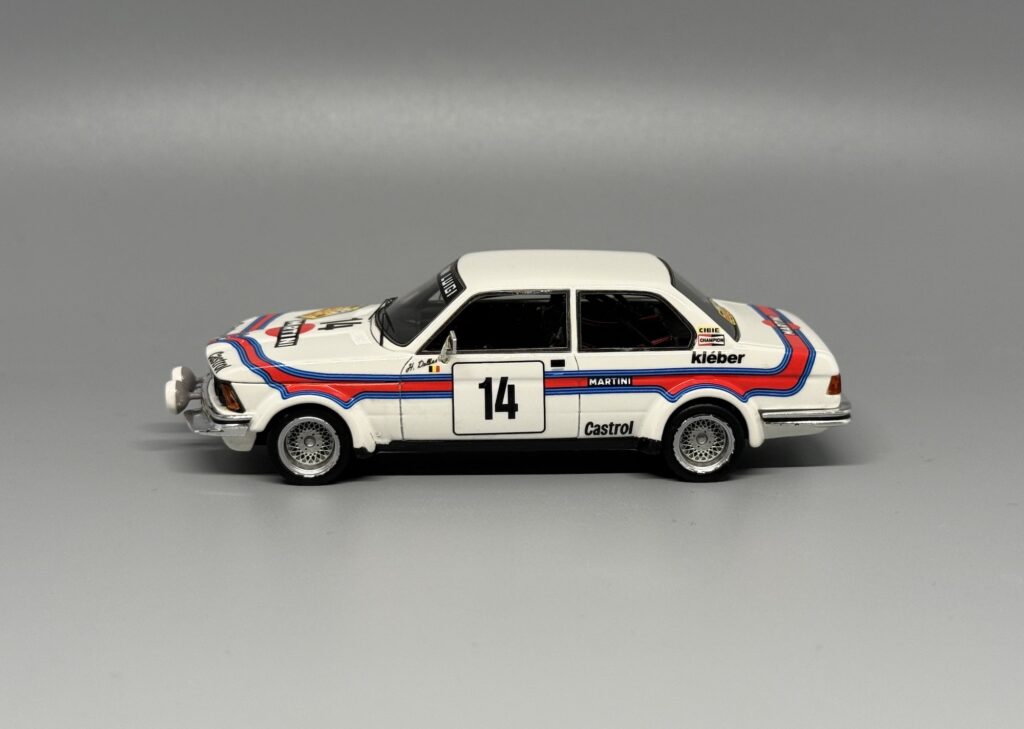
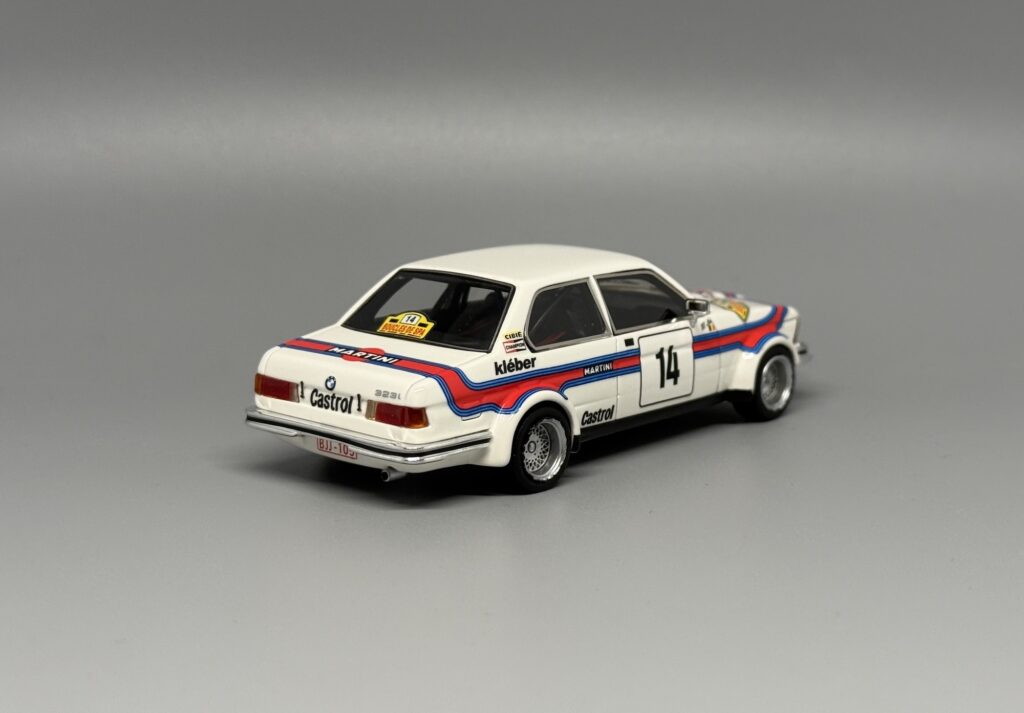
BMW 323i Martini – Boucles de Spa 1980 (E21) represents a lesser-known but successful chapter in the rally history of the first-generation BMW 3 Series. During 1980, a BMW 323i prepared by Luigi Racing competed in Belgian rallies with Hermès Delbar behind the wheel. Featuring Martini Racing’s distinctive competition livery, the car combined the sporting character of the E21 generation, a 2.3-litre six-cylinder engine and mechanical modifications permitted under Group 2 regulations. At the 1980 Boucles de Spa rally, Delbar and co-driver Willy Lux competed in the BMW carrying number 14. Although the exact result of this particular event has not been conclusively documented, the 1980 season proved highly successful for Delbar. Driving the BMW 323i, he won the Belgian Rally Championship in Group 2 and finished third in the overall championship standings.
The BMW 323i – flagship of the first 3 Series
The first-generation BMW 3 Series (E21) was introduced in 1975, continuing the tradition of compact sporting cars established by the successful BMW 02 Series. Initially, the new range was offered with four-cylinder engines, but the first six-cylinder versions followed in 1977. Production of the most powerful model, the BMW 323i, began in early 1978. It featured a 2,315 cc M20 inline-six engine equipped with Bosch K-Jetronic mechanical fuel injection and producing 143 hp. Compared with smaller-engined E21 models, the 323i received chassis improvements, more powerful brakes and a distinctly sporting character. Its rear-wheel-drive layout, compact dimensions and strong six-cylinder performance also made it an attractive basis for competition cars. Although the E21 generation became particularly well known in circuit racing, its engineering qualities were equally suited to the demands of rallying.
Luigi Racing and Belgian rallying
Hermès Delbar’s BMW 323i was associated with Luigi Racing, one of Belgium’s established specialists in preparing BMW competition cars. Luigi Racing had already achieved success with six-cylinder BMW racing machines and possessed the experience required to adapt the E21-generation 323i for demanding rally events. Belgian rallying was highly competitive during the late 1970s, with events taking place on fast asphalt roads and in unpredictable weather conditions. The championship attracted a wide variety of cars from manufacturers including Porsche, Ford, Opel and Saab. The BMW 323i competed in Group 2, a category that permitted more extensive technical modifications than those allowed for largely standard production cars. The strengths of the Luigi-prepared BMW included the balanced handling of its rear-wheel-drive chassis and the ability to adapt its mechanical specification to different rally conditions.
The distinctive Martini Racing livery
One of the most recognisable features of Hermès Delbar’s BMW 323i was its Martini Racing competition livery. By the late 1970s, Martini had become one of the most famous sponsors in international motorsport, with its distinctive stripes appearing on sports cars, circuit racers and rally machines. In 1980, Martini colours were also carried by Luigi Racing’s BMW 323i, giving the car a striking appearance on Belgian rally stages. Additional driving lamps, competition wheels and the logos of technical and commercial partners completed its period racing identity. The BMW belonged to an era when a racing car’s sponsor livery could become almost as recognisable as the vehicle itself. During the following years, sponsorship arrangements in Belgian BMW motorsport changed, and the Martini colours were eventually replaced by other prominent racing liveries.
The 2.3-litre six-cylinder rally car
The competition version of the BMW 323i was based on the two-door rear-wheel-drive E21 saloon. In standard production form, its M20 engine produced 143 hp at 5,800 rpm, offering an effective combination of performance and reliability. Group 2 regulations permitted competition modifications to the engine, suspension, transmission and braking system, allowing rally versions to differ considerably from road-going cars. Rally preparation also required a roll cage, competition seats, safety harnesses and appropriate additional equipment. Different road surfaces and demanding weather conditions made suspension durability and adjustable chassis settings particularly important. However, the exact engine output, gearbox specification and weight of Delbar’s 1980 BMW 323i have not been consistently documented in reliable public sources. Consequently, the standard production figure of 143 hp should not be presented as the confirmed power output of this particular competition car.
Boucles de Spa 1980
The Boucles de Spa was one of Belgium’s best-known rallies, with a history stretching back to the 1950s. Held on roads around the town of Spa, it formed part of the Belgian and, during various periods, European rally calendars. Although the name Spa is internationally associated with the Spa-Francorchamps racing circuit, the Boucles de Spa was a traditional road rally, with special stages running through the winding roads and often challenging conditions of the surrounding region. The 1980 event brought together cars from several competition categories, with overall victory going to Stig Blomqvist and Björn Cederberg in a Saab 99 Turbo. Hermès Delbar and Willy Lux competed in the Martini-liveried BMW 323i carrying racing number 14. The car was entered as a Group 2 rally machine, a category in which engine performance, durability and precise handling were essential. The exact finishing position of this particular entry has not been sufficiently verified.
Hermès Delbar and Willy Lux
Hermès Delbar was one of Belgium’s best-known and most spectacular rally drivers during the late 1970s and early 1980s. He also competed under the pseudonym Sotrim and had already achieved success in several different cars. In 1979, driving a Porsche, he finished third in the Belgian Rally Championship and secured second place at the Ypres Rally. The following year, he took the wheel of Luigi Racing’s BMW 323i. His co-driver at the 1980 Boucles de Spa was Willy Lux, who would later become one of the most respected co-drivers in Belgian rallying. The Delbar–Lux partnership is documented in historical rally photograph collections and specialist model-car catalogues. Their BMW represents an era when success depended not only on mechanical preparation but also on the close cooperation between driver and co-driver, particularly on demanding stages where accurate pace notes and rapid reactions were essential.
Belgian Group 2 Champion in 1980
The 1980 season became one of the most successful periods of Hermès Delbar’s rally career. Driving the Luigi Racing BMW 323i, he secured the Belgian Rally Championship title in Group 2 and finished third overall in the national championship, behind Guy Colsoul and Robert Droogmans. This was a remarkable achievement, particularly given the strong competition from rally cars of different engine capacities and technical specifications. Delbar continued competing with a BMW 323i during the following season, when Georges van Oosten served as his co-driver. Historical accounts of Belgian rallying regard Delbar’s BMW years as an important chapter in his career. His Group 2 championship victory demonstrated that the E21-generation 323i was not merely a sporting road car or successful circuit racer, but also a competitive machine in a demanding national rally championship.
The significance of the BMW 323i Martini
The BMW 323i Martini – Boucles de Spa 1980 represents a chapter of BMW motorsport history often overshadowed by the marque’s more famous factory racing cars. While the E21-generation BMW 320i achieved international recognition on racing circuits, Delbar’s 323i demonstrated the potential of the same model family on rally stages. Its six-cylinder engine, rear-wheel drive and competition-prepared chassis provided the qualities required to perform well in a highly competitive environment. The Martini Racing livery and Luigi Racing preparation gave the car a distinctive identity closely associated with Belgian motorsport in the early 1980s. Most importantly, its connection with Hermès Delbar’s 1980 Belgian Group 2 championship title ensures that this rare rally version has an established place in the sporting history of the first BMW 3 Series.
Model in the collection
The BMW 323i Martini – Boucles de Spa 1980 (E21) model in my collection was produced by Neo Scale Models. It represents the Group 2 BMW 323i driven by Hermès Delbar and Willy Lux at the 1980 Boucles de Spa rally, carrying racing number 14. The model reproduces the historic Martini Racing livery, auxiliary rally lamps, competition wheels and other characteristic details of this particular racing version.
Technical data
Competition year: 1980
Base vehicle: BMW 323i (E21)
Base vehicle production period: 1978–1982
Body style: two-door rally saloon
Competition category: FIA Group 2
Base vehicle origin: BMW, Germany
Competition preparation: Luigi Racing, Belgium
Engine: BMW M20 naturally aspirated inline-six
Standard engine displacement: 2,315 cc
Standard production output: 105 kW / 143 hp at 5,800 rpm
Exact competition engine output: unconfirmed
Engine position: longitudinal front engine
Drive: rear-wheel drive
Body construction: competition-modified BMW E21 unitary body
Chassis: adapted for Group 2 rally competition
Safety equipment: competition roll cage and driver safety equipment
Event: Boucles de Spa 1980, Belgium
Racing number: 14
Driver: Hermès Delbar
Co-driver: Willy Lux
Livery: Martini Racing
Boucles de Spa result: not independently confirmed
Major achievement: Hermès Delbar’s 1980 Belgian Group 2 Rally Championship title
1980 Belgian Rally Championship: 3rd overall
Competition cars produced: exact number unconfirmed
Special feature: Martini-liveried BMW 323i prepared by Luigi Racing, representing the E21 generation’s successful Group 2 rally programme in Belgium