BMW M4 DTM (F82) was one of BMW’s most important racing cars of the 2010s, continuing the marque’s successful participation in the Deutsche Tourenwagen Masters championship. Introduced in 2014, the M4 DTM combined a carbon-fibre chassis, a powerful four-litre V8 engine and extensively developed aerodynamics. Although the racing car retained the recognisable appearance of the BMW M4 Coupé, it was a purpose-built competition machine. During the 2015 season, British driver Tom Blomqvist raced the BMW Team RBM car carrying number 31 in his first year in the DTM. His greatest achievement came on 13 September at Oschersleben, where he won Sunday’s race and, at the age of 21, became the youngest BMW driver ever to win a DTM race. The victory also contributed to BMW securing the 2015 Manufacturers’ Championship.
The BMW M4 enters the DTM
BMW returned to the DTM in 2012 after an absence of almost twenty years. The BMW M3 DTM proved immediately successful, with Bruno Spengler winning the drivers’ championship during the manufacturer’s comeback season. When BMW introduced the new M4 Coupé in 2014, it also replaced the M3 as the basis for the marque’s DTM racing identity. The BMW M4 DTM visually resembled the F82-generation production coupé, but its engineering differed almost completely from the road-going model. The racing car featured a carbon-fibre monocoque, a reinforced cockpit structure and specialised aerodynamic bodywork. Its engine was also entirely different: whereas the production M4 was powered by a turbocharged three-litre inline-six, the DTM version continued using a naturally aspirated four-litre V8. The new racing car made an exceptionally successful debut in 2014, when Marco Wittmann won the DTM drivers’ championship. BMW continued competing with the M4 DTM in 2015, focusing on optimising its aerodynamic performance and chassis setup.
The 2015 DTM season and revised regulations
The 2015 DTM season introduced an important change to the championship format. For the first time since 2000, each race weekend featured two separate races awarding equal championship points. Saturday’s races lasted 40 minutes, while Sunday’s races were scheduled for 60 minutes, giving the season a total of 18 races across nine weekends. The championship brought together the BMW M4 DTM, Audi RS 5 DTM and Mercedes-Benz C-Class racing cars. These highly sophisticated machines were developed under strict technical regulations intended to control costs and maintain close competition. BMW entered eight M4 DTMs operated by four teams: RMG, RBM, Schnitzer and MTEK. The revised race format, together with intense competition between the manufacturers, made the season particularly unpredictable, with victories shared among numerous drivers.
BMW Team RBM and Tom Blomqvist
BMW Team RBM was a Belgian racing organisation led by Bart Mampaey. Its partnership with BMW extended back to an earlier era of international touring car racing, with its most successful period including Andy Priaulx’s European and World Touring Car Championship titles. When BMW returned to the DTM in 2012, RBM became one of its official racing partners. In 2015, the team paired experienced Brazilian driver Augusto Farfus, racing number 18, with DTM newcomer Tom Blomqvist, racing number 31. Born in Britain in 1993, Blomqvist was the son of Stig Blomqvist, the 1984 World Rally Champion. Unlike his father, Tom concentrated on circuit racing and established himself in single-seater championships, including European Formula 3. Moving into the DTM represented a major challenge, as the cars’ complex aerodynamics and the exceptionally competitive field required significant adaptation.
The four-litre BMW P66 V8
The BMW M4 DTM was powered by the BMW P66 naturally aspirated four-litre V8 engine, producing approximately 480 hp. The engine featured a 90-degree cylinder-bank angle and four valves per cylinder, with maximum torque of around 500 Nm. Under DTM technical regulations, the intake system used two 28 mm air restrictors to limit power and maintain comparable performance between manufacturers. Engine management was provided by a Bosch MS 5.1 electronic control unit. The high-revving racing engine was mounted longitudinally at the front of the car, transmitting power to the rear wheels through a six-speed sequential racing gearbox. Pneumatic gear changes were controlled by paddles mounted on the steering wheel, while the drivetrain incorporated a four-plate carbon-fibre clutch and an adjustable limited-slip differential. According to BMW’s official technical information, the M4 DTM could accelerate from 0 to 100 km/h in approximately three seconds.
Carbon-fibre construction and racing chassis
At the heart of the BMW M4 DTM was a carbon-fibre monocoque incorporating the fuel tank and a steel roll cage. Additional carbon-fibre crash structures were fitted to the front, rear and sides to provide protection in an accident. Much of the outer bodywork was also manufactured from carbon-fibre composite, reducing weight while providing high structural rigidity. Independent double-wishbone suspension was used at both ends, with springs and dampers operated through pushrods. Adjustable dampers and H&R coil springs allowed the car’s handling characteristics to be adapted to different circuits. Braking was provided by ventilated racing discs, with the driver able to adjust the distribution of braking force from the cockpit. The car used Hankook racing tyres mounted on forged aluminium wheels. BMW’s technical documentation quoted a weight of approximately 1,120 kg including the driver, although the actual competition weight could vary under the performance ballast regulations used during the 2015 season.
Aerodynamics and the adjustable rear wing
Aerodynamic development was one of the most sophisticated aspects of the BMW M4 DTM. Although the body retained the production M4’s long bonnet, low roofline and distinctive BMW kidney grille, its major surfaces were designed specifically for racing. The front spoiler, air ducts around the wheel arches, side aerodynamic elements and large rear wing helped reduce drag while generating the downforce required for high-speed cornering. The car also featured the DRS, or Drag Reduction System, which allowed the driver to change the angle of the rear wing under certain conditions. Under the 2015 regulations, the rear wing could be lowered by 18 degrees when the driver met the specified distance requirement behind another car. Its use was restricted to encourage overtaking without eliminating the importance of racing strategy. Precise aerodynamic balance was essential, as extremely small differences in lap times could determine starting positions and race results in the competitive DTM field.
13 September 2015 – victory at Oschersleben
Tom Blomqvist achieved his first DTM victory on 13 September 2015 at the Motorsport Arena Oschersleben. The event was the fourteenth race of the season, and Blomqvist started his BMW M4 DTM carrying number 31 from second on the grid. His teammate Augusto Farfus started from pole position, but Blomqvist made a better getaway and passed him on the approach to the first corner. He then gradually extended his advantage and never surrendered the lead. After 40 laps, Blomqvist crossed the finish line as the winner, finishing 7.712 seconds ahead of Farfus. Marco Wittmann completed the podium in third, while António Félix da Costa finished fourth, securing a remarkable one-two-three-four result for BMW. At just 21 years of age, Blomqvist became the youngest BMW driver ever to win a DTM race. His achievement was particularly impressive because it came in only the fourteenth race of his DTM career.
The final results of the 2015 season
Tom Blomqvist’s first DTM season began with a difficult period of adaptation to the championship’s demanding cars and intense competition. He scored his first championship points at Zandvoort, and his qualifying performance and race pace improved considerably during the second half of the season. Victory at Oschersleben became the highlight of this progress. By the end of the year, Blomqvist had scored 59 points and finished fourteenth in the drivers’ championship. He also received the unofficial Rookie of the Year recognition. For BMW, the season ended particularly successfully, as the manufacturer secured the Manufacturers’ Championship with 602 points, narrowly defeating Audi. The drivers’ title went to Mercedes-Benz driver Pascal Wehrlein. BMW Team RBM finished eighth in the teams’ standings, with Blomqvist’s Oschersleben victory remaining its only win of the season.
The significance of the BMW M4 DTM
The BMW M4 DTM belonged to a period when German touring car racing had reached an exceptionally high level of technical sophistication. Although the cars resembled production coupés, their carbon-fibre bodywork concealed purpose-built racing chassis, powerful V8 engines and advanced aerodynamic systems. BMW won the DTM drivers’ championship with the M4 in 2014 and followed this with the manufacturers’ title in 2015, confirming its position among the championship’s leading competitors. Tom Blomqvist’s victory at Oschersleben added a particularly memorable chapter to the model’s history, as a young rookie defeated established rivals and controlled the race from the opening corner to the finish. The number 31 BMW M4 DTM therefore represents both BMW’s technical expertise and a major breakthrough in the early career of a talented international touring car driver.
Model in the collection
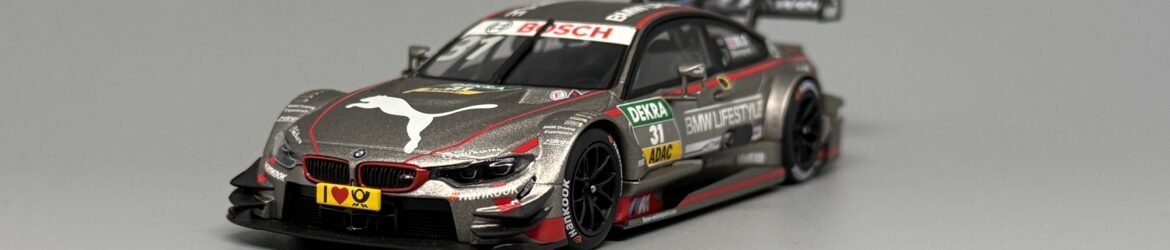
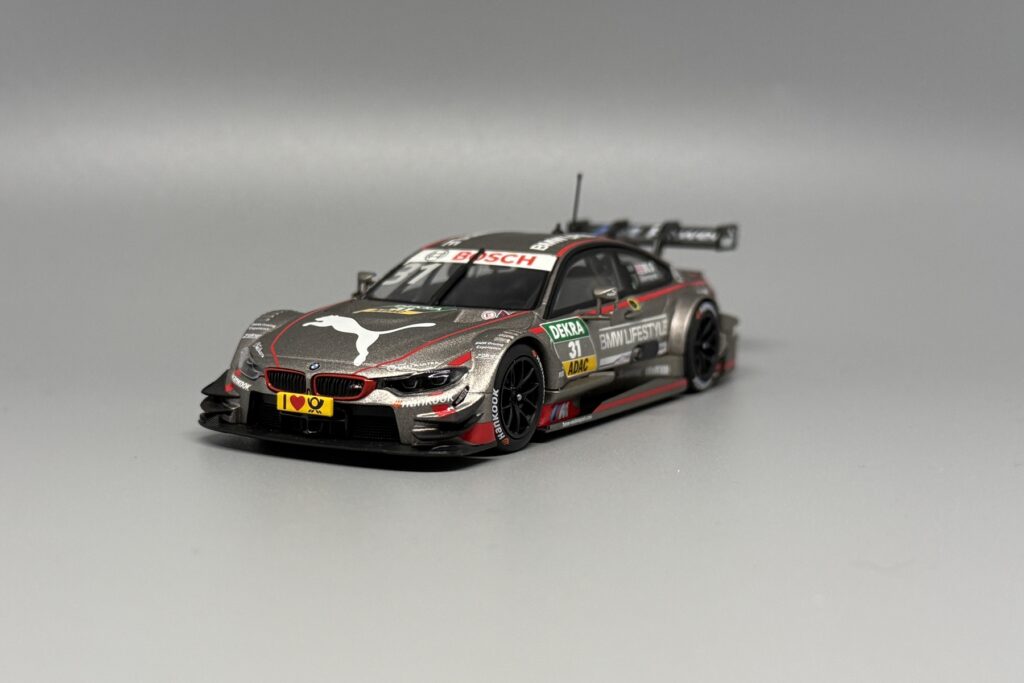
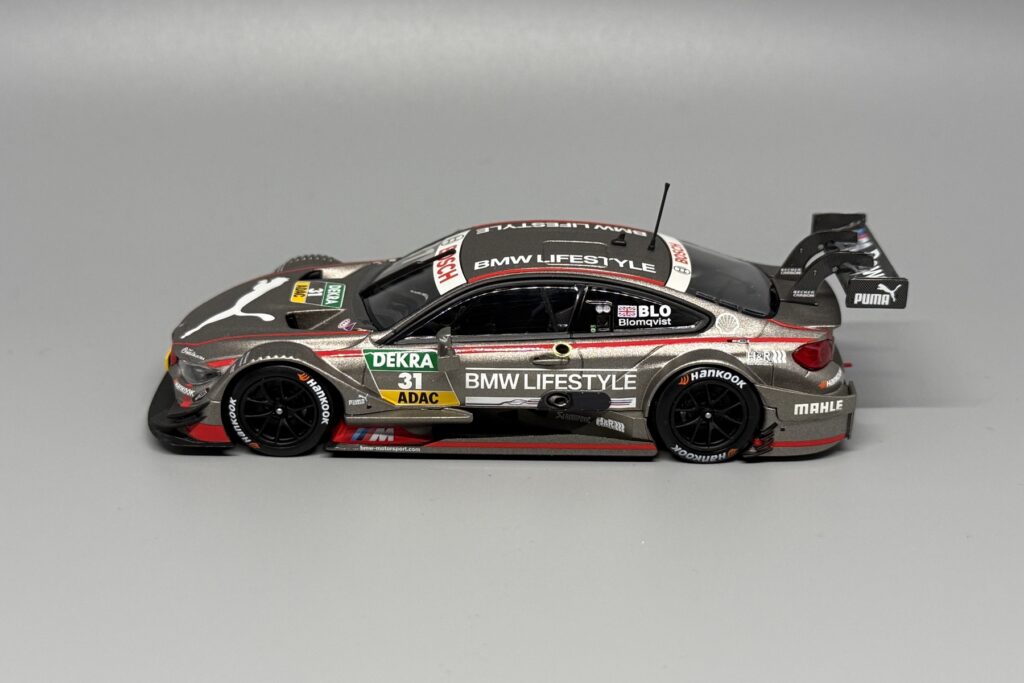
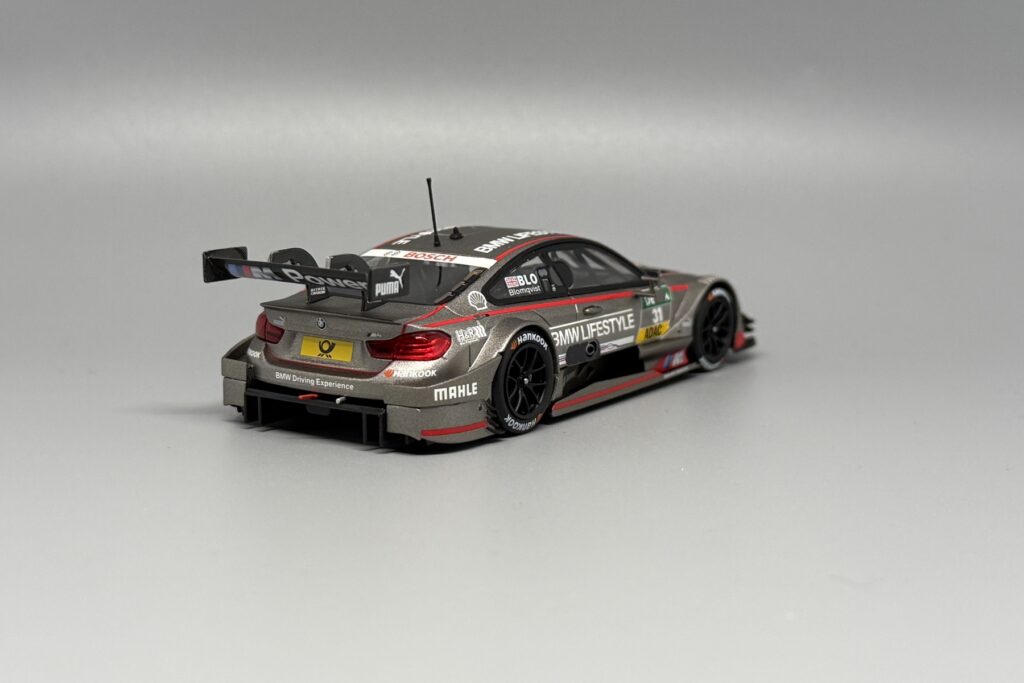
The BMW M4 DTM (F82) model in my collection was produced by Minichamps. It represents Tom Blomqvist’s winning car from the 2015 DTM race at Oschersleben, where he achieved his first DTM victory driving for BMW Team RBM. The car carried racing number 31 and featured BMW Lifestyle sponsorship markings. The model reproduces the M4 DTM’s wide racing bodywork, aerodynamic details, prominent rear wing and authentic competition livery. It was released as a limited edition of 504 pieces.
Technical data
Racing model debut: 2014
Represented racing season: 2015
Base vehicle: BMW M4 Coupé (F82)
Body style: two-door enclosed DTM racing coupé
Racing series: Deutsche Tourenwagen Masters (DTM)
Developer: BMW Motorsport, Germany
Engine: BMW P66 naturally aspirated 90-degree V8
Displacement: 4,000 cc
Valve gear: four valves per cylinder
Air intake: two 28 mm air restrictors
Power output: approximately 480 hp
Maximum torque: approximately 500 Nm
Engine management: Bosch MS 5.1
Engine location: longitudinal front engine
Transmission: 6-speed sequential racing gearbox
Gear selection: pneumatic paddle-shift system
Clutch: ZF four-plate carbon-fibre clutch
Drive: rear-wheel drive
Differential: adjustable limited-slip differential
Chassis: carbon-fibre monocoque with steel roll cage
Suspension: independent double-wishbone suspension with pushrods and adjustable dampers
Brakes: ventilated racing discs with adjustable brake-force distribution
Aerodynamics: front spoiler, aerodynamic side elements and DRS-equipped rear wing
Tyres: Hankook
Tyre sizes: front 300/680 R18, rear 320/710 R18
Wheels: front 18 × 12 inches, rear 18 × 13 inches
Length: 4,775 mm
Width: 1,950 mm
Height: approximately 1,200 mm
Weight: approximately 1,120 kg including the driver; subject to race-specific adjustments
Fuel tank capacity: 120 litres
Acceleration 0–100 km/h: approximately 3 seconds
Team: BMW Team RBM
Driver: Tom Blomqvist
Racing number: 31
Notable race: Oschersleben, 13 September 2015, Race 2
Starting position: 2nd
Laps completed: 40
Result: 1st place
Season result: 14th in the drivers’ championship, 59 points
Recognition: 2015 DTM Rookie of the Year
BMW season result: 2015 Manufacturers’ Championship title
Production total: eight BMW M4 DTMs competed in the 2015 season; exact overall production total unconfirmed
Special feature: BMW Team RBM racing car driven by Tom Blomqvist to his first DTM victory at Oschersleben in 2015, making him the youngest BMW DTM race winner at the time
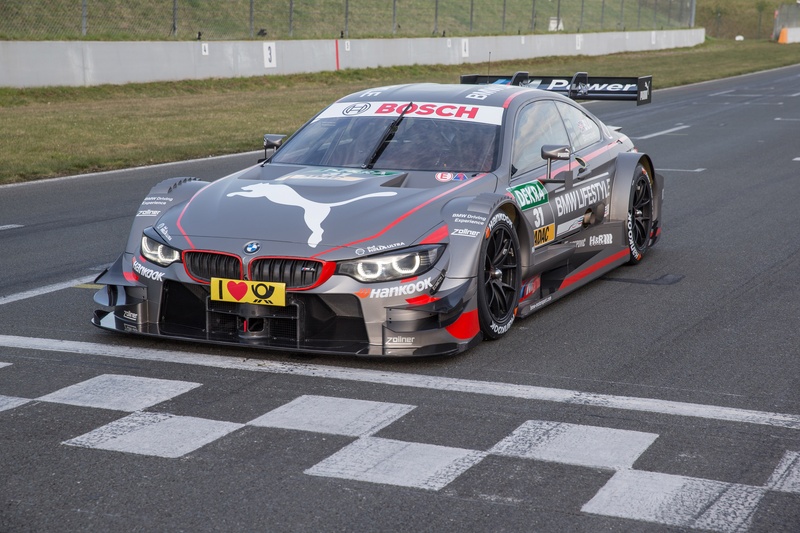
Photo of the real car. Photo: BMW AG / BMW Group